Here’s an astonishing poll: David Freddoso at Conservative Intelligence Briefing links to a report by the Washington Post’s Aaron Blake that West Virginia 3rd district incumbent Rep. Nick Rahall trails Republican challenger state Sen. Evan Jenkins by a 54-percent to 40-percent margin. The poll was conducted by the Tarrance Group, a Republican firm which, like several Democratic and other Republican firms, has had a good record for reliability over the years.
This is astonishing for several reasons. Rahall, first elected in 1976, is now the seventh most senior member of the House, with three of the more senior members retiring (John Dingell, Henry Waxman, George Miller) and another with a serious primary challenge (Charlie Rangel). Moreover, his district in southern West Virginia has historically been very Democratic; in its previous boundaries it voted for Walter Mondale overRonald Reagan in 1984. Rahall won in 1976 by 46 percent to 37 percent over Ken Hechler, his predecessor in the seat, who after losing a Democratic primary for governor ran as a write-in candidate; the Republican nominee received only 18 percent of the vote. From 1978 to 2008, Rahall was re-elected with at least 64 percent of the vote, except in 1990 when he beat Republican Marianne Brewster by only 52 percent to 48 percent.
But this is coal country, and Rahall’s margins have gone down after President Obama was elected president. In 2010, Rahall won by a reduced margin of 56 percent to 44 percent, and in 2012, his margin was only 54 percent to 46 percent. Obama’s unpopularity surely cost him: John McCain carried the district within its then-boundaries by a 56-percent to 42-percent margin in 2008, and Mitt Romney carried the current district 65 percent to 33 percent in 2012. Rahall is ranking Democrat on the Transportation and Infrastructure Committee and was Chairman of the Natural Resources Committee when Democrats had a majority in the House; these are committee positions of importance to a mountainous coal district, but apparently they are not enough to help him now.
So, this time the culprit isn’t Obama’s terrible health care policy, it’s Obama’s terrible energy policy. Remember, the Environmental Protection Agency basically banned construction on all future coal plants which cost a lot of jobs. Not only that, but coal plants have been closing because of Democrat energy policies. Lastly, restrictions on coal production by Democrats have made energy prices go up, especially in the South. So people who are connected to the coal industry in Ohio, Pennsylvania, West Virginia, etc. should really be thinking a second time about supporting the Democrats in 2014 – and 2016, too.
Walker has actually cut taxes three times in less than a year.
I know what you’re thinking, (if you’re a Democrat). You’re thinking “how can a governor cut taxes three times and have a surplus?”.
When the government cuts taxes, people in the private sector who either create jobs or work at jobs get to keep more of their own money. They either spend or invest their money. Spending money is OK, but the magic really happens when people invest money. Even something as simple as putting money into a savings account can achieve magic, because banks lend that money to job creating businesses. What is the magic? The magic is that when people invest or save their money, the money makes its way to job-creating individuals and businesses, so that they can develop new products and services. For example, if Samsung keeps more of it’s own money, it can hire more and better employees to to develop the S5 smartphone – a new product that performs better than the previous S4 model, even though it will probably cost less than the previous S4 model.
What happens when consumers can get more functionality for less money? It means that they can do more in their own lives using the better products and services, but also means that they have more money to save or spend somewhere else. So what really drives the economy is not government handing out food stamps or government giving money to companies linked to their campaign fundraisers (e.g. – Solyndra). What really drives the economy is the private sector. That’s where new innovative products and services are made. When you thinking of government, you should think of the people with degrees in Marxist studies and women’s studies who take money away from Samsung, so they have less money to innovate with. Government takes money from Samsung and gives it to Brigham and Women’s hospital to study why lesbians are often overweight. (It’s purely a coincidence that this is where Obama’s Surgeon General nominee Vivek Murphy works, and purely a coincidence that he founded “Doctors for America” to market Obamacare to the voters).
When you keep the money in the private sector, you get new products and services that people actually want to buy. The more money that businesses keep, the more they higher workers, and the more the state collects in payroll and income taxes. The more that consumers spend to buy better products and services, the more the state collects in sales tax. The key to economic growth is to have businesses produce better products for less money. When consumers can do more and have more money left over, there is economic growth, which boosts tax revenues. Government rarely spends money as efficiently and effectively as job creators and workers can.
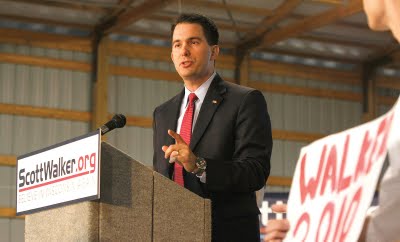
With that in mind, let’s see what happened when Governor Scott Walker cut taxes and let job creators and workers keep more of their own money.
Senate Republicans Tuesday narrowly passed Gov. Scott Walker’s $541 million tax cut proposal in a vote that guaranteed the cuts will become law.
The tax decreases — the third round of cuts by Republicans in less than a year — passed 17-15 with GOP Sen. Dale Schultz of Richland Center joining all Democrats in voting against the proposal. The proposal now goes to the Assembly, which passed a different version of the tax cuts last month with two Democrats joining all Republicans in supporting it.
With growing tax collections now expected to give the state a $1billion budget surplus in June 2015, Walker’s bill will cut property and income taxes for families and businesses, and zero out all income taxes for manufacturers in the state.
GOP lawmakers and Walker will use the windfall for the state as an occasion to trim overall state spending slightly for the next three years rather than increase it.
[…]Also Tuesday, the Senate voted unanimously to pass a second bill to increase spending on worker training by $35.4 million through June 2015.
[…]Under Walker’s bill, the average income tax filer would receive a tax cut of $46 in April 2015 and the typical homeowner would save $131 over the existing law on this December’s bills, according to the Legislature’s nonpartisan budget office.
Also, the governor has separately had his administration alter income tax withholding rates so workers have less taken out of each paycheck — about $520 a year for a married couple making a total of $80,000 a year — starting in April.
“The more money that we give back to the taxpayers, the more money they can spend or save as they wish and the more our economy will grow,” said Sen. Alberta Darling (R-River Hills), co-chairwoman of the Legislature’s budget committee.
The bill would also lower income taxes for factory and farm owners by $36.8 million over the current two-year budget and $91.3 million over the following two years.
GOP supporters of this manufacturing tax cut in the bill see it as fuel for one of the state’s main economic engines.
Now the nice thing about Walker is that he is no Wall Street Republican. The man has been plowing money into worker re-training programs and manufacturing, which is exactly how you draw votes from working Democrats. Working Democrats tend to prefer working to collecting welfare, so Walker is out there competing for their votes by making sure that everyone who wants a job can get a job, and that those jobs pay well. Walker knows that if he can cut taxes on manufacturing, that it will cause manufacturers in his state to hire more people in order to develop cheaper and better products. That’s going to cause them to invest more in his state, and some manufacturers will even leave other Democrat-run states (e.g. – Illinois) to move to Wisconsin.
When Democrats were running Wisconsin, they created a huge $3.6 billion dollar deficit that Walker inherited. Everything has been turned around under Scott Walker, but neighboring states like Illinois continue to decline. What a resume this guy is going to have in 2016 when he runs for President. Walker bet the farm on his pro-growth policies in a blue state, and guess what? He is reaping the rewards. He knows what he is doing, and the left can’t stand him. All he does is win.
Christians ought to be concerned about poverty. Is there a way to help the poor without making them dependent on the government?
Yes! In this article, the American Enterprise Institute discusses a great program called the Doe Fund, which is run in New York City.
Excerpt:
[…][F]or more than 25 years, the organization run by George and Harriet McDonald has helped homeless men. The program they run is based on a clear contract between the shelter managers and the homeless men. “You get up every day and go to work and stay drug free-and we will pay you and house you and feed you. It’s as simple as that,” Mr. McDonald said at his shelter on 155th street in Harlem. Doe Fund facilities are funded by revenue generation from their maintenance and cleaning business, government funding for homeless services, and private donations. The breakdown is roughly one-third each.
Anyone who enters one of the four Doe Fund facilities in New York City is handed a paper entitled: “Some of the Rules that You Will hear ALL the time.” Among the regulations are Rule No. 4: No standing or loitering in front of the building at any time of the day. Rule No. 10: You must not drink or drug while you are in the program. Rule No. 11: No cellular phones are allowed while you are working.
In return for a roof over their heads and a salary, residents of the Doe Fund shelters clean and maintain commercial strips all over New York City-real jobs, with real demands and shifts that start at 6 a.m. The Doe Fund crews add an extra touch not provided by the sanitation and park employees of New York City, and every day workers face real customers who include not only local business groups who pay for their services but also residents and pedestrians who benefit from the improved quality of life.
Hourly wages start at $8.15, which gives shelter residents a chance to save, as room and board are provided. Some men accumulate as much as $5,000 while they are in the six- to nine-month program.
According to the McDonalds, over the past three years 57% of the men who completed the six-month program got jobs at an average wage of $10.86 an hour. And 65% of those retained the job for at least six months. A 2010 Harvard University evaluation found similar results. For a program that works with homeless men, many of whom have served prison sentences, those are solid results.
In addition to a strong work and drug-free requirement (enforced by random drug tests), the Doe Fund also requires the men who are fathers to provide financial support to their children and to identify themselves to the city’s child-support enforcement office to be sure they comply with their child-support orders.
What is important about the Doe Fund is that it explicitly links aid with a strong enforcement of the rules. Doe Fund managers enforce the rules by restricting noncompliant residents to the shelter, reducing benefits or referring them to another city shelter where these opportunities are not offered. The Doe Fund is not alone in its approach-there are similar setups across the country, but in most such programs it’s still rare to tie behavior to consequences.
Now, this is the kind of anti-poverty program that I support. It’s not just handing out money with no strings attached. It’s easing people into the work force in a structured environment. I think that deep down, poor people really want to work, and this program is exactly how we should be getting them started at that.
But there is one thing that might hurt this program, and the article mentions it. Can you guess what it is? Look at the hourly wages these entry-level workers are being paid.
Here’s what it is:
It is troubling that at the same time the president has announced a new focus on helping young minority men, one of his administration’s top legislative priorities is a substantial hike in the federal minimum wage-a mandate on employers that is likely to reduce job opportunities for the very young men the president wants to help with My Brother’s Keeper.
If we really wanted to help the poor, we should be LOWERING the minimum wage, and then maybe the government can make up the difference. I would much rather have the government subsidizing work by topping off lower salaries than subsidizing bad behaviors.

 WINTERY KNIGHT