
Tag Archives: Jay Richards

Jay Richards: what should Christians know about economics?

Here’s a good basic introduction to the free enterprise system by Dr. Jay Richards:

Here is the description:

In this edition of the Evangel Guest Lecture Series, Jay W. Richards discusses his book on the capitalist system within the context of the Christian faith and examine how enterprise based on hard work, honesty, and trust fosters creativity and growth.

Jay W. Richards, PhD, is author of many books including the New York Times bestseller Infiltrated (2013). Richards is a senior fellow at the Discovery Institute, and executive editor of The Stream. In recent years he has been a distinguished fellow at the Institute for Faith, Work & Economics, contributing editor of The American at the American Enterprise Institute, a visiting fellow at the Heritage Foundation, and research fellow and director of Acton Media at the Acton Institute.

It turns out that the best system for lifting the poor out of poverty – by work or charity – is the economic system that creates wealth through human ingenuity and hard work. That system is the free enterprise system.

Something to read?

If you can’t listen to the lecture and don’t want to buy the whole book “Money, Greed and God?” Then I have a series of posts on each chapter for you.

The index post is here.

Here are the posts in the series:

  • Part 1: The Eight Most Common Myths about Wealth, Poverty, and Free Enterprise
  • Part 2: Can’t We Build A Just Society?
  • Part 3: The Piety Myth
  • Part 4: The Myth of the Zero Sum Game
  • Part 5: Is Wealth Created or Transferred?
  • Part 6: Is Free Enterprise Based on Greed?
  • Part 7: Hasn’t Christianity Always Opposed Free Enterprise?
  • Part 8: Does Free Enterprise Lead to An Ugly Consumerist Culture?
  • Part 9: Will We Use Up All Our Resources?
  • Part 10: Are Markets An Example of Providence?

Parts 4 and 5 are my favorites. It’s so hard to choose one to excerpt, but I must. I will choose… Part 4.

Here’s the problem:

Myth #3: The Zero Sum Game Myth – believing that trade requires a winner and a loser. 

One reason people believe this myth is because they misunderstand how economic value is determined. Economic thinkers with views as diverse as Adam Smith and Karl Marx believed economic value was determined by the labor theory of value. This theory stipulates that the cost to produce an object determines its economic value.

According to this theory, if you build a house that costs you $500,000 to build, that house is worth $500,000. But what if no one can or wants to buy the house? Then what is it worth?

Medieval church scholars put forth a very different theory, one derived from human nature: economic value is in the eye of the beholder. The economic value of an object is determined by how much someone is willing to give up to get that object. This is the subjective theory of value.

And here’s an example of how to avoid the problem:

How you determine economic value affects whether you view free enterprise as a zero-sum game, or a win-win game in which both participants benefit.

Let’s return to the example of the $500,000 house. As the developer of the house, you hire workers to build the house. You then sell it for more than $500,000. According to the labor theory of value, you have taken more than the good is actually worth. You’ve exploited the buyer and your workers by taking this surplus value. You win, they lose.

Yet this situation looks different according to the subjective theory of value. Here, everybody wins. You market and sell the house for more than it cost to produce, but not more than customers will freely pay. The buyer is not forced to pay a cost he doesn’t agree to. You are rewarded for your entrepreneurial effort. Your workers benefit, because you paid them the wages they agreed to when you hired them.

This illustration brings up a couple important points about free enterprise that are often overlooked:

1. Free exchange is a win-win game.

In win-win games, some players may end up better off than others, but everyone ends up better off than they were at the beginning. As the developer, you might make more than your workers. Yet the workers determined they would be better off by freely exchanging their labor for wages, than if they didn’t have the job at all.

A free market doesn’t guarantee that everyone wins in every competition. Rather, it allows many more win-win encounters than any other alternative.

2. The game is win-win because of rules set-up beforehand. 

A free market is not a free-for-all in which everybody can do what they want. Any exchange must be free on both sides. Rule of law, contracts, and property rights are needed to ensure exchanges are conducted rightly. As the developer of the house, you’d be held accountable if you broke your contract and failed to pay workers what you promised.

An exchange that is free on both sides, in which no one is forced or tricked into participating, is a win-win game.

If you do get the book, be sure and skip the chapter on usury. It’s just not as engaging as the others, in my opinion.

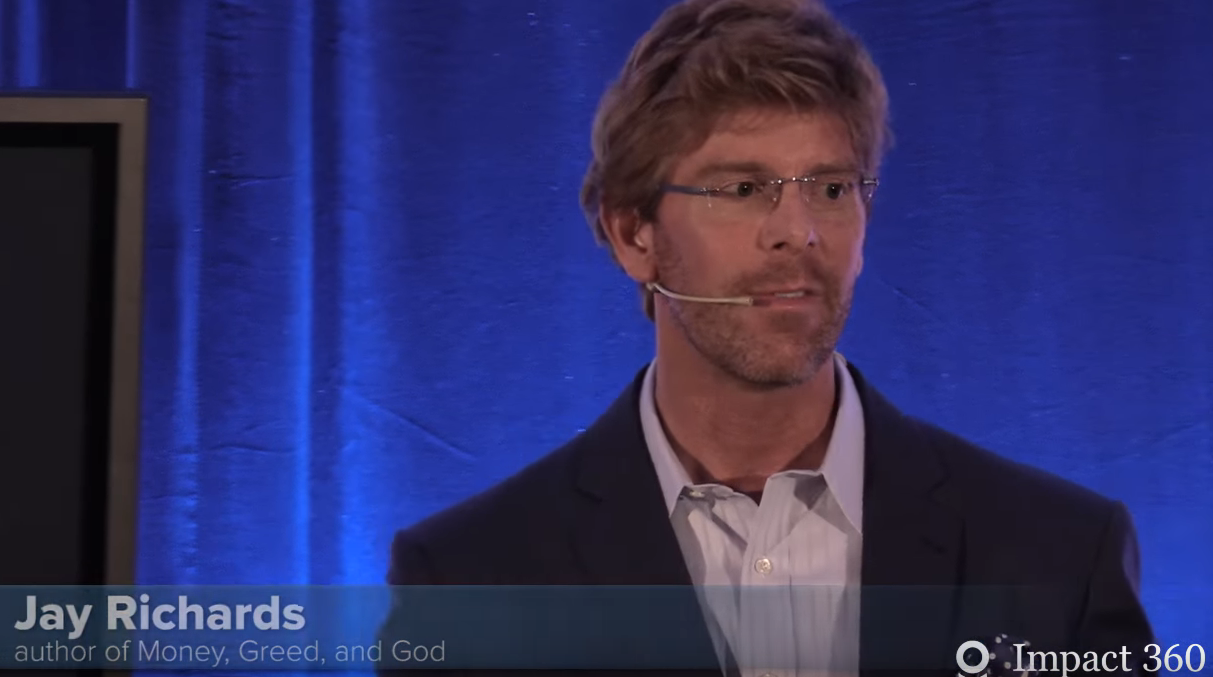
Jay Richards: How to end poverty in 10 tough steps

Jay Richards: How to end poverty in 10 tough steps

Why are some nations more prosperous than others? Is it because the wealthier nations exploit the poorer ones, keeping them poor? Or are there certain policies, laws, and cultural beliefs that lead to prosperity? Dr. Jay Richards delivers a lecture for Impact 360, in which he identifies 10 different factors that lift nations out of poverty, and explains why they work.

Summary:

  1. Establish and maintain the rule of law.
  2. Focus the jurisdiction of government on maintaining the rule of law, and limit its jurisdiction over the economy and the institutions of civil society.
  3. Implement a formal property system with consistent and accessible means for securing a clear title to property one owns.
  4. Encourage economic freedom: Allow people to trade goods and services unencumbered by tariffs, subsidies, price controls, undue regulation, and restrictive immigration policies.
  5. Encourage stable families and other important private institutions that mediate between the individual and the state.
  6. Encourage belief in the truth that the universe is purposeful and makes sense.
  7. Encourage the right cultural mores—orientation to the future and the belief that progress but not utopia is possible in this life; willingness to save and delay gratification; willingness to risk, to respect the rights and property of others, to be diligent, to be thrifty.
  8. Instill a proper understanding of the nature of wealth and poverty—that wealth is created, that free trade is win-win, that risk is essential to enterprise, that trade-offs are unavoidable, that the success of others need not come at your expense, and that you can pursue legitimate self-interest and the common good at the same time.
  9. Focus on your comparative advantage rather than protecting what used to be your competitive advantage.
  10. Work hard.

Solving economic problems is just like solving any other problem. First, we read to learn what has been proven to work. Then, we do what works. I want to encourage Christians to move beyond good intentions to good results when voting for economic policies. Often, people on the left want to “fix” inequalities by doing what feels good to them, or what sounds good to them. Economics is about choosing policies that we know have worked in other times and places.

Let’s talk more about #4 from Richards’ list.

Economic freedom linked to prosperity

Consider the book “The Poverty of Nations: A Sustainable Solution” by famous conservative theologian Wayne Grudem.

You can even read an article about it from the left-wing Christian Post here:

In a presentation of his new book at the Family Research Council, biblical theologian Wayne Grudem argued that poor countries can become rich only by producing their own prosperity, and that the free market is not only the economic answer, but in tune with the Bible’s moral teachings.

“Every nation that has escaped poverty has done so by producing its own prosperity,” said Grudem, professor of theology and biblical studies at Phoenix Seminary in Arizona. Perhaps best known for his book Systematic Theology: An Introduction to Biblical Doctrine, Grudem presented the key themes in his new book The Poverty of Nations: A Sustainable Solution. The very first of his 79 factors to help nations escape poverty in “a free market economy.”

[…]Grudem argued that the wealth of a country is determined by its per-capita income – the average amount of money each citizen makes. The only way to increase this is to increase the production of goods and services, creating more wealth for everyone, he said.

[…]The professor pointed to 79 factors to help a country produce more goods and services, in three different key areas: the economic system, government, and cultural beliefs and values.

For the economic system, Grudem mentioned the Index of Economic Freedom, a report put out by the Heritage Foundation to judge each country’s openness to trade and wealth creation.

You can find the Heritage Foundation Index of Economic Freedom right here. Take a look at the countries at the top… these countries also have a very high per capita income. Their citizens are earning a lot of money by selling what they produce to willing customers. The ones at the bottom are run by socialist governments. You wouldn’t want to try to make a living in Venezuela or Cuba or North Korea. But these are the places that American socialists admire and support. Does that tell you something about what they would do to you, if they got hold of the reins of government?

The Fraser Institute in Canada did a similar ranking of economic freedom (economic freedom = low taxes, low regulation, free trade), and they concluded:

Countries in the top quartile (25 per cent) of economic freedom (such as the U.K., Japan and Ireland) had an average per-capita income of US$40,376 in 2016 compared to US$5,649 for the bottom quartile countries (such as Venezuela, Iran and Zimbabwe). And life expectancy is 79.5 years in the top quartile of countries compared to 64.4 years in the bottom quartile.

Economic freedom works best.

Brian Auten interviews Jay Richards about Christian apologetics

Recently, I picked up the audio book version of “The Privileged Planet”, which is a book by philosopher / economist Jay Richards and astronomer Guillermo Gonzalez. This book is different from books about the origin of the universe and cosmic fine-tuning. It talks about what it takes to make a habitable planet. And it talks about how the habitable places in the universe are also the best places to make scientific discoveries.

Christian scholar Jay Richards was interviewed by Brian Auten of Apologetics 315.

The MP3 file is here.

Topics:

  • What is intelligent design (ID)?
  • Is ID specifically Christian?
  • How does ID helpful to Christian apologetics?
  • What does ID prove?
  • Is it OK to use an argument that doesn’t prove Christianity specifically?
  • What is the difference between deism and theism?
  • Do ID arguments get you to deism or theism?
  • What is materialism, and how can you challenge it?
  • How do opponents of ID define ID?
  • What factors do you need to make a habitable planet?
  • Are habitable planets common or rare in the universe?
  • What is “The Privileged Planet” hypothesis?
  • Is there an overlap between habitability and suitability for making scientific discoveries?
  • What is the “Copernican Principle”?
  • Has the progress of science made Earth seem common and ordinary?
  • What is the most Earth-like planet that we’ve ever discovered?
  • How should ID proponents respond to the objection that creatures aren’t perfect?
  • Does having a big moon make a planet more or less habitable?
  • Does a planet’s distance to the Sun make that planet more or less habitable?
  • How do these two habitability factors affect the observability of solar eclipses?
  • What does co-relation between habitability and “discoverability” tell us about God?
  • How important is training in philosophy to Christian apologetics?
  • What one thing should a Christian apologist work on to be more effective?

If you’d like to learn more about his book “The Privileged Planet”, you can find out more here. I recently bought the audio book version of the book.