Tag Archives: Intelligent Design

What is theistic evolution? Can a person believe in God and evolution at the same time?

Was Mount Rushmore designed?

Here’s a post on Evolution News that explains what theistic evolution is:

Three geologists stand at the foot of Mt. Rushmore. The first geologist says, “This mountain depicts perfectly the faces of four U.S. Presidents, it must be the work of a master sculptor.” The second says, “You are a geologist, you should know that all mountains were created by natural forces, such as volcanoes and plate movements, the details were then sculpted by erosion from water and wind. How could you possibly think this was the work of an intelligent sculptor? Only a person completely ignorant of geophysics could think those faces were designed.”

The third geologist says to himself, “I don’t want to be seen as ignorant, but the faces in this mountain sure do look like they were designed.” So he thinks a moment and says to the second geologist, “Of course you are right, these faces were sculpted by natural forces such as erosion. Only an ignorant person would think they were designed.” Then he turns to the first and says, “But what a magnificent result, there obviously must have been a master sculptor standing by and watching.”

The third geologist is a theistic evolutionist. Someone who thinks that God did nothing detectable by science in the whole history of the universe, but who also loves to talk about their religious experience and what hymns they like to sing in church. Synonyms for this definition of theistic evolution are “supernaturalist naturalism” and “theistic atheism”. I like the latter, myself. Theistic atheism. Atheism at work for my colleagues on Monday, and theism in the church for my pastor on Sundays.

Now if you call yourself a theistic evolutionist, but you think that intelligent design is detectable in nature by non-theists doing ordinary science with ordinary scientific methods, then you are not a theistic evolutionist according to this definition. This post is not describing you.

You can listen to a debate on theistic evolution between Michael Behe and theistic evolutionist Keith Fox right here to decide if theistic evolution is true. A summary is provided for those who prefer to read instead of listen.

Atheist philosopher of science Bradley Monton discusses intelligent design

Philosopher Bradley Monton

About Bradley Monton:

I’m a philosophy professor at the University of Colorado at Boulder. I work in philosophy of time, philosophy of religion, philosophy of science (especially physics), and probabilistic epistemology.

There’s an interview with Dr. Monton in Salvo magazine’s new issue, which is on science and faith.

The interview has more about his credentials:

Bradley Monton • Associate Professor of the Philosophy of Science at the University of Colorado • BA in Physics and Philosophy from Rice University • PhD in Philosophy from Princeton University • Author of Seeking God in Science: An Atheist Defends Intelligent Design

And here are the interview questions:

  1. What makes you take intelligent design (ID) seriously?
  2. Why do you think some scientists refuse to take intelligent design seriously?
  3. You write in your book that you don’t fully endorse intelligent design. In your opinion, what are some of the weaknesses of ID?
  4. Then why can’t you fully support intelligent design?
  5. So what are the strengths of intelligent design?
  6. What do you think about the multiverse theory—this belief that there are actually an infinite number of universes out there, making the complexity of our own universe more likely and less special?
  7. Do you think intelligent design should be taught in public schools?
  8. Do you teach your own students about intelligent design?
  9. Do you think academic freedom is limited for non-tenured proponents of intelligent design?
  10. How have other academics responded to your writings and statements on intelligent design?
  11. You’ve written that intelligent-design arguments have made you less certain of your atheism. What would it take to make you abandon it altogether?
  12. So what sort of scientific evidence would be compelling enough to change your mind?
  13. Are there other atheist scientists out there who believe that intelligent-design arguments hold some merit?

Here’s my favorite question (#12) and the answer:

So what sort of scientific evidence would be compelling enough to change your mind?

It would be evidence for mind as a fundamental feature of the universe. As far as I’m concerned, God would have to be a purely mental entity, not connected to physical reality in the way that we are through our bodies. So if we could discover some kind of evidence that mind is fundamental, then that would go a long way toward making me a believer. And if we could find evidence that the physical world isn’t causally closed—that not only is mind a fundamental entity, but it likewise plays a causal role in the structure of the world—then that would also be compelling evidence for the existence of God. Now, if it is found that mind plays a role in our brain processes alone, that by itself wouldn’t make me believe in God, though it would certainly make me more open to the idea. But if we were to discover that mind is intervening in other places in the world besides our brain processes, then that would pretty much be the smoking gun.

Yeah, I think there is good evidence for a non-physical mind, both from science and philosophy.

I think a lot of Christians who grew up with young-Earth creationism are startled to find that there are non-theistic, non-Christians scholars who take ID seriously. I think if I were a smart young-Earth creationist like Paul Nelson or Marcus Ross, I would try to create common ground with scholars by discussing intelligent design with them.


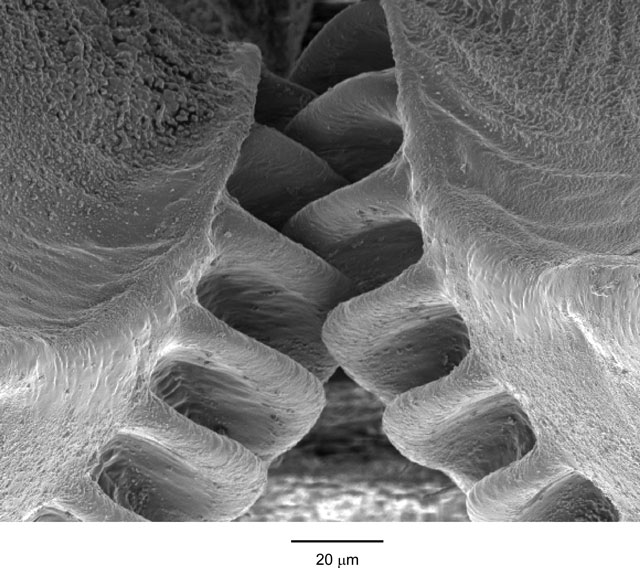
First mechanical gear discovered in a living creature

A scanning electron micrograph image of the issus gears

This article from Popular Mechanics will astonish you. (H/T Uncommon Descent via a tweet from J. Warner Wallace)

Excerpt:

With two diminutive legs locked into a leap-ready position, the tiny jumper bends its body taut like an archer drawing a bow. At the top of its legs, a minuscule pair of gears engage—their strange, shark-fin teeth interlocking cleanly like a zipper. And then, faster than you can blink, think, or see with the naked eye, the entire thing is gone. In 2 milliseconds it has bulleted skyward, accelerating at nearly 400 g’s—a rate more than 20 times what a human body can withstand. At top speed the jumper breaks 8 mph—quite a feat considering its body is less than one-tenth of an inch long.

This miniature marvel is an adolescent issus, a kind of planthopper insect and one of the fastest accelerators in the animal kingdom. As a duo of researchers in the U.K. report today in the journal Science, the issus also the first living creature ever discovered to sport a functioning gear.

[…]The gears themselves are an oddity. With gear teeth shaped like cresting waves, they look nothing like what you’d find in your car or in a fancy watch. (The style that you’re most likely familiar with is called an involute gear, and it was designed by the Swiss mathematician Leonhard Euler in the 18th century.) There could be two reasons for this. Through a mathematical oddity, there is a limitless number of ways to design intermeshing gears. So, either nature evolved one solution at random, or, as Gregory Sutton, coauthor of the paper and insect researcher at the University of Bristol, suspects, the shape of the issus’s gear is particularly apt for the job it does. It’s built for “high precision and speed in one direction,” he says. “It’s a prototype for a new type of gear.”

Another odd thing about this discovery is that although there are many jumping insects like the issus—including ones that are even faster and better jumpers—the issus is apparently the only one with natural gears. Most other bugs synchronize the quick jolt of their leaping legs through friction, using bumpy or grippy surfaces to press the top of their legs together, says Duke University biomechanics expert Steve Vogel, who was not involved in this study. Like gears, this ensures the legs move at the same rate, but without requiring a complicated interlocking mechanism. “There are a lot of friction pads around, and they accomplish pretty much of the same thing,” he says. “So I wonder what extra capacity these gears confer. They’re rather specialized, and there are lots of other jumpers that don’t have them, so there must be some kind of advantage.”

Even stranger is that the issus doesn’t keep these gears throughout its life cycle. As the adolescent insect grows, it molts half a dozen times, upgrading its exoskeleton (gears included) for larger and larger versions. But after its final molt into adulthood—poof, the gears are gone. The adult syncs its legs by friction like all the other planthoppers. “I’m gobsmacked,” says Sutton. “We have a hypothesis as to why this is the case, but we can’t tell you for sure.”

These gears remind me of the parts of the bacterial flagellum, which also correspond to machine parts, as Dr. Fazale Rana of Reasons to Believe has argued. But if you’re a naturalist, then this all happened by chance.