Tag Archives: Intelligent Design

New study: another example of convergence, this time for geomagnetic navigation

We have to start this post with the definition of convergence in biology.

In evolutionary biology, convergent evolution is the process whereby organisms not closely related (not monophyletic), independently evolve similar traits as a result of having to adapt to similar environments or ecological niches.

It is the opposite of divergent evolution, where related species evolve different traits.

On a molecular level, this can happen due to random mutation unrelated to adaptive changes; see long branch attraction. In cultural evolution, convergent evolution is the development of similar cultural adaptations to similar environmental conditions by different peoples with different ancestral cultures. An example of convergent evolution is the similar nature of the flight/wings of insects, birds, pterosaurs, and bats.

All four serve the same function and are similar in structure, but each evolved independently.

And now, Evolution News has a story about a new discovery.

Turtles have the ability to navigate by sensing magnetic isolines:

Science Magazine gives a brief review of the findings:

Much like shifting sand, magnetic fields slide slightly over time, and their strength also increases as one moves away from the equator, akin to latitude.This property gives each stretch of coast a unique geographic marker, known as an isoline. The team found that in years when these magnetic isolines moved apart, the turtle nests spread out over a larger area — by 1 or 2 kilometers. Conversely, when isolines converged, the nests squeezed into a smaller patch of beach, suggesting the turtles follow shifting magnetic tracks to their favorite nests. The findings also argue that a magnetic address is imprinted on loggerhead turtles at birth to point the way home.

But so do salmon, and other birds, fishes and mammals:

Remarkably, salmon show this same ability. Brothers and Lohman write:

In a previous study, the migratory route of salmon approaching their natal river was shown to vary with subtle changes in the Earth’s field. Whereas the endpoint of the salmon spawning migration was presumably the same regardless of route, our findings demonstrate for the first time a relationship between changes in Earth’s magnetic field and the locations where long-distance migrants return to reproduce.

Joining the contenders for this skill set are more unrelated animal types:

… our results provide the strongest evidence to date that sea turtles find their nesting areas at least in part by navigating to unique magnetic signatures along the coast. In addition, our results are consistent with the hypothesis that turtles accomplish natal homing largely on the basis of magnetic navigation and geomagnetic imprinting. These findings, in combination with recent studies on Pacific salmon, suggest that similar mechanisms might underlie natal homing in diverse long-distance migrants such as fishes, birds, and mammals.

So here we have a highly-precise navigational ability, able to cue on very faint properties in the earth’s magnetic field, then on olfaction, and possibly on “other supplemental local cues” to find home across thousands of miles. The sensory “instruments” involved are integrated so that they are able to coordinate their functions for the same goal. Furthermore, the baby turtles, with their tiny brains, must have the ability to memorize the natal signatures of odors and magnetic field properties at birth, then recall those memories years later as large adults. (Sea turtles return about every two years to lay eggs.)

That would be a conundrum enough to explain by unguided processes like natural selection. But then, adding to the difficulty for Darwinism, similar abilities are found in distantly related animals like fish, birds, and mammals. Even if a Darwinian could show a possible line of descent from fish to mammal, the abilities involved would have been lost and regained multiple times, because not all fish, birds, and mammals use magnetic navigation. Given the complexities of the sensory systems involved, this would represent a case of “convergent evolution” on steroids. If the origin of this capability in one type of animal is highly implausible by mutation and selection, how about four times or more?

A design perspective, by contrast, would expect that unrelated animals on a common planet would share similar capabilities for their needs. The earth’s magnetic field is global. It isn’t surprising that very different animals would be designed to use that feature of the earth.

How can it be that animals that have no recent common ancestor can have evolved this remarkable ability independently? The best explanation of this convergence is common design, not common descent.

More posts on convergence

Can a person believe in God and evolution at the same time?

Was Mount Rushmore designed?

Here’s a post on Evolution News that explains what theistic evolution is:

Three geologists stand at the foot of Mt. Rushmore. The first geologist says, “This mountain depicts perfectly the faces of four U.S. Presidents, it must be the work of a master sculptor.” The second says, “You are a geologist, you should know that all mountains were created by natural forces, such as volcanoes and plate movements, the details were then sculpted by erosion from water and wind. How could you possibly think this was the work of an intelligent sculptor? Only a person completely ignorant of geophysics could think those faces were designed.”

The third geologist says to himself, “I don’t want to be seen as ignorant, but the faces in this mountain sure do look like they were designed.” So he thinks a moment and says to the second geologist, “Of course you are right, these faces were sculpted by natural forces such as erosion. Only an ignorant person would think they were designed.” Then he turns to the first and says, “But what a magnificent result, there obviously must have been a master sculptor standing by and watching.”

The third geologist is a theistic evolutionist. Someone who thinks that God did nothing detectable by science in the whole history of the universe, but who also loves to talk about their religious experience and what hymns they like to sing in church. Synonyms for this definition of theistic evolution are “supernaturalist naturalism” and “theistic atheism”. I like the latter, myself. Theistic atheism. Atheism at work for my colleagues on Monday, and theism in the church for my pastor on Sundays.

Now if you call yourself a theistic evolutionist, but you think that intelligent design is detectable in nature by non-theists doing ordinary science with ordinary scientific methods, then you are not a theistic evolutionist according to this definition. This post is not describing you.

You can listen to a debate on theistic evolution between Michael Behe and theistic evolutionist Keith Fox right here to decide if theistic evolution is true. A summary is provided for those who prefer to read instead of listen.

New study: bird origins poses a convergence challenge to common ancestry

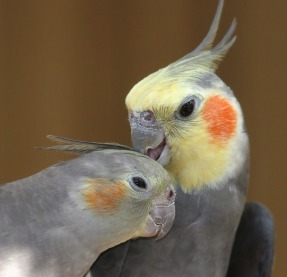
Male normal gray cockatiel preens his wife's crest
Male cockatiel preens his wife’s crest

We have to start this post with the definition of convergence in biology.

In evolutionary biology, convergent evolution is the process whereby organisms not closely related (not monophyletic), independently evolve similar traits as a result of having to adapt to similar environments or ecological niches.

It is the opposite of divergent evolution, where related species evolve different traits.

On a molecular level, this can happen due to random mutation unrelated to adaptive changes; see long branch attraction. In cultural evolution, convergent evolution is the development of similar cultural adaptations to similar environmental conditions by different peoples with different ancestral cultures. An example of convergent evolution is the similar nature of the flight/wings of insects, birds, pterosaurs, and bats.

All four serve the same function and are similar in structure, but each evolved independently.

And now, this new article on convergence in birds and humans, from Evolution News.

They write:

Everyone is familiar with the striking ability of certain birds (such as parrots) to vocalize speech, much as humans do. Well, according to the new papers published in Science that I wrote about earlier, confirming that birds arose explosively, those vocalization abilities are the result of “convergent evolution” at both the morphological and genetic levels.

Nature News reports, “The authors also conclude that vocal learning may have evolved independently in the ancestors of parrots, hummingbirds and songbirds.” But this is about more than just birds. According to a Science Daily article about the technical papers, the genetic “convergent evolution” extends to birds and humans:

“We’ve known for many years that the singing behavior of birds is similar to speech in humans — not identical, but similar — and that the brain circuitry is similar, too,” said Jarvis, an associate professor of neurobiology at the Duke University Medical School and an investigator at the Howard Hughes Medical Institute. “But we didn’t know whether or not those features were the same because the genes were also the same.”Now scientists do know, and the answer is yes — birds and humans use essentially the same genes to speak.

After a massive international effort to sequence and compare the entire genomes of 48 species of birds representing every major order of the bird family tree, Jarvis and his colleagues found that vocal learning evolved twice or maybe three times among songbirds, parrots and hummingbirds.

Even more striking is that the set of genes involved in each of those song innovations is remarkably similar to the genes involved in human speaking ability.

If you’re already thinking “This isn’t ‘convergent evolution,’ it’s common design,” you haven’t seen the best part yet. Science Daily goes on:

One of the Dec. 12 papers in Science found there is a consistent set of just over 50 genes that show higher or lower activity in the brains of vocal learning birds and humans. These changes were not found in the brains of birds that do not have vocal learning and of non-human primates that do not speak, according to this Duke team, which was led by Jarvis; Andreas Pfenning, a graduate of the PhD program in computational biology and bioinformatics (CBB); and Alexander Hartemink, professor of computer science, statistical science and biology.”This means that vocal learning birds and humans are more similar to each other for these genes in song and speech brain areas than other birds and primates are to them,” Jarvis said.

These genes are involved in forming new connections between neurons of the motor cortex and neurons that control the muscles that produce sound.

The Science paper puts it this way:

More than 50 genes contributed to their convergent specialization and were enriched in motor control and neural connectivity functions. These patterns were not found in vocal nonlearners, but songbird RA was similar to layer 5 of primate motor cortex for another set of genes, supporting previous hypotheses about the similarity of these cell types between bird and mammal brains.(Pfenning et al., “Convergent transcriptional specializations in the brains of humans and song-learning birds,” Science, Vol. 346: 1256846-1 – 1256846-13 (December 12, 2014). )

So certain birds and humans use the same genes for vocalization — but those genetic abilities are absent in non-human primates and birds without vocal learning? If not derived from a common ancestor, as they clearly were not, how did the genes get there? This kind of extreme convergent genetic evolution points strongly to intelligent design.

The rest of the article talks about the conclusions of the study authors – they think it’s a huge problem – and it is.

I hope you’re all beginning to see why I love birds so much. I just adore them. In fact, I am excited about them right now, and will probably appear silly by gushing about how great they are. Fortunately, my editorette is not hear to stop me!

Birds are not just a living disproof of naturalistic evolution. They are also loveable and adorable. (Especially parrots, of course) If you guys are considering a pet, go out and get yourself a cockatiel, if it’s your first bird, or a green-cheek conure, if you’ve had birds before. Just remember that they live 20-25 years, so you have to be ready to face responsibilities, expectations and obligations if you make a commitment like that. And you know what? That is totally awesome, to have someone to care about. It’s good stewardship to care for animals. And if you can’t commit to a parrot of your own over the long haul, then put out an additional bird feeder this winter, and vote against wind power. Wind power kills birds, and I hate it.

Also, that bird in the Evolution News post is an Indian ringneck parrot. And they are awesome!!!!

More posts on convergence