An article from Evolution News that takes a statement from an evolutionist who supports common descent, and then then refutes it point by point.
Here’s the case for common descent:
UCA is now supported by a wealth of evidence from many independent sources, including: (1) the agreement between phylogeny and biogeography; (2) the correspondence between phylogeny and the palaeontological record; (3) the existence of numerous predicted transitional fossils; (4) the hierarchical classification of morphological characteristics; (5) the marked similarities of biological structures with different functions (that is, homologies); and (6) the congruence of morphological and molecular phylogenies.
(Douglas L. Theobald, “A formal test of the theory of universal common ancestry,” Nature, Vol. 465:219-222 (May 13, 2010).)
And here’s a response to each of those points from the Evolution News post:
(1) Phylogeny and biogeography don’t always agree.
(2) Phylogeny and paleontology don’t always agree.
(3) Transitional fossils are often missing (or the “predicted” transitional fossils fall apart on closer inspection).
(4) Hierarchical classifications often fail.
(5) “Homologous” structures often have different developmental pathways or different structures often have “homologous” developmental pathways.
(6) Morphological and molecular phylogenies are often incongruent.
Before I read this post, I only knew about 3, 4, 5 and 6.
A related podcast
Casey Luskin did a good podcast explaining a problem with two kinds of evidence commonly used to argue for common ancestry.
Details:
On this episode of ID the Future, Casey Luskin takes a keen-eyed look at Darwin’s tree of life and finds that common descent, far from being confirmed by the data, is actually contradicted by it, as New Scientist pointed out in their cover story, “Why Darwin was wrong about the tree of life.”
Listen in to learn how the data is challenging Darwinist assumptions, and check out “A Primer on the Tree of Life” for more information.
The paper linked above seems to be exactly what he read out loud in the podcast.
Here is one section from the paper that summarizes everything:
One authoritative review paper by Darwinian leaders in this field stated, “As morphologists with high hopes of molecular systematics, we end this survey with our hopes dampened. Congruence between molecular phylogenies is as elusive as it is in morphology and as it is between molecules and morphology.”
Another set of pro-evolution experts wrote, “That molecular evidence typically squares with morphological patterns is a view held by many biologists, but interestingly, by relatively few systematists. Most of the latter know that the two lines of evidence may often be incongruent.“
The two methods of determining ancestry are “often incongruent”. What I am looking for in order to be convinced of common ancestry is substantial agreement between morphological phylogenies and molecular phylogenies. I don’t see that, so I am still skeptical of common ancestry. Especially with all the examples of convergence that I keep finding out about.
Sherlock Holmes and John Watson: let’s take a look at the facts
What should we make of theistic evolutionists telling us that you can believe in God, while still knowing that matter, law and chance fully explain the development of all of biological life?
Consider this quotation from Phillip E. Johnson.
Quote:
The National Academy’s way of dealing with the religious implications of evolution is akin to the two-platoon system in American football. When the leading figures of evolutionary science feel free to say what they really believe, writers such as Edward O. Wilson, Richard Dawkins, Daniel Dennett, Carl Sagan, Steven Pinker, Stephen Jay Gould, Richard Lewontin and others state the “God is dead” thesis aggressively, invoking the authority of science to silence any theistic protest. That is the offensive platoon, and the National Academy never raises any objection to its promoting this worldview.
At other times, however, the scientific elite has to protect the teaching of the “fact of evolution” from objections by religious conservatives who know what the offensive platoon is saying and who argue that the science educators are insinuating a worldview that goes far beyond the data. When the objectors are too numerous or influential to be ignored, the defensive platoon takes the field. That is when we read those spin-doctored reassurances saying that many scientists are religious (in some sense), that science does not claim to have proved that God does not exist (but merely that he does not affect the natural world), and that science and religion are separate realms which should never be mixed (unless it is the materialists who are doing the mixing). Once the defensive platoon has done its job it leaves the field, and the offensive platoon goes right back to telling the public that science has shown that “God” is permanently out of business.
(Phillip E. Johnson: “The Wedge of Truth”, IVP 2000, pp. 88-89).
So what naturalistic scientists believe is that God didn’t do anything to create the diversity of life – that nature does all of its own creating without God. In fact, it doesn’t matter if the best naturalistic explanation is improbable or implausible – naturalists must bitterly cling to materialistic explanations of natural phenomena. Any doubts about the efficacy of naturalistic mechanisms get met by “theistic evolutionists” – scientists who think that science shows that God didn’t do anything in the history of life.
When it comes to discussing origins, you have to be very careful with theistic evolutionists. The one question they want to avoid is whether science, done in the ordinary naturalistic way, can discover evidence of intelligent agency in the history of the development of life. And that’s why you have to ask them that question first. “Is there any scientific evidence that intelligent causes were active during the history of the development of life on this planet?” Their answer to that is the same as atheists, namely: “there is no scientific evidence that intelligent causes are responsible for the effects we see in the history of life on Earth”. Theistic evolutionists and atheists agree on that: as far as pure scientific evidence is concerned, nature can do its own creating without any intelligence writing genetic code or engineering animal body plans.
For his part, [Ken] Miller, a biologist, has no qualms about telling us what God would do: “And in Catholicism, he said, God wouldn’t micromanage that way. ‘Surely he can set things up without having to violate his own laws.'”
I am unaware of any tenet of Catholic theology that requires God not to micromanage. It is, however, a tenet of deism.
Got that? What really happened is that God didn’t do anything. How does he know that? From the science? No. Because he assumes naturalism. Oh, it’s true that he says that God is lurking somewhere behind the material processes that created life. But God’s agency is undetectable by the methods of science. And he is hoping that you will accept his subjective pious God-talk as proof that a fundamentally atheistic reality is somehow reconcilable with a robust conception of theism.
More from Richards:
Then we get Stephen Barr offering his private definition of “chance.”
It is possible to believe simultaneously in a world that is shaped by chance and one following a divine plan. “God is in charge and there’s a lot of accident,” said Barr, also a Catholic. “It’s all part of a plan. . . . God may have known where every molecule was going to move.”
What does Barr really believe? He believes that what science shows is that nature created life without any interference by an intelligent agent. Barr then offers believers his subjective pious God-talk to reassure them that evolution is compatible with religion. He has a personal belief – NOT BASED ON SCIENCE – that the material processes that created all of life are “all part of a plan”. He cannot demonstrate that from science – it’s his faith commitment. And more speculations: “God may have known…”. He can’t demonstrate that God did know anything from science. He is just offering a personal opinion about what God “could have” done. The purpose of these subjective opinions is to appease those who ask questions about what natural mechanisms can really create. Can natural causes really account for the development of functional proteins? Never mind that – look at my shiny spiritual-sounding testimony!
That’s theistic evolution. What really happened is that no intelligent causes are needed to explain life. What they say is “God could” and “God might” and “I pray” and “I attend this church” and “I received a Christian award” and “I sing praise hymns in church”. None of these religious opinions and speculations are relevant to the science – they are just opinions, speculations and biographical trivia. Atheists and theistic evolutionists agree on what science shows about the diversity of life – intelligent causes didn’t do anything.
Front-loading?
One of the ways that theistic evolutionists try to affirm design is by insisting that the design is “front-loaded”. The design for all the information and body plans is somehow embedded in matter.
Here is Stephen C. Meyer to assess that:
It’s very important to understand that there is no scientific evidence for design (information) being front-loaded. So although the theistic evolutionists are talking about design, it’s still in the realm of faith – not detectable to scientific investigation. And as Dr. Meyer explained, it doesn’t work to explain design anyway.
I attended a Wheaton College philosophy conference where Dr. Michael Murray read a paper advocating for this front-loaded view of design. I raised my hand to ask him a question, “hey, philosophy guy, did God front-load the information in that paper you’re reading, or did you write it yourself?” But the philosophy moderators must have known that I was an engineer, and would talk sense into him, because they never called on me. However, I did e-mail him later and asked him if he had any evidence for this front-loading theory, and couldn’t God write sequence information in time the same way he had sequenced information in his essay. He replied and said that front-loading was more emotionally satisfying for him. That’s philosophy, I guess. Thank goodness an engineer wrote his e-mail program so that he could at least come clean about his silly view.
The quickest way to disarm a theistic evolutionist is to ask them for a naturalistic explanation of the origin of life. And for a naturalistic explanation of the Cambrian explosion. And so on. Focus on the science – don’t let them turn the conversation to their personal beliefs, or to the Bible, or to religion. No one cares about the psychology of the theistic evolutionist. We only care what science can show.
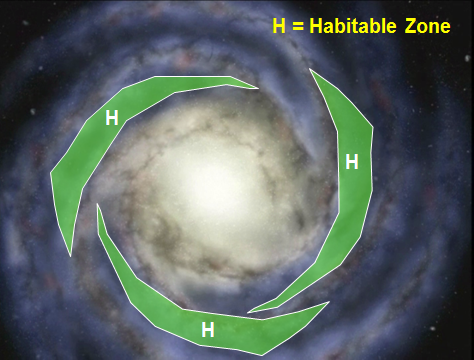
The galactic habitable zone (GHZ) is shown in green superimposed on a spiral galaxy
This is going to be old news to readers of this blog who are familiar with the Michael Strauss, Walter Bradley and Guillermo Gonzalez lectures on habitability and fine-tuning. But, it’s nice to see these ideas show up in one of the most presitigious peer-reviewed science journals in the world (if not the most presitigious).
Scientists have known for several years now that stars, galaxies, and almost everything in the universe is moving away from us (and from everything else) at a faster and faster pace. Now, it turns out that the unknown forces behind the rate of this accelerating expansion—a mathematical value called the cosmological constant—may play a previously unexplored role in creating the right conditions for life.
That’s the conclusion of a group of physicists who studied the effects of massive cosmic explosions, called gamma ray bursts, on planets. They found that when it comes to growing life, it’s better to be far away from your neighbors—and the cosmological constant helps thin out the neighborhood.
“In dense environments, you have many explosions, and you’re too close to them,” says cosmologist and theoretical physicist Raul Jimenez of the University of Barcelona in Spain and an author on the new study. “It’s best to be in the outskirts, or in regions that have not been highly populated by small galaxies—and that’s exactly where the Milky Way is.”
Jimenez and his team had previously shown that gamma ray bursts could cause mass extinctions or make planets inhospitable to life by zapping them with radiation and destroying their ozone layer. The bursts channel the radiation into tight beams so powerful that one of them sweeping through a star system could wipe out planets in another galaxy. For their latest work, published this month in Physical Review Letters, they wanted to apply those findings on a broader scale and determine what type of universe would be most likely to support life.
The research is the latest investigation to touch on the so-called anthropic principle: the idea that in some sense the universe is tuned for the emergence of intelligent life. If the forces of nature were much stronger or weaker than physicists observe, proponents note, crucial building blocks of life—such fundamental particles, atoms, or the long-chain molecules needed for the chemistry of life—might not have formed, resulting in a sterile or even completely chaotic universe.
Basically, the best place for a galaxy that permits complex, embodied life to exist is one where you can pick up enough heavy elements from dying stars nearby, but not be in an area that is so crowded by stars that you will be murdered by intense gamma radiation when they die.
The cosmological constant has to be set just right that we spread out enough to make space between spiral arms for life-permitting solar systems, but no so spread out that we cannot pick up the heavy elements we need for a metal-rich star, a moon, and the bodies of the intelligent agents themselves.
More:
As it turns out, our universe seems to get it just about right. The existing cosmological constant means the rate of expansion is large enough that it minimizes planets’ exposure to gamma ray bursts, but small enough to form lots of hydrogen-burning stars around which life can exist. (A faster expansion rate would make it hard for gas clouds to collapse into stars.)
Jimenez says the expansion of the universe played a bigger role in creating habitable worlds than he expected. “It was surprising to me that you do need the cosmological constant to clear out the region and make it more suburbanlike,” he says.
Remember, this is only one of many characteristics that must obtain in order for a have a location in the universe that can support complex, embodied life of any conceivable kind.
Let’s review the big picture
Time for me to list out some of the things that are required for a galaxy, solar system and planet to support complex embodied life. Not just life as we know it, but life of any conceivable kind given these laws of physics.
a solar system with a single massive Sun than can serve as a long-lived, stable source of energy
a terrestrial planet (non-gaseous)
the planet must be the right distance from the sun in order to preserve liquid water at the surface – if it’s too close, the water is burnt off in a runaway greenhouse effect, if it’s too far, the water is permanently frozen in a runaway glaciation
the solar system must be placed at the right place in the galaxy – not too near dangerous radiation, but close enough to other stars to be able to absorb heavy elements after neighboring stars die
a moon of sufficient mass to stabilize the tilt of the planet’s rotation
plate tectonics
an oxygen-rich atmosphere
a sweeper planet to deflect comets, etc.
planetary neighbors must have non-eccentric orbits
It’s not easy to make a planet that supports life. For those who are interested in reaching out to God, he has left us an abundance of evidence for his existence – and his attention to detail.
And remember, these requirements for a habitable planet are downstream from the cosmic fine-tuning of constants and quantities that occurs at the Big Bang. No point in talking about the need for plate tectonics if you only have hydrogen in your universe. The habitability requirements are a further problem that comes after the fine-tuning problem.
Resources
The best book to read on this topic is “The Privileged Planet“, by Guillermo Gonzalez and Jay W. Richards. The latter is one of my absolute favorite Christian scholars, a real renaissance man. If the book is too much, there is a DVD by the same name that covers everything you need to know at a high level. Just FYI, Gonzalez made the cover of Scientific American in 2001, for his research on habitable zones. This is real evidence you can discuss with anyone, anywhere.
You can also watch the DVD for FREE on YouTube. Not sure how long that will be there. If you like it, buy the DVD, so you can show your friends.



 WINTERY KNIGHT