“The unemployment rate for young Americans has exploded to 52.2 percent — a post-World War II high, according to the Labor Dept. — meaning millions of Americans are staring at the likelihood that their lifetime earning potential will be diminished and, combined with the predicted slow economic recovery, their transition into productive members of society could be put on hold for an extended period of time.”
“The number represents the flip-side to the Labor Dept.’s report that the employment rate of 16-to-24 year olds has eroded to 46.6 percent — the lowest ratio of working young Americans in that age group, including all but those in the military, since WWII.”
And they’ll have to pay for the trillions that Obama is adding to our national debt, too.
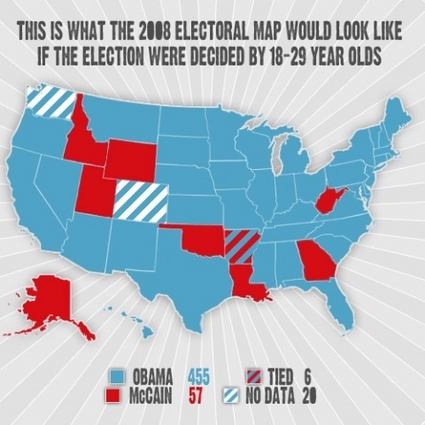
Remember, young people really liked Obama during the election:
I’m thinking that those young people should be more careful about considering a politician’s voting record instead of listening to their government-funded public school teachers. It seems to be that government-run public schools will always indoctrinate children to vote for bigger government, and that means higher unemployment in the private sector, especially for entry-level job-seekers. Maybe the young people didn’t think that far ahead, but then they should be more cautious about forming opinions without asking their parents for input.
You may also be interested in a wonderful video linked here that shows several prominent Democrats assuring us that the stimulus bill was needed to create millions of jobs and keep unemployment below 8%. They don’t understand economics – they’re Democrats. The know less about economics than my keyboard. If young people want to learn about economics, then they need to read Thomas Sowell and Walter Williams. Those are the two greatest living economists, and they teach economics so that regular people like me can understand.
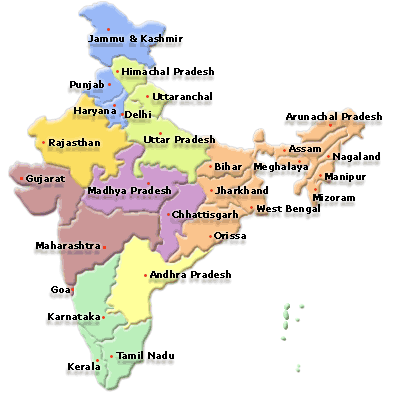
China extended its lead over the U.S. as the world’s biggest auto market in November, with production and sales both surpassing 1 million vehicles, and India saw sales jump 71.9-percent.
[…]China’s auto market is sizzling, thanks largely to tax cuts and subsidies aimed at supporting the industry and encouraging use of more fuel-efficient vehicles. The boom has clinched China’s status as the world’s biggest vehicle market due to languishing sales in the U.S.
[…]The surge is also a sign of how the Indian consumer — encouraged by government tax cuts, a big disbursement of back pay for government employees and falling interest rates — is fueling economic growth in Asia’s third-largest economy.
As everyone knows, the Democrats chose to bail out auto companies with taxpayer money and reward people with taxpayer money for destroying fully functional vehicles. And we all know how well that has worked out.
Chile poised to jump from the third world to the first world
Chile is expected to win entry to OECD’s club of developed countries by Dec. 15 — a great affirmation for a once-poor nation that pulled itself up by trusting markets. One thing that stands out here is free trade.
[…]It’s not like Chile was born lucky. Only 30 years ago, it was an impoverished country with per capita GDP of $1,300. Its distant geography, irresponsible neighbors and tiny population were significant obstacles to investment and growth. And its economy, dominated by labor unions, wasn’t just closed, but sealed tight.
In the Cato Institute’s 1975 Economic Freedom of the World Report it ranked a wretched 71 out of 72 countries evaluated.
Today it’s a different country altogether. Embracing markets has made it one of the most open economies in the world, ranking third on Cato’s index, just behind Hong Kong and Singapore. Per capita GDP has soared to $15,000.
Besides its embrace of free trade, other reforms — including pension privatization, tax cuts, respect for property rights and cutting of red tape helped the country grow not only richer but more democratic, says Cato Institute trade expert Daniel Griswold.
But the main thing, Griswold says, is that the country didn’t shift course. “Chile’s economy is set apart from its neighbors, because they have pursued market policies consistently over a long period,” he said. “Free trade has been a central part of Chile’s success.”
I gave my Dad my copy of “Money, Greed and God” by Jay Richards, and although he thought that it started out slow, he’s warmed up to it. He calls me on the phone at least twice a day, and last night he alerted me to this web site, where you can track each countries average citizen’s life span and per-capita GDP over time. My Dad was pretty liberal on economics before, so naturally I’ve been working on him with lots of introductory books on economics. He’s read about a dozen now, and Thomas Sowell is his favorite.
Anyway, my Dad says that this is what a country needs to succeed:
free trade with other nations
the rule of law
low judicial activism
low tax rates
private property protections
currency not threatened by inflation
low government spending
minimal regulation of commerce
And at that web site, you can track the success of countries like Singapore and Hong Kong, which embrace conservative small government free market fiscal policies, and compare them with countries like Zimbabwe and North Korea, which embrace big government protectionist fiscal policies. Countries fail because they adopt the wrong policies. They succeed when they adopt the right policies. It doesn’t matter how poor they start, if they have the right policies, they grow rich over time.
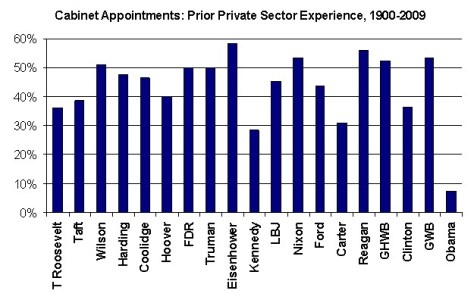
Why are the Democrats so incompetent on economic policy?
Well, it’s because there is almost no one in the Obama socialist regime who has ever run a business or worked in a business. Check out this graphic. (H/T Flopping Aces)
Hunger is spreading while the number of homeless families is increasing as a result of the recession and other factors, according to a report on Tuesday.
The U.S. Conference of Mayors said cities reported a 26 percent jump in demand for hunger assistance over the past year, the largest average increase since 1991.
Middle-class families as well as the uninsured, elderly, working poor and homeless increasingly looked for help with hunger, which was mainly fueled by unemployment, high housing costs and low wages.
Democrats really don’t know what they are doing. It’s like putting pre-schoolers in charge of Amazon.com. It doesn’t work. Their ivory tower, silver-spoon worldview cannot comprehend real-world, grown-up complexities. So long as the Democrats continue to attack the businesses that employ citizens while redistributing wealth from people who produce to people who vote Democrat, our economic troubles will continue.
This podcast explains how Obama’s health care reform bill would require young people to buy insurance, while simultaneously preventing medical insurers from reducing their premium amounts in accordance with the lower health risks of young people.
Ph.D., Massachusetts Institute of Technology, Economics, 1994.
B.A., High Honors, University of California, Santa Barbara, Business Economics, 1990.
Department of Economics, University of Kentucky, Associate Professor, July 1, 2001-present.
Associate Editor, Journal of Public Economics, January 2004-present.
And you can read the paper that is being discussed in the podcast.
Excerpt from the abstract:
One of the most interesting questions about the health care overhaul now moving through Congress is how it would affect young adults. That legislation would force most or all Americans to purchase health insurance (an “individual mandate”) and would impose price controls on health insurance (“community rating”) that would limit insurers’ ability to offer lower premiums to low-risk enrollees.
Those provisions would drive premiums down for 55-year-olds but would drive them up for 25-year-olds—who are then implicitly subsidizing older adults. According to the Urban Institute, many young people could see their premiums double, whereas premiums for older adults could be cut in half.
[…]The irony is that Barack Obama won the presidency with 66 percent of the vote among adults aged 18 to 29. That’s a larger share than any presidential candidate has won in decades. Yet his health care overhaul could impose its greatest burdens on young adults.

 WINTERY KNIGHT