
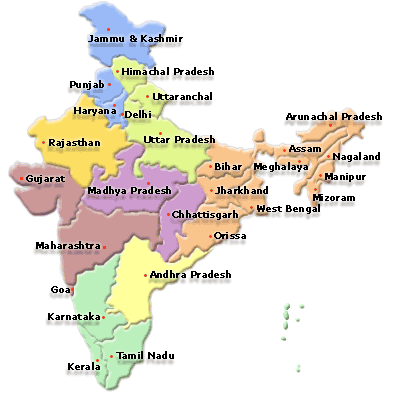
First, let’s hear about an anti-Christian crime that occurred in Orissa, the most anti-Christian area in India.
Excerpt:
The Central Bureau of investigation (CBI) wanted the death penalty for Singh, who was linked to extreme right-wing Hindu group Bajrang Dal. The GCIC has opposed the request for a death sentence. The wife of the slain pastor, Gladys Staines, had already forgiven Dara and his accomplices involved in the brutal murder of her husband and children. (20/01/2009 Widow of Graham Staines: “Do not give up hope, pray for India”).
Twelve years ago, Graham Staines was burnt alive with his children aged eight and ten years in the small village of Manoharpur, in the tribal area of Orissa. Graham Staines had worked for thirty years with leprosy patients in Orissa, and was sleeping with his children in a car, on his journey home on a cold December night. A group of attackers poured petrol on the car, and burned them alive.
The Staines tried to escape, but the assailants, fifty in all, prevented them. A witness said the attackers shouted slogans in praise of Dara Singh, the Hindu movement and the god Hanuman.
In 2003 a court in Khurda judged all 13 accused guilty. Life in prison for everyone else, a death sentence for Dara Singh. In 2005, the Orissa High Court commuted the death penalty to life imprisonment, judged Hembran guilty and exonerated the others.
Shalini sent me this story about how the Supreme Court upheld the High Court’s decision.
Excerpt:
Dara Singh killed Australian missionary Graham Staines and his two minor sons by setting fire to the vehicle in which they were sleeping, but the Supreme Court on Friday ruled that it was not a “rarest of rare” category crime to warrant death penalty for him.
In a judgment drawing curtains on court proceedings in the sensational incident of January 1999, a bench of Justices P Sathasivam and B S Chauhan upheld the Orissa High Court judgment imposing life sentence on Singh alias Rabindra Kumar Pal and Mahendra Hembram. The trial court had awarded death penalty to Singh.
The bench said the Orissa HC was justified in awarding life term to Singh and Hembran as the crime was committed in the passion to teach Staines a lesson for his alleged attempts to convert tribals.
“Though Graham Staines and his two minor sons were burnt to death while they were sleeping inside a station wagon at Manoharpur, the intention was to teach a lesson to Staines about his religious activities, namely, converting poor tribals to Christianity,” it said.
“All these aspects have been correctly appreciated by the high court and modified the sentence of death into life imprisonment with which we concur,” the bench said.
Justice Sathasivam, writing the judgment for the bench, also dismissed the CBI`s appeal challenging the HC`s decision to acquit 11 other accused. “We have highlighted the weakness and infirmities of the prosecution case insofar as acquitted accused, who are poor tribals,” he said. The CBI had taken over the probe from Orissa Police on May 3, 1999.
“In the absence of definite assertion from the prosecution side about their specific role and involvement, it is not safe to convict them. We entirely agree with the reasoning and conclusion of the high court,” it said.
While condemning killings in the name of religion, the bench also expressed its disapproval of conversion. “It is undisputed that there is no justification for interfering in someone`s belief by way of `use of force`, provocation, conversion, incitement or upon a flawed premise that one religion is better than the other,” said the bench.
This story is interesting because it shows how the pluralist view that “all religions are valid” can actually lead to violence. The pluralist view is itself a point of view that takes itself to be true. Pluralists think that religions like Christianity, which claim to be true, are actually FALSE. In short, pluralism DOES disagree with Christianity. If disagreement with other religions is bad, then pluralists are just as guilty of being bad as Christians.
Is what they say about Christians being “exclusive” true? Does being “exclusive” make Christians dangerous? Well, the reason why the practice of Christianity DOES NOT result in violence is because part of the “truth” that Christians believe is that they should love their enemies and pray for the people who persecute them. That’s why the victim’s wife forgave the murderers for their crimes.
I actually have Hindus and Muslims in my family. They treat religion as a cultural or national identity – not really something to investigate to see if it is true or false. Hindus are not usually Hindus because they did some big investigation and found Hinduism to be true. (Hinduism requires an eternally oscillating cosmology, which contradicts physics and the Big Bang theory). It’s more like that they do it for personal reasons or community reasons – it’s like part of their national/cultural identity.
Why do some Hindus oppose evangelism?
A while back I posted this debate featuring a Hindu who disagreed with Christian evangelism and wanted to make it illegal. He complained about Christians using “force” (being kind and giving gifts) to convince people to become Christians. In the next breath he was pushing the government to use force his anti-Christian views onto Christians. He did not want them to evangelize, so he wanted to pass that view into law and force his neighbors to accept HIS views by force. He thought his view of Christianity and evangelism was TRUE, and he thought the traditional, Biblical Christian view was false. He actually insisted that his interpretation of the Bible was correct and all the Christian theologians were misinterpreting the Bible. He expected Christians to act like Hindus! And he thought that Christianity WAS Hinduism – or that it should be redefined to be understood to be Hinduism. Then he complained about Christians who thought that their views were TRUE and that his were FALSE.
The difference between Christians and Hindus is that committed Christians think they are right and use ideas and words to persuade, while militant Hindus think they are right and are willing to use force to make people agree with them. I think the difference is that a Christian can appeal to facts like the Big Bang theory, and the Hindu cannot really do that, as this Hindu commenter to another post showed.
I really recommend that you listen to that debate, and there is a play-by-play summary that I wrote in case the bandwidth is too high. And read my exchange with the Hindu commenter, too.
Here is the major persecution story in Orissa that I blogged about before. And here’s another small story from Orissa that I found.

 WINTERY KNIGHT