Tag Archives: India

Muslims crack down on freedom of religion in Kashmir

From the National Catholic Register. (H/T ECM)

Excerpt:

The sharia court in Muslim-majority Kashmir has no constitutional or legal authority. But its recent verdict ordering the expulsion of five Christians from the troubled Indian side of Kashmir has sent alarm bells ringing among Christians in India.

Apart from ordering the expulsion of the Christians, the court also directed the government of Jammu and Kashmir to take over the management of the Christian missionary schools besides monitoring their activities.

Those ordered to be expelled include Father Jim Borst of the Dutch Mill Hill Missionaries, who has been based in Kashmir since 1963.

“This is much more than conversion. It is humiliating and certainly threatening for us,” Bishop Peter Celestine Elampassery of Jammu-Srinagar told the Register Jan. 27, reacting to the verdict.

Srinagar is the capital of the Indian state of Jammu and Kashmir, which is nestled in the Himalayas.

On Jan. 19, the court ordered the expulsion of Father Borst, along with two Protestant pastors and their wives, accusing them of “luring the (Kashmir) valley Muslims to Christianity.”

The verdict focused more on Pastor Chander Mani Khanna of the Protestant All Saints Church at Srinagar and pronounced him guilty of conversion. The pastor of the Church of North India had been arrested in November by state police on the dubious charge of “fomenting communal trouble” after Muslim groups pressed charges against him. Though the civil court released him on bail, the sharia court went ahead with its own trial.

“Khanna and his associates have been found guilty of spreading communal disaffection and were involved in immoral activities. They are ordered to be expelled from the state,” deputy grand mufti of Jammu and Kashmir, Nasir-ul-Islam, said Jan.19 while reading the verdict of the sharia court.

Father Borst, a well-known retreat preacher, runs the Good Shepherd School at Pulwama. The school had been partially burnt during widespread protests against the desecration of the Quran in the United States during the 9/11 anniversary in 2010.

I think it says something about a religion when the only way they can stop people from leaving their faith is through coercion and violence.

Gendercide: Planned Parenthood and NARAL oppose ban on sex-selection abortions

Letitia, who blogs at Talitha, Koum, notified me about this article in Life News.

Excerpt:

As members of Congress hold a hearing today on legislation that would ban sex-selection abortions and abortions done if the unborn child is of a specific race, leading pro-abortion advocacy groups are strongly opposed to it.

Their opposition could explain why organizations like Planned Parenthood, NARAL and the ACLU almost never speak out against the horrible human rights abuses associated with the one-child policy in China – ranging from sex-selection abortions, to forced abortions, to coercive sterilizations and infanticides.

[…]Planned Parenthood, NARAL, ACLU and a total of 30 pro-abortion groups banded together for a letter opposing the legislation, the Prenatal Nondiscrimination Act.

The claim the bill, sponsored by pro-life Rep. Trent Franks, an Arizona Republican, is “simply more of the same from the anti-choice extremists choice extremists in the House” and they urged a no vote on it.

“[T]he bill will effectively exacerbate already existing disparities by limiting some women’s access to comprehensive reproductive health care and penalizing health care providers,” they allege.

They claim:  “Instead of addressing health disparities and ensuring accessible and culturally competent medical care for all women, the Prenatal Nondiscrimination Act will further isolate and stigmatize some women — particularly those in the Asian American and Pacific Islander and African American communities — from exercising their fundamental human right to make and implement decisions about their reproductive lives.”

Nancy Northup, President of Center for Reproductive Rights talked about her group’s opposition to the bill with Fox News and said it is an “anti-choice” measure that she claims is a “trumped up bill for a trumped up problem,” and a “ridiculous waste of congressional resources at a time when the U.S. economy is faltering.”

“This bill is a cynical and offensive attempt to evoke race and sex discrimination when actually it’s about taking women’s rights away,” she said.

Got that? If you want to kill a baby simply because it’s a girl, and you wanted a boy, then Planned Parenthood and NARAL are all in favor of that. They support sex-selection abortions. They don’t just permit it, they lobby in favor of it. That’s how “pro-woman” they are.

Here’s an article from the Economist that explains how gendercide is happening in India and China.

Excerpt:

In January 2010 the Chinese Academy of Social Sciences (CASS) showed what can happen to a country when girl babies don’t count. Within ten years, the academy said, one in five young men would be unable to find a bride because of the dearth of young women—a figure unprecedented in a country at peace.

The number is based on the sexual discrepancy among people aged 19 and below. According to CASS, China in 2020 will have 30m-40m more men of this age than young women. For comparison, there are 23m boys below the age of 20 in Germany, France and Britain combined and around 40m American boys and young men. So within ten years, China faces the prospect of having the equivalent of the whole young male population of America, or almost twice that of Europe’s three largest countries, with little prospect of marriage, untethered to a home of their own and without the stake in society that marriage and children provide.

Gendercide—to borrow the title of a 1985 book by Mary Anne Warren—is often seen as an unintended consequence of China’s one-child policy, or as a product of poverty or ignorance. But that cannot be the whole story. The surplus of bachelors—called in China guanggun, or “bare branches”— seems to have accelerated between 1990 and 2005, in ways not obviously linked to the one-child policy, which was introduced in 1979. And, as is becoming clear, the war against baby girls is not confined to China.

Parts of India have sex ratios as skewed as anything in its northern neighbour. Other East Asian countries—South Korea, Singapore and Taiwan—have peculiarly high numbers of male births. So, since the collapse of the Soviet Union, have former communist countries in the Caucasus and the western Balkans. Even subsets of America’s population are following suit, though not the population as a whole.

The real cause, argues Nick Eberstadt, a demographer at the American Enterprise Institute, a think-tank in Washington, DC, is not any country’s particular policy but “the fateful collision between overweening son preference, the use of rapidly spreading prenatal sex-determination technology and declining fertility.” These are global trends. And the selective destruction of baby girls is global, too.

Boys are slightly more likely to die in infancy than girls. To compensate, more boys are born than girls so there will be equal numbers of young men and women at puberty. In all societies that record births, between 103 and 106 boys are normally born for every 100 girls. The ratio has been so stable over time that it appears to be the natural order of things.

That order has changed fundamentally in the past 25 years. In China the sex ratio for the generation born between 1985 and 1989 was 108, already just outside the natural range. For the generation born in 2000-04, it was 124 (ie, 124 boys were born in those years for every 100 girls). According to CASS the ratio today is 123 boys per 100 girls. These rates are biologically impossible without human intervention.

Letitia has written a post about the prevalence of sex-selection abortions in the Asian community. Go here to read that. And Letitia also writes about the legalization of sex-selection abortions in Sweden here.

You can learn more about the Republican bill to end sex-selection and race-selection abortions.

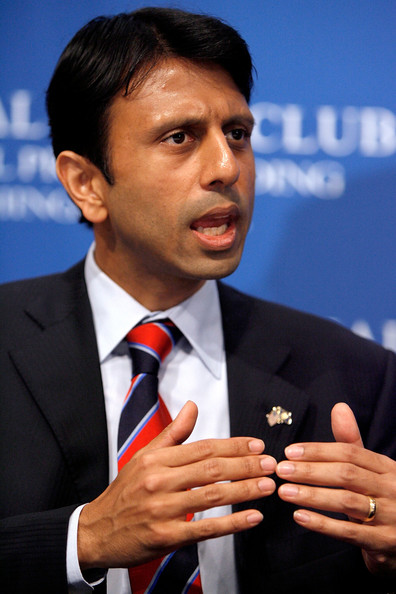
Bobby Jindal cuts Louisiana budget by 25%… and gets re-elected in landslide?

Gov. Bobby Jindal
Gov. Bobby Jindal

From the Philadelphia Inquirer.

Excerpt:

One gubernatorial election ended early this fall, when Louisiana Gov. Bobby Jindal won the state’s blanket primary Oct. 22. Under Louisiana’s system, all candidates of all parties are listed on the ballot, and if no one gets 50 percent, the top two finishers go to a runoff. Jindal blew past the threshold with 66 percent.

Jindal’s reelection was unusual in several respects. The only previous time the state has not had a runoff was his election in 2007. He is only the fourth Republican governor in the last 125 years in Louisiana, and one of those four switched over from the Democrats in office. Jindal’s best-known challenger this year was a schoolteacher, who raised less than 1 percent of the incumbent’s campaign treasury. The Democratic State Central Committee declined to endorse any candidate running on its party label.

But perhaps most unbelievable is that Jindal faced no serious competition after cutting state spending more than 25 percent. In January 2008, the state had a budget of $34.3 billion. This summer, Jindal signed into law a budget spending $25 billion. As governors from Harrisburg to Trenton to Columbus to Madison have learned, cutting a state’s budget is difficult enough; doing so without a significant backlash seems a politically impossible task.

A key part of Jindal’s story is recognizing that he took the helm of a state that had hit bottom: Decades of mismanagement and corruption had taken their toll even before Hurricane Katrina wreaked such devastation and exposed such colossal unresponsiveness in state government. The state, recognizing the bitter fruit of its traditions of colorful corruption, was ready to take a chance on a then-37-year-old Indian American congressman who speaks roughly 100 words per minute. The state was willing to try a new approach to governing; how much worse could it be?

Privatization played a big role in Jindal’s reinvention of state government, with private contractors taking over state-run operations for a lesser cost. The companies often hired the state workers who would often be the centerpiece of opponents’ criticism.

His administration privatized the state’s Office of Risk Management. Then the state’s Division of Administration privatized claims management and loss prevention in the self-insurance program, saving $20 million over five years. The Department of Health and Hospitals privatized six inpatient, residential-treatment programs around the state, saving $2.5 million. Separately, patients were moved from state-operated institutions that cost $600 or more per patient per day to community-based services and private group homes that average $191 per day, saving an additional $23.8 million.

Consolidation was another key element: The state’s Department of Revenue shrank from eight offices statewide to three. The Department of Children and Family Services consolidated its offices from 157 to 90, saving a total of $2.7 million.

But some of Jindal’s cuts are the old-fashioned kind. The state sold 1,300 vehicles from its fleet of automobiles. Louisiana’s Transportation Department shut down a ferry that was used by only 7,200 drivers per year, saving the state roughly three-quarters of a million dollars.

In fiscal 2011, Louisiana eliminated more than 3,500 full-time government positions. Add the 6,363 previous reductions during Jindal’s term, and that means a total of almost 9,900 full-time positions reduced since he took the oath, a savings of almost $600 million. Louisiana now has the lowest level of full-time state government employees in almost 20 years.

“You change people’s expectations and you make structural changes,” Jindal said, while racing around the state about three weeks before the election. “The most important is this cultural change, to say government is not the answer to everything. In a weird way, I want the office of governor to be less important than it is. What I mean by that is, there was an old joke that kids in Louisiana don’t grow up wanting to be president; they grow up wanting to be governor. You should want them to want to business leaders or doctors or teachers.”

Some cuts were more noticeable to the public, but Louisianans found shorter hours and workweeks at state facilities more palatable than complete shutdowns or higher taxes: Historic sites are now open five days a week instead of seven, pools at a half dozen state parks were closed on Mondays and Tuesdays this summer, and entrance stations at all state parks had shorter hours. Finally, 54,000 rank-and-file state workers are going without a raise for the second consecutive year.

Jindal’s first term was marked by several high-profile crises he successfully managed – Hurricane Gustav and the response to the BP oil spill, along with the Obama administration’s six-month moratorium on all drilling in the Gulf of Mexico – but the state’s economy has generally chugged along: Louisiana’s unemployment rate is 7.1 percent, two percentage points lower than the national average, and a comparably booming economy makes cuts in state spending much easier to take.

“If you have a good-paying job with benefits, you wouldn’t need the state to do so many things for you,” Jindal says. “You become less dependent, and that diminishes the role of the state and so you need fewer state employees, and it’s a virtuous cycle. You can lower taxes and lower government spending.”

Louisiana is a swing state. If Bobby Jindal can cut government spending in a swing state and get re-elected with 66% of the vote, then we do have hope that the American people will do the right thing. Maybe we just need to hit bottom with Obama so that we realize that competence does matter after all. We have a deep, deep bullpen for future elections. Governors like Scott Walker (Wisconsin), Rick Scott (Florida) and John Kasich (Ohio)would be excellent presidential candidates.  And of course we have Marco Rubio and soon-to-be senators Josh Mandel and Ted Cruz waiting in the wings.