A common thing that I see is people trying to wall off arguments they don’t like by stating a slogan, like “you shouldn’t push your moral rules on other people” or “that’s true for you, but not for me”. Those slogans are meant to get the person out of having to be reasonable about respecting moral obligations, or having to consider how the world really works when choosing what to do.
A self-defeating (or self-refuting) statement is one that fails to meet its own standard. In other words, it is a statement that cannot live up to its own criteria. Imagine if I were to say,
I cannot speak a word in English.
You intuitively see a problem here. I told you in English that I cannot speak a word in English. This statement is self-refuting. It does not meet its own standard or criteria. It self-destructs.
The important thing to remember with self-defeating statements is that they are necessarily false. In other words, there is no possible way for them to be true. This is because they violate a very fundamental law of logic, the law of non-contradiction. This law states that A and non-A cannot both be true at the same time and in the same sense. For example, it is not possible for God to exist and not exist at the same time and in the same sense. This would violate the law of non-contradiction. So if I were to say, “God told me He doesn’t exist” you would see intuitively the obvious self-refuting nature of this statement.
Aaron goes on to explain how to deal with self-refuting statements in the article.
Have you ever heard any of those? It’s amazing how often I hear statements like that when discussing interesting things like moral issues and politics with young people. The trick to being prepared to answer these is to learn lots of them. Then you recognize them when you hear them.
I’ve blogged about a half-dozen studies from different countries on the link between abortion and breast cancer. It’s always interesting to keep up with the research, so we know what to tell young people about the likely consequences of their choices with sex and abortion. The survey was reported by Life News.
Excerpt:
In 2018, the Breast Cancer Prevention Institute funded and published “Induced Abortion as an Independent Risk Factor for Breast Cancer: A Systematic Review and Meta-analysis of Studies on South Asian Women” in Issues in Law and Medicine. (A meta-analysis looks at separate but similar studies in order to use the pooled data for statistical significance. It is regarded by scientists as very strong evidence.)
Of the 20 studies analyzed, 16 were done on Indian women. The meta-analysis found a 151% increased risk of breast cancer after an induced abortion.
In 2014, “Breast Cancer and Induced Abortion,” an analysis also published in Issues in Law and Medicine, revealed that the incidence of breast cancers increased 10-14 years after an abortion. This analysis was consistent with the known biology of breast cancer. There was no statistically significant increase in breast cancer risk before 10 years and after 14 years of an abortion.
Induced abortion in India, referred to as “Medical Termination of Pregnancy,” was legalized in 1971. Sons are most highly prized and sex selection abortions, although illegal, are not uncommon.
A study published in the Lancet 2006 and based on conservative assumptions, reported that the practice of sex-selection accounts for about a half million missing female births yearly. Over the past two decades this translates into the abortion of some 10 million female fetuses.
Abortion is especially a problem for Indian women, because – as in China – India is very pro-abortion. Both India and China have a very pro-abortion culture, and sex-selection abortion is seen as normal.
Here are a couple of studies that focused on China and Chinese women who choose abortion.
Based on the expression of estrogen receptor (ER), progesterone receptor (PR) and HER2/neu (HER2), breast cancer is classified into several subtypes: luminal A (ER+ and/or PR+, HER2-), luminal B (ER+ and/or PR+, HER2+), HER2-overexpressing (ER-, PR-, and HER2+) and triple-negative (ER-, PR-, and HER2-). The aim of this case-control study is to determine reproductive factors associated with breast cancer subtypes in Chinese women. A total of 1,417 patients diagnosed with breast cancer in the First Affiliated Hospital, China Medical University, Shenyang, China between 2001 and 2009 and 1,587 matched controls without a prior breast cancer were enrolled.
[…]Postmenopause and spontaneous abortion were inversely associated with the risk of luminal tumors. By contrast, multiparity, family history of breast cancer and induced abortion increased the risk of breast cancer.
OBJECTIVE: To explore the risk factors of breast cancer for better control and prevention of the malignancy.
METHODS: The clinical data of 232 patients with pathologically established breast cancer were investigated in this 1:1 case-control study to identify the risk factors of breast cancer.
RESULTS: The history of benign breast diseases, family history of carcinoma andmultiple abortions were the statistically significant risk factors of breast cancer, while breast feeding was the protective factor.
CONCLUSION: A history of benign breast diseases, family history of carcinoma and multiple abortions are all risk factors of breast cancer.
Those are both about abortion and breast cancer in China.
IA is significantly associated with an increased risk of breast cancer among Chinese females, and the risk of breast cancer increases as the number of IA increases. If IA were to be confirmed as a risk factor for breast cancer, high rates of IA in China may contribute to increasing breast cancer rates.
The effect seems to be most observable for women who have induced abortions before ever completing a pregnancy.
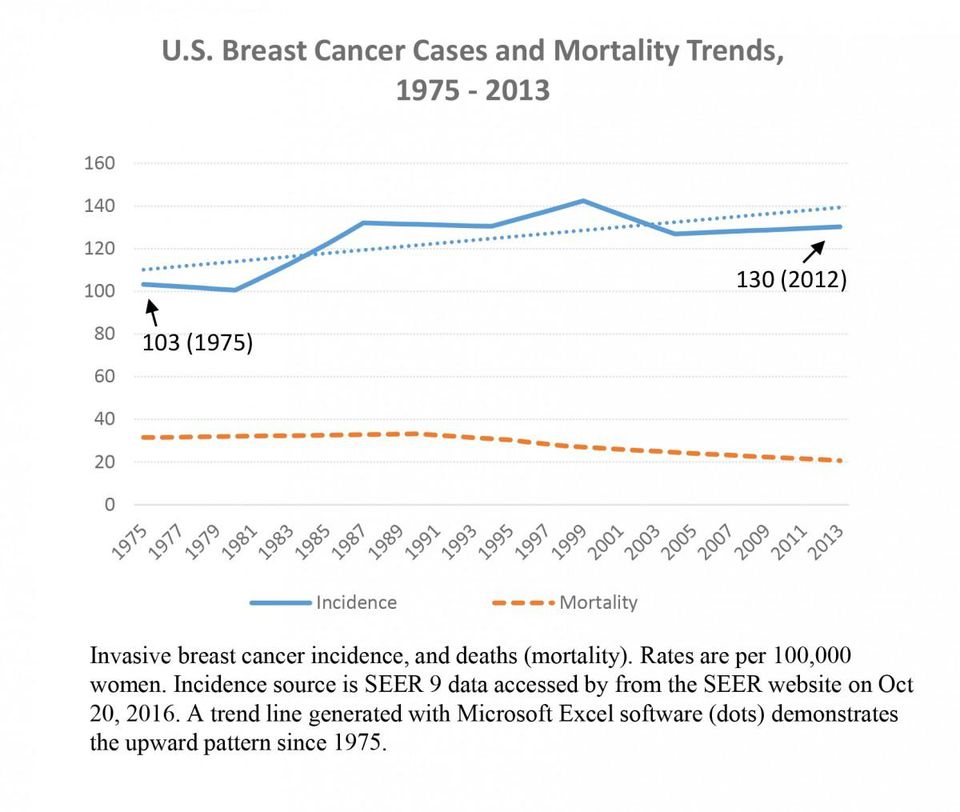
Even though the United States has massively focused on breast cancer screening and treatment, (in contrast to other cancers, such as prostate cancer), the rate of breast cancer has not declined:
Breast cancer rates have been rising since abortion was legalized
We have so much attention on breast cancer in the West. Many charities raising money for it. Policy changes to promote early testing. Taxpayer money being spent to stop it. And yet the rate has not gone down. It started going up right around the time abortion became legal.
Stopping abortion
So, what about legislative solutions to this problem? I noticed that the new Senator from Tennessee Marsha Blackburn has already introduced a new piece of legislation designed to stop taxpayer-funding of abortion.
Newly elected Sen. Marsha Blackburn announced Thursday that she has introduced her first bill in the Senate, one that would end federal funding to all abortion providers, including Planned Parenthood.
“Tennesseans and the American people do not want their tax dollars funding abortions,” Blackburn, R-Tenn., said in a statement posted on her Twitter page Friday.
Blackburn, 66, was elected to the Senate on Nov. 6, beating Democrat Phil Bredesen, a former governor. She had previously represented Tennessee in the U.S. House since 2003, and before that, served in the state Senate.
Republicans have introduced similar bills in the House and Senate, but they usually get defeated by Democrats, who are in favor of taxpayer-funding for abortion through all nine months of pregnancy.
Four articles from Paul Copan over at the UK site “BeThinking”. Each article responds to a different slogan that you might hear if you’re dealing with non-Christians on the street.
“That’s just your interpretation!”
Some of his possible responses:
Gently ask, ‘Do you mean that your interpretation should be preferred over mine? If so, I’d like to know why you have chosen your interpretation over mine. You must have a good reason.’
Remind your friend that you are willing to give reasons for your position and that you are not simply taking a particular viewpoint arbitrarily.
Try to discern if people toss out this slogan because they don’t like your interpretation. Remind them that there are many truths we have to accept even if we don’t like them.
‘There are no facts, only interpretations’ is a statement that is presented as a fact. If it is just an interpretation, then there is no reason to take it seriously.
If you say that the Christian view is bad because it is exclusive, then you are also at that exact moment doing the very thing that you are saying is bad. You have to be exclusive to say that something is bad, since you exclude it from being good by calling it bad.
There is a difference, a clear difference between tolerance and truth. They are often confused. We should hold to what we believe with integrity but also support the rights of others to disagree with our viewpoint.
Sincerely believing something doesn’t make it true. You can be sincere, but sincerely wrong. If I get onto a plane and sincerely believe that it won’t crash then it does, then my sincerity is quite hopeless. It won’t change the facts. Our beliefs, regardless of how deeply they are held, have no effect on reality.
If my belief is only true for me, then why isn’t your belief only true for you? Aren’t you saying you want me to believe the same thing you do?
You say that no belief is true for everyone, but you want everyone to believe what you do.
You’re making universal claims that relativism is true and absolutism is false. You can’t in the same breath say, ‘Nothing is universally true’ and ‘My view is universally true.’ Relativism falsifies itself. It claims there is one position that is true – relativism!
Just because there are many different religious answers and systems doesn’t automatically mean pluralism is correct.
If we are culturally conditioned regarding our religious beliefs, then why should the religious pluralist think his view is less arbitrary or conditioned than the exclusivist’s?
If the Christian needs to justify Christianity’s claims, the pluralist’s views need just as much substantiation.



 WINTERY KNIGHT