Tag Archives: Human Rights Commission

Youtube reverses decision to ban video critical of gay activism in Canada

Here’s the original story about the banning of the video from May 18th, 2012.

Excerpt:

In a victory for gay rights extremists, YouTube has agreed to remove a video critical of Canadian laws concerning homosexuality from its website, even though the video discusses policy issues and does not use any derogatory language about gays and does not advocate violence against them.

The video created May 16 by preacher and hard rock drummer Bradlee Dean to accompany his weekly column published by WorldNet Daily and other news outlets, exposes facts about the hatred and oppression directed at conservative Christians and opponents of gay marriage in Canada by the radical Left toward people of faith, those who hold to traditional marriage. The video also details a solemn warning to American’s to get vocal on the issue or prepare for the cultural overhaul under way in Canada.

Among the shocking examples of how gay rights extremists are using hate speech laws to silence conservatives is a ruling by a Canadian official that Christian parents who home-school their children can not teach their children that homosexuality is a sin.

Within 2 hours, the video was taken offline by YouTube after it was flagged by a discriminatory individual for “hate speech.”

The video now appears in its original version on MRCTV.

And here is the updated story about the decision to reverse the charge.

Excerpt:

YouTube has reversed its decision to censor the views of a pro-traditional marriage organization after attention was drawn to its removal of a video last week produced by Christian preacher and hard rock drummer Bradlee Dean.

[…]Dean’s video did not attack or demean gays – it addressed serious policy questions raised by actual events and political decisions in Canada. By taking Dean’s video offline, YouTube called into serious question its commitment to “defend everyone’s right to express unpopular points of view” isn’t all that strong when it comes to defending the right of people who hold traditional values.

The situation was all the more worsened by the fact that Dean’s video (which you can now watch on YouTube) was, among other things, denouncing censorship. We’re glad Google has reversed course and stood up for political speech. No matter what your opinion on gay marriage or homosexuality in general is, Dean’s clip didn’t deserve to be removed. His opponents should stick to criticizing his actions rather than trying to censor them.

Rank and file gay people deserve to be treated with respect, and they should treat those who disagree with them with that same respect. We can disagree without having to resort to taking away fundamental rights, like the right to free speech.

Alberta judge rules that it is legal to disagree with homosexuality

Political map of Canada

Good news in Alberta.

Excerpt:

Alberta Court of Queen’s Bench Justice Paul Jeffrey has dismissed a Crown appeal of a decision from a lower court that acquitted Bill Whatcott of trespassing charges for distributing “Truth about homosexuality” pamphlets at the University of Calgary in 2008.

On Friday, March 30, Jeffrey upheld the November 2011 ruling by provincial court Judge John D. Bascom that stated the University of Calgary infringed on Whatcott’s Charter rights to freedom of expression when campus security arrested and detained him for distributing a pamphlet that addressed the “harmful consequences” of homosexuality.

The university had argued that the Charter only applied to “government actors and government actions,” not to the university itself since it was a private entity.

Bascom ruled, however, that the Canadian Charter of Rights and Freedoms applies to the University of Calgary since “the University is not a Charter free zone,” in that it carried out “specific” governmental work by providing post-secondary education to the public in Alberta, making its actions subject to scrutiny under the Charter.

“Mr. Whatcott entered the university property with a purpose to distribute his literature to students, staff and public,” said the judge, adding, “His activity was peaceful and presented no harm to the university structures or those who frequented the campus. … Although Mr. Whatcott’s pamphlet is not scholarly, freedom of speech is not limited to academic works.”

Bascom concluded that “the means used by campus security halted Mr. Whatcott’s distribution of these flyers and violated his right of free expression.”

The judge also lifted the University’s ban against Whatcott that would have indefinitely prohibited him from setting foot on the campus again, stating that the ban was “arbitrary and unfair.”

Do you all remember that the University of Calgary is one of the ones that harassed pro-lifers with armed policemen? That’s still better than Carleton University, which actually had pro-lifers arrested by armed policemen.

This Alberta ruling dovetails nicely with a 2010 ruling from the province of Saskatchewan:

In 2010 Whatcott won an appeal in Saskatchewan when Justice Darla Hunter of Saskatchewan’s Court of Appeal overturned a 2006 Saskatchewan Human Rights Tribunal ruling that found him guilty of violating the province’s human rights code by publicly criticizing homosexuality through a series of flyers he distributed in Saskatoon and Regina in 2001 and 2002.

The tribunal had ordered Whatcott to pay $17,500 and imposed a “lifetime” ban on his freedom to publicly criticize homosexuality.

In her decision Justice Hunter ruled that Whatcott did not violate section 14(1)(b) of the Saskatchewan Human Rights Code by distributing flyers to oppose the teaching of homosexuality in Saskatoon’s public schools.

“It is acceptable, in a democracy, for individuals to comment on the morality of another’s behaviour. … Anything that limits debate on the morality of behaviour is an intrusion on the right to freedom of expression,” Justice Hunter had remarked.

Alberta and Saskatchewan are the two most conservative provinces in Canada. Let’s hope that other provinces move in the same direction.

Conservative MP’s bill to repeal Section 13 moves to committee

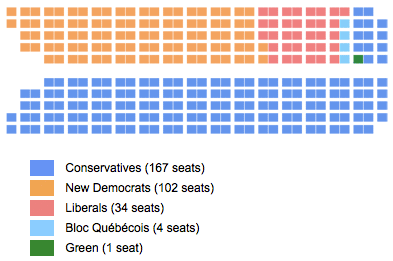
Canada 2011 Federal Election Seats
Canada 2011 Federal Election Results

Andrew sent me this article from the Chronicle Herald.

Excerpt:

To protect freedom of expression in Canada, sometimes you need a majority government in Ottawa.

That’s the moral of the story of a Conservative backbencher’s private member’s bill — which has now cleared second reading in the House of Commons and gone to committee — seeking to repeal Section 13 of the Canadian Human Rights Act.

Let’s recall the exact wording of that infamous clause. Hate messages, according to Section 13 (1), are communications “likely to expose a person or persons to hatred or contempt by reason of the fact that that person or those persons are identifiable on the basis of a prohibited ground of discrimination.”

In other words, if I were to write something critical about Islam, for example, and someone reading my column felt it “likely” that my words could provoke “contempt” towards Muslims, they could lodge a complaint against me with one of Canada’s government-created human rights commissions.

Truth would not be a defence. Neither would my intent. And the person complaining wouldn’t even have to be a Muslim.

That’s because, on top of the appallingly loose wording of this section of federal human rights law — a clause echoed in its provincial counterparts — any complaints are adjudicated by government-appointed tribunals, where the standard protections afforded any accused in a court of law don’t necessarily apply.

When complainants’ cases go forward, taxpayers pick up the tab. Meanwhile, those accused must pay to defend themselves out of their own pockets.

It’s a system ripe for abuse. And that’s exactly what has happened. We’ve seen comics fined for insulting hecklers (B.C. human rights tribunal), former publishers spend $100,000 in legal fees over three years to defend themselves for printing “offensive” cartoons (Alberta human rights commission), and Maclean’s magazine investigated by three human rights bodies (federal, Ontario and B.C.) for running an article on Muslim demographics in Europe.

The Conservatives have long opposed Section 13, but didn’t feel they had the support they needed from the other parties, as a minority government, to push the issue legislatively.

They also were concerned, with good reason, that some opponents might twist the issue for political advantage, slamming the Tories for being soft on hate.

Yes, Bill C-304, which aims to repeal Sections 13 and 54 (dealing with penalties under S.13), was put forward by Alberta MP Brian Storseth (Westlock-St. Paul) and is a private member’s bill, but the legislation has the justice minister’s endorsement. So there’s a good chance the bill will be back in the Commons this spring for final reading, then on to the Senate and, hopefully, passage and royal assent.

The bill, if made law, would take effect a year after receiving royal assent.

Canada does not protect free speech right now. Repealing Section 13 would be good, but Canada is not a good place for families to raise children. Even if they get Section 13 repealed, there is still the recent unanimous Supreme Court decision affirming that the provincial governments have a right to decide what children will believe – not parents. The Supreme Court was mostly selected by the previous Liberal governments.