Tag Archives: Health-care

New study: Angus Reid Institute analyzes Canada’s single payer healthcare system

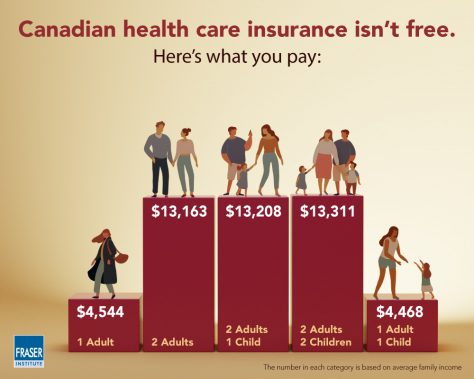
Price of healthcare per Canadian household (Source: Fraser Institute)
The cost of healthcare for average Canadian households

I found two interesting studies from Canada’s Angus Reid Institute describing single payer health care in Canada. I’m very interested in find out what things are like in countries that have true government-run health care. A typical Canadian family pays $13,000+ per year per household for healthcare, or about $585,000 over their working lives. What are they getting for all that money?

Here is the first Angus Reid article:

The study finds more than 2 million Canadians aged 55 and older face significant barriers when accessing the health care system in their province, such as being unable to find a family doctor or experiencing lengthy wait-times for surgery, diagnostic tests, or specialist visits.

Moreover, most Canadians in this age group have at least some difficulty getting the care they want or need in a timely manner.

The study focuses on the health care experiences of older Canadians, as well as their assessments of the quality of care they receive.

According to the article, 31% of respondents (aged 55 and older) rated access to the government’s healthcare system as “easy”. 48% had “moderate” problems with access, and 21% had “major” problems with access.

Remember: in the Canadian system, you pay your money up front in taxes, and then they decide how much healthcare you will get later – and how soon you will get it. If you worked from ages 20 to age 65, then your household will have paid 45 x $13,000 = $585,000 into the system, in order to get “moderate” problems with accessing healthcare after you’re aged 55.

And the Canadian system DOES NOT cover prescription drugs.

The second Angus Reid article explains:

This second part of the study finds one-in-six Canadians (17%) in the 55-plus age group – a figure that represents upwards of 1.8 million people – say that they or someone else in their household have taken prescription drugs in a way other than prescribed because of cost.

One-in-ten (10%) have decided to simply not fill a prescription because it was too expensive, and a similar number (9%) have decided not to renew one for the same reason. One-in-eight (12%) have taken steps to stretch their prescriptions, such as cutting pills or skipping doses.

Some 17 per cent of Canadians 55 and older have done at least one of these things, and that proportion rises among those who have greater difficulty accessing other aspects of the health care system.

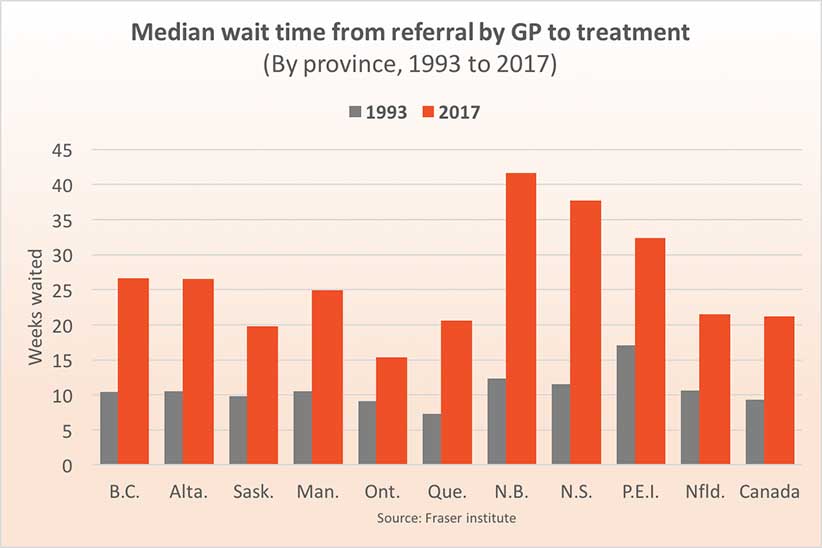
In a previous blog post, I reported on how Canadians have to wait in order to see their GP doctor. If that doctor refers them to a specialist, then they have to wait to see the specialist. And if that specialist schedules surgery, then they have to wait for their surgery appointment. The delays can easily go from weeks to months and even years. The MEDIAN delay from GP referral to treatment is 19.5 weeks.

But remember – they paid into the system FIRST. The decisions about when and if they will be treated are made later, by experts in the government. This is what it means for a government monopoly to run health care. There are no free exchanges of money for service in a competitive free market. Costs are controlled by delaying and withholding treatment. And no one knows this better than elderly Canadians themselves. But by the time they realize how badly they’ve been swindled, it’s too late to get their money back out. You can’t pull your tax money out of government if you are disappointed with the service you receive. There are no refunds. There are no returns.
How well is Canada’s “Medicare for All” health care working for patients?

Wait times in weeks (Source: Maclean's magazine)
Wait times for health care treatment in Canada (Source: Fraser institute)

I get into conversations about politics with my co-workers about who they like in the 2020 election. And I also ask them which particular policies of the candidates they like best. The one they like most is Medicare for All, with “for All” including illegal immigrants. When I ask them which country has got Medicare for All working, they say “Canada”. Let’s take a look at Canada’s health care system.

Here’s a nice article from Mona Charen, posted in TownHall.

She writes:

It’s true that all Canadian citizens and legal residents (though not immigrants there illegally) get “free” health care, but only in the sense that you don’t get a bill after seeing a doctor or visiting a hospital. Medical care is subsidized by taxes, but the price comes in another form as well — rationing. A 2018 report from the Fraser Institute, a Canadian think tank, found that wait times between seeing a general practitioner and a specialist average 19.8 weeks. That’s the average. There are variations among specialties. Those hoping to see an orthopedist wait an average of 39 weeks in Nova Scotia, while those seeking an oncologist wait about 3.8 weeks.

[…]Imagine the anxiety of learning that you need an MRI to find out whether the mass in your breast is anything to worry about and then being told that the next available appointment is in 10 weeks. In addition to the psychic price, Canadians who had to wait for treatment expended an average of $1,822 out of pocket last year, due to lost wages and other costs. The Fraser Institute also calculated the value of the lost productivity of those waiting for treatment — nearly $5,600 per patient, totaling $5.8 billion nationally.

[…]When there’s an artificial shortage of a good or service, a black market usually follows. I have heard from several Canadians that paying doctors bribes to jump the line is not uncommon. But Canada has another pressure reliever: Ninety percent of Canadians live within 90 miles of the U.S. border, and medical centers in Buffalo, Chicago, Rochester and elsewhere receive tens of thousands of Canadian patients every year.

Regarding that last point, I’ve written many times about socialist politicians in Canada electing to travel to the United States for care, and that’s because (as you might expect) health care outcomes for Canadians are vastly inferior to health care outcomes for Americans. And keep in mind that the delay from specialist to GP does not take into account the delay to see the GP, or the delay from seeing the specialist to actually getting treatment.

And how much are Canadians spending for the privilege of waiting 19.8 weeks to see a specialist? Well, the average cost of Canadian health care is about $13,000 per household per year, paid through taxes. What that means is that people who work pay for all the health care being provided, including the health care for people who don’t work. But when it’s time to get treatment, those who pay the bills get in line behind those who don’t pay anything.

So how good is American health care? Maybe Canadians are waiting in line because their health care is so much better than ours.

American health care

One of the best health care policy experts writing today is Avik Roy, who writes for Forbes magazine.

Here is a recent column, which I think is useful for helping us all get better at debating health care policy.

Excerpt:

If you really want to measure health outcomes, the best way to do it is at the point of medical intervention. If you have a heart attack, how long do you live in the U.S. vs. another country? If you’re diagnosed with breast cancer? In 2008, a group of investigators conducted a worldwide study of cancer survival rates, called CONCORD. They looked at 5-year survival rates for breast cancer, colon and rectal cancer, and prostate cancer. I compiled their data for the U.S., Canada, Australia, Japan, and western Europe. Guess who came out number one?

The United States came out number one, and you can click here to see the larger graph of the complete results.

Some people like to point out that the United States has a low life expectancy, but there’s a problem with those numbers.

The article continues:

Another point worth making is that people die for other reasons than health. For example, people die because of car accidents and violent crime. A few years back, Robert Ohsfeldt of Texas A&M and John Schneider of the University of Iowa asked the obvious question: what happens if you remove deaths from fatal injuries from the life expectancy tables? Among the 29 members of the OECD, the U.S. vaults from 19th place to…you guessed it…first. Japan, on the same adjustment, drops from first to ninth.

It’s great that the Japanese eat more sushi than we do, and that they settle their arguments more peaceably. But these things don’t have anything to do with socialized medicine.

Finally, U.S. life-expectancy statistics are skewed by the fact that the U.S. doesn’t have one health-care system, but three: Medicaid, Medicare, and private insurance. (A fourth, the Obamacare exchanges, is supposed to go into effect in 2014.) As I have noted in the past, health outcomes for those on government-sponsored insurance are worse than for those on private insurance.

To my knowledge, no one has attempted to segregate U.S. life-expectancy figures by insurance status. But based on the data we have, it’s highly likely that those on private insurance have the best life expectancy, with Medicare patients in the middle, and the uninsured and Medicaid at the bottom.

If we’re going to discuss health care, then let’s discuss facts. We shouldn’t be picking a health care system from the campaign speeches of politicians who tell us that we can keep our doctor, and keep our health plan, and our premiums will go down. We tried electing a charismatic deceiver in 2008, and it didn’t work out. We lost our doctors, lost our health plans, and our premiums went up astronomically. We can do better than single-payer health care. We can do better than socialism.

Who is better on health care? Republicans (Ted Cruz) or Democrats (Bernie Sanders)?

I noticed that the Democrats are trying to focus on health care in the 2018 mid-terms, so I thought I would re-post a debate on health care between Ted Cruz and Bernie Sanders. I think debates are always a good idea, because you have to listen to both sides. If you can’t watch the full debate, there’s a good article summarizing the main points further down.

Here is the full video:

It’s 90 minutes long. No commercials. This was basically a debate of similar substance to the William Lane Craig debates, where actual economic evidence was continuously produced in order to show who was telling the truth, and who was just trying to be popular by saying what people who are uneducated at economics want to hear. In short: there was a clear winner and loser in this debate, and it was clear all the way through, and was reinforced over and over every time evidence was produced. The person producing the evidence would turn his back on the camera, and return to his podium to get the evidence. That person won the debate by being grounded in reality.

Also, the questions were excellent, especially from the small business owners who were impacted by Obamacare. The moderators were biased towards Sanders, but not excessively.

For those who cannot watch, there is an article at the Daily Signal.

Full text:

In a prime-time debate on CNN this week, Sens. Bernie Sanders, I-Vt., and Ted Cruz, R-Texas, discussed “The Future of Obamacare” in America. Cruz, a leading critic of the law, used the moment to outline the law’s failures.

Here are four things Cruz said about Obamacare:

1) “Now, nobody thinks we’re done once Obamacare is repealed. Once Obamacare is repealed, we need commonsense reform that increases competition, that empowers patients, that gives you more choices, that puts you in charge of your health care, rather than empowering government bureaucrats to get in the way. And these have been commonsense ideas.”

2) “Indeed, I don’t know if the cameras can see this, but in 70 percent of the counties in America, on Obamacare exchanges, you have a choice of one or two health insurance plans, that’s it … It’s interesting. You look at this map, this also very much looks like the electoral map that elected Donald Trump. It’s really quite striking that the communities that have been hammered by this disaster of a law said enough already.”

During one of the more powerful moments in the debate, Cruz held up aHeritage Foundation chart showing viewers how many counties in the U.S. have access to only one or two insurers under Obamacare. Additionally, only 11 percent of counties have access to four or more insurance providers.

3) “Whenever you put government in charge of health care, what it means is they ration. They decide you get care and you don’t. I don’t think the government has any business telling you you’re not entitled to receive health care.”

The U.S. should not envy other health care systems, especially Canada and the United Kingdom, Cruz said. He referred to a governor from Canada who came to the U.S. specifically to have heart surgery.

4) “That’s why I think the answer is not more of Obamacare, more government control, more of what got us in this mess. Rather, the answer is empower you. Give you choices. Lower prices. Lower premiums. Lower deductibles. Empower you and put you back in charge of your health care.”

Obamacare is burdening Americans. The average deductible for a family on a bronze plan is $12,393, according to a HealthPocket analysis. According to aneHealth report, the average nationwide premium increase for individuals is 99 percent and 140 percent for families from 2013-2017.

I really recommend you watch this debate, because it these things were done on a weekly or monthly basis, then people would be able to think critically about what they are presented with from the mainstream media, Hollywood elites and liberal academics.