
Tag Archives: Harvard University

A Harvard University student explains how evidence changed her mind about God

Here’s a must-read article  about the effectiveness of apologetics on college campuses in Christianity Today. (H/T Sanjay M.)

Excerpt:

I don’t know when I first became a skeptic. It must have been around age 4, when my mother found me arguing with another child at a birthday party: “But how do you know what the Bible says is true?” By age 11, my atheism was so widely known in my middle school that a Christian boy threatened to come to my house and “shoot all the atheists.” My Christian friends in high school avoided talking to me about religion because they anticipated that I would tear down their poorly constructed arguments. And I did.

As I set off in 2008 to begin my freshman year studying government at Harvard (whose motto is Veritas, “Truth”), I could never have expected the change that awaited me.

It was a brisk November when I met John Joseph Porter. Our conversations initially revolved around conservative politics, but soon gravitated toward religion. He wrote an essay for the Ichthus, Harvard’s Christian journal, defending God’s existence. I critiqued it. On campus, we’d argue into the wee hours; when apart, we’d take our arguments to e-mail. Never before had I met a Christian who could respond to my most basic philosophical questions: How does one understand the Bible’s contradictions? Could an omnipotent God make a stone he could not lift? What about the Euthyphro dilemma: Is something good because God declared it so, or does God merely identify the good? To someone like me, with no Christian background, resorting to an answer like “It takes faith” could only be intellectual cowardice. Joseph didn’t do that.

And he did something else: He prodded me on how inconsistent I was as an atheist who nonetheless believed in right and wrong as objective, universal categories. Defenseless, I decided to take a seminar on meta-ethics. After all, atheists had been developing ethical systems for 200-some years. In what I now see as providential, my atheist professor assigned a paper by C. S. Lewis that resolved the Euthyphro dilemma, declaring, “God is not merely good, but goodness; goodness is not merely divine, but God.”

Joseph also pushed me on the origins of the universe. I had always believed in the Big Bang. But I was blissfully unaware that the man who first proposed it, Georges Lemaître, was a Catholic priest. And I’d happily ignored the rabbit trail of a problem of what caused the Big Bang, and what caused that cause, and so on.

By Valentine’s Day, I began to believe in God. There was no intellectual shame in being a deist, after all, as I joined the respectable ranks of Thomas Jefferson and other Founding Fathers.

I wouldn’t stay a deist for long. A Catholic friend gave me J. Budziszewski’s book Ask Me Anything, which included the Christian teaching that “love is a commitment of the will to the true good of the other person.” This theme—of love as sacrifice for true good—struck me. The Cross no longer seemed a grotesque symbol of divine sadism, but a remarkable act of love. And Christianity began to look less strangely mythical and more cosmically beautiful.

Now, I’m going to get into a lot of trouble for saying this, but I think that if you are a Christian and you are in a secular university, then you really need to have put in the effort to study the areas of science, history and philosophy that are relevant to the Christian faith. This is regardless of your personal abilities or field of study. We must all make an effort regardless of how comfortable we are with things that are hard for us to learn.

Granted, most atheists are not interested in truth, because they tend to jettison truth whenever it conflicts with their personal autonomy – their desire to seek pleasure apart from moral constraints. But there is another kind of atheist. This kind of atheist is honest, open-minded, and they just have never encountered any good reasons or evidence to think that God exists and that Jesus is anything other than a man. There are a lot of atheists like that who are just waiting to hear some decent evidence. Our job is to prepare for them and then engage them, if they are willing to be engaged.

I think that definition of love she cited – self-sacrifice for the true good of another person – is important. I don’t think that ordinary Christians like you or me spends time on apologetics because we “like” it. I know lots of Christians who are in tough, expensive academic programs trying to get the skills they need to defend truth in areas that matter. They do this because they know that there are people out there who are interested in truth, and who are willing to re-prioritize their lives if the truth is made clear to them. We need to be willing to serve God by doing hard things that work.
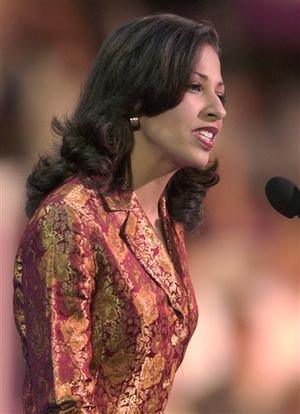
Erika Harold: Harvard law graduate and former Miss America runs for Congress

Republican candidate Erika Harold

The Weekly Standard reports.

Excerpt:

The most interesting House primary of the 2014 cycle began in June in the 13th District of Illinois. It pits freshman Republican congressman Rodney Davis against an insurgent candidate named Erika Harold. Davis is a political operative who won his seat last year nearly by accident. Erika Harold is a 33-year-old lawyer. Who happens to have been Miss America.

[…]In addition to the charisma and poise native to good politicians, Harold has exhibited the principled toughness of the best pols. And again, to appreciate this aspect of her character, you need only go back to Miss America.

Her platform as a Miss America candidate included abstinence:

Harold competed three times for the Miss Illinois crown, which she finally won in 2003. Each time, she ran on a platform of abstinence. But one of the arcane traditions of Miss America is that while contestants choose their own platforms when competing for the state crown, it’s the state organization that decides what platform the winner will take to Atlantic City. The year Harold was named Miss Illinois, her state committee settled on a bland platform opposing “youth violence.” (Think of it as “world peace,” for the children.) Harold agreed to oppose youth violence.

After she was named Miss America, however, Harold decided to add abstinence to her platform for the year of her reign. She didn’t abandon “youth violence” but rather included it, along with abstinence, in a broad appeal to kids to respect themselves by standing up to bullies and avoiding sex, drugs, and alcohol. This was, as a matter of both intellectual coherence and moral sense, a significant improvement on the pure “youth violence” platform she’d been handed. The Miss America organization did not like it one bit.

The organization pushed back hard and told Harold to keep quiet—especially about sex. The disagreement made national headlines and culminated in a news conference at the National Press Club in Washington, where the newly crowned Harold told reporters, “I will not be bullied. I’ve gone through enough adversity in my life to stand up for what I believe in.” Miss America stared down the pageant and won.

Promotes fiscal conservativism to African Americans:

Harold was already interested in politics. During a Miss America appearance at East St. Louis High School, students asked her what she wanted to be when she grew up. She told them, “My ultimate goal is that I want to be the first black female president of the United States.” While still an undergraduate at Illinois, she volunteered for conservative Patrick O’Malley’s doomed 2002 Illinois gubernatorial campaign. She also volunteered with the Republican National Committee in an effort to promote conservative economic principles in African-American communities. After graduating from law school, she joined a Chicago firm where her practice has specialized in health care law and religious freedom.

[…][W]hile Harold tries to resist easy classification, her ideological markers are highly suggestive of a conservative worldview. There’s the abstinence, of course. She’s fiercely pro-life. She favors concealed-carry gun laws. And she’s on the board of Prison Fellowship Ministries, the program founded by Chuck Colson.

Focused on religious liberty:

The most interesting part of Harold’s legal practice has been her work defending faith-based entities. In one case, for example, she represented a retirement community affiliated with a religious group. The organization featured a cross on its logo and used a Bible verse in its mission statement—which attracted a lawsuit from an advocacy group contending that this amounted to discrimination. Describing this work, Harold says, “It’s a passion of mine.”

Looking across the broader national landscape, Harold sees ample reason to be concerned about religious freedom. “We’re starting to see ways in which our constitutional protections are being encroached upon,” she says. “We all are less free when any group isn’t afforded their constitutional protections.”

And not just less free, but less well off. Harold says that her time with Prison Fellowship Ministries has deepened her appreciation for the good religious organizations can do. “I’ve seen firsthand the need for there to be a space in public life for religious groups to be able to offer service to their fellow man,” she says. When government seeks to quarantine religious organizations, moving from freedom of religion to “freedom of worship” (to use the formulation President Obama favors), “it’s far too limiting in terms of the good they can do for the public, and it’s far too restrictive in terms of the protections which are afforded religious groups by the Constitution. We give something up when we say that certain voices aren’t welcome in the public square.”

Harold says she intends to make religious freedom an issue in her campaign. This is fitting at a time when the HHS mandate, the Hobby Lobby case, and the torrent of litigation about to be unleashed by the Supreme Court’s gay marriage decisions appear likely to make religious freedom a central front in the culture war.

We have such a deep bench, so there’s reason for optimism – if you’re a Republican like me! Here’s another story I found about another young, female Republican candidate Elise Stefanik. I would not be annoyed at all if all of our candidates were women or minorities or minority women. I wouldn’t even be annoyed if our candidates were some sort of dolphin-alligator hybrid monstrosities, (although I prefer pretty lawyers ladies). The main thing I want is that our candidates are conservative. That’s what really matters to me.

A Harvard University student explains how evidence changed her mind about God

Here’s a must-read article  about the effectiveness of apologetics on college campuses in Christianity Today. (H/T Sanjay M.)

Excerpt:

I don’t know when I first became a skeptic. It must have been around age 4, when my mother found me arguing with another child at a birthday party: “But how do you know what the Bible says is true?” By age 11, my atheism was so widely known in my middle school that a Christian boy threatened to come to my house and “shoot all the atheists.” My Christian friends in high school avoided talking to me about religion because they anticipated that I would tear down their poorly constructed arguments. And I did.

As I set off in 2008 to begin my freshman year studying government at Harvard (whose motto is Veritas, “Truth”), I could never have expected the change that awaited me.

It was a brisk November when I met John Joseph Porter. Our conversations initially revolved around conservative politics, but soon gravitated toward religion. He wrote an essay for the Ichthus, Harvard’s Christian journal, defending God’s existence. I critiqued it. On campus, we’d argue into the wee hours; when apart, we’d take our arguments to e-mail. Never before had I met a Christian who could respond to my most basic philosophical questions: How does one understand the Bible’s contradictions? Could an omnipotent God make a stone he could not lift? What about the Euthyphro dilemma: Is something good because God declared it so, or does God merely identify the good? To someone like me, with no Christian background, resorting to an answer like “It takes faith” could only be intellectual cowardice. Joseph didn’t do that.

And he did something else: He prodded me on how inconsistent I was as an atheist who nonetheless believed in right and wrong as objective, universal categories. Defenseless, I decided to take a seminar on meta-ethics. After all, atheists had been developing ethical systems for 200-some years. In what I now see as providential, my atheist professor assigned a paper by C. S. Lewis that resolved the Euthyphro dilemma, declaring, “God is not merely good, but goodness; goodness is not merely divine, but God.”

Joseph also pushed me on the origins of the universe. I had always believed in the Big Bang. But I was blissfully unaware that the man who first proposed it, Georges Lemaître, was a Catholic priest. And I’d happily ignored the rabbit trail of a problem of what caused the Big Bang, and what caused that cause, and so on.

By Valentine’s Day, I began to believe in God. There was no intellectual shame in being a deist, after all, as I joined the respectable ranks of Thomas Jefferson and other Founding Fathers.

I wouldn’t stay a deist for long. A Catholic friend gave me J. Budziszewski’s book Ask Me Anything, which included the Christian teaching that “love is a commitment of the will to the true good of the other person.” This theme—of love as sacrifice for true good—struck me. The Cross no longer seemed a grotesque symbol of divine sadism, but a remarkable act of love. And Christianity began to look less strangely mythical and more cosmically beautiful.

Now, I’m going to get into a lot of trouble for saying this, but I think that if you are a Christian and you are in a secular university, then you really need to have put in the effort to study the areas of science, history and philosophy that are relevant to the Christian faith. This is regardless of your personal abilities or field of study. We must all make an effort regardless of how comfortable we are with things that are hard for us to learn.

Granted, most atheists are not interested in truth, because they tend to jettison truth whenever it conflicts with their personal autonomy – their desire to seek pleasure apart from moral constraints. But there is another kind of atheist. This kind of atheist is honest, open-minded, and they just have never encountered any good reasons or evidence to think that God exists and that Jesus is anything other than a man. There are a lot of atheists like that who are just waiting to hear some decent evidence. Our job is to prepare for them and then engage them, if they are willing to be engaged.

I think that definition of love she cited – self-sacrifice for the true good of another person – is important. I don’t think that ordinary Christians like you or me spends time on apologetics because we “like” it. I know lots of Christians who are in tough, expensive academic programs trying to get the skills they need to defend truth in areas that matter. They do this because they know that there are people out there who are interested in truth, and who are willing to re-prioritize their lives if the truth is made clear to them. We need to be willing to serve God by doing hard things that work.