Tag Archives: Greece

Moody’s downgrades credit rating of 26 Italian banks, Spain is next

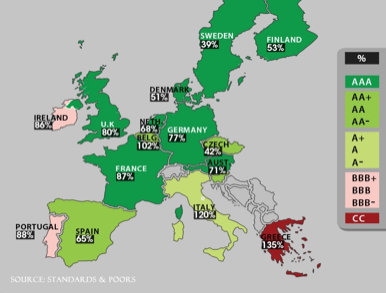
European Debt to GDP and Credit Rating

From Yahoo News.

Excerpt:

Moody’s Investors Service has downgraded the ratings on 26 Italian banks as they struggled with the effect of government austerity measures.

The rating agency said Monday that the banks are suffering because Italy is back in recession and government austerity measures are cutting demand for loans.

The banks are struggling with more loan losses, limited access to funding and weaker profits.

Moody’s noted that support of the European Central Bank lowered the default risk of many banks.

Its outlook for all 26 banks is negative.

From the Wall Street Journal.

Excerpt:

The ratings for Italian banks are now among the lowest within advanced European countries, reflecting these banks’ susceptibility to the adverse operating environments in Italy and Europe, Moody’s said in a statement. Two of the country’s largest institutions, UniCredit SpA (UCG.MI, UNCFF) and Intesa Sanpaolo SpA (ISP.MI, ISNPY), were included.

Moody’s move came hours after the firm raised an alarm on Spain, arguing the country’s banks remain vulnerable even after Madrid moved to increase the banks’ cushions against potential losses from real-estate loans.

[…]Italy, saddled with EUR1.9 trillion ($2.44 trillion) debt, has signed onto the EU’s fiscal compact that sets strict limits on the country’s deficit levels. In recent weeks, Mr. Monti has begun pressing Germany to give Italy more fiscal slack to stimulate its economy and create jobs. Mr. Monti has recently proposed that the EU create special exemptions to the budget rules when countries target their public spending on projects like broadband investments and infrastructure.

Moody’s downgrades come after the ratings firm in February placed various ratings of 114 financial institutions in 16 European countries on review for possible downgrade, highlighting the region’s banks’ vulnerability to the euro-zone sovereign debt crisis.

Moody’s is expected to follow the downgrade of Italian banks by cutting the ratings of Spanish banks. By the end of June, more than 100 European banks, as well as Wall Street giants like Bank of America Corp. (BAC) and Citigroup Inc. (C), are likely to have ratings that are at least one notch lower.

[…]Moody’s also alluded to J.P. Morgan Chase & Co.’s (JPM) recent disclosures of more than $2 billion in trading losses as a reminder of potential problems lurking at some European banks.

“Recent events highlight the risks for creditors from potential weaknesses in governance, controls and risk management, especially at some smaller, privately-held banks,” Moody’s said in its news release.

Moody’s says it will conclude its reviews by the end of June. In coming weeks, major U.S. financial institutions, Bank of America Corp., Citigroup Inc., Goldman Sachs and Morgan Stanley are likely to face downgrades.

Banks in Austria and Sweden are expected to see downgrades after Spain.

Italy’s debt is $2.44 trillion, ours is nearly $16 trillion.

Greece and France vote against fiscal responsibility

Greece is the most fiscally irresponsible country in Europe. Recently, their socialist government has been receiving bailouts from the  more responsible nations of the EU, especially Germany. These bailouts have come with the requirement that austerity measures be imposes. The spoiled Greeks have now voted against austerity measures, which will certainly imperil future bailouts, and will probably lead to the collapse of Greece and its withdrawal from the European Union.

Here’s a story that explains what happened on the weekend.

Excerpt:

The two mainstream parties that approved the second international £110 billion rescue loan and its stringent requirements for cuts were heavily punished as support surged for the Left and Right.

The shattering of the political status quo threw into doubt Greece’s commitment to meeting the terms of its debt and could spread instability throughout the euro zone.

Weeks of uncertainty are likely to follow as numerous parties vie to cobble a majority coalition, with a fresh election within two months a distinct possibility.

There will also be fears that ensuing political instability will see a return to the street violence that has scarred Athens since the debt crisis surfaced two years ago.

Exit polls said the conservative monolith New Democracy would finish first with a maximum of 20 per cent, while Pasok, the main socialist party, would suffer a dramatic fall to 13-14 percent, a third of what it received when winning the 2009 election. Voters held both responsible for years of mismanagement and corruption.

[…]Greeks angry at record unemployment, collapsing businesses and steep wage cuts ignored warnings that a vote against the harsh terms of the bailout would push Greece towards bankruptcy.

“The exit polls confirm what has been patently clear for some time: there’s no political consensus for the kind of reforms that Greece must implement if it wants to remain in the euro zone,” said Nicholas Spiros of Spiro Sovereign Strategy.

Othon Anastasakis, director of southeast European studies at Oxford University told Reuters: “Greeks are sending a very strong message abroad, which is enough with austerity.”

As they voted, many Greeks expressed their rage at the parties who accepted the harsh conditions of two bailouts that have kept the country from bankruptcy.

“My vote was a protest vote because they cut my pension,” said 75-year-old pensioner Kalliopi, her fists clenched in anger. “I live in a basement but pay the same (property) tax as someone who lives in a penthouse,” said Kalliopi after voting.

“I voted for Left Coalition, even if this means elections again in a month. I feel vindicated, things are changing little by little because people decided to speak up,” said 22-year-old student Klelia Avgerinopoulou.

[…]International lenders and investors fear success for the small anti-bailout parties could lead to Greece reneging on the harsh terms of the program, risking a hard sovereign default and dragging the euro zone back into the worst crisis since its creation.

Euro zone paymaster Germany has warned there would be “consequences” to an anti-bailout vote and the EU and IMF insist whoever wins the election must stick to austerity if they want to receive the aid that keeps Greece afloat.

What is most disturbing to me are the quotations from Greek citizens. Their knowledge of economic policy seems to be limited to that of spoiled children.

“The politicians who got us into this mess continue to mock us. Neither of them will do anything, all they are interested in is pulling the wool over our eyes so they can get into power again,” said Yiorgos Vrassidis, 55, after casting his vote at a “Voting for them would be like committing national suicide.”

He opted for the anti-austerity Syriza, an acronym for Coalition of the Radical Left, which shocked political observers by heading for second place. Three years ago it received just a few percent.

[…]Yianna Kiritsi, who was made redundant 18 months ago, said: “I want Greek people to decide for themselves, not the troika to decide for us. They make decisions for everybody. We are not allowed to take decisions.” Greeks routinely and derisively refer to the EU, International Monetary Fund and the European Central Bank which imposed the debt terms as “the troika”.

Dimitris Davos, a Communist voter, said: “We have to restore our dignity and national sovereignty. This election in Greece will send a strong message from the south of Europe to the rest that we can’t take any more pain. We need to be rid of these loan sharks and bankers.”

France also had elections, and they are taking the same anti-austerity (anti-reality) stance.

Excerpt:

 On Sunday night Mr Hollande had won 51.56 per cent of the vote compared to Mr Sarkozy’s 48.41 per cent with 90 per cent of the ballots counted.

Over 100,000 jubilant supporters gathered at Paris’s revolutionary Place de la Bastille, a pilgrimage site for the Left, chanting “François President”.

Many were too young to remember that it was here that a gigantic crowd gathered for the 1981 victory of the last Socialist president, François Mitterrand.

But even as the festivities got under way, officials close to both Mr Hollande and Mr Sarkozy were fearful of a market backlash against the Socialist’s plans to tax the wealthy and expand jobs in the state sector.

There are concerns that Mr Hollande will be unable to respect fiscal discipline targets while enacting a tax — and-spend programme that would see him create 60,000 more state education posts, partly revoke a pension reform and slap a 75 per cent tax on millionaire owners.

A senior Conservative source told The Daily Telegraph that fears France was about to reverse course would cause turmoil and uncertainty.

He said: “Clearly it’s going to focus a lot of market attention on the French public finances, which are nothing to write home about. I don’t think it is going to make life in the bond markets any easier next week.

“We haven’t chosen austerity because it’s fun. We have to do austerity, and so does France.

“He will have to be very careful about his public spending commitments and the lack of welfare reform.”

So the grown-ups have been voted out and the children are now in power. European voters want their ice cream, and they want it now, and they don’t want to have to behave to get it. How money is earned, how goods and services are produced, and how prices are set, etc. are all irrelevant to them. They have no idea why their goodies are being taken away, and they are having a tantrum.

Europe’s socialist debt crisis: who suffers most? Can bailouts fix it?

This is the most popular article on Investors Business Daily right now.

Excerpt:

Rational or not, Greece’s street riots and emigration rates signify one thing: Socialism offers very little to the young. So why is the EU’s $172 billion bailout geared toward saving so much of the failed socialist system?

As Europe prepares to deliver a historic $172 billion bailout to Greece in a deal announced Monday, it’s pretty much a given that the austerity conditions required, in the absence of a true free market, will hit youth hardest. Athens will be trashed by another youth rampage, as many youths blame the pain on something other than Greece’s deeply rooted socialism.

A bigger effect will come from Greeks who do recognize reality. They won’t riot. They’ll leave, voting with their feet just as Eastern Europe’s youth once did.

The young in both cases are victims of socialism, which claims to make people equal but, in reality, penalizes the young. For Greece, a country already gutted by a below-replacement birth rate and an aging population, that’s a disaster.

It’s not just Greece, but also every EU state with institutionalized socialism — where high government spending seeks to create a warm blanket insulating everyone from risk, but instead has led to bankruptcy.

[…]One out of five jobs in Greece is held by a bureaucrat, which is why unemployment among the under-24s runs at 42%. A 2010 poll shows that seven out of 10 Greek college graduates seek to leave.

Some 9% of Greek college graduates and at least 51% of Greece’s Ph.D.s are already gone, according to University of Macedonia demographer Lois Lambrianidis.

What jobs there are come from the bottom of a two-tier labor system that shields older workers in Greece’s rigid labor market. Young Greeks earn a 500-and-change euro monthly minimum wage as older workers doing the same work make 700.

In contrast, immigrant-magnet Australia holds packed job fairs at its Athens embassy. In 2011, it took in 249,000 immigrants. In 2012, a 20% rise is expected.

[…]Meanwhile, Spain’s EFE News reports that the Spanish Embassy in Santiago, Chile, has seen a 10% rise in registered nationals to 48,000, while Chile reports a 25% rise in work permits issued to Spanish citizens.

It’s not just jobs that are penalizing Europe’s young. Housing is stacked against youth, too. Eurostat reports that in 2008, 46% of young European adults ages 18-34 lived with their parents — 51 million people.

The two-tier job market, which leans heavily toward unstable contract employment, affects housing choices for the young. Other socialist measures designed to protect current owners against the market also shut out the young.

Perhaps most hostile of all to youth are the EU’s outdated state pension systems — which force the young to pay the pensions of the old as the population shrinks.

In Italy, 14% of all economic output goes to pensions. It’s no coincidence that states attracting Europe’s young, like Chile and Australia, have privatized their social security systems that give youth a real shot at building personal wealth and a credible pension through their own efforts, instead of political favoritism.

This is the direction that the United States is also headed in. What I find mystifying is why young people in the United States are voting for these policies. Young people here have a higher rate of unemployment, and they ought to know that all of these entitlement programs won’t be there for them when they retire. What possible reason could they have for voting for more and more government control?