Tag Archives: Governor

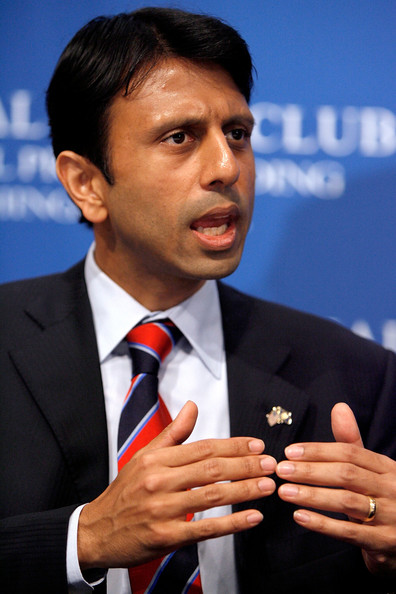
Bobby Jindal cuts Louisiana budget by 25%… and gets re-elected in landslide?

Gov. Bobby Jindal
Gov. Bobby Jindal

From the Philadelphia Inquirer.

Excerpt:

One gubernatorial election ended early this fall, when Louisiana Gov. Bobby Jindal won the state’s blanket primary Oct. 22. Under Louisiana’s system, all candidates of all parties are listed on the ballot, and if no one gets 50 percent, the top two finishers go to a runoff. Jindal blew past the threshold with 66 percent.

Jindal’s reelection was unusual in several respects. The only previous time the state has not had a runoff was his election in 2007. He is only the fourth Republican governor in the last 125 years in Louisiana, and one of those four switched over from the Democrats in office. Jindal’s best-known challenger this year was a schoolteacher, who raised less than 1 percent of the incumbent’s campaign treasury. The Democratic State Central Committee declined to endorse any candidate running on its party label.

But perhaps most unbelievable is that Jindal faced no serious competition after cutting state spending more than 25 percent. In January 2008, the state had a budget of $34.3 billion. This summer, Jindal signed into law a budget spending $25 billion. As governors from Harrisburg to Trenton to Columbus to Madison have learned, cutting a state’s budget is difficult enough; doing so without a significant backlash seems a politically impossible task.

A key part of Jindal’s story is recognizing that he took the helm of a state that had hit bottom: Decades of mismanagement and corruption had taken their toll even before Hurricane Katrina wreaked such devastation and exposed such colossal unresponsiveness in state government. The state, recognizing the bitter fruit of its traditions of colorful corruption, was ready to take a chance on a then-37-year-old Indian American congressman who speaks roughly 100 words per minute. The state was willing to try a new approach to governing; how much worse could it be?

Privatization played a big role in Jindal’s reinvention of state government, with private contractors taking over state-run operations for a lesser cost. The companies often hired the state workers who would often be the centerpiece of opponents’ criticism.

His administration privatized the state’s Office of Risk Management. Then the state’s Division of Administration privatized claims management and loss prevention in the self-insurance program, saving $20 million over five years. The Department of Health and Hospitals privatized six inpatient, residential-treatment programs around the state, saving $2.5 million. Separately, patients were moved from state-operated institutions that cost $600 or more per patient per day to community-based services and private group homes that average $191 per day, saving an additional $23.8 million.

Consolidation was another key element: The state’s Department of Revenue shrank from eight offices statewide to three. The Department of Children and Family Services consolidated its offices from 157 to 90, saving a total of $2.7 million.

But some of Jindal’s cuts are the old-fashioned kind. The state sold 1,300 vehicles from its fleet of automobiles. Louisiana’s Transportation Department shut down a ferry that was used by only 7,200 drivers per year, saving the state roughly three-quarters of a million dollars.

In fiscal 2011, Louisiana eliminated more than 3,500 full-time government positions. Add the 6,363 previous reductions during Jindal’s term, and that means a total of almost 9,900 full-time positions reduced since he took the oath, a savings of almost $600 million. Louisiana now has the lowest level of full-time state government employees in almost 20 years.

“You change people’s expectations and you make structural changes,” Jindal said, while racing around the state about three weeks before the election. “The most important is this cultural change, to say government is not the answer to everything. In a weird way, I want the office of governor to be less important than it is. What I mean by that is, there was an old joke that kids in Louisiana don’t grow up wanting to be president; they grow up wanting to be governor. You should want them to want to business leaders or doctors or teachers.”

Some cuts were more noticeable to the public, but Louisianans found shorter hours and workweeks at state facilities more palatable than complete shutdowns or higher taxes: Historic sites are now open five days a week instead of seven, pools at a half dozen state parks were closed on Mondays and Tuesdays this summer, and entrance stations at all state parks had shorter hours. Finally, 54,000 rank-and-file state workers are going without a raise for the second consecutive year.

Jindal’s first term was marked by several high-profile crises he successfully managed – Hurricane Gustav and the response to the BP oil spill, along with the Obama administration’s six-month moratorium on all drilling in the Gulf of Mexico – but the state’s economy has generally chugged along: Louisiana’s unemployment rate is 7.1 percent, two percentage points lower than the national average, and a comparably booming economy makes cuts in state spending much easier to take.

“If you have a good-paying job with benefits, you wouldn’t need the state to do so many things for you,” Jindal says. “You become less dependent, and that diminishes the role of the state and so you need fewer state employees, and it’s a virtuous cycle. You can lower taxes and lower government spending.”

Louisiana is a swing state. If Bobby Jindal can cut government spending in a swing state and get re-elected with 66% of the vote, then we do have hope that the American people will do the right thing. Maybe we just need to hit bottom with Obama so that we realize that competence does matter after all. We have a deep, deep bullpen for future elections. Governors like Scott Walker (Wisconsin), Rick Scott (Florida) and John Kasich (Ohio)would be excellent presidential candidates.  And of course we have Marco Rubio and soon-to-be senators Josh Mandel and Ted Cruz waiting in the wings.

Mitt Romney’s political views on gay marriage, abortion and global warming

ECM sent me this article about Mitt Romney’s political views from the Washington Post.

Excerpt:

Mitt Romney was firm and direct with the abortion rights advocates sitting in his office nine years ago, assuring the group that if elected Massachusetts governor, he would protect the state’s abortion laws.

Then, as the meeting drew to a close, the businessman offered an intriguing suggestion — that he would rise to national prominence in the Republican Party as a victor in a liberal state and could use his influence to soften the GOP’s hard-line opposition to abortion.

He would be a “good voice in the party” for their cause, and his moderation on the issue would be “widely written about,” he said, according to detailed notes taken by an officer of the group, NARAL Pro-Choice Massachusetts.

“You need someone like me in Washington,” several participants recalled Romney saying that day in September 2002, an apparent reference to his future ambitions.

Romney made similar assurances to activists for gay rights and the environment, according to people familiar with the discussions, both as a candidate for governor and then in the early days of his term.

[…]Melissa Kogut, the NARAL group’s executive director in 2002, recalled Wednesday that as she and other participants in the meeting began to pack their belongings to leave after the 45-minute session, Romney became “emphatic that the Republican Party was not doing themselves a service by being so vehemently anti-choice.”

The abortion rights supporters came away from the meeting pleasantly surprised. Romney declined to label himself “pro-choice” but said he eschewed all labels, including “pro-life.” He told the group that he would “protect and preserve a woman’s right to choose under Massachusetts law” and that he thought any move to overturn the landmark Roe v. Wade decision would be a “serious mistake for our country.”

“We felt good about the interview. He seemed genuine,” said Nicole Roos, the NARAL official who took the notes and shared them with a reporter.

Same-sex marriage:

Romney’s approach to reassuring the left was first evident in 1994, when he tried to unseat Sen. Edward M. Kennedy (D) by offering himself as an unconventional Republican in the mold of the popular and socially liberal Gov. William Weld.

In a widely publicized letter to the Log Cabin Republicans, a gay group, he touted himself as a stronger advocate on gay rights issues than the liberal lion himself.

In an Aug. 25, 1994, interview with Bay Windows, a gay newspaper in Boston, he offered this pitch, according to excerpts published on the paper’s Web site: “There’s something to be said for having a Republican who supports civil rights in this broader context, including sexual orientation. When Ted Kennedy speaks on gay rights, he’s seen as an extremist. When Mitt Romney speaks on gay rights he’s seen as a centrist and a moderate.

“It’s a little like if Eugene McCarthy was arguing in favor of recognizing China, people would have called him a nut. But when Richard Nixon does it, it becomes reasonable. When Ted says it, it’s extreme; when I say it, it’s mainstream.”

In his campaign for governor eight years later, he publicly opposed gay marriage. But he again courted Log Cabin Republicans, meeting with them at a gay bar in Boston and sitting for another interview with Bay Windows, leaving some in the community with a vaguer impression of his stance.

In that interview, he called himself the “token Republican” who could use the power of his office to push lawmakers toward supporting certain domestic-partner benefits. He singled out the speaker of the state House at the time, who opposed legislation on that issue.

“I will support and endorse efforts to provide those domestic partnership benefits to gay and lesbian couples,” Romney said.

One participant in the Log Cabin session said Romney simply seemed opposed to the word “marriage” being used for same-sex couples.

“I certainly inferred from that that he didn’t have a problem with me as long as I called it something other than the M-word,” said Boston businessman Richard Babson.

Another participant, who spoke on the condition of anonymity, said that Romney “left the impression of being friendly to the concept of some sort of same-sex union and not being vehemently opposed to gay marriage.”

Global warming:

On the environment, Romney seemed interested in carving out an agenda largely in line with the state’s most fervent activists on the left.

After he took office in 2003, some state employees and activists were nervous about how the new governor would approach the climate-change issue. Massachusetts had already reached an agreement with other Northeastern states and some Canadian provinces on a plan to limit greenhouse gas emissions.

Romney surprised them by taking a hands-on approach, personally helping craft a “Massachusetts Climate Protection Plan” that he unveiled in 2004.

He reorganized the state government to create the Office of Commonwealth Development — with the former president of the liberal Conservation Law Foundation, Douglas Foy, as its head — to better coordinate climate work and sustainable-growth activities among different agencies.

As he worked on the plan, according to people familiar with the process, he even overruled some objections by his chief of staff, who criticized the plan as potentially too left-leaning.

Romney backed incentives for buying efficient vehicles, tougher vehicle emissions rules and mandatory cuts in emissions linked to global warming.

The plan not only called for reducing the state’s overall greenhouse gas emissions to 1990 levels by 2010 and cutting them another 10 percent by 2020, but it said that “to eliminate any dangerous threat to the climate . . . current science suggests this will require reductions as much as 75-85 percent below current levels.”

[…]Beyond the state climate plan, Romney repeatedly pushed to promote clean energy and cut the use of fossil fuels.

In March 2003 he pledged to buy up to $100 million worth
of electricity from renewable sources. That month, he declared, “the global warming debate is now pretty much over.”

That’s his record as governor. Why should we listen to his speeches now when we have his record as governor to tell us what the man really believes?

I previously posted videos of Mitt Romney explaining his views on abortion, gun control, gay rights, socialized medicine, stem cell research, etc.

What happened to Illinois businesses when Democrats raised taxes?

Central United States

How do Illinois businesses respond to Democrat Governor Quinn’s tax increases?

From CBS News. (H/T Marathon Pundit)

Excerpt:

The Chicago area will soon have a few hundred fewer jobs, while Northwest Indiana will have a few hundred more.

As CBS 2’s Susanna Song reports, sources say Modern Forge is moving from Blue Island across the state line to Merrillville, Ind., and the new town is rolling out the its welcome mat for the plant.

[…]On Tuesday, Indiana succeeded as Blue Island-based manufacturer Modern Forge announced it was moving across the state line. CEO Greg Heim said Illinois made it impossible to stay.

“The environment in Illinois, I would say there was no — we did not see any change coming in Illinois,” Heim said. “Illinois continues to stay on a path of not being – for us – a (pro-business) environment and the excitement and energy here in Indiana, that’s very important to us.”

That’s why, after 97 years in Blue Island, Modern Forge is picking up and moving its building and 240 jobs to Indiana.

“It’s a huge thrill for us,” Indiana Gov. Mitch Daniels said.

Daniels didn’t mince words when he said luring business is the Hoosier State’s #1 priority. And there’s no question that Illinois – and companies like Modern Forge – are main targets.

He claimed that “well over a dozen” businesses have moved from Illinois to Indiana in the past few months. “And it’s not like this just started recently,” he added.

In fact, it really ramped up last year when Illinois lawmakers hiked the state’s income tax. Since then, some businesses have bailed and others threatened to do so, citing high taxes, worker’s compensation issues, lack of incentives and an overall lack of encouragement from the Quinn administration.

[…]According to U.S. Labor Bureau statistics, Quinn needs to do something. Statistics show a steady jobs decline beginning in January, shortly after the tax hike passed.

Daniels said he sees tax concerns in Illinois as a potential Indiana win.

“We’ve had a big upsurge in contacts from businesses who want to explore an Indiana location because the arithmetic tells them it’s less expensive to hire people here,” Daniels said.

And more from the Illinois Policy Institute:

In a trend that continues to worsen, more Illinoisans found themselves unemployed in the month of July.

Illinois lost more jobs during the month of July than any other state in the nation, according to the most recent Bureau of Labor Statistics report. After losing 7,200 jobs in June, Illinois lost an additional 24,900 non-farm payroll jobs in July. The report also said Illinois’s unemployment rate climbed to 9.5 percent. This marks the third consecutive month of increases in the unemployment rate.

Illinois started to create jobs as the national economy began to recover. But just when Illinois’s economy seemed to be turning around, lawmakers passed record tax increases in January of this year. Since then, Illinois’s employment numbers have done nothing but decline.

Data released today by the bureau confirms this downward trajectory. When it comes to putting people back to work, Illinois is going backwards. Since January, Illinois has dropped 89,000 people from its employment rolls.

Democrats complain a lot about companies that outsource jobs. And now we see what causes companies to outsource jobs – Democrats.They cause the very thing that they complain about. That’s insane.