
Tag Archives: Government

UK doctors who refuse to perform sex changes can be banned from practicing

Dina sent me this alarming article from the UK Telegraph.

Excerpt:

The General Medical Council has issued guidance warning that it would be “discriminatory” for doctors not to prescribe either the pill or morning-after pill because they disagree with people having sex before marriage.

[…]The draft GMC guidelines, entitled Personal Beliefs and Medical Practice, stipulate that doctors “cannot be willing to provide married women with contraception but unwilling to prescribe it for unmarried women”.

“This would be a breach of our guidance as you would be refusing to treat a particular group of patients,” the document adds.

It also warns it would be illegal for doctors to refuse to carry out “gender reassignment”, because it would also amount to discrimination.

“Serious or persistent failure to follow this guidance will put your registration at risk,” the guidelines warn.

[…]Bishop Tom Williams of the Archdiocese of Liverpool claimed the advice discriminated against “certain groups of doctors” and risked creating an “atmosphere of fear” in which doctors would be “prohibited from ever expressing their own religion”.

Dr Peter Saunders, chief executive of the Christian Medical Fellowship and a former surgeon, said the rules would “marginalise Christian health professionals in Britain”.

He told the Daily Mail: “The problem is that 21st century British medicine now involves practices which many doctors regard as unethical.”

In other secular left regimes like the Soviet Union and Nazi Germany, conscience rights for medical professionals were similarly frowned upon. For a socialist, whatever the state wants is right, and who cares about the individual’s freedom?

Many Christians today in the United States, and especially in socialist countries, think that it is a good idea for the government to provide medical care to everyone, regardless of their lifestyle choices. It doesn’t matter if some people are freely choosing lifestyles that expose them to higher medical costs, like promiscuity or homosexuality. These socialist Christians think that individuals and their employers should be taxed in order to pay for abortions, sex changes, HIV treatments, and so on. The secular left things that birth control pills, which can cause abortions, are “health care”, and socialist Christians agree with them.

A dollar can only be spent one way. It can be spent on an apologetics book, or it can be spent on a sex change. It can be spent on private Christian school tuition or it can be spent on a partial birth abortion. What would God prefer? Would he rather that people who are sinning face higher costs for their sins, so that they think twice about committing them? Or would he rather that people who are sinning have the costs paid by someone else who isn’t, so that the sin becomes cheaper? Well, when I talk to socialist Christians, especially in Canada, they think that God is happier with a bigger secular government, so that sinful people have lower costs and government approval. That doesn’t make sense to me, though.
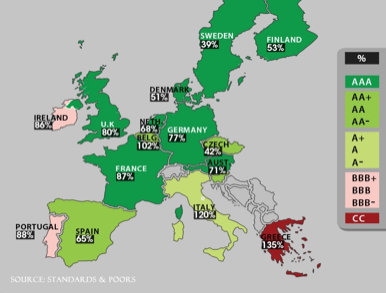
Moody’s downgrades credit rating of 26 Italian banks, Spain is next

European Debt to GDP and Credit Rating

From Yahoo News.

Excerpt:

Moody’s Investors Service has downgraded the ratings on 26 Italian banks as they struggled with the effect of government austerity measures.

The rating agency said Monday that the banks are suffering because Italy is back in recession and government austerity measures are cutting demand for loans.

The banks are struggling with more loan losses, limited access to funding and weaker profits.

Moody’s noted that support of the European Central Bank lowered the default risk of many banks.

Its outlook for all 26 banks is negative.

From the Wall Street Journal.

Excerpt:

The ratings for Italian banks are now among the lowest within advanced European countries, reflecting these banks’ susceptibility to the adverse operating environments in Italy and Europe, Moody’s said in a statement. Two of the country’s largest institutions, UniCredit SpA (UCG.MI, UNCFF) and Intesa Sanpaolo SpA (ISP.MI, ISNPY), were included.

Moody’s move came hours after the firm raised an alarm on Spain, arguing the country’s banks remain vulnerable even after Madrid moved to increase the banks’ cushions against potential losses from real-estate loans.

[…]Italy, saddled with EUR1.9 trillion ($2.44 trillion) debt, has signed onto the EU’s fiscal compact that sets strict limits on the country’s deficit levels. In recent weeks, Mr. Monti has begun pressing Germany to give Italy more fiscal slack to stimulate its economy and create jobs. Mr. Monti has recently proposed that the EU create special exemptions to the budget rules when countries target their public spending on projects like broadband investments and infrastructure.

Moody’s downgrades come after the ratings firm in February placed various ratings of 114 financial institutions in 16 European countries on review for possible downgrade, highlighting the region’s banks’ vulnerability to the euro-zone sovereign debt crisis.

Moody’s is expected to follow the downgrade of Italian banks by cutting the ratings of Spanish banks. By the end of June, more than 100 European banks, as well as Wall Street giants like Bank of America Corp. (BAC) and Citigroup Inc. (C), are likely to have ratings that are at least one notch lower.

[…]Moody’s also alluded to J.P. Morgan Chase & Co.’s (JPM) recent disclosures of more than $2 billion in trading losses as a reminder of potential problems lurking at some European banks.

“Recent events highlight the risks for creditors from potential weaknesses in governance, controls and risk management, especially at some smaller, privately-held banks,” Moody’s said in its news release.

Moody’s says it will conclude its reviews by the end of June. In coming weeks, major U.S. financial institutions, Bank of America Corp., Citigroup Inc., Goldman Sachs and Morgan Stanley are likely to face downgrades.

Banks in Austria and Sweden are expected to see downgrades after Spain.

Italy’s debt is $2.44 trillion, ours is nearly $16 trillion.

How public sector pensions force children to pay for the prosperity of adults

From the UK Telegraph.

Excerpt:

People retiring from the private sector need to save £250,000 to buy pension income equal to the national minimum wage – currently, £12,646 a year – or a total of £518,000 for a pension equal to national average earnings of £25,900.

These are among many eye-stretching facts in a new analysis of how unfunded promises to pay index-linked pensions to public sector workers are way beyond what most private sector savers can hope to achieve – and how these debts will burden children who have not yet left school.

The Intergenerational Foundation (IF) think tank used freedom of information requests to find out that 78,000 former public sector workers enjoy pensions of more than £25,900; and more than 12,000 get more than £50,000 a year. Three quarters of the latter are doctors and this index-linked income is irrespective of any private work or savings.

While many public sector workers pay into pension schemes, benefits usually outstrip employee contributions and the difference – or deficit – must be funded by future generations. Taxpayers’ total liability for public sector pensions, according to the report: ‘Are Government Pensions Unfair on the Younger Generation?’ is equivalent to £45,000 for every household in Britain and totals £1.2 trillion or £1,200,000,000,000.

An IF spokesman said: “This demonstrates the true scale of pension apartheid in the UK with news that 88pc  of public sector workers are currently entitled to pensions related to their final salaries, which are typically the most generous type of pension, compared to just 10pc of workers in the private sector.”

Don’t be fooled – this sort of thing happens in the United States as well, where teachers and government workers live high on the hog today and pass the bill to their children, who will be forced to pay for it all tomorrow. Is that fair?