Tag Archives: Government

New study finds that students who cheat prefer to work in government over private sector

What’s in your government?

Phys.org reports on a new study that explains what kind of people prefer to work in a government monopoly.

Excerpt:

College students who cheated on a simple task were more likely to want government jobs, researchers from Harvard University and the University of Pennsylvania found in a study of hundreds of students in Bangalore, India.

Their results, recently released as a working paper by the National Bureau of Economic Research, suggest that one of the contributing forces behind  could be who gets into government work in the first place.

[…]Researchers ran a series of experiments with more than 600 students finishing up college in India. In one task, students had to privately roll a die and report what number they got. The higher the number, the more they would get paid. Each student rolled the die 42 times.

Although researchers do not know for sure if any one student lied, they could tell whether the numbers each person reported were wildly different from what would turn up randomly – in other words, whether there were a suspiciously high number of 5s and 6s in their results.

Cheating seemed to be rampant: More than a third of students had scores that fell in the top 1 percent of the predicted distribution, researchers found. Students who apparently cheated were 6.3 percent more likely to say they wanted to work in government, the researchers found.

“Overall, we find that dishonest individuals – as measured by the dice task – prefer to enter government service,” wrote Hanna and co-author Shing-yi Wang, an assistant professor at the University of Pennsylvania’s Wharton School.

They added, “Importantly, we show that cheating on this task is also predictive of fraudulent behaviors by real government officials.”

The same test, given to a smaller set of government nurses, showed that those who appear to have cheated with the dice were also more likely to skip work. Previous studies suggest that the bulk of such absenteeism is fraudulent, Hanna said.

Aside from the armed forces, most people who go into government go there because they want to have a secure job that they cannot be fired from no matter how poorly they perform. They want to be insulated from market forces and free trade. They don’t want to have to do a good job and please customers in order to get paid. Naturally, people who cheat on tests and lack qualifications are attracted to unionized industries like government for these reasons.

How well is government-run health care working out in socialist Venezuela?

Are Barack Obama and Hugo Chavez very different?

Here is an article about government-run health care from the radically leftist New York Times, of all places.

Excerpt:

Doctors not allied with the government say many patients began dying from easily treatable illnesses when Venezuela’s downward economic slide accelerated after Chavez’s death from cancer in March. Doctors say it’s impossible to know how many have died, and the government doesn’t keep such numbers, just as it hasn’t published health statistics since 2010.

Almost everything needed to mend and heal is in critically short supply: needles, syringes and paraffin used in biopsies to diagnose cancer; drugs to treat it; operating room equipment; X-ray film and imaging paper; blood and the reagents needed so it can be used for transfusions.

Last month, the government suspended organ donations and transplants. At least 70 percent of radiotherapy machines, precisely what Gonzalez will need once her tumor is removed, are now inoperable in a country with 19,000 cancer patients — meaning fewer than 5,000 can be treated, said Dr. Douglas Natera, president of the Venezuelan Medical Federation.

[…]The country’s 1999 constitution guarantees free universal health care to Venezuelans, who sit on the world’s largest proven oil reserves. Maduro’s government insists it’s complying. Yet of the country’s 100 fully functioning public hospitals, nine in 10 have just 7 percent of the supplies they need, Natera said.

[…]Venezuela’s 400 private hospitals and clinics are overburdened and strapped for supplies, 95 percent of which must be imported, said Dr. Carlos Rosales, president of the association that represents them.

The private system has just 8,000 of the country’s more than 50,000 hospital beds but treats 53 percent of the country’s patients, including the 10 million public employees with health insurance. Rosales said insurers, many state-owned, are four to six months behind in payments and it is nearly impossible to meet payrolls and pay suppliers.

Worse, government price caps set in July for common procedures are impossible to meet, Rosales said. For example, dialysis treatment was set at 200 bolivars ($30 at the official exchange rate and less than $4 on the black market) for a procedure that costs 5,000 bolivars to administer.

[…]At Maracay’s 433-bed Central Hospital, mattresses are missing, broken windows go unrepaired and the cafeteria has been closed for a year. Paint peels off walls and rusty pipes lie exposed. In the halls, patients on intravenous drips lie recovering on gurneys.

[…]Broken anesthesia machines and battered stainless-steel instrument tables, some held together with tape, filled one of five idled operating rooms. Foul odors and water from leaky pipes continue to seep into the rooms, doctors said.

In August, cancer patients protested at the eight-month mark since the hospital’s two radiotherapy machines broke down. The machines remain out of order.

Half the public health system’s doctors quit under Chavez, and half of those moved abroad, Natera said.

Now, support staff is leaving, too, victim of a wage crunch as wages across the economy fail to keep up with inflation.

At the Caracas blood bank, Lopez said 62 nurses have quit so far this year along with half the lab staff. It now can take donations only on weekday mornings.

And here is a comment about a Chavez supporter who has been waiting for years for care: “Gonzalez says she adored Chavez for his anti-poverty programs, always voted for him and constantly applied for government benefits, though she never received any.” Yes. That’s what causes problems like this. Low-information voters voting for a charismatic strong man who tells them what they want to hear, and seizes wealth from the most-educated, productive citizens in order to hand it out to his supporters. But eventually, you run out of other people’s money to spend, and that’s where Venezuela is now. But they keep on digging their hole.

If you’re a big-government sort of person, then you would love the Venezuelan health care system. Price controls make sure that doctors and hospitals don’t make any money by providing care. Everyone is equal and you have to wait your turn in line whether you pay taxes or not. The only problem is that it’s capitalism – not communism – which cares about the needs of consumers. In a capitalist system, consumers buy what they like, and businesses compete with each other to lower prices and raise quality. Not so in a communist system, which forces the most talented people in the country to stop producing, or just leave the country completely.

Related posts

Big government spending is suffocating the next generation with debt

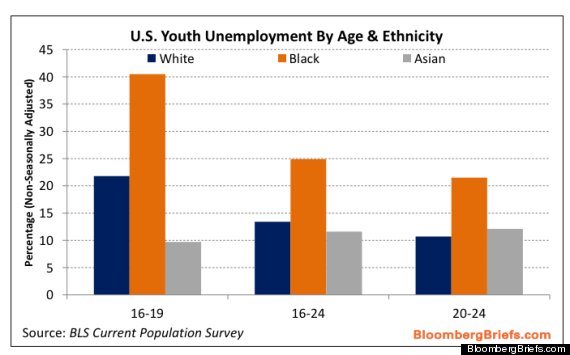
Youth unemployment by ethnicity (5/13)

Libertarian economist Veronique de Rugy writes about it in Reason magazine.

Excerpt:

A word of caution for kids heading off to college this year: Your degree may be worth less and cost more than you think. Your job prospects will likely be grim, whether or not you get that sheepskin. Oh, and you’re on the hook for trillions in federal debt racked up by your parents and grandparents.

Washington has willfully ignored the looming crisis of entitlement spending, knowingly consigning young Americans to a future of crushing debt, persistent underemployment, and burdensome regulation. Politicians on both sides of the aisle share the blame.

This summer, Congress made a big bipartisan show of cutting student loan rates to 3.4 percent from an already artificially low 6.8 percent. But even that seemingly helpful gesture will wind up hurting the Americans it claims to help. Federal student aid, whether in the form of grants or loans, is the main factor behind the runaway cost of higher education. Subsidies raise prices, leading to higher subsidies, which raise prices even more. This higher education bubble, like the housing bubble before it, will eventually pop. Meanwhile, large numbers of students will graduate with more debt than they would have in an unsubsidized market.

And when those new, debt-laden graduates head out into the labor market with their overpriced diplomas, they may not be able to find a job. According to data provided to me by my Mercatus Center colleague, former Bureau of Labor Statistics (BLS) commissioner Keith Hall, fewer than half of Americans today between the ages of 18 and 25 are employed. For those in that cohort actively on the job market, the unemployment rate is 16 percent, versus 6 percent for job-seekers aged 25 and above.

These young folks are also more likely to be long-term unemployed: While accounting for just 14 percent of the labor force, they make up 19 percent of the long-term unemployed, defined by the BLS as 27 weeks or longer.

The lucky few young’uns with jobs of some kind also suffer from rampant underemployment. In a recent blog post, Diana Carew of the Progressive Policy Institute wrote: “In July 2013, just 36 percent of Americans age 16-24 not enrolled in school worked full-time, 10 percent less than in July 2007.” In other words, of these 17 million young Americans, 5.6 million were working part-time, 3.2 million were unemployed, and 8.4 million were out of the labor force altogether.

I really recommend you read the rest of the article, especially if you aren’t following what Obama’s policies are doing to our economy. Special attention is given to the effects of Obamacare on job creation.

Just as a community service, I want to post for you young people (and your parents) a list of the majors that lead to higher paying jobs:

Top 10 highest-paid college majors

  1. Petroleum Engineering: $120,000
  2. Pharmacy Pharmaceutical Sciences and Administration: $105,000
  3. Mathematics and Computer Science: $98,000
  4. Aerospace Engineering: $87,000
  5. Chemical Engineering: $86,000
  6. Electrical Engineering: $85,000
  7. Naval Architecture and Marine Engineering: $82,000
  8. Mechanical Engineering: $80,000
  9. Metallurgical Engineering: $80,000
  10.  Mining and Mineral Engineering: $80,000

And here are some majors that you should avoid at all costs:

  1. Counseling Psychology: $29,000
  2. Early Childhood Education: $36,000
  3. Theology and Religious Vocations: $38,000
  4. Human Services and Community Organization: $38,000
  5. Social Work: $39,000
  6. Drama and Theater Arts: $40,000
  7. Studio Arts: $40,000
  8. Communication Disorders Sciences and Service: $40,000
  9. Visual and Performing Arts: $40,000
  10. Health and Medical Preparatory Programs: $40,000

So young people need to be careful what they study in order to get a job that will allow them to pay off all the government debts that their teachers were busy running up. Their teachers taught them that government spending was good, but their teachers aren’t going to be paying for the government spending. They are the beneficiaries of the increased government spending. The pupils are the ones who will have to work to pay for the spending on the social programs enjoyed by their teachers.

It’s very important for young Christians to understand that degrees are getting more expensive, and it’s important to choose a field that is going to produce a return on your investment. Not only do STEM (science, technology, engineering and math) degrees get you a job that pays, but it has other benefits. For example STEM degrees grind out every last bit of impracticality and entitlement-feeling out of you – because in a STEM program, no one cares about your “specialness”. You solve problems or you fail the class. It’s not a situation where you can just repeat what the professor says in order to get good grades, as is often (but not always) the case in the humanities.