Tag Archives: Government

How Obama’s plan to raise the minimum wage will hurt young black men

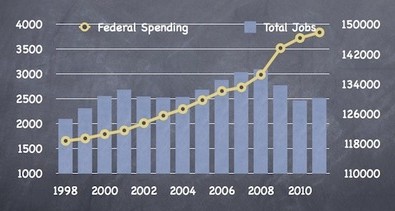
Government Spending Vs Jobs

From Investors Business Daily.

Excerpt:

How amusing to watch Democrats wring their hands over what they can do to get businesses to create jobs, when one of the biggest job killers is the minimum wage they keep hiking.

Recall that it was Democrats who raised the federal wage floor a whopping $2.10 an hour in the middle of the recession. The record 41% increase has led to record unemployment among young people, especially black teens.

Congress started ratcheting up the minimum wage from $5.15 an hour in mid-2007, arguing it would help abate poverty. But retailers looking to slash costs eliminated low-skilled, entry-level jobs rather than pay the mandated increases.

Now 1.5 million fewer teens are working. Last year’s unemployment rate for workers ages 16 to 19 shot up to 26% from 2007’s 15%.

As for black teens, their joblessness soared to a record 43% after the final raise to $7.25 took effect in mid-2009. It helped put more than half of young black men out of work — a first.

The president proposes cranking the minimum wage even higher to $9.50. Then he wants to raise it every year thereafter as a “living wage” indexed to inflation.

Yes, this is the problem that happens when you elect someone who knows nothing whatsoever about economics. And when I say nothing, I mean he is in disagreement with virtually all economists across the ideological spectrum.

Moderate economist Gregory Mankiw of Harvard University lists the policies that are accepted by virtually all economists.

Here’s Greg’s list, together with the percentage of economists who agree:

  1. A ceiling on rents reduces the quantity and quality of housing available. (93%)
  2. Tariffs and import quotas usually reduce general economic welfare. (93%)
  3. Flexible and floating exchange rates offer an effective international monetary arrangement. (90%)
  4. Fiscal policy (e.g., tax cut and/or government expenditure increase) has a significant stimulative impact on a less than fully employed economy. (90%)
  5. The United States should not restrict employers from outsourcing work to foreign countries. (90%)
  6. The United States should eliminate agricultural subsidies. (85%)
  7. Local and state governments should eliminate subsidies to professional sports franchises. (85%)
  8. If the federal budget is to be balanced, it should be done over the business cycle rather than yearly. (85%)
  9. The gap between Social Security funds and expenditures will become unsustainably large within the next fifty years if current policies remain unchanged. (85%)
  10. Cash payments increase the welfare of recipients to a greater degree than do transfers-in-kind of equal cash value. (84%)
  11. A large federal budget deficit has an adverse effect on the economy. (83%)
  12. A minimum wage increases unemployment among young and unskilled workers. (79%)
  13. The government should restructure the welfare system along the lines of a “negative income tax.” (79%)
  14. Effluent taxes and marketable pollution permits represent a better approach to pollution control than imposition of pollution ceilings. (78%)

From CNBC, we get this article showing that any increase in the minimum wage will raise the unemployment rate for young people.

Excerpt:

A quarter of teenagers were jobless in March, representing a surprising increase from February, even as the unemployment rate for the rest of the population decreased.

This figure may only get worse if budget-strapped states raise the minimum wage, and it could also be a sign of greater structural damage underlying our economy, analysts said.

The unemployment rate for 16- to 19-year olds jumped back up to 24.5 percent in March, up from 23.9 percent the prior month, according to the latest jobs data from the Labor Department.

[…]“Even when comprehending that teen employment is volatile in nature, the data that exists serves up some shock and awe,” said Brian Sozzi, a retail research analyst with Wall Street Strategies, in a note Wednesday. “If these (wage) increases do go through, the prospect for teen employment will remain grim as employers search for workers with advanced skills to fill positions.”

Twelve states, including Illinois and Pennsylvania, are considering a hike in the minimum wage. While this has been the subject of a long-running debate, many economists and analysts say raising this pay bar may cause more teen layoffs, even as it helps teens who manage to stay employed make more.

“Minimum wage increases over the past few years has definitely made it worse,” said Peter Boockvar, chief equities strategist at Miller Tabak. “In fact, there should be zero minimum wage for teenagers, or at most, something much less than the current rate.”

Teens typically are the first to be fired and the last to be hired back in a normal economic cycle, so this rate can be considered a kind of leading indicator of employment.

A new study shows that only 25% of teens will be able to find jobs this summer. And Obama thinks that this number is apparently too high. He wants to lower it by raising the price that must be paid by employers who would like to hire younger workers.

You can find out more about how raising the minimum wage increases unemployment from this comprehensive, 50-year, government study.

Excerpt:

Summary of Research on the Minimum Wage

* The minimum wage reduces employment.

Currie and Fallick (1993), Gallasch (1975), Gardner (1981), Peterson (1957), Peterson and Stewart (1969).

* The minimum wage reduces employment more among teenagers than adults.

Adie (1973); Brown, Gilroy and Kohen (1981a, 1981b); Fleisher (1981); Hammermesh (1982); Meyer and Wise (1981, 1983a); Minimum Wage Study Commission (1981); Neumark and Wascher (1992); Ragan (1977); Vandenbrink (1987); Welch (1974, 1978); Welch and Cunningham (1978).

* The minimum wage reduces employment most among black teenage males.

Al-Salam, Quester, and Welch (1981), Iden (1980), Mincer (1976), Moore (1971), Ragan (1977), Williams (1977a, 1977b).

* The minimum wage helped South African whites at the expense of blacks.

Bauer (1959).

* The minimum wage hurts blacks generally.

Behrman, Sickles and Taubman (1983); Linneman (1982).

* The minimum wage hurts the unskilled.

Krumm (1981).

* The minimum wage hurts low wage workers.

Brozen (1962), Cox and Oaxaca (1986), Gordon (1981).

* The minimum wage hurts low wage workers particularly during cyclical downturns.

Kosters and Welch (1972), Welch (1974).

* The minimum wage reduces average earnings of young workers.Meyer and Wise (1983b).

* The minimum wage reduces employment in low-wage industries, such as retailing.Cotterman (1981), Douty (1960), Fleisher (1981), Hammermesh (1981), Peterson (1981).

* The minimum wage causes employers to cut back on training.Hashimoto (1981, 1982), Leighton and Mincer (1981), Ragan (1981).

* The minimum wage encourages employers to install labor-saving devices.Trapani and Moroney (1981).

* The minimum wage increases the number of people on welfare.Brandon (1995), Leffler (1978).

* The minimum wage hurts the poor generally.

Stigler (1946).

* The minimum wage does little to reduce poverty.

Bonilla (1992), Brown (1988), Johnson and Browning (1983), Kohen and Gilroy (1981), Parsons (1980), Smith and Vavrichek (1987).

* The minimum wage helps unions.Linneman (1982), Cox and Oaxaca (1982).

* The minimum wage increases teenage crime rates.Hashimoto (1987), Phillips (1981).

* The minimum wage encourages employers to hire illegal aliens.

Beranek (1982).

* Few workers are permanently stuck at the minimum wage.

Brozen (1969), Smith and Vavrichek (1992).

* The minimum wage has reduced employment in foreign countries.Canada: Forrest (1982); Chile: Corbo (1981); Costa Rica: Gregory (1981); France: Rosa (1981).

This is why it is important for voters to understand economics. When you raise the price of labor, fewer employers will purchase labor. Supply and demand.

Michele Bachmann: hot photos from her vacation on the beach

Rep. Michele Bachmann

Before we see the hot pictures of Michele Bachmann from her vacation on the beach, let’s take a look at this Wall Street Journal article and find out what sorts of economics books Michele Bachmann reads on the hot beach possibly in her bathing suit.

Ms. Bachmann is best known for her conservative activism on issues like abortion, but what I want to talk about today is economics. When I ask who she reads on the subject, she responds that she admires the late Milton Friedman as well as Thomas Sowell and Walter Williams. “I’m also an Art Laffer fiend—we’re very close,” she adds. “And [Ludwig] von Mises. I love von Mises,” getting excited and rattling off some of his classics like “Human Action” and “Bureaucracy.” “When I go on vacation and I lay on the beach, I bring von Mises.”

Consider Thomas Sowell’s “The Housing Boom and Bust”. Here’s a photo of that book which Michele Bachmann reads on the hot beach possibly in a swimsuit:

Picture of book Michele Bachmann reads on the hot beach
Picture of a book Michele Bachmann reads on the hot beach

The Wall Street Journal explains more:

As we rush from her first-floor digs in the Cannon House Office Building to the House floor so she can vote, I ask for her explanation of the 2008 financial meltdown. “There were a lot of bad actors involved, but it started with the Community Reinvestment Act under Jimmy Carter and then the enhanced amendments that Bill Clinton made to force, in effect, banks to make loans to people who lacked creditworthiness. If you want to come down to a bottom line of ‘How did we get in the mess?’ I think it was a reduction in standards.”

She continues: “Nobody wanted to say, ‘No.’ The implicit and then the explicit guarantees of Fannie Mae and Freddie Mac were sopping up the losses. Being on the Financial Services Committee, I can assure you, all roads lead to Freddie and Fannie.”

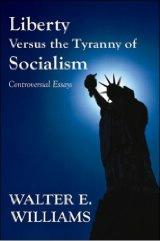
Consider Walter Williams’ “Liberty vs the Tyranny of Socialism”. Here’s a picture of that book which Michelle Bachman reads on the hot beach possibly in a bathing suit:

Photo of a book Michelle Bachman reads on the hot beach

The Wall Street Journal explains more:

Ms. Bachmann voted against the Troubled Asset Relief Program (TARP) “both times,” she boasts, and she has no regrets since Congress “just gave the Treasury a $700 billion blank check.” She complains that no one bothered to ask about the constitutionality of these extraordinary interventions into the financial markets. “During a recent hearing I asked Secretary [Timothy] Geithner three times where the constitution authorized the Treasury’s actions, and his response was, ‘Well, Congress passed the law.'”

Insufficient focus on constitutional limits to federal power is a Bachmann pet peeve. “It’s like when you come up to a stop sign and you’re driving. Some people have it in their mind that the stop sign is optional. The Constitution is government’s stop sign. It says, you—the three branches of government—can go so far and no farther. With TARP, the government blew through the Constitutional stop sign and decided ‘Whatever it takes, that’s what we’re going to do.'”

Does this mean she would have favored allowing the banks to fail? “I would have. People think when you have a, quote, ‘bank failure,’ that that is the end of the bank. And it isn’t necessarily. A normal way that the American free market system has worked is that we have a process of unwinding. It’s called bankruptcy. It doesn’t mean, necessarily, that the industry is eclipsed or that it’s gone. Often times, the phoenix rises out of the ashes.”

Consider Milton Friedman’s “Capitalism and Freedom”. Here’s a pic of that book which Michelle Bauchman reads on the hot beach possibly in a bikini:

Pics of a book Michelle Bockman reads on the hot beach
Pics of a book Michelle Bauchman reads on the hot beach

The Wall Street Journal explains more:

“For one, I believe my policies prior to ’08 would have been much different from [President Bush’s]. I wouldn’t have spent so much money,” she says, pointing in particular at the Department of Education and the Medicare prescription drug bill. “I would have advocated for greater reductions in the corporate tax rate and reductions in the capital gains rate—even more so than what the president did.” Mr. Bush cut the capital gains rate to 15% from 20% in 2003.

She’s also no fan of the Federal Reserve’s decade-long policy of flooding the U.S. economy with cheap money. “I love a lowered interest rate like anyone else. But clearly the Fed has had competing goals and objectives. One is the soundness of money and then the other is jobs. The two different objectives are hard to reconcile. What has gotten us into deep trouble and has people so perturbed is the debasing of the currency.”

That’s why, if she were president, she wouldn’t renominate Ben Bernanke as Fed chairman: “I think that it’s very important to demonstrate to the American people that the Federal Reserve will have a new sheriff” to keep the dollar strong and stable.

[…]Ms. Bachmann attributes many of her views, especially on economics, to her middle-class upbringing in 1960s Iowa and Minnesota. She talks with almost religious fervor about the virtues of living frugally, working hard and long hours, and avoiding debt. When she was growing up, she recalls admiringly, Iowa dairy farmers worked from 5 a.m. to 10 p.m.

Her political opponents on the left portray her as a “she-devil,” in her words, a caricature at odds with her life accomplishments. She’s a mother of five, and she and her husband helped raise 23 teenage foster children in their home, as many as four at a time. They succeeded in getting all 23 through high school and later founded a charter school.

Michele Bachman is actually willing to pass a lower corporate tax rate than even Tim Pawlenty’s 15% rate:

If she were to take her shot, she’d run on an economic package reminiscent of Jack Kemp, the late congressman who championed supply-side economics and was the GOP vice presidential nominee in 1996. “In my perfect world,” she explains, “we’d take the 35% corporate tax rate down to nine so that we’re the most competitive in the industrialized world. Zero out capital gains. Zero out the alternative minimum tax. Zero out the death tax.”

The 3.8 million-word U.S. tax code may be irreparable, she says, a view she’s held since working as a tax attorney at the IRS 20 years ago. “I love the FAIR tax. If we were starting over from scratch, I would favor a national sales tax.” But she’s not a sponsor of the FAIR tax bill because she fears that enacting it won’t end the income tax, and “we would end up with a dual tax, a national sales tax and an income tax.”

Her main goal is to get tax rates down with a broad-based income tax that everyone pays and that “gets rid of all the deductions.” A system in which 47% of Americans don’t pay any tax is ruinous for a democracy, she says, “because there is no tie to the government benefits that people demand. I think everyone should have to pay something.”

On the stump she emphasizes an “America-centered energy policy” based on “drilling and mining for our rich resources here.” And she believes that repealing ObamaCare is a precondition to restoring a prosperous economy.

[…]Ms. Bachmann also voted for the Republican Study Committee budget that cuts deeper and faster than even Mr. Ryan would. “We do have an obligation with Social Security and Medicare, and we have to recognize that” for those who are already retired, she says. But after that, it’s Katy bar the door: “Everything else is expendable to bring spending down,” and she’d ax “whole departments” including the Department of Education.

Below are some links to learn more about Michele.

Campaign speeches, interviews and debates

Speeches:

Reactions from her recent debate performance:

Profiles of Michele Bachmann:

And here are some of her media interviews and speeches in the House of Representatives.

You can contribute to her campaign right here. You can be her friend on Facebook here and also here.

This post was linked by:

And tweeted by Kathleen McKinley and Robert Stacy McCain.

Related posts

Obama administration threatens Indiana for defunding Planned Parenthood

From Life Site News.

Excerpt:

The Obama administration is not happy with Indiana for being the first state to defund Planned Parenthood. According to reports, the administration is considering taking away the state’s Medicaid money in retaliation.

Pro-life Gov. Mitch Daniels recently signed into law a measure that bars state agencies from entering into contracts with abortion providers, aside from hospitals. The law also bans abortion past 20 weeks gestation, with an exception for the life or physical health of the mother.

The law effectively cuts Planned Parenthood off from approximately $3 million in state family planning funds, unless the state organization divides into separate independent affiliates that have nothing to do financially with abortion-providing affiliates.

The New York Times reports that federal officials are considering withholding some or all of the state’s Medicaid money in order to pressure the state to allow the nation’s largest abortion provider to tap into family planning funds.

The Times reports that the administration has 90 days to take action.

The federal Centers for Medicare and Medicaid Services said in a statement approved by the White House: “Federal law prohibits federal Medicaid dollars from being spent on abortion services. Medicaid does not allow states to stop beneficiaries from getting care they need — like cancer screenings and preventive care — because their provider offers certain other services. We are reviewing this particular situation and situations in other states.”

Marcus J. Barlow, representing the Indiana Family and Social Services Administration, pointed out to the Times, however, that the state was not cutting off funds for family planning services. “It’s a change in providers,” he explained, observing that clients of Planned Parenthood could go to other non-abortion providing clinics for those services.

Bioethicist Wesley J. Smith posed the question on his blog: “Is PP so important to Obama that he and his HHS Secretary are willing to materially hurt poor people by cutting off Medicaid funding to try and leverage restored funding for PP?”

“So long as those services are available, what business is it to the Feds which facilities provide them? Or, are we to believe that PP has a right to receive public money?” he said.

Well, the other service providers didn’t donate massive amounts of money to the Demcorat Party, like Planned Parenthood did. (See below) Some people who claim to be pro-life voted for Barack Obama, and I think those people really need to reconsider the facts. The Democrats are a pro-abortion party.

Related posts