Tag Archives: Good

Clay Jones and his truth S.E.R.U.M.M. inoculates you against moral relativism

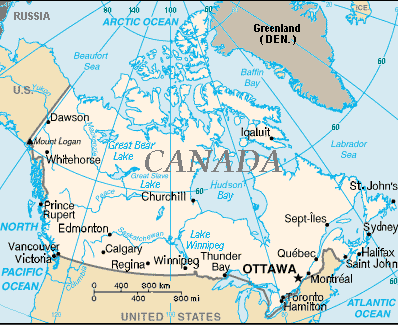
Map of Canada with cities

Moral relativism is the idea that when it comes to right and wrong, no point of view is any more correct than any other. Morality is not independent of what humans think, so that it applies to all of us equally. Moral relativism says that every person or society invents their own standard of morality. Each standard is arbitrary and varies by time or place arbitrarily. There is no viewpoint that is better than any other – they are all equal.

How do you get around that? Well Justin Wishart of the Faith Beyond Belief team in Calgary, Alberta has posted a list of helpful points that he got from Dr. Clay Jones of Biola University.

Here’s the introduction from Justin:

I had the pleasure of driving Professor Clay Jones to Airdrie Koinonia Christian School to present a talk to grade 11 and 12 students. Jones is a Professor of Apologetics at one of the top Christian universities, BIOLA. He started with a succinct history lesson, explaining how most students do not accept there are objective moral truths – that morality is relative. This is called moral relativism, which Jones summed up as, “you have your truth, I have my truth, your truth is no better than my truth and my truth is no better than your truth, and there is no moral truth with a capital T”.

Even though this sounds so open-minded and tolerant to our modern ears, Jones insists it isn’t. He presented the students with an acronym that spells “S.E.R.U.M.M.” which shows that moral relativism is absurd and even dangerous.

Here is the acronym in brief:

  • S= Self-Refuting
  • E= Evil-Enabling
  • R= Racist Befriending
  • U= Utterly Hypocritical
  • M= Morally Stagnating
  • M= Mind Closing

Let’s take a look at the first one only:

Moral relativists will often say things like, “you can’t push your morality on others!” But, this is obviously absurd, for, the moral relativist is saying “you shouldn’t” do something which is the definition of pushing your morality on others. He is doing the very thing that he says you cannot do. Even more fundamental, moral relativism is a distinct moral system that the moral relativist obviously thinks is right. But, moral relativism by definition says that there is no correct moral system, which means that moral relativism is wrong. In other words, to say that moral relativism is right is to say that moral relativism is wrong. It refutes itself.

You can click through for the rest of the list. They have other good things to read on their blog, as well.

If God wanted us to believe in him, why doesn’t he give us more evidence?

Have you ever heard someone say that if God existed, he would give us more evidence? This is called the “hiddenness of God” argument. It’s also known as the argument from “rational non-belief”.

Basically the argument is something like this:

  1. God is all powerful
  2. God is all loving
  3. God wants all people to know about him
  4. Some people don’t know about him
  5. Therefore, there is no God.

You may hear have heard this argument before, when talking to atheists, as in William Lane Craig’s debate with Theodore Drange, (audio, video).

Basically, the atheist is saying that he’s looked for God real hard and that if God were there, he should have found him by now. After all, God can do anything he wants that’s logically possible, and he wants us to know that he exists. To defeat the argument we need to find a possible explanation of why God would want to remain hidden when our eternal destination depends on our knowledge of his existence.

What reason could God have for remaining hidden?

Dr. Michael Murray, a brilliant professor of philosophy at Franklin & Marshall College, has found a reason for God to remain hidden.

His paper on divine hiddenness is here:
Coercion and the Hiddenness of God“, American Philosophical Quarterly, Vol 30, 1993.

He argues that if God reveals himself too much to people, he takes away our freedom to make morally-significant decisions, including responding to his self-revelation to us. Murray argues that God stays somewhat hidden, so that he gives people space to either 1) respond to God, or 2) avoid God so we can keep our autonomy from him. God places a higher value on people having the free will to respond to him, and if he shows too much of himself he takes away their free choice to respond to him, because once he is too overt about his existence, people will just feel obligated to belief in him in order to avoid being punished.

But believing in God just to avoid punishment is NOT what God wants for us. If it is too obvious to us that God exists and that he really will judge us, then people will respond to him and behave morally out of self-preservation. But God wants us to respond to him out of interest in him, just like we might try to get to know someone we admire. God has to dial down the immediacy of the threat of judgment, and the probability that the threat is actual. That leaves it up to us to respond to God’s veiled revelation of himself to us, in nature and in Scripture.

(Note: I think that we don’t seek God on our own, and that he must take the initiative to reach out to us and draw us to him. But I do think that we are free to resist his revelation, at which point God stops himself short of coercing our will. We are therefore responsible for our own fate).

The atheist’s argument is a logical/deductive argument. It aims to show that there is a contradiction between God’s will for us and his hiding from us. In order to derive a contradiction, God MUST NOT have any possible reason to remain hidden. If he has a reason for remaining hidden that is consistent with his goodness, then the argument will not go through.

When Murray offers a possible reason for God to remain hidden in order to allow people to freely respond to him, then the argument is defeated. God wants people to respond to him freely so that there is a genuine love relationship – not coercion by overt threat of damnation. To rescue the argument, the atheist has to be able to prove that God could provide more evidence of his existence without interfering with the free choice of his creatures to reject him.

More of Michael Murray’s work

Murray has defended the argument in works published by prestigious academic presses such as Cambridge University Press, (ISBN: 0521006104, 2001) and Routledge (ISBN: 0415380383, 2007). The book chapter from the Cambridge book is here. The book chapter from the Routledge book is here.

Michael Murray’s papers are really fun to read, because he uses hilarious examples. I should mention that I disagree with his view that God’s work of introducing biological information in living creatures has to be front-loaded.

Here’s more terrific stuff from Dr. Murray:

Is there any evidence of God’s existence?

Yes, just watch this lecture by Dr. William Lane Craig. It contains 5 reasons why God exists and 3 reasons why it matters.

Romney gave 1,000 times as much to charity in one year as Biden gave in a decade

From the Weekly Standard:

The release of Mitt Romney’s 2011 tax returns shows that he freely gave away more than $4 million to charity last year (about 30 percent of his income).  In comparison, when Joe Biden was first running for vice president, his tax returns showed that he had given away just $3,690 to charity over the previous ten years (about 0.2 percent of his income).  In other words, Romney gave away a thousand times as much to charity in one year as Biden gave in a decade.

That’s despite the fact that the Bidens earned well over $2 million over that decade.  In fact, their income was $320,000 in 2008, thereby putting them comfortably over the $250,000-a-year line that marks the entry point for “millionaires and billionaires” in Obama-speak.

Last year, Romney freely gave away more than $10,000 a day to charity — an impressive sum by nearly any standard.  Of course, it’s not too hard to beat Biden’s tally.  Over the span of that decade, or 3,650 days, he gave away $3,690 — an average of $1.01 a day.

Should we be surprised by this lack of charity from leftists? Well, Democrats are typically non-religious, as you might expect of people who support killing unborn children. In fact, Obama leads Romney 69% to 23% among non-religious people. So do people of no religion typically give a lot to charity, like the religious Romney, or are they mostly opposed to giving charity, like the pro-abortion secularist Joe Biden?

Consider this article from the Boston Globe.

Excerpt:

States with the least religious residents are also the stingiest about giving money to charity, a new study on the generosity of Americans suggests.

The study, released Monday by the Chronicle of Philanthropy, found that residents in states where religious participation is higher than the rest of the nation, particularly in the South, gave the greatest percentage of their discretionary income to charity.

The Northeast, with lower religious participation, was the least generous to charities, with the six New England states filling the last six slots among the 50 states.

[…]The most generous state was Utah, where residents gave 10.6 percent of their discretionary income to charity. Next were Mississippi, Alabama, Tennessee and South Carolina. The least generous was New Hampshire, at 2.5 percent, followed by Maine, Vermont, Massachusetts and Rhode Island.

[…]The study found that in the Northeast region, including New England, Pennsylvania, New Jersey and New York, people gave 4.1 percent of their discretionary income to charity. The percentage was 5.2 percent in the Southern states, a region from Texas east to Delaware and Florida, and including most of the so-called Bible Belt.

[…]The study was based on Internal Revenue Service records of people who itemized deductions in 2008, the most recent year statistics were available. The data allowed researchers to detail charitable giving down to the ZIP code.

To ensure that states with differing costs of living were judged by the same standard, researchers calculated each state’s median discretionary income — the money remaining per household after variable but essential costs such as housing, child care and food are paid for. They then looked at the percentage of discretionary income that the typical household in each state gave to charity.

[…]Of the 10 least generous states, nine voted for Democrat Barack Obama for president in the last election. By contrast, of the 10 most generous states, eight voted for Republican John McCain.

If you think that this is the only life you have, and there is no one out there to hold you accountable, then it’s easy to be self-centered. Unless charity makes you feel good, there is no reason to do it on atheism. And when you don’t have a reason to be moral, then you often won’t be.