Tag Archives: God

What was Thanksgiving Day really like in history?

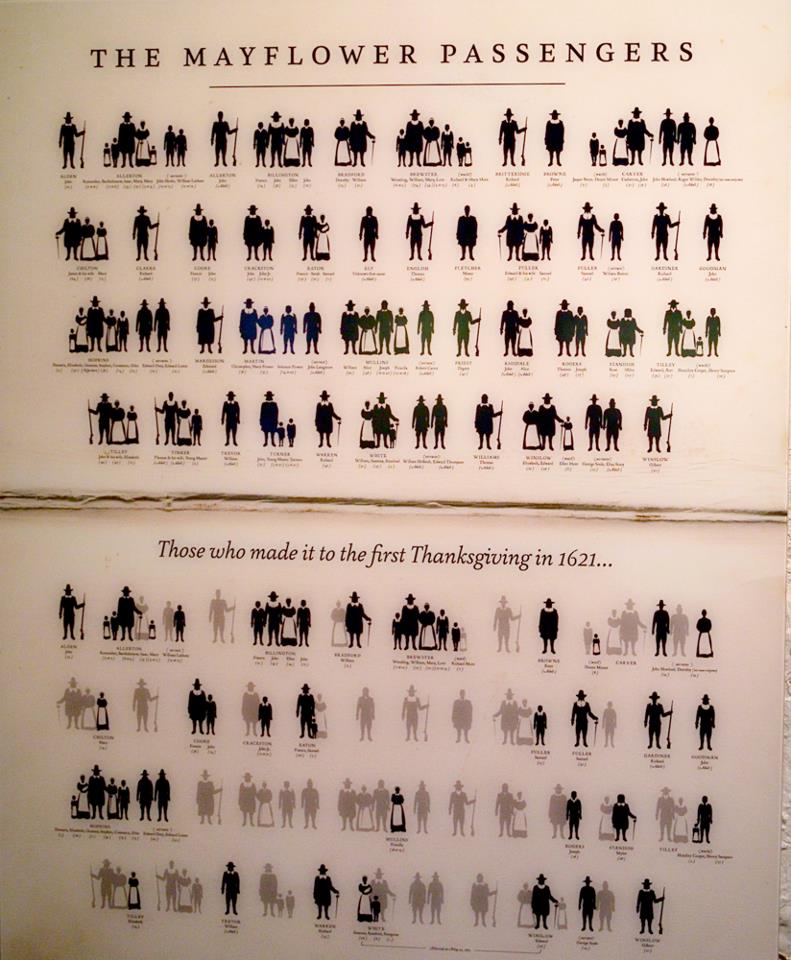
The First Thanksgiving

A mysterious Dr. J (not that Dr. J, this one is Jewish) posted this article on Facebook.

Full text:

The major similarity between the first Jamestown settlers and the first Plymouth settlers was great human suffering.

November was too late to plant crops. Many settlers died of scurvy and malnutrition during that horrible first winter. Of the 102 original Mayflower passengers, only 44 survived. Again like in Jamestown, the kindness of the local Native Americans saved them from a frosty death.

The Pilgrims’ remarkable courage was displayed the following spring. When the Mayflower returned to Europe, not a single Pilgrim deserted Plymouth.

Massasoit, chief of the Wampanoag tribe, signed a treaty with the Pilgrams in 1621, that was never broken. As a result, the two groups enjoyed a peaceful coexistence.

By early 1621, the Pilgrims had built crude huts and a common house on the shores of Plymouth Bay. Soon neighboring Indians began to build relations with the Pilgrims. SQUANTO, a local Indian who had been kidnapped and taken to England nearly a decade before, served as an interpreter with the local tribes. Squanto taught the Pilgrims to fertilize the soil with dried fish remains to produce a stellar corn crop.

MASSASOIT, the chief of the nearby Wampanoags, signed a treaty of alliance with the Pilgrims in the summer. In exchange for assistance with defense against the feared Narragansett tribe, Massasoit supplemented the food supply of the Pilgrims for the first few years.

The modern conception of a Pilgrim might include a man in a black hat with a buckle, but not all of the original settlers of Plymouth County fit this description.

Successful colonies require successful leadership. The man to step forward in Plymouth colony wasWILLIAM BRADFORD. After the first governor elected under the Mayflower Compact perished from the harsh winter, Bradford was elected governor for the next thirty years. In May of 1621, he performed the colony’s first marriage ceremony.

Under Bradford’s guidance, Plymouth suffered less hardship than their English compatriots in Virginia. Relations with the local natives remained relatively smooth in Plymouth and the food supply grew with each passing year.

By autumn of 1621, the Pilgrims had much for which to be thankful. After the harvest, Massasoit and about ninety other Indians joined the Pilgrims for the great English tradition of HARVEST FESTIVAL. The participants celebrated for several days, dining on venison, goose, duck, turkey, fish, and of course, cornbread, the result of a bountiful corn harvest. This tradition was repeated at harvest time in the following years.

It was President Lincoln who declared Thanksgiving a national celebration in 1863. The Plymouth Pilgrims simply celebrated survival, as well as the hopes of good fortune in the years that lay ahead.

This might be a good thing to read out at the Thanksgiving table if you are looking for something meaningful to read.

Is the concept of moral responsibility compatible with physicalism / materialism?

I saw that Brian Auten of Apologetics 315 linked to this post by J. Warner Wallace.

Excerpt:

When examining the causes for an event (such as a death) we can separate them into two categories: event causation and agent causation (prior physical events cause things to happen and free agents cause things to happen). It’s important to recognize that free agents alone have the freedom to act or respond without a prior physical causal event. Physical objects, like dominoes, cannot cause themselves to fall over; they require a prior event to cause them to fall. But you and I have the ability to cause the first domino to fall as a simple matter of choice (we don’t need a prior event to cause this action). You can’t blame a car for running over a victim; the car is simply a physical object subject to a series of physical processes, none of which can be held morally culpable. But we can blame thedriver of the car for driving the car over the victim. The driver is a free agent, and we recognize that his choices are just that: free choices. The driver is not like the car. His choice is not simply the result of a series of purely physical processes, like dominoes falling. He had the freedom to choose otherwise, and this is why we seek to arrest and prosecute him.

Our recognition of the moral culpability of the driver (rather than the car) is an admission that materialism (physicalism) fails to explain who we are as humans. Consider the following argument:

No Physical System is a Free Agent
Physical systems are either “determined” (one event necessarily following the other) or “random”

Therefore No Physical System Has Moral Responsibility
Moral responsibility requires moral freedom of choice

Human Beings DO Have Moral Responsibility
We recognize that each of us has the responsibility and choice to act morally, and indeed, we seek to hold each other legally accountable for each other’s free-will choices

Therefore, Human Beings Are NOT Simply Physical Systems
Our recognition of moral responsibility and our efforts to hold each other accountable are irrational and unwarranted if humans are merely physical systems

If we, as humans, are only physical systems (merely matter), we ought to stop trying to hold each other accountable for misbehavior. In fact, there can be no misbehavior if we are only physical brains and bodies; there can only be behavior. Our actions have no moral content at all unless we truly have the freedom to choose and the ability to break the bondage of physical event causation.

I finally learned what the “Twinkie defense” was by reading that post. It’s worth it for that reason alone.

This quote by JWW reminded me of a famous chapter in Theodore Dalrymple’s famous book “Life at the Bottom”, in which he explains the worldview of the lower classes in Britain. The chapter is called “The Knife Went In“, and it shows how people in the underclass describe their crimes in a way that completely minimizes their own free choices and their own responsibilities.

Take a look:

It is a mistake to suppose that all men, or at least all Englishmen, want to be free. On the contrary, if freedom entails responsibility, many of them want none of it. They would happily exchange their liberty for a modest (if illusory) security. Even those who claim to cherish their freedom are rather less enthusiastic about taking the consequences of their actions. The aim of untold millions is to be free to do exactly as they choose and for someone else to pay when things go wrong.

In the past few decades, a peculiar and distinctive psychology has emerged in England. Gone are the civility, sturdy independence, and admirable stoicism that carried the English through the war years. It has been replaced by a constant whine of excuses, complaint, and special pleading. The collapse of the British character has been as swift and complete as the collapse of British power.

Listening as I do every day to the accounts people give of their lives, I am struck by the very small part in them which they ascribe to their own efforts, choices, and actions. Implicitly, they disagree with Bacon’s famous dictum that “chiefly the mould of a man’s fortune is in his own hands.” Instead, they experience themselves as putty in the hands of fate.

It is instructive to listen to the language they use to describe their lives. The language of prisoners in particular teaches much about the dishonest fatalism with which people seek to explain themselves to others, especially when those others are in a position to help them in some way. As a doctor who sees patients in a prison once or twice a week, I am fascinated by prisoners’ use of the passive mood and other modes of speech that are supposed to indicate their helplessness. They describe themselves as the marionettes of happenstance.

Not long ago, a murderer entered my room in the prison shortly after his arrest to seek a prescription for the methadone to which he was addicted. I told him that I would prescribe a reducing dose, and that within a relatively short time my prescription would cease. I would not prescribe a maintenance dose for a man with a life sentence.

“Yes,” he said, “it’s just my luck to be here on this charge.”

Luck? He had already served a dozen prison sentences, many of them for violence, and on the night in question had carried a knife with him, which he must have known from experience that he was inclined to use. But it was the victim of the stabbing who was the real author of the killer’s action: if he hadn’t been there, he wouldn’t have been stabbed.

My murderer was by no means alone in explaining his deed as due to circumstances beyond his control. As it happens, there are three stabbers (two of them unto death) at present in the prison who used precisely the same expression when describing to me what happened. “The knife went in,” they said when pressed to recover their allegedly lost memories of the deed.

The knife went in—unguided by human hand, apparently. That the long-hated victims were sought out, and the knives carried to the scene of the crimes, was as nothing compared with the willpower possessed by the inanimate knives themselves, which determined the unfortunate outcome.

I wonder how much the secularism and atheism of the Britain academics has now seeped down to the lower classes and caused them to view themselves as lumps of meat or animals, rather than responsible free agents. Britain is the country of Charles Darwin and the idea of unguided Darwinian evolution. If you believe that you are an animal who evolved by accident in an accidental universe, then you don’t believe in free will, moral choices or moral obligations. The funniest thing in the world to me is how atheists go about their lives helping themselves to moral language that is not grounded by their worldview. Like parrots who have been trained to talk about the stock market. There is no realm of objective moral values and duties on atheism, so why are they using moral language and making moral judgments? On their view right and wrong are just social customs and conventions that vary by time and place, and human actions are biologically determined anyway. There are no choices. There is no responsibility.

You can read the whole Dalrymple book for free online, and I’ve linked to all the chapters in this one post.

Dr. Robin Collins explains two kinds of cosmic fine-tuning

I was busy working my way through “Debating Christian Theism“, a book published by Oxford University Press in August 2013. It features about 20 different topics from science, to philosophy, to history. For each topic, there is an essay by a world-class scholar in favor, and one opposed. So you get both sides of many interesting issues, at a very advanced level. The section on cosmic fine-tuning features a chapter written by Dr. Robin Collins.

About Robin Collins:

Robin Collins (PhD, University of Notre Dame, 1993), is professor of philosophy at Messiah College, Grantham, PA specializing in the area of science and religion.  He has written over twenty-five articles and book chapters on a wide range of topics, such as the fine-tuning of the cosmos as evidence for the existence of God, evolution and original sin, the Doctrine of Atonement, Asian religions and Christianity, and Bohm’s theory of quantum mechanics.  Some of his most recent articles/book chapters are “Philosophy of Science and Religion” in The Oxford Handbook of Science and Religion, “Divine Action and Evolution” in The Oxford Handbook of Philosophical Theology (2009)  “The Multiverse Hypothesis: A Theistic Perspective,” in Universe or Multiverse? (Cambridge University Press), and “God and the Laws of Nature,” in Theism or Naturalism: New Philosophical Perspectives (Oxford University Press, forthcoming).  He recently received a grant from the John Templeton Foundation to finish a book that presents the case for design based on physics and cosmology,  tentatively entitled The Well-Tempered Universe: God, Cosmic Fine-tuning, and the Laws of Nature.

The fine-tuning argument

Here’s a short article where Collins gives TWO examples of the fine-tuning. He is very modest in his argument, merely asserting that the fine-tuning is more compatible with theism than it is with atheism.

Excerpt:

Science is commonly thought to have undercut belief in God. As Nobel Prize winning physicist Steven Weinberg famously remarked, “the more we find out about the universe, the more meaningless it all seems.” Yet, the discoveries of modern physics and cosmology in the last 50 years have shown that the structure of the universe is set in an extraordinarily precise way for the existence of life; if its structure were slightly different, even by an extraordinarily small degree, life would not be possible. In many people’s minds, the most straightforward explanation of this remarkable fine-tuning is some sort of divine purpose behind our universe.

This fine-tuning falls into three categories: the fine-tuning of the laws of nature, the fine-tuning of the constants of physics, and the fine-tuning of the initial conditions of the universe. “Fine-tuning of the laws of nature” refers to the fact that if the universe did not have precisely the right combination of laws, complex intelligent life would be impossible. If there were no universal attractive force (law of gravity), for example, matter would be dispersed throughout the universe and the energy sources (such as stars) needed for life would not exist. Without the strong nuclear force that binds protons and neutrons together in the nucleus, there would not be any atoms with an atomic number greater than hydrogen, and hence no complex molecules needed for life. And without the Pauli-exclusion principle, all electrons would fall to the lowest orbital of an atom, undercutting the kind of complex chemistry that life requires.

Some fundamental physical numbers governing the structure of the universe—called the constants of physics—also must fall into an exceedingly narrow range for life to exist. For example, many have estimated that the cosmological constant—a fundamental number that governs the expansion rate of empty space—must be precisely set to one part in 10120 in order for life to occur; if it were too large, the universe would have expanded too rapidly for galaxies and stars to form, and if it were too small, the universe would have collapsed back on itself. As Stephen Hawking wrote in his book A Brief History of Time, “The remarkable fact is that the values of these numbers [i.e. the constants of physics] seem to have been very finely adjusted to make possible the development of life.” Finally, the initial distribution of mass energy at the time of the big bang must have an enormously special configuration for life to occur, which Cambridge University mathematical physicist Roger Penrose has calculated to be on the order of one part in 1010123. This is an unimaginably small number.

I know what you’re thinking: How do we know that non-Christian scientists acknowledge the fine-tuning of gravity in the way that Collins describes?

Well, the New Scientist actually talks about the fine-tuning of the force of gravity. And they’re not Christians.

Excerpt:

The feebleness of gravity is something we should be grateful for. If it were a tiny bit stronger, none of us would be here to scoff at its puny nature.

The moment of the universe‘s birth created both matter and an expanding space-time in which this matter could exist. While gravity pulled the matter together, the expansion of space drew particles of matter apart – and the further apart they drifted, the weaker their mutual attraction became.

It turns out that the struggle between these two was balanced on a knife-edge. If the expansion of space had overwhelmed the pull of gravity in the newborn universe, stars, galaxies and humans would never have been able to form. If, on the other hand, gravity had been much stronger, stars and galaxies might have formed, but they would have quickly collapsed in on themselves and each other. What’s more, the gravitational distortion of space-time would have folded up the universe in a big crunch. Our cosmic history could have been over by now.

Only the middle ground, where the expansion and the gravitational strength balance to within 1 part in 1015 at 1 second after the big bang, allows life to form.

Here’s a very long paper by Collins on the fine-tuning argument, where he answers several objections to the argument, including the multiverse/many-universe hypothesis. I normally make fun of the multiverse, (= the Flying Spaghetti Monster), but it actually does deserve a reasonable, fair response. (Unless Jerry asks, then it’s Flying Spaghetti Monster all the way).