Tag Archives: God

New study on tidal heating strengthens stellar habitability argument

Circumstellar Habitable Zone

Note: If you need a refresher on the habitability argument, click here.

Here’s an article entitled “Tidal heating shrinks the ‘goldilocks zone’: Overlooked factor suggests fewer habitable planets than thought”. It appeared in Nature, the most prestigious peer-reviewed science journal.

The gist of it is that tidal forces can alter orbits so that planets don’t spend all of their orbit in the habitable zone. If planets go outside the habitable zone, it damages their supply of liquid water, and any life chemistry going on in there is disrupted.

Excerpt:

A previously little-considered heating effect could shrink estimates of the habitable zone of the Milky Way’s most numerous class of stars — ‘M’ or red dwarfs — by up to one half, says Rory Barnes, an astrobiologist at the University of Washington in Seattle. That factor — gravitational heating via tides — suggests a menagerie of previously undreamt-of planets, on which tidal heating is a major source of internal heat. Barnes presented the work yesterday at a meeting of the American Astronomical Society’s Division on Dynamical Astronomy in Timberline Lodge, Oregon.

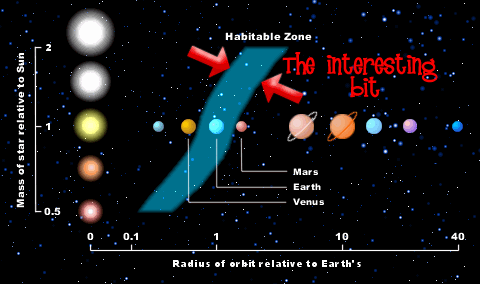
The habitable zone is the orbital region close enough to a star for a planet to have liquid water, but not so close that all of the water evaporates. For our Sun, the zone extends roughly from the inner edge of the orbit of Mars to the outer edge of that of Venus. For smaller, cooler stars, such as M-class dwarfs, the zone can be considerably closer to the star than Mercury is to the Sun. And because close-in planets are easier to spot than more distant ones, such stars have been a major target for planet hunters seeking Earth-like worlds.

There’s just one problem with finding habitable planets around such stars, says Barnes. Because tidal forces vary dramatically with the distance between a planet and its star, closer orbits also result in massively larger tidal forces.

Since planets do not have perfectly circular orbits, these tidal forces cause the planet to flex and unflex each time it moves closer to or further from its star; kneading its interior to produce massive quantities of frictional heat. Substantial heat can be produced, he added, with even slight deviations from a perfectly circular orbit. And, Barnes notes, other factors — such as the rate of the planet’s rotation and its axial tilt — can also influence heat production.

A similar tidal process makes Jupiter’s moon Io the most volcanic body in the Solar System. “I’m just scaling that Io–Jupiter system up by a factor of 1,000 in mass,” Barnes said at the meeting. “It’s the same process, on steroids.”

So, stars that are smaller and cooler will have a habitable zone that is closer to the star, exposing them to more tidal forces. More tidal forces makes their orbits less likely to stay circular – within the habitable zone around the star. These variations cause an increase in heat production on the planet. Too much heat means that the planet is unable to support liquid water on the surface, making it inhospitable for life. Therefore, solar systems with less massive stars can be ruled out as possible sites for life, because of these tidal forces.

Two astrophysicists dialog: Hugh Ross and Paul Davies on Unbelievable

Here’s the description from the Unbelievable page:

Hugh Ross is an astronomer and founder of Reasons To Believe, an apologetics organisation aiming to show why modern science confirms and supports the Christian worldview. Paul Davies is a British astrophysicist and popular science author currently based at Arizona State University. An agnostic, much of his writing has focussed on the extraordinary “fine tuning” of the Universe that allows life to exist and why the universe’s order and intelligibility defy a purely naturalistic explanation. Hugh and Paul discuss whether the properties of our Universe may be the result of a creator God, competing hypotheses such as the multiverse, whether science can be used to test the Biblical worldview… and Hugh explains why he wants NASA to look for fossils on the moon.

The MP3 file is here.

Paul Davies is one of the scientists that William Lane Craig often quotes in his debates.

Like this quote for the cosmological argument:

The evidence for the Big Bang theory of the origin of the universe points to the creation of the universe out of nothing.  Not just matter and energy, but physical space and time themselves come into existence at the Big Bang.  In the words of the British physicist P. C. W. Davies, ‘the big bang represents the creation event; the creation not only of all the matter and energy in the universe, but also of spacetime itself.’

Or this quote for the fine-tuning argument :

British physicist P. C. W. Davies has calculated that the odds against the initial conditions being suitable for later star formation (without which planets could not exist) is one followed by a thousand billion billion zeroes, at least.  He also estimates that a change in the strength of gravity or of the weak force by only one part in 10100 would have prevented a life-permitting universe.

It’s interesting that Craig chooses non-theistic scientists as sources to support his premises.

By the way, did you know that Unbelievable is having a conference later this month? Click here to find out about it, especially if you like science apologetics.

Are moral values and moral duties rationally grounded in atheism?

Brian Auten posted the audio a few milliseconds after the debate concluded!

Here is the MP3 file.

Sean’s case is similar to the one I make, but he only has 3 minimal requirements for morality.

First, he explains the difference between objective and subjective truth claims, and points out that statements of a moral nature are meaningless unless morality is objective. Then he states 3 things that are needed in order to ground objective morality.

  1. an objective moral standard
  2. free will
  3. objective moral value of humans

The question of the foundations of morality is without a doubt the easiest issue for beginning apologists to discuss with their neighbor. If you’re new, then you need to at least listen to his opening speech. He’s an excellent speaker, and his rebuttals are very, very smooth. The citations of atheist philosophers like Walter Sinnott-Armstrong, e.g. – to show that “religious” wars had nothing to do with religion, really hurt his opponent. He seems to cite prominent atheists like Thomas Nagel, Richard Taylor, Michael Shermer, etc., constantly in order to get support for his assertions. That took preparation. I can’t believe that McDowell is this calm in a debate situation.

When I listen to Frank Turek, he seems to struggle in his rebuttals. McDowell sounds like he foreknew exactly what his opponent would say and pre-wrote responses. He even had powerpoint slides made in advance for his rebuttals! I am not making this up – Corbett even remarked on it.

For those of you who want to understand how these things work, listen to the debate. There is a period of cross-examination if you like that sort of thing. I do!