
Tag Archives: Germany

American health care: does it cause poor life-expectancy and high infant mortality?

Probably one of the best health care policy experts writing today is Avik Roy, who writes for Forbes magazine.

Here is his latest column, which I think is useful for helping us all get better at debating health care policy. (H/T Matt from Well Spent Journey)

Excerpt:

It’s one of the most oft-repeated justifications for socialized medicine: Americans spend more money than other developed countries on health care, but don’t live as long. If we would just hop on the European health-care bandwagon, we’d live longer and healthier lives. The only problem is it’s not true.

[…]If you really want to measure health outcomes, the best way to do it is at the point of medical intervention. If you have a heart attack, how long do you live in the U.S. vs. another country? If you’re diagnosed with breast cancer? In 2008, a group of investigators conducted a worldwide study of cancer survival rates, called CONCORD. They looked at 5-year survival rates for breast cancer, colon and rectal cancer, and prostate cancer. I compiled their data for the U.S., Canada, Australia, Japan, and western Europe. Guess who came out number one?

Here is the raw data:
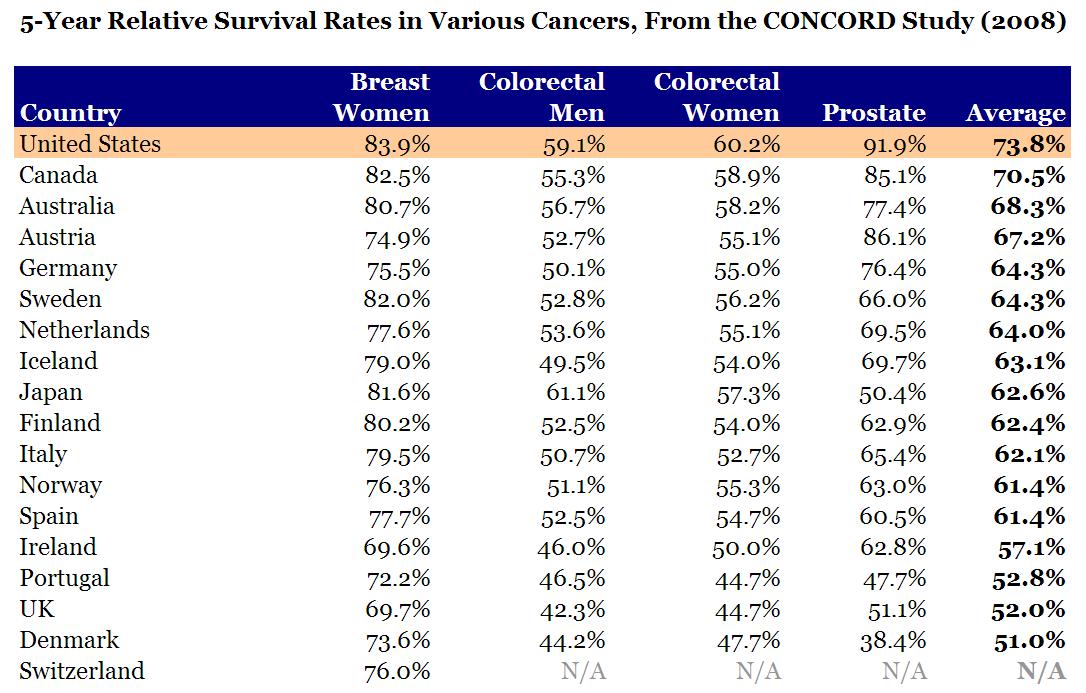
Health care outcomes
Health care outcomes by country and type of treatment

Click here to see the larger graph.

So, what explains this?

The article continues:

Another point worth making is that people die for other reasons than health. For example, people die because of car accidents and violent crime. A few years back, Robert Ohsfeldt of Texas A&M and John Schneider of the University of Iowa asked the obvious question: what happens if you remove deaths from fatal injuries from the life expectancy tables? Among the 29 members of the OECD, the U.S. vaults from 19th place to…you guessed it…first. Japan, on the same adjustment, drops from first to ninth.

It’s great that the Japanese eat more sushi than we do, and that they settle their arguments more peaceably. But these things don’t have anything to do with socialized medicine.

Finally, U.S. life-expectancy statistics are skewed by the fact that the U.S. doesn’t have one health-care system, but three: Medicaid, Medicare, and private insurance. (A fourth, the Obamacare exchanges, is supposed to go into effect in 2014.) As I have noted in the past, health outcomes for those on government-sponsored insurance are worse than for those on private insurance.

To my knowledge, no one has attempted to segregate U.S. life-expectancy figures by insurance status. But based on the data we have, it’s highly likely that those on private insurance have the best life expectancy, with Medicare patients in the middle, and the uninsured and Medicaid at the bottom.

I know that my readers who like to dig deep into economics and policy will love the links at the bottom of the article:

For further reading on the topic of life expectancy, here are some recommendations. Harvard economist Greg Mankiw discusses some of the confounding factors with life expectancy statistics, citing this NBER study by June and Dave O’Neill comparing the U.S. and Canada. (Mankiw calls the misuse of U.S. life expectancy stats “schlocky.”) Chicago economist Gary Becker makes note of the CONCORD study in this blog post. In 2009, Sam Preston and Jessica Ho of the University of Pennsylvania published a lengthy analysis of life expectancy statistics, concluding that “the low longevity ranking of the United States is not likely to be a result of a poorly functioning health care system.”

The funniest thing I have found when talking to people from countries with socialized health care systems, like Canada and the UK, is that they are woefully uninformed about American health care. They literally do not know about free emergency room care, which is free for anyone regardless of insurance – including illegal aliens. They do not know about our expensive Medicaid program, which helps people who cannot afford health insurance. And our very very expensive Medicare program, which provides health care to the elderly – including prescription drugs. I get the feeling that foreign critics of American health care are getting their views from amateur documentaries produced by uneducated Hollywood propagandists, or maybe from TV shows on the Comedy Channel. They certainly are not getting their information from peer-reviewed studies by credentialed scholars from top universities, like the ones cited above.

I have literally spoken to Canadians who think that people in the USA without insurance do not get treatment and just die in the streets from stab wounds. They don’t know about the emergency room rule, or about charity care, or about Medicaid and Medicare. There is a lot of ignorance up there – wilful ignorance, in some cases. And keep in mind that the average Canadian household is paying over $11,000 a year for this substandard health care! They are paying more for less, and that’s not surprising since a large chunk of the taxes that are collected for health care go to overpaid unionized bureaucrats. Naturally, when their left-wing politicians need treatment, the first place they go is to the United States, where they pay out of pocket for the better health care. But that doesn’t stop them from denouncing American health care when they are talking to voters.

Higher infant mortality rates?

One of the other common arguments you hear from uninformed people outside the USA is the higher infant mortality rates argument.

Here’s an article by Stanford University professor Scott Atlas to explain why the argument fails.

Excerpt:

Virtually every national and international agency involved in statistical assessments of health status, health care, and economic development uses the infant-mortality rate — the number of infants per 1,000 live births who die before reaching the age of one — as a fundamental indicator. America’s high infant-mortality rate has been repeatedly put forth as evidence “proving” the substandard performance of the U.S. health-care system.

[…]n a 2008 study, Joy Lawn estimated that a full three-fourths of the world’s neonatal deaths are counted only through highly unreliable five-yearly retrospective household surveys, instead of being reported at the time by hospitals and health-care professionals, as in the United States. Moreover, the most premature babies — those with the highest likelihood of dying — are the least likely to be recorded in infant and neonatal mortality statistics in other countries. Compounding that difficulty, in other countries the underreporting is greatest for deaths that occur very soon after birth.

[…]The United States strictly adheres to the WHO definition of live birth (any infant “irrespective of the duration of the pregnancy, which . . . breathes or shows any other evidence of life . . . whether or not the umbilical cord has been cut or the placenta is attached”) and uses a strictly implemented linked birth and infant-death data set. On the contrary, many other nations, including highly developed countries in Western Europe, use far less strict definitions, all of which underreport the live births of more fragile infants who soon die. As a consequence, they falsely report more favorable neonatal- and infant-mortality rates.

[…]Neonatal deaths are mainly associated with prematurity and low birth weight. Therefore the fact that the percentage of preterm births in the U.S. is far higher than that in all other OECD countries — 65 percent higher than in Britain, and more than double the rate in Ireland, Finland, and Greece — further undermines the validity of neonatal-mortality comparisons.

You can listen to a podcast with Dr. Atlas here, from the Library of Economics web site.

If you want to read more about how American health care compares with health care in socialized systems, read this article by Stanford University professor of medicine Dr. Scott Atlas. And you can get his book “In Excellent Health: Setting the Record Straight on America’s Health Care” from Amazon.
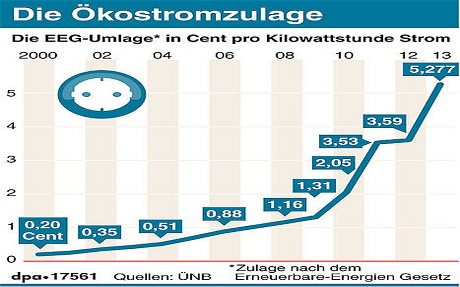
How well is government promotion wind and solar power working out in Germany?

Surcharge paid by German households and SMEs

First, let’s hear from the ultra-leftist New York Times. (H/T Dennis Prager)

Excerpt:

It is an audacious undertaking with wide and deep support in Germany: shut down the nation’s nuclear power plants, wean the country from coal and promote a wholesale shift to renewable energy sources.

But the plan, backed by Chancellor Angela Merkel and opposition parties alike, is running into problems in execution that are forcing Germans to come face to face with the costs and complexities of sticking to their principles.

German families are being hit by rapidly increasing electricity rates, to the point where growing numbers of them can no longer afford to pay the bill. Businesses are more and more worried that their energy costs will put them at a disadvantage to competitors in nations with lower energy costs, and some energy-intensive industries have begun to shun the country because they fear steeper costs ahead.

Newly constructed offshore wind farms churn unconnected to an energy grid still in need of expansion. And despite all the costs, carbon emissions actually rose last year as reserve coal-burning plants were fired up to close gaps in energy supplies.

A new phrase, “energy poverty,” has entered the lexicon.

“Often, I don’t go into my living room in order to save electricity,” said Olaf Taeuber, 55, who manages a fleet of vehicles for a social services provider in Berlin. “You feel the pain in your pocketbook.”

Mr. Taeuber relies on just a single five-watt bulb that gives off what he calls a “cozy” glow to light his kitchen when he comes home at night. If in real need, he switches on a neon tube, which uses all of 25 watts.

Even so, with his bill growing rapidly, he found himself seeking help last week to fend off a threat from Berlin’s main power company to cut off his electricity. He is one of a growing number of Germans confronting the realities of trying to carry out Ms. Merkel’s most ambitious domestic project and one of the most sweeping energy transformation efforts undertaken by an industrialized country.

[…]The cost of the plan is expected to be about $735 billion, according to government estimates, and may eventually surpass even that of the euro zone bailouts that have received far more attention during Ms. Merkel’s tenure. Yet as the transition’s unknowns have grown, so have costs for the state, major companies and consumers.

[…]With consumers having to pay about $270 each in surcharges this year to subsidize new operators of renewable power, the hardest hit are low-wage earners, retirees and people on welfare, Mr. Gärtner said. Government subsidies for the plan amounted to $22.7 billion in 2012 and could reach $40.5 billion by 2020, according to John Musk, a power analyst at RBC Capital Markets.

[…]Part of the reason consumer prices have risen so sharply is that, for now, the government has shielded about 700 companies from increased energy costs, to protect their competitive position in the global economy.

Industrial users still pay substantially more for electricity here than do their counterparts in Britain or France, and almost three times as much as those in the United States, according to a study by the German industrial giant Siemens. The Cologne Institute for Economic Research said there had been a marked decline in the willingness of industrial companies to invest in Germany since 2000.

Note that German industry has been EXEMPT from paying the green energy surcharge. Households and small-to-medium-size enterprises are paying it.

The key part of the article, I think, is this:

One of the first obstacles encountered involves the vagaries of electrical power generation that is dependent on sources as inconsistent and unpredictable as the wind and the sun.

And no one has invented a means of storing that energy for very long, which means overwhelming gluts on some days and crippling shortages on others that require firing up old oil- and coal-burning power plants. That, in turn, undercuts the goal of reducing fossil-fuel emissions that have been linked to climate change.

Last year, wind, solar and other nonfossil-fuel sources provided 22 percent of the power for Germany, but the country increased its carbon emissions over 2011 as oil- and coal-burning power plants had to close gaps in the evolving system, according to the German electricity association BDEW.

Didn’t anyone think of that problem before starting out this crazy plan? No. Because they important thing was feelings – politicians had to feel good about solving a made-up crisis.

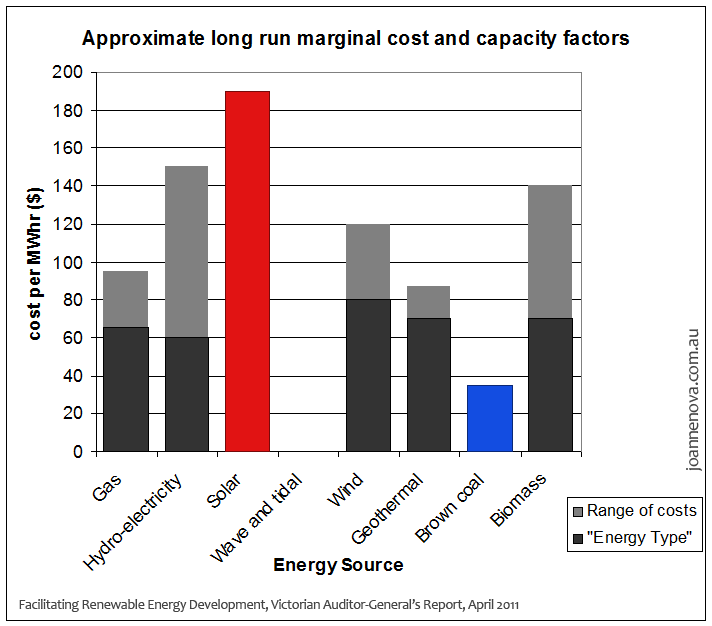
Cost of renewable wind and solar energy

Why can’t leftists learn from the failed experiments of others?

Government-subsidized green energy scams have been tried before in Spain and Denmark. Did they work?

Well, we know that in Spain, the green jobs programs failed. (H/T ECM)

Excerpt:

Subsidizing renewable energy in the U.S. may destroy two jobs for every one created if Spain’s experience with windmills and solar farms is any guide.

For every new position that depends on energy price supports, at least 2.2 jobs in other industries will disappear, according to a study from King Juan Carlos University in Madrid.

U.S. President Barack Obama’s 2010 budget proposal contains about $20 billion in tax incentives for clean-energy programs. In Spain, where wind turbines provided 11 percent of power demand last year, generators earn rates as much as 11 times more for renewable energy compared with burning fossil fuels.

The premiums paid for solar, biomass, wave and wind power – – which are charged to consumers in their bills — translated into a $774,000 cost for each Spanish “green job” created since 2000, said Gabriel Calzada, an economics professor at the university and author of the report.

“The loss of jobs could be greater if you account for the amount of lost industry that moves out of the country due to higher energy prices,” he said in an interview.

The Heritage Foundation cites a study from Denmark, which shows that wind power has also failed.

Excerpt:

But according to a new study from the Danish Centre for Political Studies (CEPOS), commissioned by the Institute for Energy Research, the road to increased wind power is less traveled for a reason. The study refutes the claim that Denmark generates 20 percent of its power from wind stating that its high intermittency not only leads to new challenges to balance the supply and demand of electricity, but also provides less electricity consumption than assumed. The new study says, “wind power has recently (2006) met as little as 5% of Denmark’s annual electricity consumption with an average over the last five years of 9.7%.” Furthermore, the wind energy Denmark exports to its northern neighbors, Sweden and Norway, does little to reduce carbon dioxide emissions because the energy it replaces is carbon neutral.

The study goes on to say that the only reason wind power exists in Denmark is “through substantial subsidies supporting the wind turbine owners. Exactly how the subsidies have been shared between land, wind turbine owners, labor, capital and its shareholders is opaque, but it is fair to assess that no Danish wind industry to speak of would exist if it had to compete on market terms.”

But there’s a cost involved. When government spends more money, it necessarily diverts labor, capital and materials from the private sector. Just like promises are made in the United States about green jobs creation, the heavily subsidized Danish program created 28,400 jobs. But “this does not, however, constitute the net employment effect of the wind mill subsidy. In the long run, creating additional employment in one sector through subsidies will detract labor from other sectors, resulting in no increase in net employment but only in a shift from the non-subsidized sectors to the subsidized sector.”

And because these resources are being diverted away from more productive uses (in terms of value added, the energy technology underperforms compared to industrial average), “Danish GDP is approximately $270 million lower than it would have been if the wind sector work force was employed elsewhere.”

Why do people keep voting in leaders who don’t know what they are doing? Why are people surprised when emotional craziness and moral preening doesn’t work out financially?

Previously, I blogged about how Obama was causing our electricity prices to skyrocket by effectively banning coal power. Not to mention blocking the Keystone XL pipeline. Keep that in mind when you are lighting your house with 5 Watt light bulbs. This doesn’t happen by accident – you need politicians to wage war on the free market system in order for this to happen. And that’s what we’ve been voting for in the last two elections.

Related Posts

Police invade home of homeschooling family and seize four children

The UK Daily Mail reports.

Excerpt:

Armed police in Germany launched a terrifying raid on a family’s home to seize their four children after they defied the country’s ban on home schooling.

A team of 20 social workers, police officers, and special agents stormed the home of Dirk and Petra Wunderlich because they refused to send their children to state schools.

The youngsters were taken to unknown locations after officials allegedly ominously promised the parents that they would not be seeing them again ‘any time soon’.

The only legal grounds for the removal of the children, aged from seven to 14, were the family’s insistence on home schooling their children, with no other allegations of abuse or neglect.

According to court documents obtained and translated by the Home Schooling Legal Defense Association (HSLDA), officials did not even allege that the parents had failed to provide an adequate education.

The raid took place on Thursday morning at 8am at the Wunderlichs’ home near Darmstadt, 25 miles south of Frankfurt, in south-west Germany.

Citing the parents’ failure to cooperate ‘with the authorities to send the children to school’, the judge even authorised the use of force ‘against the children’ if necessary, according to court documents cited by the HSLDA.

[…]Mr Wunderlich said that he and his wife had been left devastated by the authorities’ decision to take their children. He said that his 14-year-old daughter Machsejah had to be forcibly taken out of the home.

‘When I went outside, our neighbour was crying as she watched. I turned around to see my daughter being escorted as if she were a criminal by two big policemen,’ he said.

‘They weren’t being nice at all. When my wife tried to give my daughter a kiss and a hug goodbye, one of the special agents roughly elbowed her out of the way and said — “It’s too late for that”.

‘What kind of government acts like this?’

Funny that you would ask that, Mr. Wunderlich, because here’s a story about a German homeschooling family that is being ejected from the United States.

Excerpt:

The White House has posted a response to the petition to stop the deportation of the Romeikes, a homeschooling family from Germany. The White House does not respond to issues before the courts, the response said, but they understand why parents would value the freedom to homeschool.

[…]Though the White House says it understands why parents would value the freedom to homeschool, the administration, through the Justice Department, has been trying to deport the Romeikes back to Germany, where they could lose custody of their children if they were to continue to homeschool. In the various court cases, the Justice Department has argued that the right of parents to decide their children’s education is not a fundamental right, and it agreed with a German court’s opinion that banning homeschooling teaches tolerance of diverse views.

The Romeikes lost their last appeal in the U.S. Sixth Circuit Court of Appeals. The Home School Legal Defense Association, which represents the Romeikes, has now appealed the case to the Supreme Court.

In a blog post on the HSLDA website, HSLDA Chairman Michael Farris criticized the administration for taking so long say that it could not respond, and for allowing certain current unauthorized immigrants, the so-called “dreamers,” to stay in the country while going out of its way to try to deport one family.

“No one can understand why the White House is showing so much leniency to millions of immigrants who have come here illegally in hopes of securing better jobs, but is so determined to deport this one family who has come to America in search of freedom for themselves and their children,” Farris declared. “This petition was the perfect opportunity for the White House to explain why this administration appealed the original grant of asylum. This was a perfect opportunity for the White House to explain the blatantly unequal treatment being received by the Romeike family. But the White House stalled for four months and said absolutely nothing.”

Isn’t that interesting? The same administration that is pushing for amnesty for 20 million illegal immigrants wants to deport one family for homeschooling their children. What is it that causes people on the left to want to drive a wedge between parents and their own children? Why are they so anxious to raise taxes so that both parents are forced to work, and the children will be raised in government-run public schools? What is their goal in doing that? What pleasure do they get out of separating mothers from their 1-year olds? What pleasure do they get in taking a man’s child away and teaching the child things that are opposed to the father’s values – while taking his salary to pay for it?

I know that there are a lot of people who are very passionate about public education, and making everyone equal, and pushing left-wing ideologies onto children against the will of their parents. Every Democrat votes for it when they vote to tax families more to pay for higher pay and benefits for public school teachers. Still, you would think that a story like this might cause them to think twice about what their support for state-run education really means. Make no mistake, Democrats are opposed to homeschooling, and even private schooling. They don’t want parents to have a say – they just want them to pay for whatever the government decides to do with their children.