Tag Archives: Gambling

The lottery is a voluntarily tax on the poorest people

You need to study math so that you don't end up doing this your whole life
You need to study math so that you don’t end up doing this your whole life

Here is a good article on basic economics by Arthur C. Brooks, president of the American Enterprise Institute (a free market think tank).

He writes in the Wall Street Journal:

Powerball—the lottery shared by 44 states, the District of Columbia and two territories—is just one of the sweepstakes run by 47 jurisdictions in the U.S. These games produce nearly $70 billion a year in government revenue and enjoy profits of about 33%—much higher than margins in the private gambling industry.

Who are these lotteries’ most loyal customers? Poor people. Lots of folks buy the occasional ticket, but studies have long shown a steady association between poverty and lottery play. Many scholars report that the poorest third of Americans buy more than half of all lotto tickets, which is why states advertise so aggressively in poor neighborhoods.

Harmless entertainment, you may say, but poor people don’t see it that way. They tend to view lottery tickets as an investment. Duke University social scientists Charles Clotfelter and Philip Cook reported in a 1990 study that people earning less than $30,000 a year are 25% more likely to say they play the lottery for the money rather than the entertainment.

[…]Even if someone feels compelled to throw a financial “Hail Mary,” the lottery is a terrible choice. The odds of winning last week’s jackpot were about 1 in 292 million. And the average return from $1 spent on lottery tickets is 52 cents, according to a 2002 paper by Melissa Kearney, an economist now at the University of Maryland.

But this isn’t easy to see for those with low levels of education. My own analysis of survey data from the National Gambling Impact Study Commission suggests that someone who didn’t attend college may think the return on lottery tickets is 40% higher than the estimate given by a person of similar demographics who holds a degree.

If you took a poll of how people who bought lottery tickets voted, I’m certain that you would find that 90% of them are Democrats. This is because Democrats are economically illiterate, judging for their support for minimum wage increases and opposition to free trade. I suppose there would be a fair number of Donald Trump supporters in there, too. People can can do math don’t buy lottery tickets. It’s much better to pay off debt and then start saving for your retirement. Although public schools used to teach math and basic economics, now they are so busy teaching young people to hate their parents, their God and their country that there is no time for teaching math and basic economics. Even if the public school teachers knew math and basic economics, which they probably don’t, judging by how members of teacher unions vote.

Apparently, people on the political left now oppose teaching math, because it’s racist or sexist or something.

The Daily Caller explains:

Is math sexist? One Vanderbilt University professor believes that it is.

Writing in an academic journal last month, the professor complained about the masculinization of math and how it causes the oppression of women.

Describing mathematics as a “white and heteronormatively masculinized space,” professor Luis A. Leyva insists that factors including teacher expectations and cultural norms “serve as gendering mechanisms that give rise to sex-based achievement differences,” per Campus Reform.

[…]In the article titled “Unpacking the Male Superiority Myth and Masculinization of Mathematics at the Intersection,” Leyva says that teachers “contribute to the masculinization of the  domain that unfairly holds students to men’s higher levels of achievement and participation as a measure of success.”

In other words, being held to a high standard keeps women down.

Do you ever wonder why Democrats want to halt all education reform? Well, people who can’t do math tend to be awful at earning and saving money. And do you know what happens to people who are terrible at earning and saving money? They become dependent on welfare and they vote for bigger government, i.e. – Democrats.

The Pew Research Center, a liberal organization, actually did a study on this uninformed voter problem.

Excerpt:

So Republicans are more knowledgeable than Democrats, contrary to what many would like to believe.

According to whom?  None other than the Pew Research Center, a left-of-center organization.  Moreover, Pew’s latest survey only reaffirms previous surveys demonstrating the same result.

In fact, the results weren’t even close.

In a scientific survey of 1,168 adults conducted during September and October of last year, respondents were asked not only multiple-choice questions, but also queries using maps, photographs and symbols.  Among other subjects, participants identified international leaders, cabinet members, Supreme Court justices, nations on a world map, the current unemployment and poverty rates and war casualty totals.

In a 2010 Pew survey, Republicans outperformed Democrats on 10 of 12 questions, with one tie and Democrats outperforming Republicans on just 1 of the 12.  In the latest survey, however, Republicans outperformed Democrats on every single one of 19 questions.

[…]Those Pew results are confirmed by some surprising other sources.  According to a New York Times headline dated April 14, 2010, “Poll Finds Tea Party Backers Wealthier and More Educated.”  Shattering widespread myths, that survey revealed that Tea Party supporters were more likely to possess a college degree than their counterparts (23% to 15%), and also more likely to have completed post-graduate studies (14% to 10%).  Tea Partiers were also more likely to have completed “some college” by a 33% to 28% margin, and substantially less likely to have not completed high school than non-supporters (3% versus 12%), or to possess only a high school degree (26% versus 35%).

I hope no readers of this blog drop math before they go to college or trade school, and you all better be studying something that pays if you do go to college. I don’t want to catch any of you buying lottery tickets as your retirement plan. I want to encourage you all to make a long-term plan for your retirement, and make sure that the pieces in the short-term fit with that long-term plan.

New report: Americans rank last in problem solving using technology

The Wall Street Journal reports on a new analysis of problem solving skills.

Excerpt:

A new report finds U.S. workers rank dead last among 18 industrial countries when it comes to “problem solving in technology-rich environments,” or using digital technology to evaluate information and perform practical tasks. The consequences of that emerging competitive disadvantage is energizing the volatile undercurrent of this year’s presidential race, some observers say.

If the problem-solving deficit is bad, the reasons for it may be worse, said Stephen Provasnik, the U.S. technical adviser for the International Assessment for Adult Competency: flagging literacy and numeracy skills, which are the fundamental tools needed to score well on the survey.

[…]The results build off a global survey conducted in 2012 by the Organization for Economic Cooperation and Development. To better compare the skills of younger and older adults and the unemployed, researchers did additional surveys in 2014. The countries that scored the highest on the problem-solving with technology criteria were Japan, Finland, Sweden and Norway. Poland scored second to last, just above the U.S.

One stark revelation is that about four-fifths of unemployed Americans cannot figure out a rudimentary problem in which they have to spot an error when data is transferred from a two-column spreadsheet to a bar graph. And Americans are far less adept at dealing with numbers than the average of their global peers.

Why is that a problem? It’s a problem because the best jobs all require proficiency in math.

Consider these starting salaries and mid-career salaries for various majors:

Starting and Mid-Career salaries by profession (click for larger image)

(Source)

The common denominator in all these degrees is mathematics, which is out of favor with many Americans. But clearly learning math would enable them to get the highest paying jobs – private sector STEM jobs. So why aren’t they learning math?

People drop math because it’s too hard

People who drop math typically do so because they want to focus on other things that are less difficult. Most of them just want to have fun… sometimes with watching TV all day, sometimes with premarital sex, sometimes with alcohol and drugs. Families break down as women choose hot, irresponsible men and have babies with them out of wedlock. And those kids learn less than their parents knew. There just isn’t any interest in much of America about learning hard things like math, so you can get those private sector STEM jobs that pay well.

Consider this post by Kevin Williamson in National Review magazine:

The white middle class may like the idea of Trump as a giant pulsing humanoid middle finger held up in the face of the Cathedral, they may sing hymns to Trump the destroyer and whisper darkly about “globalists” and — odious, stupid term — “the Establishment,” but nobody did this to them. They failed themselves.

If you spend time in hardscrabble, white upstate New York, or eastern Kentucky, or my own native West Texas, and you take an honest look at the welfare dependency, the drug and alcohol addiction, the family anarchy — which is to say, the whelping of human children with all the respect and wisdom of a stray dog — you will come to an awful realization. It wasn’t Beijing. It wasn’t even Washington, as bad as Washington can be. It wasn’t immigrants from Mexico, excessive and problematic as our current immigration levels are. It wasn’t any of that.

Nothing happened to them. There wasn’t some awful disaster. There wasn’t a war or a famine or a plague or a foreign occupation. Even the economic changes of the past few decades do very little to explain the dysfunction and negligence — and the incomprehensible malice — of poor white America. So the gypsum business in Garbutt ain’t what it used to be. There is more to life in the 21st century than wallboard and cheap sentimentality about how the Man closed the factories down.

The truth about these dysfunctional, downscale communities is that they deserve to die. Economically, they are negative assets. Morally, they are indefensible. Forget all your cheap theatrical Bruce Springsteen crap. Forget your sanctimony about struggling Rust Belt factory towns and your conspiracy theories about the wily Orientals stealing our jobs. Forget your goddamned gypsum, and, if he has a problem with that, forget Ed Burke, too. The white American underclass is in thrall to a vicious, selfish culture whose main products are misery and used heroin needles. Donald Trump’s speeches make them feel good. So does OxyContin. What they need isn’t analgesics, literal or political. They need real opportunity, which means that they need real change, which means that they need U-Haul.

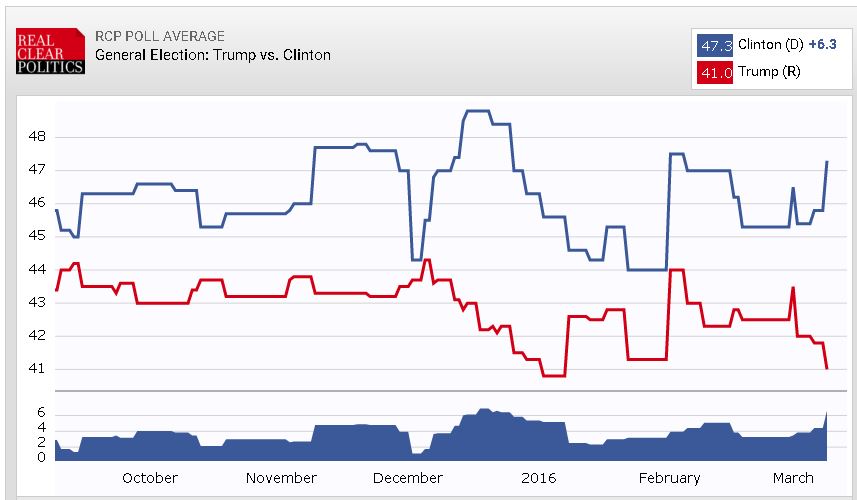
Trump vs Hillary head-to-head: No Trumpkin can make sense of this chart
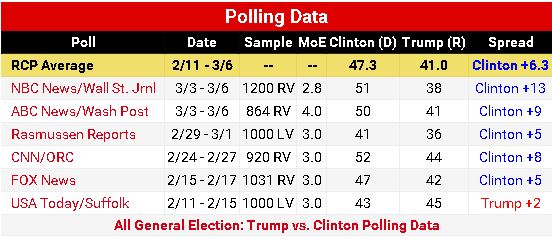
Trump vs Hillary head-to-head: Trumpkins lack the math skills to make sense of this table

David French, who grew up in Kentucky, and then attended Harvard Law School, adds this in National Review:

These are strong words, but they are fundamentally true and important to say. My childhood was different from Kevin’s, but I grew up in Kentucky, live in a rural county in Tennessee, and have seen the challenges of the white working-class first-hand. Simply put, Americans are killing themselves and destroying their families at an alarming rate. No one is making them do it. The economy isn’t putting a bottle in their hand. Immigrants aren’t making them cheat on their wives or snort OxyContin. Obama isn’t walking them into the lawyer’s office to force them to file a bogus disability claim.

For generations, conservatives have rightly railed against deterministic progressive notions that put human choices at the mercy of race, class, history, or economics. Those factors can create additional challenges, but they do not relieve any human being of the moral obligation to do their best.

Yet millions of Americans aren’t doing their best. Indeed, they’re barely trying. As I’ve related before, my church in Kentucky made a determined attempt to reach kids and families that were falling between the cracks, and it was consistently astounding how little effort most parents and their teen children made to improve their lives. If they couldn’t find a job in a few days — or perhaps even as little as a few hours — they’d stop looking. If they got angry at teachers or coaches, they’d drop out of school. If they fought with their wife, they had sex with a neighbor. And always — always — there was a sense of entitlement.

And that’s where disability or other government programs kicked in. They were there, beckoning, giving men and women alternatives to gainful employment. You don’t have to do any work (your disability lawyer does all the heavy lifting), you make money, and you get drugs. At our local regional hospital, it’s become a bitter joke the extent to which the community is hooked on “Xanatab” — the Xanax and Lortab prescriptions that lead to drug dependence.

Of course we should have compassion even as we call on people to do better. I have compassion for kids who often see the worst behavior modeled at home. I have compassion for families facing economic uncertainty. But compassion can’t excuse or enable self-destructive moral failures.

Chart showing Trump vs Clinton: Trumpkins can't read this
Chart showing Trump vs Clinton: Trumpkins can’t read this chart, because it requires math skills

I have compassion for the kids, too. But not for the grown-ups, who seem to think that the world owes them a living even if they avoid learning hard things like math, and behave immorally. But there is no guarantee of success for people who don’t learn math, and who don’t behave morally. And it’s not anyone else’s fault.

Related posts

New study: gambling hurts the poorest people in society

The Albany Times-Union reports on a new study on gambling. (H/T Al Mohler podcast)

Excerpt:

Few things are clear about the expansion of casinos in New York, but additional slot machines will add significantly to problem gambling and may not be economically rewarding for the state, according to a fresh study by the Institute for American Values.

Note, the IAV’s president is a pro-gay-marriage moderate. Don’t be fooled by the conservative name.

More:

The institute’s new report, “Why Casinos Matter,” is based on several government and academic studies here and abroad. The authors arrived at several conclusions:

The new American casino is mostly a center filled with slot machines — essentially sophisticated computers designed to addict players. The machines figure out betting patterns and provide just enough in rewards to keep a person hooked for hours. “The more you play, the more you lose,” the report says, backing up the statement with findings by MIT anthropologist Natasha Schull. Schull details her observations in the 2012 book “Addiction by Design: Machine Gambling in Las Vegas.”

Modern slot machines “engineer the psychological experience of being in the ‘zone’ — a trancelike state that numbs feeling and blots out time/space. For some heavy slot players, the goal is not winning money,” the study said.

Casinos depend on problem gamblers for their revenue base, drawing 40 to 60 percent of slot machine revenues from these people, many of whom are low rollers.

Living near a casino or working at a casino increases the chance of becoming problem gambler. Those who live within 10 miles of a casino are twice as likely to be a problem gambler than those who do not.

Problem gambling is more widespread than many casino industry leaders claim. The problem gamblers frequently go to a casino, and their lives and livelihoods may be adversely affected by their betting. They are not necessarily the heavy gamblers who are pathological and who suffer from increasing preoccupations to gamble and a loss of control.

The benefits of casinos are short-term and easy to measure, but many costs pop up during the longer term that are harder to quantify. Economic stimulus fades after the casino becomes a dominant business that drives out established local businesses, such as restaurants, replacing them with pawnshops, auto title lenders and check-cashing stores. And since problem gambling develops over four to seven years, the stress on families and finances may gradually become apparent.

State regulation of casinos creates a conflict of interest. Government is supposed to protect people from harmful business practices, but the state is a partner with casinos or is co-sponsoring gambling. In New York, the Cuomo administration announced last week that it anticipates $430 million a year in annual revenues — $192 million for local governments and $238 million for schools or property tax relief — from four new upstate casinos. The New York Division of the Lottery reported almost $9 billion in revenues last year, a record, with more than $3 billion of that going to public education.

Although people on the left, like Mario Cuomo, like to talk about helping the poor, they actually favor policies that hurt the poor. It’s very important to separate what people say in front of cameras with what effects their policies actually cause. Good effects are more important than good intentions.