Tag Archives: Freedom

Scott Walker signs right-to-work: workers not forced to join a union in order to work

Scott Walker signs right-to-work law
Gov. Scott Walker signs right-to-work bill

He has a diary up at Red State, the grassroots conservative web site, where he explains why he did it.

He writes:

When I took office as governor of Wisconsin in 2011, I called together our new Republican majority in the legislature and told them it was time to “put up or shut up.” As the elected leaders of our state, we owed it to our fellow Wisconsinites to follow through with our promises and to tackle the big issues head on.

Our first order of business was reclaiming power for the people of our state. For too long, the big government union bosses had called the shots in our state capital.

At the time, Wisconsin faced a $3.6 billion budget shortfall. We needed to reduce spending, yet collective bargaining by public employees had limited the ability of taxpayers and local governments to control that spending. Taxpayers picked up the tab for all pension contributions and most health insurance contribution. The unions even had a virtual monopoly on schools’ health insurance business by having negotiated requirements to use a union-owned insurance company. Unions didn’t even have to collect their own dues—taxpayers footed the bill for that too.

To change all this, we enacted legislation that became known as Act 10.This is the bill that prompted all the protests in our capitol building and even in front of my personal home. But for all the attention, it was really pretty commonsense legislation.

With Act 10, we reformed the collective bargaining laws so that public employees now make modest contributions to their healthcare and pensions—much like private sector employees. Public employees can now decide for themselves whether to join a union. And while unions can still collectively bargain for wages, they can’t bargain over things like the size of bulletin boards or getting paid time off for union business.

Act 10 also allowed local governments and districts to pay employees based on merit and not just seniority. Teachers can get raises and promotions for a doing a good job—not just being there the longest. Taxpayers get a better deal because local governments can shop around for the most affordable employee insurance plans.

Because Act 10 freed up funds for school districts, fewer have had to lay off teachers. In fact, the three districts with the most teacher layoffs following Act 10 were ones that did not adopt the reforms.

In short, Act 10 ensured that the state government treated taxpayers fairly and spent tax dollars more effectively. While the D.C.-based special interests have attacked us for it, the people of Wisconsin like what they see. We have been re-elected three times in four years.

Now we are once again presented with another chance at big and bold reform—taking on the special interests a second time. Yesterday, the Wisconsin state Senate passed Freedom to Work legislation, which will mean no Wisconsin worker can be forced to join a union as a condition of employment. I will sign the bill into law.

I’ve supported Freedom to Work for years, dating back to my time in the state legislature when I co-sponsored it. And now the people of Wisconsin have voiced their support through their state Senators and representatives. According to polling, 69 percent of Wisconsinites support the policy, and a majority of union households—51 percent—also support the law.

Here’s why I’m signing Freedom to Work in Wisconsin: it is good for economic growth. In the last decade, forced unionization states have had about half the rate of wage growth, job growth and manufacturing growth as Right to Work states. Adjusted for cost of living, employees in forced unionization states have almost $2,000 less disposable income. Bottom line, this reform is pro-freedom and pro-work for Wisconsin.

Here’s the right-to-work map now:

Right to Work Map 2015

Please see below to learn more about Scott Walker. If you look over the stories below, you can see how he took an incremental approach to getting the support for this law. First, reformed collective bargaining, to prevent unions signing deals with health care providers they own, etc. Second, cut off automatic deduction of union dues, to force unions to spend their own money to collect the dues, further limiting their ability to interfere in politics. Third, pass this right-to-work law, to allow conservative blue-collar mid-Westerners to work a job without having to shell out money to the unions. The law passed with a majority of union households supporting it. They want their take-home pay! Walker is sitting in a blue state that has gone for Democrats in every presidential election since 1984. He knows how to get conservative reforms passed – by chipping away at his opponents and building consensus.

Get caught up!

The Weekly Standard has an excellent re-cap on Walker’s accomplishments as governor. If you don’t know Walker’s history in Wisconsin, please read it!

One snippet:

Which is that Scott Walker is a very bad man. And not merely because he opposes the progressive agenda and would like to roll back its successes. Hell, all kinds of right wing pols want to do that.  Or say they do, anyway. You shake a Republican tree and half-a-dozen of them fall to the ground, talking about repealing this and defunding that. But Scott Walker is unusual, maybe even unique, and recalls the old joke about the graduate student out doing sociological research on religion in the rural South.  He comes upon an old son of the soil and after a bit of conversation to soften him up, says delicately, “I’m wondering, sir, since you are a religious man, if you believe in Baptism by immersion.”

The old fellow squints and spits and says. “Believe in it?  Hell, sonny, I seen it done.”

When it comes to rolling back the progressive agenda, you see, Walker has actually done it. That’s what the recall election was about. His enemies, many of whom still bear the tread marks of his tires on their backs, know that he is not another hapless Republican who makes it his business to raise taxes to pay for the excesses of the other party and calls that good government. Instead of enabling bloated government, he takes it on.

Walker’s appeal, one suspects, is based on a sense among the demoralized citizenry that government at all levels lives high, doesn’t deliver, and fears no man.

There is a reason that people like this guy. He talks moderate, and then mauls his opponents in horrible ways. I almost feel sorry for them, except not really. We have an $18.5 trillion dollar debt, and we need to have a grown-up at the helm in 2016.

Related posts

Republicans propose expansion of 529 college savings plans

I guess by now everyone has heard about Obama’s plan to eliminate college savings plans.

The left-leaning New York Times reported on it:

President Obama is proposing a radical change to the 529 college savings plans held by millions of families, which would require those who use them to rethink their approach to college savings.

As part of his plan to simplify the tax code and help the middle class, one of the 529 plan’s most attractive benefits would be eliminated: Money could no longer be withdrawn tax-free. (The new rules would apply only to new contributions.)

The accounts, many of which are run by the states, allow people to make contributions that grow tax-free. The money can be withdrawn without the paying of capital gains taxes as long as the proceeds are used for education expenses. Many states provide state income tax deductions for contributions as well.

The proposal has now been withdrawn after a huge uproar. The real question is, why would he propose such a stupid thing?

First, it’s important to understand that government raises the cost of higher education with subsidies, which the Democrats favor:

A new study by Dennis Epple, Richard Romano, Sinan Sarpca and Holger Sieg for the National Bureau of Economic Research suggests that the impact of these aid programs is clearly different from what federal policy makers intended. “We show that private colleges game the federal financial aid system,” they conclude. Every dollar in new financial aid to students leads to about 40 cents less spent by the colleges on institutional financial aid — so students benefit far less than federal policy makers intended.

In 1987, Secretary of Education William Bennett argued that more federal aid leads to higher tuitions, enabling schools to increase spending. This seems broadly consistent with the latest research results. The net attendance impact of these federal programs, according to the study for NBER, is “modest.” In short, these programs haven’t substantially spurred student access to colleges, all the while burdening taxpayers and student borrowers.

The ballooning federal aid increases schools’ spending. The researchers don’t analyze changes in university spending, but an examination of other evidence suggests that money isn’t going primarily into improving instruction. Colleges have gone on a building spree (financed in part by amassing large debt — more than $220 billion at schools whose bonds are rated by Moody’s alone), and pay and perquisites for top university administrators has risen sharply.

The Democrats already want higher education to be out of reach – that’s why they keep increasing subsidies. So, eliminating college savings plans is in line with this goal of putting higher education out of reach. It’s another way to cause people to have fewer children, something that Democrats are very passionate about. After all, if you can’t pay for higher education for four kids, you’ll only have two. Democrats have this terrible fear of over-population, and it drives a lot of their policies, including abortion.

But that’s not all – there’s another reason to stop people from saving for college.

Second, it stops people from saving their own money:

Megan McArdle suggests, quite reasonably, that this is a desperate move by those who need to finance ever bigger government and are simply going where the money is: the vast American middle class. You can understand why the champions of big government would be slavering over the very thing that defines the middle class, its savings. As she points out, 529s are not the first target. There have already been trial balloons about raiding 401(k)s and IRAs. The truly committed leftist looks upon our private savings as a vast reserve of capital unfairly withheld from its proper function of servicing the needs of the state.

I think that’s the real explanation. This is not so much a rational calculation about how to finance the behemoth state. This is an admission by a man who has no more election campaigns to run, and therefore no pragmatic constraints, about his real outlook and real preferences. A president who just a few weeks ago hailed the triumph of a supposed “middle-class economics” is revealing his hatred and contempt for the middle class.

Republicans would like to see people saving more and more money so that they are less and less dependent on the government. This is because the more independent you are, the more fre you are – and Republicans are for personal liberty.

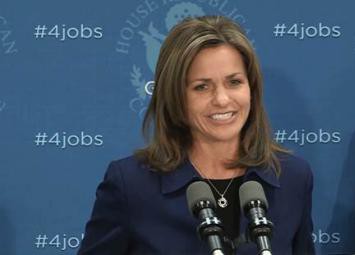
This is GOP Congressman Lynn Jenkins:

Kansas Congresswoman Lynn Jenkins

Here is her Republican response to Obama’s proposal to eliminate 529s:

Good morning. I’m Lynn Jenkins, Congresswoman from the Second District of Kansas and Vice-Chair of the House Republican Conference.

This is the time of year when high school seniors are putting the final touches on their college applications. That means it’s also the time when families are preparing to start paying for that education — whether it’s a 4-year college, community college, or a technical school. (Scroll down for video of these remarks.)

As a parent with two children in college, I know this can be one of the most rewarding, and at the same time challenging, aspects of being a parent — particularly at a time when costs are going up while wages stay about the same. All told, Americans now owe more than $1 trillion in student loan debt.

And so in the new Congress, Republicans are working to lower costs for middle-class families and empower folks with bottom-up solutions that help prepare you for the future.

That’s why, this week, I introduced a bipartisan plan to expand popular 529 college savings accounts.

As you know, these 529 plans were created to help middle-class families save and plan for college. Many parents open them not long after their children are born. And ever since Congress allowed folks to withdraw from these accounts tax-free for college expenses, 1 million account holders have turned into 12 million.

Unfortunately, instead of expanding 529s, the president recently proposed raising taxes on college savings. If implemented his scheme would have turned back the clock on middle-class families, and taken money from your savings to pay for more government. This would have discouraged families from using 529s, meaning less savings, more debt, and more government dependence.

This proposal increases middle-class independence from the government, and makes people more free to work, earn, save and chart their own course. It’s different from the Democrat proposals which increase dependence on government and reduces liberty.

Should Christians be committed to small government conservatism?

I found a paper (PDF) on the University of Washington web site that makes the case for why Christians ought to care about more than just social issues.

Here’s the abstract:

What accounts for cross-national variation in religiosity as measured by church attendance and non-religious rates? Examining answers from both secularization theory and the religious economy perspective, we assert that cross-national variation in religious participation is a function of government welfare spending and provide a theory that links macro-sociological outcomes with individual rationality. Churches historically have provided social welfare. As governments gradually assume many of these welfare functions, individuals with elastic preferences for spiritual goods will reduce their level of participation since the desired welfare goods can be obtained from secular sources. Cross-national data on welfare spending and religious participation show a strong negative relationship between these two variables after controlling for other aspects of modernization.

Here’s the conclusion:

It is quite apparent that there is a strong statistical relationship between state social welfare spending and religious participation and religiosity. Countries with higher levels of per capita welfare have a proclivity for less religious participation and tend to have higher percentages of non-religious individuals. People living in countries with high social welfare spending per capita even have less of a tendency to take comfort in religion, perhaps knowing that the state is there to help them in times of crisis.34 As laid out in the theory above, there is likely a substitution effect for some individuals between state-provided services and religious services. Religion will still be there to serve the spiritual needs of people seeking answers to the philosophic mysteries of life, but those who value those spiritual goods less than the tangible welfare benefits churches provide will be less likely to participate in religious services once secular substitutes become available. Given that religious practice and values are often passed down from generation to generation, the weakening of practice in one generation will likely translate into weaker practice in subsequent generations. Does this mean that secularization theory is correct in its prediction that religion will gradually fade away? Doubtful. Realizing that there is still a yearning among many people to understand the mysteries of life, religion is not likely to dissipate at any time soon. Government simply cannot offer credible substitutes for these less tangible, supernatural goods. The explosion in spirituality once religion was made legal in former Soviet bloc countries lends credence to this assertion (Greeley 1994). As religious markets become more deregulated in various parts of the world, it is likely that new religious movements will take advantage of increased liberty and discover ways to expand.

Perhaps one of the most important lessons from the findings above is that the religiosity of a society is not simply determined by sociological factors. Government policy can play an important role in shaping the religiosity of a nation. Policies aimed at regulating the activities of religious organizations — from tax laws to zoning regulations — have important effects on the firms that supply religious goods and services. Many of these policies are designed consciously to promote or inhibit religious practice. Alternatively, welfare policy has been shown here to unintentionally affect the demand for religious services, likely over the course of generations. And, finally, since an extensive welfare state is considered by many to be a hallmark of modernized societies, the microfoundational analysis presented above provides a way of incorporating a component part of the secularization thesis (which relies heavily on notions of modernization) into the religious economy perspective.

Have you ever heard a sermon that addresses the size of government and individual liberty and prosperity? I haven’t. You’d have to be reading Wayne Grudem or Jay Richards to find that. The typical church you attend either praises big government or says nothing about it. After all, we can keep making withdrawals on the liberties we have right now without ever worrying about having to make any deposits, right? Everything will be fine, and it’s easier not to have to think about what’s down the road to serfdom, so long as the scenery is nice for us right now. Religion is primarily about comfort, not truth. Right?

The funny thing is that when I talk to most Christians about this, especially non-Americans, they simply don’t have the knowledge of economics to understand how big government affects liberty, prosperity and security. There is no one reading F.A. Hayek and Thomas Sowell in Europe, and there are not that many people reading them here at home either.