
Tag Archives: Free Enterprise

Food stamp president: nearly 16 million more people getting food stamps since Obama’s election

From CNS News.

Excerpt:

 Since taking office in 2009, food stamp rolls under President Barack Obama have risen to more than 47 million people in America, exceeding the population of Spain.

“Now is the time to act boldly and wisely – to not only revive this economy, but to build a new foundation for lasting prosperity,” said Obama during his first joint session address to Congress on Feb. 24, 2009.

Since then, the number of participants enrolled in food stamps, known as the Supplemental Assistance Nutrition Program (SNAP), has risen substantially.

When Obama entered office in January 2009 there were 31,939,110 Americans receiving food stamps.  As of November 2012—the most recent data available—there were 47,692,896Americans enrolled, an increase of 49.3 percent.

Not only are we borrowing trillions of dollars to pay for all these handouts, but being dependent on government is not good for people.

Arthur Brooks explains in the Wall Street Journal.

Excerpt:

Earned success means defining your future as you see fit and achieving that success on the basis of merit and hard work. It allows you to measure your life’s “profit” however you want, be it in money, making beautiful music, or helping people learn English. Earned success is at the root of American exceptionalism.

The link between earned success and life satisfaction is well established by researchers. The University of Chicago’s General Social Survey, for example, reveals that people who say they feel “very successful” or “completely successful” in their work lives are twice as likely to say they are very happy than people who feel “somewhat successful.” It doesn’t matter if they earn more or less income; the differences persist.

The opposite of earned success is “learned helplessness,” a term coined by Martin Seligman, the eminent psychologist at the University of Pennsylvania. It refers to what happens if rewards and punishments are not tied to merit: People simply give up and stop trying to succeed.

During experiments, Mr. Seligman observed that when people realized they were powerless to influence their circumstances, they would become depressed and had difficulty performing even ordinary tasks. In an interview in the New York Times, Mr. Seligman said: “We found that even when good things occurred that weren’t earned, like nickels coming out of slot machines, it did not increase people’s well-being. It produced helplessness. People gave up and became passive.”

Learned helplessness was what my wife and I observed then, and still do today, in social-democratic Spain. The recession, rigid labor markets, and excessive welfare spending have pushed unemployment to 24.4%, with youth joblessness over 50%. Nearly half of adults under 35 live with their parents. Unable to earn their success, Spaniards fight to keep unearned government benefits.

Meanwhile, their collective happiness—already relatively low—has withered. According to the nonprofit World Values Survey, 20% of Spaniards said they were “very happy” about their lives in 1981. This fell to 14% by 2007, even before the economic downturn.

If we really cared about people, we would give incentives to job creators (“the rich”) to create jobs for them. Earned success makes people happy.
Conservative Party MP Pierre Poilievre explains how Canada escaped the recession

Conservative M.P. Pierre Poilevre (Nepean-Carleton), a member of the majority government in Canada, explains how Canada embraced the free entreprise system that America has rejected, and the results they got.

Here is the speech that went viral on Youtube:

And here is his article in the liberal Huffington Post.

Excerpt:

In a few days the “fiscal cliff” deadline will arrive and potentially bring massive automatic spending cuts and tax increases. Even if Congress and the President agree to avoid the cliff, the next crisis awaits. Treasury Secretary, Timothy Geithner, wrote the Senate this week to report that the “statutory debt limit will be reached on December 31, 2012,” which will require extraordinary measures to prevent a mass default. These measures will give the government 60 days before it runs out of money and Uncle Sam’s head smashes into the so-called “debt ceiling.”

It has long been said that when the U.S. sneezes, Canada catches a cold. So why have these debt-related ailments in the U.S. not afflicted the Canadian government?

The answer is that Canada has been practicing what the U.S. always preached: free markets, low taxes and minimal state interference. And it is working.

For example, Canada avoided the interventionist policies that led the U.S. to the sub-prime crisis.

In an attempt to expand home ownership, administrations from Carter to Bush Jr. forced banks to offer mortgages to people who would otherwise not qualify for them. Washington then ordered government-sponsored enterprises such as Freddie Mac and Fannie Mae to insure these “sub-prime” mortgages.

According to a 2010 Report on the U.S. Financial Crisis by the World Bank’s Development Research Group, Freddie and Fannie bought an estimated 47 per cent of these toxic mortgages. Harvard financial historian Niall Ferguson indicates that the amount of mortgage debt backed by these government-sponsored enterprises grew from $200-million in 1980 to $4-trillion in 2007.(1) The government pumped so much air into the housing bubble that it burst in 2008. The resulting financial crisis led to government bailouts of the banking sector.

Big government caused the economic crisis. So we are told the solution is more big government. Funny how the problem becomes the solution.

Because the Canadian government did not impose sub-prime mortgages on the country’s charter banks, we avoided the crisis and did not bailout a single financial institution. To keep it that way, Canada’s Finance Minister has ended all government-backed insurance of low-down payment and long-amortization mortgages. In other words, if you want to take on risky debt, taxpayers will not insure you.

Governments must lead by example when managing their own debt and spending. Low debt is the result of low spending. Federal government spending as a share of the overall economy is 15 per cent in Canada (2) and 24 per cent in the U.S. (3). The numbers are not merely the result of prodigious U.S. military spending, though that is certainly a factor. Non-military federal government spending is 14 per cent of Canada’s economy (4), and 18 per cent of America’s (5).

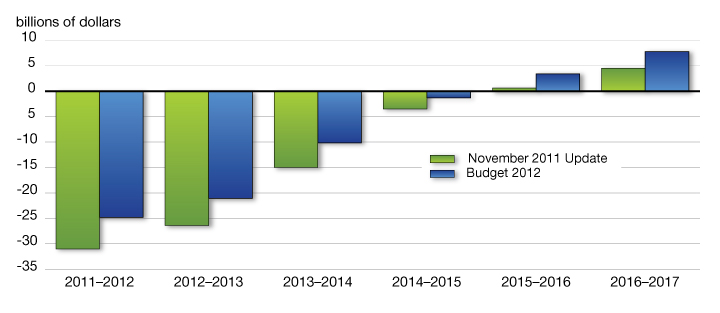
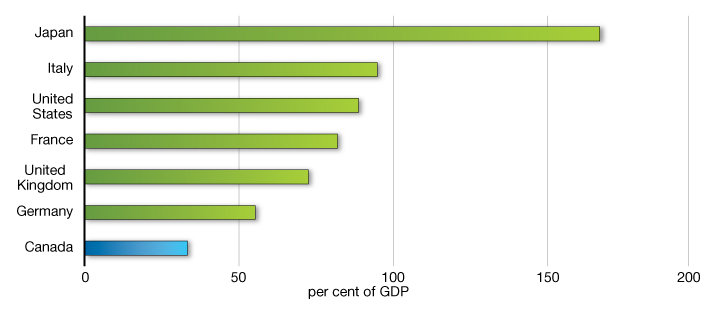
Take a look at some of these graphs from earlier in the year about the Canadian 2012 budget. (This is straight from their government’s web site – they have new transparency/anti=corruption measures now, so the citizens know everything that government does). When comparing the deficit and debt of Canada to the United States, always multiply the Canadian number by 10 to get a benchmark to compare. For example, Canadian GDP is 1.7 trillion, and the US GDP is 15 trillion.

Canada’s budget deficit is around 30 billion, but ours is 1.2 trillion:

Canada Federal Budget Deficit / Surplus 2012

If we were doing as well as Canada, our deficit would be about $300 billion. But we have run up about 6 trillion in debt over 4 years! Not only that, but Canada’s national debt is only $600 billion. If we multiple that by 10, we would expect ours about $6 trillion. And it was that – during the Bush Presidency. But then the Democrats took over the House and Senate in 2007 and everything went wrong and we packed trillions and trillions onto the debt, including about $6 trillion during Obama’s first term.

Canada’s Debt to GDP ratio is 34%:

Canada vs US Debt to GDP

But things are even worse for the United States, now. The current United States Debt to GDP is 105%, according to official U.S. government figures. We are due for yet another credit downgrade, and should see Greece-like levels of Debt to GDP during Obama’s second term. We are spending too much, and we aren’t going to be able to make up trillion dollar deficits even if we confiscate every penny that rich people earn. (And they won’t be daft enough to keep working as hard if we did that – they would move, and probably to Canada)

What is happening to us here in the United States is self-inflicted. We are – and have been – voting to impoverish ourselves and generations of children born and unborn, by punishing those who work hard and play by the rules, and rewarding those who don’t work and don’t play by the rules. It didn’t have to be this way. We could have elected a President who actually knew something about business and economics. Knowledge matters. We can’t just choose a President who gives us the “tingles” and then expect him to perform the actual duties of being President. Competence is more important than confidence. Substance is more important than style.

Economist Thomas Sowell explains why wealth redistribution doesn’t work

Thomas Sowell, an economist for the people

A whole slew of people are linking to this article by famous economist Thomas Sowell.

Excerpt:

The history of the 20th century is full of examples of countries that set out to redistribute wealth and ended up redistributing poverty. The communist nations were a classic example, but by no means the only example.

In theory, confiscating the wealth of the more successful people ought to make the rest of the society more prosperous. But when the Soviet Union confiscated the wealth of successful farmers, food became scarce. As many people died of starvation under Stalin in the 1930s as died in Hitler’s Holocaust in the 1940s. [Professor Sowell is referring to the forced collectivization of the Ukraine.  If you want to inform yourself of the horrors thereof, I recommend  Robert Conquest, The Harvest of Sorrow: Soviet Collectivization and the Terror-Famine, Oxford UP, 1986.]

How can that be? It is not complicated. You can only confiscate the wealth that exists at a given moment. You cannot confiscate future wealth — and that future wealth is less likely to be produced when people see that it is going to be confiscated. Farmers in the Soviet Union cut back on how much time and effort they invested in growing their crops, when they realized that the government was going to take a big part of the harvest. They slaughtered and ate young farm animals that they would normally keep tending and feeding while raising them to maturity.

[…]Among the most valuable assets in any nation are the knowledge, skills, and productive experience that economists call “human capital.” When successful people with much human capital leave the country, either voluntarily or because of hostile governments or hostile mobs whipped up by demagogues exploiting envy, lasting damage can be done to the economy they leave behind.

Fidel Castro’s confiscatory policies drove successful Cubans to flee to Florida, often leaving much of their physical wealth behind. But poverty-stricken refugees rose to prosperity again in Florida, while the wealth they left behind in Cuba did not prevent the people there from being poverty-stricken under Castro. The lasting wealth the refugees took with them was their human capital.

Stuart Schneiderman had this to say about the piece:

If the productive members of society are no longer working for themselves and their progeny they are going to be less productive. They have less incentive to produce when more of what they produce, or more of the profit, is going to be taxed or confiscated.

Besides, when you confiscate wealth people will resist and will spend more of their time and energy trying to keep what they have earned. This time and energy could be used for more productive activities.

Since wealth exists in assets whose value is determined in a market, a regime that confiscates assets will force the wealthy to liquidate their assets, thus lowering the value of everyone’s assets and making it far more difficult to attract investment capital.

I was happy to receive the 4th edition of Thomas Sowell’s “Basic Economics” textbook from one of our readers in New York city. (Thanks Tom!) If you are a Christian who is interested in economics, I really recommend that you pick up “Intellectuals and Society“, which is a great introduction to his thought.

I once was courting a young homeschooled lady who was skeptical of university degrees. She read one Thomas Sowell book, then read 5 more – all within a 6 week period. She then went on to do a B.A. in economics. If you are a Christian looking to branch out into economics, Thomas Sowell is your man. You can’t read just one of his books. It’s absolutely impossible.