
Here’s an article from Dan Mitchell of the Cato Institute, published with Forbes magazine. Cato economists are libertarians, so they are good at fiscal policy, but terrible at moral and social issues.
It says:
But here’s the part of Cruz’s plan that raises a red flag. He says he wants a “business flat tax,” but what he’s really proposing is a value-added tax.
His proposal is a VAT because wages are nondeductible. And that basically means a 16 percent withholding tax on the wages and salaries of all American workers (for tax geeks, this part of Cruz’s plan is technically a subtraction-method VAT).
Normally, I start foaming at the mouth when politicians talking about value-added taxes. But Senator Cruz obviously isn’t proposing a VAT for the purpose of financing a bigger welfare state.
Instead, he’s doing a swap, imposing a VAT while also getting rid of the corporate income tax and the payroll tax.
And that’s theoretically a good deal because the corporate income tax is so senselessly destructive(swapping the payroll tax for the VAT, as I explained a few days ago in another context, is basically a wash).
But it’s still a red flag because I worry about what might happen in the future. If the Cruz plan is adopted, we’ll still have the structure of an income tax (albeit a far-less-destructive income tax). And we’ll also have a VAT.
So what happens 10 years from now or 25 years from now if statists control both ends of Pennsylvania Avenue and they decide to reinstate the bad features of the income tax while retaining the VAT? They now have a relatively simple way of getting more revenue to finance European-style big government.
And also don’t forget that it would be relatively simple to reinstate the bad features of the corporate income tax by tweaking Cruz’s business flat tax/VAT.
[…]Notwithstanding my concern about the VAT, Senator Cruz has put forth a plan that would be enormously beneficial to the American economy.
Instead of being a vehicle for punitive class warfare and corrupt cronyism, the tax code would simply be the method by which revenue was collected to fund government.
Rubio ignored all of those details during the debate, and instead accused Cruz of bringing in a VAT tax that is the same as those in Europe, with no other taxes being lowered or eliminated to compensate. It’s dishonest, but he was probably hoping that Cruz would not have time to respond.
Here’s Cruz’s response from the debate last night:
In Rubio’s question, he deliberately misrepresented Cruz’s proposal by neglecting to mention all the taxes that Cruz would eliminate. Dan Mitchell mentioned them. I don’t understand why Rubio is smearing a fellow conservative with such attacks. Unless maybe Rubio is not a fellow conservative at all? I’ll be looking at that more next week.
This is not the first time that Rubio has tried to distort facts in order to smear Ted Cruz. Honestly, I used to have Rubio listed as my 5th choice, but he keeps smearing Cruz with dishonest attacks that are easily cleared up with a little knowledge from experts. I have therefore removed Rubio from my list of candidates.
Debate evaluations
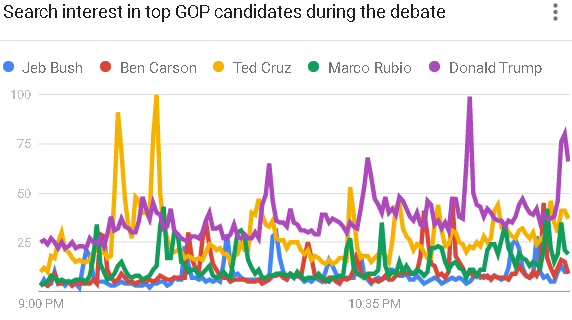
Google Trends shows that the debate was essentially a showdown between Trump and Cruz, based on search engine traffic during the debate:
There are some reports out now on who did well in last night’s debate.
- Ben Shapiro has one.
- Legal Insurrection has one.
- Red State has one.
And The Weekly Standard has a new podcast up.
 WINTERY KNIGHT