Tag Archives: Fine Tuning

Robin Collins lectures on fine-tuning for discoverability from particle physics

Christianity and the progress of science

Here’s the lecture:

This lecture is 29 minutes long, the Q&A is 15 minutes. I highly recommend this lecture to all audiences of all levels of ability, for the simple reasons that apart from the content, this lecture is a how-to clinic in the tone, body language, slides and so on for you to use when trying to be persuasive when making your case. Science is king in this lecture. The scientific method is defined and applied in a winsome way. Making science understandable should be the bread and butter approach to Christian apologetics, and this lecture rivals the Mike Strauss lecture at Stanford University and the Mike Strauss lecture at the University of Texas – Dallas as the ideal lectures for showing that. It’s not just the scientific material that makes this lecture by Collins work, it’s the narrative and the style that make the lecture work.

About Robin Collins:

Robin Collins (PhD, University of Notre Dame, 1993), is professor of philosophy at Messiah College, Grantham, PA specializing in the area of science and religion.  He has written over twenty-five articles and book chapters on a wide range of topics, such as the fine-tuning of the cosmos as evidence for the existence of God, evolution and original sin, the Doctrine of Atonement, Asian religions and Christianity, and Bohm’s theory of quantum mechanics.  Some of his most recent articles/book chapters are “Philosophy of Science and Religion” in The Oxford Handbook of Science and Religion, “Divine Action and Evolution” in The Oxford Handbook of Philosophical Theology (2009)  “The Multiverse Hypothesis: A Theistic Perspective,” in Universe or Multiverse? (Cambridge University Press), and “God and the Laws of Nature,” in Theism or Naturalism: New Philosophical Perspectives (Oxford University Press, forthcoming).  He recently received a grant from the John Templeton Foundation to finish a book that presents the case for design based on physics and cosmology,  tentatively entitled The Well-Tempered Universe: God, Cosmic Fine-tuning, and the Laws of Nature.

His thesis in one slide:
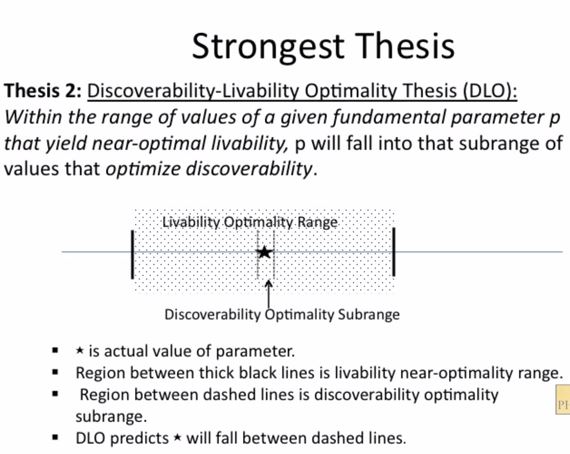
Fine-tuning for discoverability
Fine-tuning for discoverability – the DLO thesis

Summary:

  • Thesis: the universe is more intelligible than we would expect it by chance
  • The regular fine-tuning argument says that complex embodied observers are very rare
  • But the number of highly-discoverable universes that have complex embodied observers is rarer still
  • Why do we exist in a highly-discoverable universe?
  • Can we quantify and test discoverability?
  • Yes: by varying fundamental parameters and seeing how it affects discoverability
  • Conclusion of his calculations: The Discoverability-Liveability Optimality range is an even smaller range within the Liveablity Optimality range of the standard fine-tuning argument
  • Fine-tuning #1: the fine structure constant, governs the strength of the electro-magnetic force
  • If larger, wood-burning fire becomes impossible because fires won’t stay lit, and therefore forging metals becomes unlikely
  • If smaller, wood-burning fires won’t go out, e.g. – from lightning strikes, so that wood would be less accessible
  • Other constraints: smaller value decreases effectiveness of light microscopes, drastically lowers efficiency of transformers and motors
  • Fine-tuning #2: the cosmic microwave background radiation (CMBR), radiation left over from the Big Bang
  • humans need to discover the CMBR in order to confirm the Big Bang creation out of nothing, and it depends on baryon/pothon ratio
  • his calculations show that the actual value of CMBR is exactly at the peak for detectability by humans
  • if baryon/photon ratio larger, CMBR is less discoverable
  • if baryon/photon ratio smaller, CMBR is less discoverable
  • Fine-tuning #3: parameters related to subatomic particles are fine-tuned for their discovery and usefulness, e.g. – the bottom quark, the charm quark, the tau lepton and the Higgs Boson
  • the lifetime of the particles affects their usefulness to scientists who want to investigate the Standard Model of physics
  • decay rates of these subatomic particles are related to several of the finely-tuned parameters
  • for example, the mass of the bottom quark is finely-tuned for its discoverability by scientists
  • the tau lepton and the charm quark are similarly fine-tuned for disoverability
  • the mass of the Higgs boson is finely-tuned for discoverability and for making further discoveries
  • Conclusion: the DLO thesis is strongly confirmed – this is an even greater degree of fine-tuning that the already astonishing probabilities of the fine-tuning for complex, embodied intelligent beings
  • The formalized version of the philosophical argument based on this evidence is impervious with some of the traditional objections to the standard fine-tuning argument
  • #1 multiverse/selection effect: it is not subject to multiverse / observer selection objections
  • #2 normalizeability: it is not subject to the McGrew-Vestrup objection because the range of possible values is finite not infinite
  • #3 falsifiability: it makes falsifiable predictions, and in fact Collins’ earlier calculations of the CMBR discoverability contained an error that falsified the thesis – until he found the error and corrected for it
  • #4 usefulness: it gives clues about the Creator’s purpose for us, namely that the universe was created for us to be able to do science and find evidence of the Creator’s existence – there is no expectation for us to exercise blind faith, trust in God is meant to be a plausible deduction from the progress of experimental science

Sample slide:
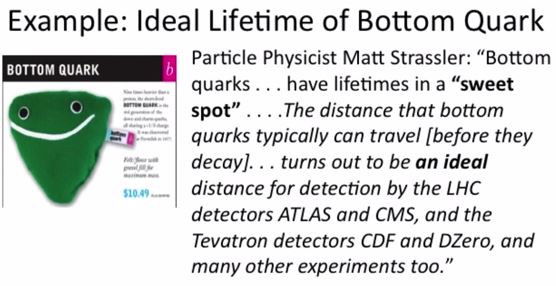
Fine-tuning of the bottom quark for discoverability
Bottom quark lifetime is finely-tuned for discoverability

And another:

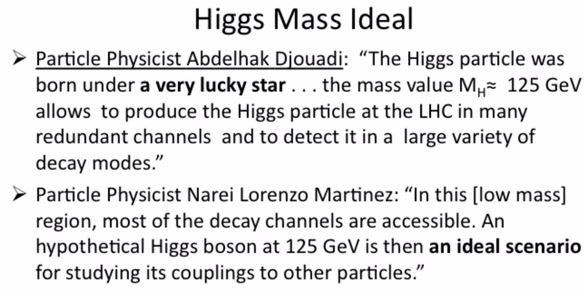
Higgs boson mass is finely-tuned for discoverability

Earlier, I blogged about a Robin Collins lecture on the fine-tuning that allows complex, embodied life to exist. Another must-see lecture. If you are looking for something to study in university, and you have funding, then physics, mathematics and philosophy are the best places to be for a Christian scholar.

Cosmologist Luke Barnes answers 11 objections to the fine-tuning argument

Christianity and the progress of science

This is from the blog Common Sense Atheism.

Atheist Luke Muehlhauser interviews well-respect cosmologist Luke Barnes about the fine-tuning argument, and the naturalistic response to it.

Luke M. did a good job explaining what was in the podcast. (I wish more people who put out podcasts would do that).

Details:

In one of my funniest and most useful episodes yet, I interview astronomer Luke Barnes about the plausibility of 11 responses to the fine-tuning of the universe. Frankly, once you listen to this episode you will be better equipped to discuss fine-tuning than 90% of the people who discuss it on the internet. This episode will help clarify the thinking of anyone – including and perhaps especially professional philosophers – about the fine-tuning of the universe.

The 11 responses to fine-tuning we discuss are:

  1. “It’s just a coincidence.”
  2. “We’ve only observed one universe, and it’s got life. So as far as we know, the probability that a universe will support life is one out of one!”
  3. “However the universe was configured, evolution would have eventually found a way.”
  4. “There could be other forms of life.”
  5. “It’s impossible for life to observe a universe not fine-tuned for life.”
  6. “Maybe there are deeper laws; the universe must be this way, even though it looks like it could be other ways.”
  7. “Maybe there are bajillions of universes, and we happen to be in one of the few that supports life.”
  8. “Maybe a physics student in another universe created our universe in an attempt to design a universe that would evolve intelligent life.”
  9. “This universe with intelligent life is just as unlikely as any other universe, so what’s the big deal?”
  10. “The universe doesn’t look like it was designed for life, but rather for empty space or maybe black holes.”
  11. “Fine-tuning shows there must be an intelligent designer beyond physical reality that tuned the universe so it would produce intelligent life.”

Download CPBD episode 040 with Luke Barnes. Total time is 1:16:31.

There is a very good explanation of some of the cases of fine-tuning that I talk about most on this blog – the force of gravity, the strong force, etc. as well as many other examples. Dr. Barnes is an expert, but he is also very very easy to listen to even when talking about difficult issues. Luke M. is very likeable as the interviewer.

What are Boltzmann brains, and what challenge do they pose to the multiverse hypothesis?

Christianity and the progress of science

I thought I would turn to the atheist theoretical physicist Sean Carroll, who has previously debated William Lane Craig, to explain to us what a Boltzmann brain is, and what threat it posts to the multiverse hypothesis.

Here is Sean Caroll, quoted by About.com:

Ludwig Boltzmann was one of the founders of the field of thermodynamics in the nineteenth century.

One of the key concepts was the second law of thermodynamics, which says that the entropy of a closed system always increases. Since the universe is a closed system, we would expect the entropy to increase over time. This means that, given enough time, the most likely state of the universe is one where everything is the in thermodynamic equilibrium … but we clearly don’t exist in a universe of this type since, after all, there is order all around us in various forms, not the least of which is the fact that we exist.

With this in mind, we can apply the anthropic principle to inform our reasoning by taking into account that we do, in fact, exist.

Here the logic gets a little confusing, so I’m going to borrow the words from a couple of more detailed looks at the situation. As described by cosmologist Sean Carroll in From Eternity to Here:

Boltzmann invoked the anthropic principle (although he didn’t call it that) to explain why we wouldn’t find ourselves in one of the very common equilibrium phases: In equilibrium, life cannot exist. Clearly, what we want to do is find the most common conditions within such a universe that are hospitable to life. Or, if we want to be more careful, perhaps we should look for conditions that are not only hospitable to life, but hospitable to the particular kind of intelligent and self-aware life that we like to think we are….

We can take this logic to its ultimate conclusion. If what we want is a single planet, we certainly don’t need a hundred billion galaxies with a hundred billion stars each. And if what we want is a single person, we certainly don’t need an entire planet. But if in fact what we want is a single intelligence, able to think about the world, we don’t even need an entire person–we just need his or her brain.

So the reductio ad absurdum of this scenario is that the overwhelming majority of intelligences in this multiverse will be lonely, disembodied brains, who fluctuate gradually out of the surrounding chaos and then gradually dissolve back into it. Such sad creatures have been dubbed “Boltzmann brains” by Andreas Albrecht and Lorenzo Sorbo….

In a 2004 paper, Albrecht and Sorbo discussed “Boltzmann brains” in their essay:

A century ago Boltzmann considered a “cosmology” where the observed universe should be regarded as a rare fluctuation out of some equilibrium state. The prediction of this point of view, quite generically, is that we live in a universe which maximizes the total entropy of the system consistent with existing observations. Other universes simply occur as much more rare fluctuations. This means as much as possible of the system should be found in equilibrium as often as possible.

From this point of view, it is very surprising that we find the universe around us in such a low entropy state. In fact, the logical conclusion of this line of reasoning is utterly solipsistic. The most likely fluctuation consistent with everything you know is simply your brain (complete with “memories” of the Hubble Deep fields, WMAP data, etc) fluctuating briefly out of chaos and then immediately equilibrating back into chaos again. This is sometimes called the “Boltzmann’s Brain” paradox.

[…]Now that you understand Boltzmann brains as a concept, though, you have to proceed a bit to understanding the “Boltzmann brain paradox” that is caused by applying this thinking to this absurd degree. Again, as formulated by Carroll:

Why do we find ourselves in a universe evolving gradually from a state of incredibly low entropy, rather than being isolated creatures that recently fluctuated from the surrounding chaos?

Unfortunately, there is no clear explanation to resolve this … thus why it’s still classified as a paradox.

Naturalists like to propose the multiverse as a way of explaining away the fine-tuning that we see, and explaining why complex, embodied intelligent beings like ourselves exist. But even if the multiverse hypothesis were true, we still would not expect to observe stars, planets, and conscious embodied intelligent beings. It is far more likely on a multiverse scenario that any observers we had would be “Boltzmann” brains in an empty universe. The multiverse hypothesis doesn’t explain the universe we have, which contains “a hundred billion galaxies with a hundred billion stars each” – not to mention our bodies which are composed of heavy elements, all of which require fine-tuning piled on fine-tuning piled on fine-tuning.

William Lane Craig answered a question about Boltzmann brains a while back, so let’s look at his answer since we saw what his debate opponent said above.

He writes:

Incredible as it may sound, today the principal–almost the only–alternative to a Cosmic Designer to explain the incomprehensibly precise fine tuning of nature’s constants and fundamental quantities is the postulate of a World Ensemble of (a preferably infinite number of) randomly ordered universes. By thus multiplying one’s probabilistic resources, one ensures that by chance alone somewhere in this infinite ensemble finely tuned universes like ours will appear.

Now comes the key move: since observers can exist only in worlds fine-tuned for their existence, OF COURSE we observe our world to be fine-tuned! The worlds which aren’t finely tuned have no observers in them and so cannot be observed! Hence, our observing the universe to be fine-tuned for our existence is no surprise: if it weren’t, we wouldn’t be here to be surprised. So this explanation of fine tuning relies on (i) the hypothesis of a World Ensemble and (ii) an observer self-selection effect.

Now apart from objections to (i) of a direct sort, this alternative faces a very formidable objection to (ii), namely, if we were just a random member of a World Ensemble, then we ought to be observing a very different universe. Roger Penrose has calculated that the odds of our solar system’s forming instantaneously through the random collision of particles is incomprehensibly more probable that the universe’s being fine-tuned, as it is. So if we were a random member of a World Ensemble, we should be observing a patch of order no larger than our solar system in a sea of chaos. Worlds like that are simply incomprehensibly more plentiful in the World Ensemble than worlds like ours and so ought to be observed by us if we were but a random member of such an ensemble.

Here’s where the Boltzmann Brains come into the picture. In order to be observable the patch of order needn’t be even as large as the solar system. The most probable observable world would be one in which a single brain fluctuates into existence out of the quantum vacuum and observes its otherwise empty world. The idea isn’t that the brain is the whole universe, but just a patch of order in the midst of disorder. Don’t worry that the brain couldn’t persist long: it just has to exist long enough to have an observation, and the improbability of the quantum fluctuations necessary for it to exist that long will be trivial in comparison to the improbability of fine tuning.

In other words, the observer self-selection effect is explanatorily vacuous. It does not suffice to show that only finely tuned worlds are observable. As Robin Collins has noted, what needs to be explained is not just intelligent life, but embodied, interactive, intelligent agents like ourselves. Appeal to an observer self-selection effect accomplishes nothing because there is no reason whatever to think that most observable worlds are worlds in which that kind of observer exists. Indeed, the opposite appears to be true: most observable worlds will be Boltzmann Brain worlds.

Allen Hainline explained some of the OTHER problems with the multiverse in a post on Cross Examined’s blog. I recommend taking a look at those as well, because I feel funny even talking about Boltzmann brains. I would rather just say that there is no experimental evidence for the multiverse hypothesis, as I blogged before, and leave it at that. But if the person you are talking to fights you on it, you can disprove the multiverse with the Boltzmann brains.