Tag Archives: Feminism

Why do some Christians say “all sins are equally bad” and “everyone is equally guilty”?

Young women very supportive of premarital sex

We were having a discussion about whether the Bible teaches that sex before marriage is morally wrong, and someone said “impure thoughts counts as adultery… there isn’t a virgin among us”.

Regarding her point that lust is equal to adultery, and so no one is really a virgin, here’s Ligonier Ministries:

In demonstrating that the seventh commandment was given also to prohibit lust, Jesus is not somehow saying that an unconsummated lustful intent is sinful to the same degree as an actual extramarital affair (though both sins merit punishment). The latter is a more blatant violation of the statute against adultery, and it has greater consequences in the form of divorce and the loss of one’s reputation as a trustworthy person.

Any serious student of the Bible is aware of Jesus’ tendency to exaggerate / use hyperbole.

Also, 1 Corinthians 7 says that wives are not supposed to make a habit of denying their husbands sex. Sex withholding is more of an epidemic today than pornography, and it should also be on the adultery spectrum. It isn’t as bad as adultery, but it definitely breaks the marital covenant.

So why would someone say that lust is the same as adultery, and that there is no such thing as a virgin?

Dr. Michael Krueger recently blogged about this “all sins are equal” view.

Krueger says this:

First, to say all sins are the same is to confuse the effect of sin with the heinousness of sin. While all sins are equal in their effect (they separate us from God), they are not all equally heinous.

Second, the Bible differentiates between sins. Some sins are more severe in terms of impact (1 Cor 6:18), in terms of culpability (Rom 1:21-32), and in terms of the judgment warranted (2 Pet 2:17; Mark 9:42; James 3:1).

Krueger explains the motivation behind the slogans:

[S]ome Christians… use this phrase as way to “flatten out” all sins so that they are not distinguishable from each other. Or, to put it another way, this phrase is used to portray all human beings as precisely the same. If all sins are equal, and all people sin, then no one is more holy than anyone else.

In a world fascinated with “equality,” this usage of the phrase is particularly attractive to folks. It allows everyone to be lumped together into a single undifferentiated mass.

Such a move is also useful as a way to prevent particular behaviors from being condemned. If all sins are equal, and everyone is a sinner, then you are not allowed to highlight any particular sin (or sinner).

Needless to say, this usage of the phrase has featured largely in the recent cultural debates over issues like homosexuality. Yes, homosexuality is a sin, some Christians reluctantly concede. But, they argue, all sins are equal in God’s sight and therefore it is no different than anything else. Therefore, Christians ought to stop talking about homosexuality unless they are also willing to talk about impatience, anger, gluttony, and so on.

Krueger also posted this fascinating follow up post, where he looks at how the phrase is being used by people on Twitter.

Look at these tweets:

  • All sins are equal. People tend to forget that. There is no bigger or smaller sin. Being gay and lying, very equal.

  • all sins are equal in God’s eyes. whatever you’re doing, is no better than what someone else is doing.

  • If you have sex before marriage please don’t come on social media preaching about the wrongs of homosexuality. All sins are equal

  • Need people to realize that all sins are equal… don’t try to look down on me or question my faith just cuz you sin differently than I do.

  • Don’t understand why you’re so quick to judge me, when all sins are equal. So much for family..

  • if you think being gay is a sin, let me ask you something, have you not done anything wrong in your life? all sins are equal. we’re sinners

  • Nope no difference at all. All sins are equal no matter what you’re running for. The bible says do not judge lest ye be judged

  • A huge problem I have with religion is the notion that all sins are equal. Like pre-martial sex and murder are the same amount t of bad.

  • people do bad things because they believe that all sins are equal and ~god~ loves y’all equally so he’s going to forgive you naman ha ha ha

  • It a sin to condemn another sinner and their actions. All sins are equal. So what makes you better than the person you’re condemning?

  • I think so b/c having sex before marriage doesn’t make you less of a women then if you waited until marriage.. all sins are equal soo

  • friendly reminder, all sins are equal in gods eyes so you’re not better than I am in any way. please worry about your own sins before mine.

  • People don’t like when I suggest abortion as an option. This is a free country and all sins are equal so mind your business!!!

  • What I do is no worse than wat you do… all sins are equal no matter what it is… a sin is a sin

  • to god all sins are equal so you have no right to compare your sins to someone else’s bc in the end it doesn’t matter

The first thing that I noticed is that premarital sex and homosexuality are the most popular sins. I would think that divorce and abortion would be up there in the rankings, as well.

People want to be free to follow their hearts when seeking pleasure, then quote the Bible (badly) afterwards, to attack anyone who says that anything they’ve done is morally wrong. They would rather escape the judgment of their peers than admit fault and try to fix the mistake, and do better next time. And they would rather tell people who are hurting themselves by breaking the rules that there are no rules. It makes them feel good to “not judge” – they feel as if they are being kind. Their compassion looks good to non-Christians. And they’re promoting moral relativism which, when it becomes widespread, prevents anyone from judging them.

It’s so bad now, that the people who have morals and who make moral judgments are seen as the real bad people. The immoral people are on the offense, and even trying to ban people from being able to disagree with them.
If we seriously want men to marry and become fathers, let’s repeal no-fault divorce

I saw a very good article at the Heritage Foundation web site about the importance of fathers for children. The author Virginia Allen listed out some of the benefits that fathers provide to children:

Studies have found that children raised without a father are:

  • At a higher risk of having behavioral problems.
  • Four times more likely to live in poverty.
  • More likely to be incarcerated in their lifetime.
  • Twice as likely to never graduate high school.
  • At a seven times higher risk of teen pregnancy.
  • More vulnerable to abuse and neglect.
  • More likely to abuse drugs and alcohol.
  • Twice as likely to be obese.

From education to personal health to career success, children who lack a father find themselves at a disadvantage to their peers raised in a two-parent household.

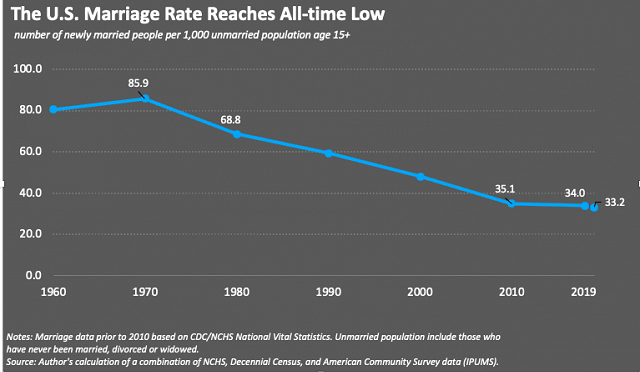
I was looking for a good analysis of why there’s been a decline of marriage and fatherhood, and I found an article by Joe Carter on far-left The Gospel Coalition, of all places. By looking at marriage rates and historical events that changed the marriage rate, he was able to identify the cause of the decline of marriage – and fatherhood.

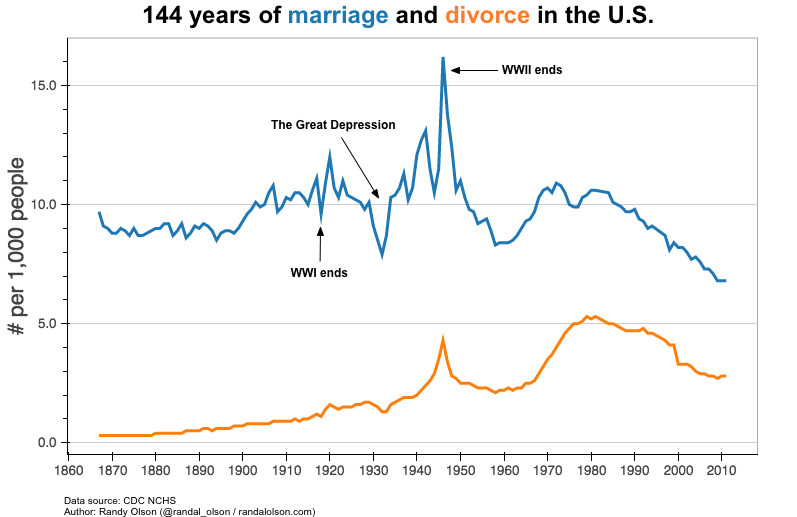
Marriage and divorce rates per capita

I’ll spare you the statistical analysis, which is excellent, and give you the conclusion – although you can guess it from the graph above:

Now that we’ve explored the data, what year should we use as the marker for the beginning of the decline of marriage in the United States? I would argue for 1985, the last year that the marriage rate topped 10 percent.

[…]What changed in 1985 that could have led to the decline in marriage? There are likely numerous factors—which we’ll examine in future articles—but one stands out in particular: By 1985, all states (except for New York) had enacted no-fault divorce legislation.

The most helpful book I know of about no-fault divorce is “Taken Into Custody”, by Dr. Stephen Baskerville. He wrote a column  for Crisis magazine that summarizes some of his ideas.

Excerpt:

Feminists were drafting no-fault divorce laws in the 1940s, which the National Association of Women Lawyers now describes as “the greatest project NAWL has ever undertaken.”

The result effectively abolished marriage as a legal contract. Today it is not possible to form a binding agreement to create a family.

The new laws did not stop at removing the requirement of citing grounds for a divorce, to allow divorce by mutual consent, as deceptively advertised at the time. Instead they created unilateral and involuntary divorce, so that one spouse may dissolve a marriage without any agreement or fault by the other.

Here’s what divorce does to the spouse who is the victim of the unilateral “no-fault” divorce:

Though marriage is a civil matter, the logic quickly extended into the criminal, including a presumption of guilt against the involuntarily divorced spouse (“defendant”). Yet formal due process protections of criminal proceedings did not apply, so forcibly divorced spouses became quasi-criminals not for recognized criminal acts but for failing or refusing to cooperate with the divorce by continuing to claim the protections and prerogatives of family life: living in the common home, possessing the common property, or—most vexing of all—parenting the common children.

Following from this are the horrendous civil liberties violations and flagrant invasions of family and individual privacy that are now routine in family courts. A personalized criminal code is legislated by the judge around the forcibly divorced spouse, controlling their association with their children, movements, and finances. Unauthorized contact with their children can be punished with arrest. Involuntarily divorced parents are arrested for running into their children in public, making unauthorized telephone calls, and sending unauthorized birthday cards.

In my conversations with men, no-fault divorce laws, and anti-male divorce courts are the main reasons given for why they do not pursue marriage and fatherhood. Men do not want to be coerced in a marriage with the threat of divorce by an unhappy wife. Men do not want to be subject to the government in so many areas of their lives if the wife does carry out the threat. They especially don’t want to be separated from their children. One my secular male friends told me that he would not marry unless the woman had evidence in her past of hating radical feminism and no-fault divorce. This was the main criteria. He actually was able to find a woman who was a men’s rights activist who hated divorce. But that was the only way he would marry.

Statistically speaking, the wife is more likely to initiate divorce than the husband. Women initiate 70% of divorces, the majority of those just because she is “unhappy”. I think this is because women get into marriage based on their feelings, and they think that it is the husband’s job to make them feel good. They see their happiness as the primary goal of the marriage, and see a marriage that does not make them happy as a marriage that needs to be ended.

Are we going to repeal no-fault divorce, then?

No-fault divorce was seen as a boon to women who had married the wrong men by following their hearts. It’s an interesting question to ask whether women really would want no-fault repealed. It would mean that they would have to get serious about who they marry, instead of just getting into marriage based on feelings. They would have to evaluate men according to expectations of what a man does in a marriage, instead of on feelings. They would have to think about what men want out of a marriage, and prepare themselves to provide for his needs. They would have to say no to their feelings, when choosing a man, and in keeping a man after the wedding.

If women aren’t willing to demand the repeal of no-fault divorce laws and get serious about men and marriage, then what’s the point of complaining that men don’t want to marry and become fathers? If you’re not willing to fix the root cause of the problem, then don’t complain about the problem.

Lori Alexander is right: serious Christian men prefer debt-free virgins without tattoos

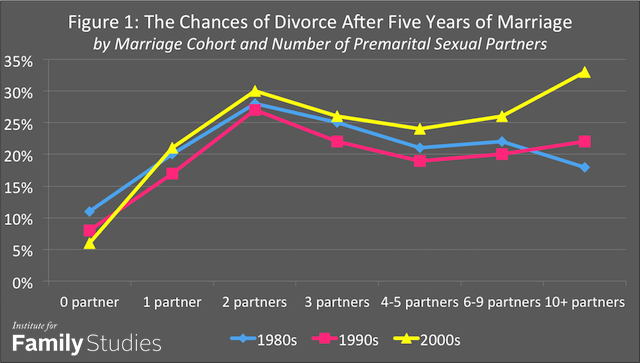
Marriage stability vs sexual partners,(Teachman et al. JAMF, August 2010)

Christian writer Lori Alexander recently wrote a blog post (H/T Lindsay) urging Christian women to do 3 things:

  1. be a virgin before marriage
  2. be debt-free before marriage
  3. don’t get any tattoos

She also urged women to be cautious about college, because it often gets them into debt. I disagree with her a little here. I always urge young women to earn a STEM degree in college, then work a few years to pay off their loans (if any) before marrying. This is because women, like men, need to have the experience of doing something hard that they don’t “feel” like doing, in order to grow. STEM degrees teach young people that the world doesn’t revolve around them, and that their feelings don’t matter when trying to solve a problem in the real world. It’s a very useful way for women and men to break themselves out of the desire for free and easy happiness that is so common in our time.

Lori’s article drew enormous opposition from both secular and Christian sources. So far, the only people defending her are men’s rights sites, like Dalrock (Christian) and Spawny (non-Christian). Every other “Christian” blog or news site that I read disagreed her article, and argued that premarital sex was no big deal, that having debt was no big deal, and that having tattoos was no big deal.

Let’s take a look at her three points, then I’ll explain why her article is largely correct, and why she is correct about what she asserts about the criteria that godly men have for women.

Even one non-husband premarital sex partner raises risk of divorce

Virginity

Regarding her first point, virginity is commanded by the Bible, it’s in line with peer-reviewed studies on marriage quality and stability. The reason that people find this difficult is that they want the freedom to give in to sexual desires without feeling shame. They want to believe that there is no permanent effect. It doesn’t help that parents and pastors are terrified of telling young people, and young women in particular, that promiscuity harms marital stability. Right now, the culture is drowning in feminism. Feminism tells women that the traditional male roles of provider, protector, and spiritual leader are “sexist”. The “best” men are good-looking pro-abortion bad boys. If a Christian woman is not able to think through the meaning of sex with respect to marriage enough to control herself, it seriously harms the stability of her future marriage.

Starting and Mid-Career salaries by profession (click for larger image)

Debt-free

Regarding her second point, almost everything a serious Christian man might plan to do for Christ with his marriage is impacted by finances. From education, to marriage timing, to number of children, to home ownership, early investment, to the success of children. to age of retirement. Less money means fewer choices, and less ability to counter challenges. Think of how important money for legal defense is to Christian-owned businesses who are being persecuted, for example. The reason that many people find the Bible’s teaching on stewardship difficult is that they don’t want to exercise self-control with money if they don’t feel like it. They want to waste money seeking fun and thrills, and then act like their poverty could not be avoided. Being debt-free is an indicator of practical wisdom and self-control in a woman.

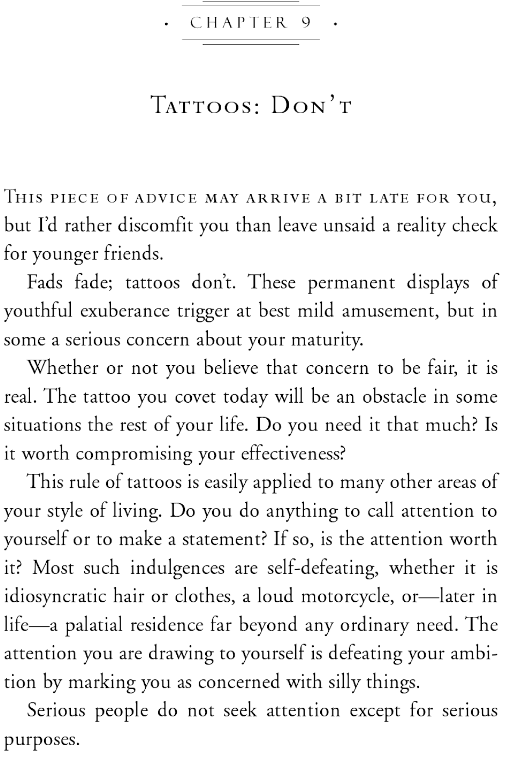
Hugh Hewitt's "In, But Not Of", Chapter 9: Tattoos, Don't
Chapter 9 of Hugh Hewitt’s “In, But Not Of: A Guide to Christian Ambition”

Tattoos

Tattoos are a problem for serious Christian men for several reasons. First, they cost money and for no gain, and can even cause you losses in your career. Second, most people get them because of low self-esteem or vanity or to look rebellious or to look dangerous. None of these motivations should be acted upon by someone with a robust Christian worldview. The money could be better used on charity, or investments, etc. Women show what their priorities really are by how they spend their money and time. Show me a woman’s bookshelf, and I’ll tell you how seriously she has thought about what it means to be a Christian in all areas of life. Instead of showing me your tattoos to demonstrate your “spirituality”, show me your apologetics books, to demonstrate your intellectual engagement. And tell me how you used that information to engage in conversations with educated non-Christians to answer their challenges to your faith. That way I’ll know that you use your money to train do hard things in order to have an influence for Christ in serious, practical, effective ways. A woman who can defend her faith and discuss Christianity with non-Christians is demonstrating her ability to raise Christian children in a secular society.

A family praying and reading the Bible

The goal of marriage is to serve God

Today, young people have been taught to follow their hearts, and to deny that there is any authority or practical wisdom that should govern their decisions. They always imagine themselves to be exempt from moral rules, statistics, cause and effect, etc. They think they know better than everyone else – even though they do almost no research on their own. Every adviser who tells them to study computer science instead of creative writing is wrong. Their same-age friends know more about what causes divorces than peer-reviewed research papers. And money should be spent on skydiving and zip-lining, regardless of what financial experts like Dave Ramsey might say.

A woman who has made many mistakes cannot fix those mistakes with words. Rationalizations, evasions, and blame-shifting do not work to show that there has been real repentance. The man can only assess whether grace has caused any real re-prioritization of goals by evaluating her outward actions over a long period of time. Furthermore, if a woman who has made mistakes attacks those who correct her from Bible’s teachings on chastity, stewardship, etc., then it’s a sign that there is no real repentance.

Choosing a wife wisely doesn’t mean that Christian men treat OTHER Christian women poorly. Christian men love all the Christian women. We care for them and support them. But when a man chooses a wife, he is choosing someone who will have more influence on his ability to serve God than anyone else. In my case, the goals for my marriage involve making a difference with apologetics in the church, having many children who will receive the educations and careers they need to have an influence, influencing government to promote Christian-friendly policies, charitable giving, mentoring young Christians, modeling a good marriage to others, and having a home that can serve to host discussions about issues that matter. These things are not free – they take careful planning and execution to achieve.

Lori’s advice is  intended for men who are serious about making their marriage produce a return for God. Men who are chaste themselves. Men who accept the Bible as an authority. Men who earned STEM degrees, instead of easy nonsense degrees that don’t lead to good careers. Men who earn 6-figure salaries, who buy houses for cash, and who are on track have a 7-figure net worth by age 50. Men who made good decisions cannot risk marrying someone who hasn’t prepared for marriage. The wrong woman in the home could ruin the man’s effort to produce a marriage that gives glory to God.

Not every man intends to achieve something for God with his marriage, but those who do need to choose a woman who has demonstrated ability at doing the job. For example, if the job requires marital fidelity, then chastity is a good indicator that the woman has the necessary self-control. If the job requires frugality, and practicality, then being debt-free, having a STEM degree, and having some private sector work experience are good indicators that she’s qualified for the role. Nothing valuable in life is ever been achieved by being lazy, wild and irresponsible. Serious Christian men look for wives who have applied themselves to difficult tasks that they didn’t feel like doing, who achieved success by remaining committed to the plan, in spite of their unhappy feelings and unmet desires.

We have a problem in the church such that we aren’t serious about teaching young people to develop marriage-ready character and to make serious plans for marriage. We are teaching them to follow their hearts, and that their feelings and desires are clues about God’s will for their happiness. We are teaching them to be uncomfortable with responsibilities, expectations and obligations to others. We are teaching them not to do their own research. We are teaching them not to make practical, wise plans. We are teaching them to ATTACK those who try to get them to be serious about doing what is likely to work. This approach is not working.

My own criteria for a wife are more demanding than Lori’s. My advice there is only for serious Christian men who want their marriage to serve God.