Tag Archives: Feminism

New study: Contraceptives double risk of depression in teenage girls

The Sydney Morning Herald reports:

A Danish study of a million women has found a link between the use of hormonal contraception such as the the pill and increased risk of depression.

Compared with non-users, women and teenage girls aged 15 to 34 who used hormonal contraception had a 1.23 times higher risk of being diagnosed with depression, especially adolescents, according to a paper published in the journal JAMA Psychiatry.

Researchers at the University of Copenhagen in Denmark analysed health registry data of one million Danish women from 2000 and followed them up after an average of six years.

Of the 55 per cent of those who used hormonal contraception, there were just over 23,000 first diagnoses of depression at the time of follow up.

More than 133,000 had received their first prescription of antidepressants.

The highest risk of depression was among the adolescent girls, who had a 1.8-times higher risk of first use of an antidepressant.

The risk varied slightly among the different types of hormonal contraception, but the risk was three times higher among those who used non-oral products, such as progestogen implants.

Few studies have quantified the effect of low-dose hormonal contraception on the risk for depression, but study author Ojvind Lidegaard says their research warrants the need for further studies into the potential adverse effects of the pill.

“Use of hormonal contraceptives was associated with subsequent antidepressant use and first diagnosis of depression at a psychiatric hospital among women living in Denmark.

“Adolescents seemed to be more vulnerable to this risk than women 20 to 34 years old,” Lidegaard said.

Of course, one wonders where these studies were BEFORE the pill was championed by the radical feminists. We didn’t have studies before we adopted abortion, no-fault divorce, single mother welfare and gay marriage, either. Do you think that those might have unintended consequences? Shouldn’t we care about the consequences before we adopt policies that go against traditional moral values?

Anyway, let’s review some studies on birth control pills, since no one ever tells young people these things before it’s too late.

This is from the ultra-leftist Time magazine, of all places.

Excerpt:

Dr. David Gaist, a neurologist at Odense University Hospital and the University of Southern Denmark, and his colleagues found that women taking hormonal contraceptives — those containing estrogen, progestin or a combination of both — showed higher rates of a rare brain tumor known as glioma. Their results, published Thursday in the British Journal of Clinical Pharmacology, raise questions about the connection between oral contraceptives and brain cancer, but shouldn’t yet be interpreted as a reason to stop taking birth control, says Gaist.

Using data from Denmark’s national registries of health records, cancer cases and prescriptions, Gaist zeroed in on the women aged 15 years to 49 years diagnosed with glioma, and then analyzed whether they were prescribed contraceptives and for how long. Overall, women who had used hormonal contraceptives at any point in their lives showed a 50% higher risk of developing the brain tumors compared to those who had not used them. And women who used the birth control for more than five years nearly doubled their risk of the cancer.

Let’s take a look at some previous studies on the effects of contraceptives.

From the Times of India.

Excerpt:

 Women who take oral contraceptives regularly are at a higher risk of developing breast cancer compared to others, shows a study by AIIMS doctors. Breast cancer risk was found to be 9.5 times more in women with a history of consuming such pills. Early menstruation cycle, late marriage and lower duration of breastfeeding were the other major factors responsible for the disease among Indians, according to the study published in the latest issue of the Indian Journal of Cancer.

The study was conducted on 640 women, of which 320 were breast cancer patients. “We found long-term use of oral contraceptive pills (OCP) higher among those suffering from breast cancer-11.9%-compared to healthy individuals-1.2%,” said Dr Umesh Kapil, a professor at the public health nutrition unit, AIIMS. He said breast cancer is caused by repeated exposure of breast cells to circulating ovarian hormones, and long-term use of OCPs, which contain estrogen and progesterone, may be increasing this risk by causing hormonal imbalance.

The study mostly had women who used OCPs for birth control. Emergency contraceptives, popularly called morning-after pills, were not included.

This is not the first study, nor even the second study, to confirm this link.

Birth control pills

Many studies showed that taking birth control pills caused an increased risk of breast cancer.

Study 1: (March 2003)

RESULTS: Among the youngest age group (<35 years, n = 545), significant predictors of risk included African-American race (RR = 2.66: 95% CI 1.4-4.9) and recent use of oral contraceptives (RR = 2.26; 95% CI 1.4-3.6). Although these relationships were strongest for estrogen receptor-negative (ER-) tumors (RRs of 3.30 for race and 3.56 for recent oral contraceptive use), these associations were also apparent for young women with ER+ tumors. Delayed childbearing was a risk factor for ER+ tumors among the older premenopausal women (Ptrend < 0.01), but not for women <35 years in whom early childbearing was associated with an increased risk, reflecting a short-term increase in risk immediately following a birth.

Study 2: (October 2008)

Oral contraceptive use ≥1 year was associated with a 2.5-fold increased risk for triple-negative breast cancer (95% confidence interval, 1.4-4.3) and no significantly increased risk for non-triple-negative breast cancer (Pheterogeneity = 0.008). Furthermore, the risk among oral contraceptive users conferred by longer oral contraceptive duration and by more recent use was significantly greater for triple-negative breast cancer than non-triple-negative breast cancer (Pheterogeneity = 0.02 and 0.01, respectively).

When people talk about a war on women, maybe they should be thinking about this practice of promoting behaviors to women that make them sick. And eventually, we all have to pay for the increased costs of health care when we encourage people to do things that make them sick. We should not be promoting birth control to young women in order to enable them to have recreational sex. It’s not worth the harm it causes them. When you add in the psychological damage and the risk of abortion if the contraception fails, it really is not the right thing to tell a young woman.

New study: women who have fewer premarital sex partners have lower risk of divorce

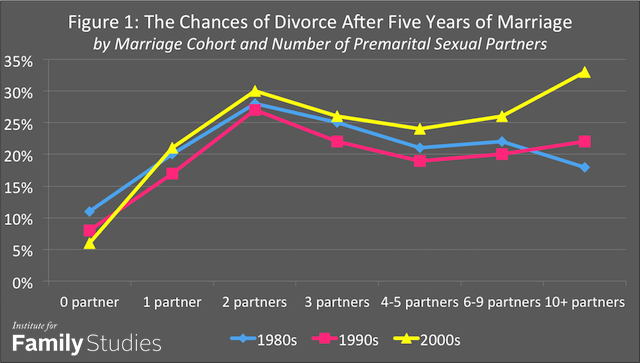
Consider this article from Family Studies that talks about how the number of pre-marital sex partners that a woman has increases her risk of divorce.

It says:

American sexual behavior is much different than it used to be. Today, most Americans think premarital sex is okay, and will have three or more sexual partners before marrying. What, if anything, does premarital sex have to do with marital stability?

This research brief shows that the relationship between divorce and the number of sexual partners women have prior to marriage is complex. I explore this relationship using data from the three most recent waves of the National Survey of Family Growth (NSFG) collected in 2002, 2006-2010, and 2011-2013. For women marrying since the start of the new millennium:

  • Women with 10 or more partners were the most likely to divorce, but this only became true in recent years;
  • Women with 3-9 partners were less likely to divorce than women with 2 partners; and,
  • Women with 0-1 partners were the least likely to divorce.

Earlier research found that having multiple sex partners prior to marriage could lead to less happy marriages, and often increased the odds of divorce.

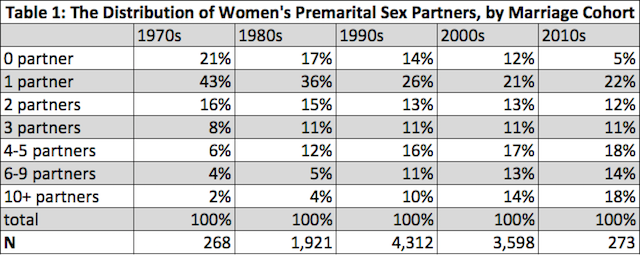
[…]Even more noteworthy has been the decline in the proportion of women who get married having had only one sex partner (in most cases, their future husbands). Forty-three percent of women had just one premarital sex partner in the 1970s.

[…]By the 2010s, only 5 percent of new brides were virgins. At the other end of the distribution, the number of future wives who had ten or more sex partners increased from 2 percent in the 1970s to 14 percent in the 2000s, and then to 18 percent in the 2010s. Overall, American women are far more likely to have had multiple premarital sex partners in recent years (unfortunately, the NSFG doesn’t have full data on men’s premarital sexual behavior, and in any event they recall their own marital histories less reliably than do women).

Here’s the change:

Women have freely chosen to dismiss the Bible and the moral law

And the problem with this, of course, is that more premarital sex partners means a higher risk of divorce:

Even one non-husband premarital sex partner raises risk of divorce

Why is the 2-partner number so high?

In most cases, a woman’s two premarital sex partners include her future husband and one other man. That second sex partner is first-hand proof of a sexual alternative to one’s husband. These sexual experiences convince women that sex outside of wedlock is indeed a possibility. The man involved was likely to have become a partner in the course of a serious relationship—women inclined to hook up will have had more than two premarital partners—thereby emphasizing the seriousness of the alternative.

The Christian Post had an article about some recent numbers from the Centers for Disease Control about virgins.

Excerpt:

A new Centers for Disease Control study examines teenage health behaviors in connection to their self-reported sexual activity and shows those who remain abstinent are much healthier on many fronts than their sexually active peers.

The report, titled “Sexual Identity, Sexual Contacts, and Health-Related Behaviors Among Students in Grades 9-12, United States and Selected Sites,” showcased the results from a 2015 survey that monitored several categories of health-related behaviors like tobacco usage, drug and alcohol use, sexual habits, unhealthy dietary behaviors, and behaviors that contribute to unintentional injuries and violence.

The report concludes “that students who had no sexual contact have a much lower prevalance of most health-risk behaviors compared with students” who had sexual contact.

The article quotes Dr. Jennifer Roback Morse, who I have featured on this blog many times:

In a Monday interview with The Christian Post, Jennifer Roback Morse, founder and president of the Ruth Institute, said, “this study is remarkable because it asks questions and reports the answers, rather than avoiding questions or assuming answers.”

As Glenn Stanton noted last week in The Federalist, the results from those questions and answers are remarkable.

With regard to smoking, teenage virgins are 3,300 percent less likely to smoke daily than their peers who are sexually involved with someone of the opposite sex, Stanton computed from the report’s data. Teen virgins are 9,500 percent less likely to smoke daily than their peers who are sexually involved with someone of the same sex or in a bisexual relationship, he added. Chaste young people are also extremely less likely to use indoor tanning beds, binge drink, smoke marijuana, ride in cars as passengers with a drunk driver, and get into physical fights than their sexually active peers. Abstinent youth are also more likely to get a solid eight hours of sleep every night and eat breakfast daily.

[…]The CDC report also included findings from 25 state surveys, and 19 large, urban school district surveys conducted among students in grades 9–12 which took place between December of 2014 and September of 2015.

Now, many pro traditional marriage people will tell young men “feminism and the sexual revolution change nothing about a woman’s suitability for marriage, so go out there and get married to these women anyway”. In my experience, no one is telling women NOT to follow their hearts, and explaining to them the harm that they do by allowing their feelings to determine who they will engage in relationships.

I would like to see women make better decisions with men before they marry, rather than be influenced by their peers and culture to give themselves to men who are not marriage-minded. Maybe a little skepticism should be shown to “follow your heart”? Women need to understand what they are losing when they choose to have premarital sex.

In my group of friends, the men are aware of the Biblical prohibition on premarital sex. My friends know about the research on marriage, and what it takes to make a marriage work. We don’t follow our hearts, because we do what we know will work to achieve the results we want. We don’t listen to the culture, and we don’t listen to radical feminists. Men generally take an engineering approach to marriage – we want to know what the best practices and tradeoffs are, and then we plan and act to succeed.

Are all sins equally bad? Or are there degrees of severity for different sins?

This question came up recently so I did some digging on theology web sites to find what Bible verses applied to the question.

Here’s what Ligonier said:

It’s clear that we have different degrees of sin when we consider the warnings of Scripture. There are at least twenty-two references in the New Testament to degrees of rewards that are given to the saints in heaven. There are different levels, different rewards, and different roles in heaven. The Bible warns us against adding to the severity of our judgment. Jesus said to Pontius Pilate, “He who delivered me over to you has the greater sin” (John 19:11). Jesus measures and evaluates guilt, and with the greater guilt and greater responsibility comes the greater judgment. It’s a motif that permeates the New Testament.

The idea of gradation of sin and reward is based upon God’s justice. If I commit twice as many sins as another person, justice demands that the punishment fits the crime. If I’ve been twice as virtuous as another person, justice demands that I get more of a reward. God tells us that entrance into heaven will be only on the basis of the merit of Christ, but once we get to heaven, rewards will be dispensed according to works. Those who have been abundant in good works will receive an abundant reward. Those who have been derelict and negligent in good works will have a small reward in heaven. By the same token, those who have been grievous enemies of God will have severe torments in hell. Those who have been less hostile will have a lesser punishment at the hands of God. He is perfectly just, and when He judges, He will take into account all of the extenuating circumstances. Jesus said, “I tell you, on the day of judgment people will give account for every careless word they speak” (Matt. 12:36).

A while back, my friend Dina sent me a sermon where that exact passage (John 19) was brought up by the pastor.

I think the correct position is that any sin is enough to separate you from God, but some sins are more severe than others in God’s objective standard of right and wrong.

OK, that was fine and good, but then I noticed a few days later that Michael Krueger had also blogged about this “all sin are equal” view, too.

Krueger says this:

First, to say all sins are the same is to confuse the effect of sin with the heinousness of sin.  While all sins are equal in their effect (they separate us from God), they are not all equally heinous.

Second, the Bible differentiates between sins. Some sins are more severe in terms of impact (1 Cor 6:18), in terms of culpability (Rom 1:21-32), and in terms of the judgment warranted (2 Pet 2:17;  Mark 9:42; James 3:1).

Even more Bible references, so we’re not on the wrong track.

So then why do some people insist that all sins are equal? It turns out that it is coming from the secular ideal of non-judgmentalism.

Krueger explains:

We should begin by observing that this phrase does not come from Scripture.  People do not use it because it appears in the Bible. Why then do they use it?

One reason, as noted above, is that some Christians use this phrase to uphold the seriousness of sin. It is viewed as a way to remind people not to be dismissive about their sin or regard it is a triviality.

Others use this phrase as way to “flatten out” all sins so that they are not distinguishable from each other.  Or, to put it another way, this phrase is used to portray all human beings as precisely the same.  If all sins are equal, and all people sin, then no one is more holy than anyone else.

In a world fascinated with “equality,” this usage of the phrase is particularly attractive to folks. It allows everyone to be lumped together into a single undifferentiated mass.

Such a move is also useful as a way to prevent particular behaviors from being condemned.  If all sins are equal, and everyone is a sinner, then you are not allowed to highlight any particular sin (or sinner).

Needless to say, this usage of the phrase has featured largely in the recent cultural debates over issues like homosexuality.  Yes, homosexuality is a sin, some Christians reluctantly concede.  But, they argue, all sins are equal in God’s sight and therefore it is no different than anything else.  Therefore, Christians ought to stop talking about homosexuality unless they are also willing to talk about impatience, anger, gluttony, and so on.

Krueger also posted this fascinating follow up post, where he looks at how the phrase is being used by people on Twitter.

Look at these tweets:

  • All sins are equal. People tend to forget that. There is no bigger or smaller sin. Being gay and lying, very equal.

  • all sins are equal in God’s eyes. whatever you’re doing, is no better than what someone else is doing.

  • If you have sex before marriage please don’t come on social media preaching about the wrongs of homosexuality. All sins are equal

  • Need people to realize that all sins are equal… don’t try to look down on me or question my faith just cuz you sin differently than I do.

  • Don’t understand why you’re so quick to judge me, when all sins are equal. So much for family..

  • if you think being gay is a sin, let me ask you something, have you not done anything wrong in your life? all sins are equal. we’re sinners

  • Nope no difference at all. All sins are equal no matter what you’re running for. The bible says do not judge lest ye be judged

  • A huge problem I have with religion is the notion that all sins are equal. Like pre-martial sex and murder are the same amount t of bad.

  • people do bad things because they believe that all sins are equal and ~god~ loves y’all equally so he’s going to forgive you naman ha ha ha

  • It a sin to condemn another sinner and their actions. All sins are equal. So what makes you better than the person you’re condemning?

  • I think so b/c having sex before marriage doesn’t make you less of a women then if you waited until marriage.. all sins are equal soo

  • friendly reminder, all sins are equal in gods eyes so you’re not better than I am in any way. please worry about your own sins before mine.

  • People don’t like when I suggest abortion as an option. This is a free country and all sins are equal so mind your business!!!

  • What I do is no worse than wat you do… all sins are equal no matter what it is… a sin is a sin

  • to god all sins are equal so you have no right to compare your sins to someone else’s bc in the end it doesn’t matter

The first thing that I noticed is that premarital sex and homosexuality are the most popular sins. I would think that divorce and abortion would be up there in the rankings, as well.

Something strange has happened in our society such that more and more people want to be led by their feelings, rather than be bounded by rules or standards. When people get caught breaking moral rules, rather than be accountable, they attack the person judging them. They would rather escape the judgment of their peers than admit fault and try to fix the mistake, and do better next time.

It’s so bad now, that the people who have morals and who make moral judgments are seen as the real bad people. The immoral people are on the offense, and even trying to ban people from being able to disagree with them. We’re seeing that with people who are being attacked for defending natural marriage against divorce and redefinition of marriage. In France, they want to make speech critical of abortion a criminal offense. And in Canada, they’ve now made speech critical of the gay agenda a criminal offense. (It’s already a human rights tribunal offense)

What is even more interesting is when the people who push the “don’t judge me” line try to justify it from the Bible. Very strange, but we seem to have forgotten the value of setting moral boundaries. Now moral boundaries are “evil”. Instead, having compassion for people who break the moral boundaries and harm themselves and others is “good”.