
Tag Archives: Feminism

Feminist explains how she chose to drink alcohol before recreational sex

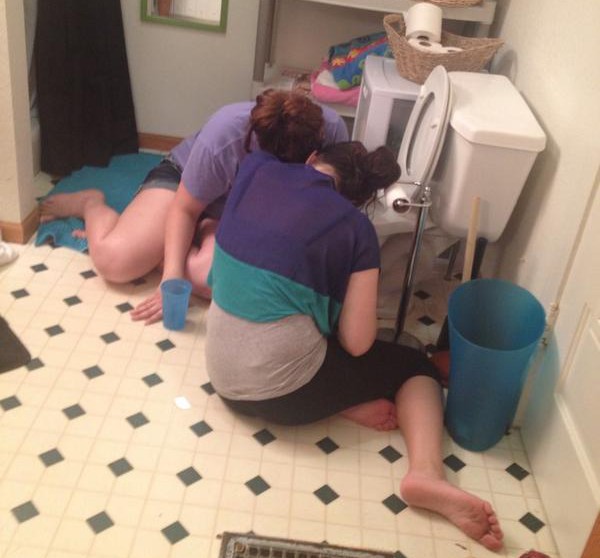
College students puking in toilet

Guess where I’m linking today? To a radical feminist web site named Jezebel, to an article written by a radical feminist who writes for the radically leftist Slate.

No, I’m not crazy. Just read it:

Much of the conversation around alcohol and sex has focused on assault—the line at which intoxication becomes incapacitation, for instance—but what we fail to mention is how haunted people can be by the sex they actually, technically consented to.

[…]I wonder what my sex life would even look like if alcohol hadn’t been there. Alcohol gave me comfort in my own body, and it allowed me to turn my erotic curiosity and hunger for experience into an action plan. I was tired of being the stuttering girl sucking in her stomach after the lights went out. I wanted to be the woman who roamed wild and free.

Alcohol also helped me cut the girlish strings on my heart, an action my college years demanded. Three months into my freshman year, I split a six pack with a dashing sophomore, and we wound up partially clothed on his bed, my bare legs wrapped around his waist, my hands around his neck. I pulled back slightly and asked him the question, the naive question of a girl who does not yet understand her fate: “What does this mean?”

He looked past me, into his studio apartment, and then back into my eyes. “It means that I’m a 19-year-old boy, and we’re having fun.”

What is interesting is that she didn’t see this man’s using her for fun after getting her drunk as any disqualification for a serious relationship. On the contrary, she believes that a serious relationship built on self-sacrificial love and commitment that lasts through difficulties can be found in a man who uses her for fun sex:

I’m not saying I didn’t enjoy that night with the dashing sophomore. I’m saying the fun part for me might have been turning our physical intimacy into a sustained attachment.

Amazing. She wasn’t looking for men with good educations, good jobs, lots of savings, who were sober and chaste – they would have made her unhappy with their bossy leading, and strict plans about courting and marriage. Nope, she wanted the drunken slut who didn’t ask her any questions or have any plan for her to develop into a wife and mother. That’s who she wanted. He was hawt! And he was free, easy and fun.

She is 35 now, and still single. I’m sure if you ask her, she would like to be married “some day”, but who could look at 20 years of drunken sex and say that this is good preparation for the challenges of marriage? Marriage is about self-sacrificial love, and endurance. To prepare for it, you learn self-denial and self-control. You learn how to accept expectations, obligations and responsibilities.

Anyway, back to the article by the drunken, promiscuous feminist. The point that I wanted to make is that she chose the alcohol herself, and that she did it for a very specific reason:

I wanted to have fun, too. And alcohol evened the score. I cared less about everything when I was drinking: What you thought of me, what I looked like in this dress, whether that taco was warm or cold when I stuffed it in my mouth. I don’t want to make it sound like I drank in order to have sex. I drank for a million reasons.

[…]Booze downshifted my intense body consciousness, and it revved up my bravado. Sex was scary—but alcohol made me feel safe.

She drank in order to have sex. Got it? She chose to get drunk in order to have sex. This is the part that permissive parents and pious pastors need to understand about their darling daughters. Many young women think that recreational sex with hot guys is a pathway to marriage. They drink in order to make progress towards the marriage they want – the marriage to the man who is fun. Not the man who is serious. They don’t want the serious man who makes plans and expects them to behave responsibly and honor obligations. They want the fun, hot man – the bad boy – and they expect to change him into a faithful, sober, responsible provider through the magical power of vagina. And if that doesn’t work, by threatening him with divorce.

Why are millenials acting like children into adulthood?

This reminds me of the Institute for American Values study. Despite their name, it is not a conservative organization

Look at this citation from p. 15:

A number of students noted that being drunk could later serve as your excuse for the hook up.

A Yale University student said, “Some people like hook up because they’re drunk or use being drunk as an excuse to hook up.”

A New York University student observed, “[Alcohol is] just part of an excuse, so that you can say, oh, well, I was drinking.”

A Rutgers University student commented, “If you’re drinking a lot it’s easier to hook up with someone… [and] drugs, it’s kind of like a bonding thing… and then if you hook up with them and you don’t want to speak to them again, you can always blame it on the drinking or the drugs.”

[…]A University of Chicago junior observed, “One of my best friends… sometimes that’s her goal when we go out. Like she wants to get drunk so I guess she doesn’t have to feel guilty about [hooking up].”

I think at this point you should assume that if your daughter is not passionate about chastity, natural marriage and pro-life, then she is probably somewhere on this drinking – recreational sex – cohabitation – abortion – no-fault divorce path. The more fun-loving and emotional a woman is, the more likely she is to fall into it, and some of them just work it together with Christianity. Once woman I know was living with a non-Christian man and praying fervently for God to make her career take off. God is there for hope and comfort, not to impose any sort of moral boundaries. And parents and pastors are oblivious – they just want to let women do whatever they want, and then blame men for not making it “work out”. Parents and pastors are not doing the job of explaining to women what their lives will really be like from age 40 to 90, and urging women to make a plan that provides lasting love and and security even as they experience declining youth, declining beauty, and declining fertility.

I hope that many of the men out there who refuse to hold women accountable for their own desires start to understand that not everything a woman wants is good, and not every plan a woman makes will work. Sometimes, you need to calmly and constructively challenge them about their priorities, plans and actions. It’s for their own good.

Maggie Gallagher does not like the message of the movie “La La Land”

Marriage and family
Marriage and family

I own a couple of books written by Maggie Gallagher, (“The Abolition of Marriage” and “The Case for Marriage”).

Here is an excerpt from her review of La-La Land, posted at The Stream: (excerpt contains spoilers)

The story begins as a classic story of two beautiful young people who meet in L.A. — a “city of magic, city of stars,” as the haunting lyric puts it, but clearly no longer City of Angels. Together they pursue their dreams both of love and success. Sebastian wants to become a jazz club singer. Mia wants to be a famous actress. The dramatic climax of the film comes after Sebastian at some personal sacrifice has given Mia the shot at her dreams, dreams she had given up on. And she chooses those dreams over him.

[…]In La La Land, [the director] chose to sharpen the clash between love and ambition. He does so in three ways:

  1. By making the choice to leave love behind the woman’s choice, rather than the man’s, brilliantly (in the commercial sense) situating the film among the emerging and popular female empowerment dramas in which women learn they do not need a man to be happy and fulfilled.
  2. By making the man a genuine hero — how else do you describe a guy who, after a woman has broken up with him and run home to Ohio to hide in the safety of her parents’ house, drives all night to deliver to her the message that she has a callback audition to a major movie? (She didn’t leave a forwarding address so he can’t just call her and let her know.)
  3. By portraying the obstacle to love as so feeble that it’s hard to imagine why it should destroy true love: Mia has to go to Paris for 6 months to make her movie. It’s her big break. Of course she has to go. But what is a love that cannot survive a few months in Paris? Is there no Skype? Are there no intercontinental flights?

One young online commentator described this twist on the iconic musical narrative, this “bittersweet ending,” as being more realistic, more grounded. I find it difficult to get into that young man’s head. How one can believe that however hard it is to find true love these days, becoming a famous Hollywood actress is a more “realistic” dream? Mia is not the loser for making this choice. She becomes famous and finds a new love, who seem a nice man, and they have a baby. She has it all, and has chosen correctly, because dreams are not transferable, but people can be replaced.

The message of the movie is clear: a good man is easier to find than a good career – especially a career that is fun, thrills and popularity. Follow your heart, and all these things will be added unto you.

She concludes with this:

[…]La La Land is a strange postmodern exercise in nostalgia, which tried to give us all the romantic feelings of the classic Hollywood musicals before ripping them away from us and substituting the idea that it is work alone on which we can rely.

If you Google La La Land, this synopsis pops up: “With modern day Los Angeles as the backdrop, this musical about everyday life explores what is more important: a once-in-a-lifetime love or the spotlight.”

I know a lot of Christian women who delay marriage because they want the spotlight.

Don’t give your money to Hollywood leftists

I don’t go to movie theaters except once every 1-3 years, because I don’t want to give Hollywood my money. If I like a movie, I buy it later on DVD for less than $10. The last movie I saw in the theater was “13 Hours”. I rarely see anything in the themes of popular movies (or popular music) that is true, good or beautiful. This movie does nothing to make me question my stewardship of my dollars. What I end up spending my money on these days is World War 2 and Korean War history audio books. Nothing in those books hurts my character. Reading military history helps me to be thankful and humble.

Consider Romans 12:1-2:

Therefore I urge you, brethren, by the mercies of God, to present your bodies a living and holy sacrifice, acceptable to God, which is your spiritual service of worship.

And do not be conformed to this world, but be transformed by the renewing of your mind, so that you may prove what the will of God is, that which is good and acceptable and perfect.

And Phil 4:8:

Finally, brethren, whatever is true, whatever is honorable, whatever is right, whatever is pure, whatever is lovely, whatever is of good repute, if there is any excellence and if anything worthy of praise, dwell on these things.

I don’t want to explain to God later why I gave the money he entrusted to me to radical leftists. What is frustrating to me about movies, (and entertainment in general, including far-left ESPN), is that all too often, my friends seem to think that my choice of entertainment is not something that God cares about.

Why don’t men today talk to women about commitment and marriage?

Painting:
Painting: “Courtship”, by Edmund Blair Leighton (1888)

I saw this essay from a young woman named Jordana Narin who is explaining how she feels about not being able to talk seriously to a man she had sex with. She is a radical feminist and has a non-STEM degree in creative writing.

The essay was published in the radically leftist New York Times.

First kiss:

I met [a guy] at summer camp in the Poconos at 14, playing pickup basketball by day and talking in the mess hall late into the night. Back home we lived only 30 minutes apart, but I didn’t see him again until 11th grade, when we ran into each other at a Halloween party in a Lower Manhattan warehouse.

[…]Under the muted flashes of a strobe light, we shared our first kiss.

No communication:

We stayed in touch for the rest of high school, mostly by text message.

[…]Every time his name popped up on my phone, my heart raced.

Still, we were never more than semiaffiliated, two people who spoke and loved to speak and kissed and loved to kiss and connected and were scared of connecting.

Where is this relationship going? This boy has no job and no savings and no proven record of steady work – and therefore he cannot marry anyone. Why is she even talking to a man who cannot afford to marry her – who has no proven record as a provider?

More:

Two years after our first kiss, we were exchanging “I’ve missed you” messages again. It was a brisk Friday evening in our first semesters of college when I stepped off a train and into his comfortable arms.

He had texted weeks earlier on Halloween (technically our anniversary) to ask if I would visit. We had not talked since summer, and I was trying to forget him. We had graduated from high school into the same inexpressive void we first entered in costume, where an “I’ve missed you” was as emotive as one got.

Long gaps in between text messages – they have nothing to talk about, and there is no goal. Nevertheless, they are away from their parents, and so she had sex with him, losing her virginity to a man she was not married to.

And then:

Naïvely, I had expected to gain clarity, to finally admit my feelings and ask if he felt the same. But I couldn’t confess, couldn’t probe. Periodically I opened my mouth to ask: “What are we doing? Who am I to you?” He stopped me with a smile, a wink or a handhold, gestures that persuaded me to shut my mouth or risk jeopardizing what we already had.

On the Saturday-night train back to Manhattan, I cried. Back in my dorm room, buried under the covers so my roommates wouldn’t hear, I fell asleep with a wet pillow and puffy eyes.

The next morning I awoke to a string of texts from him: “You get back OK?” “Let’s do it again soon :)”

So my question for you is this: should a woman who has recreational sex with a man she barely knows expect to have real relationships, including a marriage relationship?

There’s an interview that goes with it on the radically leftist NPR web site, but I saved a copy of the MP3 file here in case it disappears.

Rod Dreher comments on the interview:

I wouldn’t have understood the full scope of what this young woman is saying in her essay without the interview, which is short. In the segment, Narin says that men and women in her generation don’t have actual romantic relationships anymore. It’s all casual, non-committal sex. “

[..]She tells the interviewer that there’s lots of making out and sex, but nobody wants to be emotionally vulnerable to anybody else.

[…]“Everyone in college uses Tinder,” she said, referring to the wildly popular dating and hook-up app. “You can literally swipe right and find someone just to hang out for the night. There’s no commitments required, and I think that makes committing to someone even harder, because it’s so normal, and so expected even, to not want to commit.”

In a different time, my grandparents, my great grandparents, they might have thought they were missing out on casual sex,” she says. “But since my generation has been saddled down with that, we kind of look to the past and say well, wasn’t that nice. I think both are optimal. I’m a huge feminist, and I think women should be able to do whatever they want to do. If a woman wants to have tons of casual sex, she totally should. But I think that there should be the option. And they shouldn’t be gendered, women and men. But there should be the option of being in a relationship.”

Right. Young women like her who have swallowed radical feminism hook, line and sinker don’t want to “miss out” on casual sex right now, but they want to get married “some day” – after they have a lot of fun traveling and doing exciting, fun things. Today, they want to choose to have sex with hot guys, but tomorrow they want the “option” of a man committing to them, even though they have a repeated pattern of putting recreational sex above commitment in their own lives. Basically, they don’t want to pick a man now who can actually do marriage. Right now, they want to pick a man who has no interest in marriage. Later, they want a man to pursue them for marriage.

Consider this story from the Ottawa Sun about a woman who didn’t want to say no to sex right now, but wanted to get married “some day”:

A New York woman is facing charges after police say she lied about being raped by two football players at a party to get sympathy from a prospective love interest.

Nikki Yovino, 18, has been charged with falsely reporting an incident and tampering with or fabricating physical evidence.

Last October Yovino reported that she had been sexually assaulted in a bathroom by two Sacred Heart University football players at an off-campus party.

The men, however, said it had been consensual.

Capt. Brian Fitzgerald tells WABC-TV another student informed authorities of explicit text messages between the three. He says one man also recorded some of the incident on his cellphone.

“She admitted that she made up the allegation of sexual assault against (the football players) because it was the first thing that came to mind and she didn’t want to lose (another male student) as a friend and potential boyfriend. She stated that she believed when (the other male student) heard the allegation it would make him angry and sympathetic to her,” said an affidavit, according to the New York Post.

Two. Football. Players. At the same time.

Nowhere in society is there any man who tells women like this that they should not pursue pleasure right now if they want marriage some day. No father. No pastor. No one has the courage to tell young women that following their emotions leads them to abortion, single motherhood, divorce, infertility and missing marriage completely.

Do women prepare themselves for the self-sacrifice and self-control required in marriage?

Here’s what many women think of marriage:

Look at the lyrics:

You got that 9 to 5
But, baby, so do I
So don’t be thinking I’ll be home and baking apple pies
I never learned to cook

After every fight
Just apologize
And maybe then I’ll let you try and rock my body right
Even if I was wrong
You know I’m never wrong

And know we’ll never see your family more than mine

Even when I’m acting crazy
Tell me everything’s alright

Women today expect to be pursuing their own interests before, during and after marriage. They don’t want the constraints of relationships with a husband or children. I think this will work to get attention from certain men for a while, but when she loses her youth and beauty, it will dry up pretty quickly. Who is there telling women that they need to pick a marriage-minded man and focus on marriage earlier, rather than later?

Will anyone talk about marriage to these women?

Most men are not interested in committing to, or discussing commitment with, women who put pleasure above self-control. Most non-Christian men will have sex with a hedonistic women, but they are too smart to ever commit to them. Why would a man commit to a narcissist? If a man’s role is just to please the “huge feminist”, then there is no reason to commit to her and be the slave of her selfish impulses for the rest of his life. Radical feminists believe that relationships are about their plans and their needs. They are not interested in responsibilities, expectations or obligations to men or to children. Most men, even secular men, understand that they must not marry a woman who rejects moral obligations for fun. Especially with the looming threat of no-fault divorce.