Tag Archives: Feminism

What do college students achieve by participating in the hook-up culture?

Even one non-husband premarital sex partner raises risk of divorce

Stuart Schneiderman linked to a balanced article from the New York Times Magazine which offers scary insights into the hook-up culture at one of our elite universities.

First, feminism is definitely a driver of the hook-up culture, and women are voluntarily choosing it:

At 11 on a weeknight earlier this year, her work finished, a slim, pretty junior at the University of Pennsylvania did what she often does when she has a little free time. She texted her regular hookup — the guy she is sleeping with but not dating. What was he up to? He texted back: Come over. So she did. They watched a little TV, had sex and went to sleep.

Their relationship, she noted, is not about the meeting of two souls.

“We don’t really like each other in person, sober,” she said, adding that “we literally can’t sit down and have coffee.”

Ask her why she hasn’t had a relationship at Penn, and she won’t complain about the death of courtship or men who won’t commit. Instead, she’ll talk about “cost-benefit” analyses and the “low risk and low investment costs” of hooking up.

“I positioned myself in college in such a way that I can’t have a meaningful romantic relationship, because I’m always busy and the people that I am interested in are always busy, too,” she said.

“And I know everyone says, ‘Make time, make time,’ ” said the woman, who spoke on the condition of anonymity but agreed to be identified by her middle initial, which is A. “But there are so many other things going on in my life that I find so important that I just, like, can’t make time, and I don’t want to make time.”

It is by now pretty well understood that traditional dating in college has mostly gone the way of the landline, replaced by “hooking up” — an ambiguous term that can signify anything from making out to oral sex to intercourse — without the emotional entanglement of a relationship.

Until recently, those who studied the rise of hookup culture had generally assumed that it was driven by men, and that women were reluctant participants, more interested in romance than in casual sexual encounters. But there is an increasing realization that young women are propelling it, too.

Hanna Rosin, in her recent book, “The End of Men,” argues that hooking up is a functional strategy for today’s hard-charging and ambitious young women, allowing them to have enjoyable sex lives while focusing most of their energy on academic and professional goals.

And a bit more about “A”:

For A., college is an endless series of competitions: to get into student clubs, some of which demand multiple rounds of interviews; to be selected for special research projects and the choicest internships; and, in the end, to land the most elite job offers.

As A. explained her schedule, “If I’m sober, I’m working.”

In such an overburdened college life, she said, it was rare for her and her friends to find a relationship worth investing time in, and many people avoided commitment because they assumed that someone better would always come along.

“We are very aware of cost-benefit issues and trading up and trading down, so no one wants to be too tied to someone that, you know, may not be the person they want to be with in a couple of months,” she said.

Instead, she enjoyed casual sex on her terms — often late at night, after a few drinks, and never at her place, she noted, because then she would have to wash the sheets.

[…]“‘I’ve always heard this phrase, ‘Oh, marriage is great, or relationships are great — you get to go on this journey of change together,’ ” she said. “That sounds terrible.

“I don’t want to go through those changes with you. I want you to have changed and become enough of your own person so that when you meet me, we can have a stable life and be very happy.”

In the meantime, from A.’s perspective, she was in charge of her own sexuality.

“I definitely wouldn’t say I’ve regretted any of my one-night stands,” she said.

“I’m a true feminist,” she added. “I’m a strong woman. I know what I want.”

At the same time, she didn’t want the number of people she had slept with printed, and she said it was important to her to keep her sexual life separate from her image as a leader at Penn.

“Ten years from now, no one will remember — I will not remember — who I have slept with,” A. said. “But I will remember, like, my transcript, because it’s still there. I will remember what I did. I will remember my accomplishments and places my name is hung on campus.”

These high-powered feminist students are having sex with strangers because they are “hot”, not because they have made the man prove his intention and ability to commit by waiting until marriage.

I think the key point about this is that these women think that they are actually on a path to marriage by focusing on themselves and their careers. Their alcohol abuse is a path to marriage. Their promiscuity with bad boy men who have no interest in marriage is a path to marriage. Their career and selfishness is a path to marriage. This despite the fact that research clearly shows that the number of sexual partners that a woman has before marrying directly impacts her ability to perform in a relationship. Premarital sex with bad boys raises her estimation of her own value in relationships. When she is older and has to settle for what she can get, she will be dissatisfied and ungrateful. This is where divorce comes from.

Nothing that these women are doing is preparation for actual commitment and support. They can’t even converse with men, much less do the duties of a wife. Their ability to choose a man who can perform actual husband/father duties is not being formed by study or courtship. There is no wisdom. There is no self-sacrifice. There is no chastity. There is no support. There is no communication. These women are pro-abortion – that’s their view of  the rights and dignity of children. They are pro-gay marriage – that’s their view of providing for children’s relationship needs. These are literally the worst women in the world to marry. Their ignorance of what they must do to be good wives and mothers, and their messed up criteria for choosing men who can be husband and fathers makes them the worst women in the world to marry.

Read this carefully:

Some women went to college wanting a relationship, but when that seemed unlikely, they embraced hooking up as the best alternative. M., an athletic freshman with long legs and a button nose, arrived at college a virgin and planned to wait to have sex until she had her first boyfriend, something she expected to happen in college. But over the course of the fall, as she saw very few students forming relationships, she began to lose hope about finding a boyfriend and to see her virginity as a hindrance.

“I could be here for four years and not date anyone,” she said she realized. “Sometimes you are out, and there’s a guy you really are attracted to, and you kind of want to go back home with him, but you kind of have that underlying, ‘I can’t, because I can’t just lose my V-card to some random guy.’ ”

At a party in the spring semester, she was taking a break from dancing when she ran into a guy she had had a class with in the fall. They started talking, then danced until the party was over. M. went back to his room, where they talked some more and then started making out.

By this time, she said, “I wasn’t very drunk — I was close to sober,” which made her believe she could make a considered decision.

“I’m like, ‘O.K., I could do this now,’ ” she recalled thinking. “ ‘He’s superhot, I like him, he’s nice. But I’m not going to expect anything out of it, either.’ ”

The alternative, she said, was that “I could take the chance that one night I get really drunk and sleep with someone that I don’t want to sleep with, which probably is what would have ended up happening.”

So she had sex with him. In the morning, he walked her home.

“Honestly, all of my friends, they’re super envious, because I came back with the biggest smile on my face,” M. said. As she had expected, she and the guy remained friendly but nothing more. Yet she was still happy with her decision.

“All of my friends are jealous, because I had such a great first experience,” she added. Over spring break, she slept with someone else.

In general, she said, she thought that guys at Penn controlled the hookup culture. But women played a role as well.

“It’s kind of like a spiral,” she said. “The girls adapt a little bit, because they stop expecting that they’re going to get a boyfriend — because if that’s all you’re trying to do, you’re going to be miserable. But at the same time, they want to, like, have contact with guys.” So they hook up and “try not to get attached.”

Now, she said, she and her best friend had changed their romantic goals, from finding boyfriends to finding “hookup buddies,” which she described as “a guy that we don’t actually really like his personality, but we think is really attractive and hot and good in bed.”

I think I would really like everyone reading this to just read that last part over a few times, and let that sink in. You have a minority of good looking athletic men having sex with most of the women on campus, while the majority of men who opt-out of the hook-up culture and want to court and marry are left wondering where all the women went. And many of those will reinvent themselves as “bad boys” in order to at least get some contact with women, so that there are even fewer chaste, marriage-enabled men.

I really recommend reading some of Dr. Schneiderman’s comments on this article. He is really not happy about it, and he puts the blame squarely on feminists. As do I. Radical feminism is the ideology that gave us abortion, fatherlessness and divorce. We should call it what it is: selfish and destructive.
Comparing male and female support for abortion, divorce and gay marriage

Disclaimer: This post doesn’t apply to married women. When I refer to women below, I mean young, unmarried women. But I’m just going to say “women” for brevity’s sake.

Are women really more moral than men? Let’s take a look at the attitudes of men and women on five of the most prominent moral issues of our time: gay marriage, divorce, abortion, war, and crime.

Gay marriage, divorce and abortion

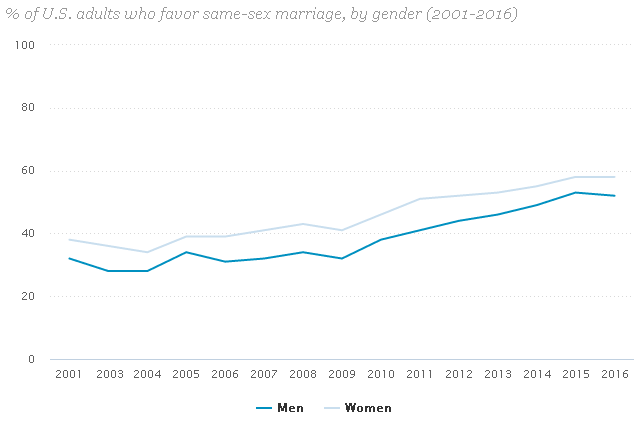
Here is Pew Research on gay marriage as of 2016:

Women far more likely to support gay marriage than men
Women are more immoral on gay marriage than men

Women favor gay marriage by a margin of 58% compared to only 52% for men.

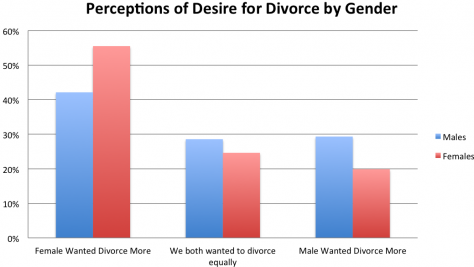
Here is the Austin Institute on divorce in 2014:

Women are more immoral on divorce than men

Women initiate about 70% of divorces, even though they freely chose the man they married, and vowed to stick by him through all circumstances.

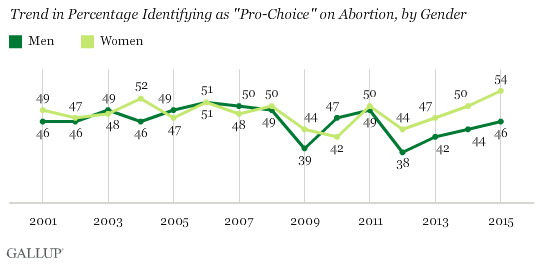
Here is Gallup on abortion as of 2015:

Women are more immoral on abortion than men

About 75% of young, unmarried women vote for the Democrat party – the party of unrestricted, taxpayer-funded abortion.

Abortion ignores the needs of unborn children. Same-sex marriage ignores the need of children for a mother and a father. Divorce devastates children, causing all sorts of negative effects. Men are more willing to judge all three of these bad behaviors than women. Men are more concerned about protecting the weak than they are about feeling compassionate and being perceived as “tolerant”.

What about war and self-defense against criminals?

Women are also more liberal than men on war and self-defense. You can just look at what happened in the Middle East to the Yazidi girls who are being raped and sex-trafficked to understand the consequences of this anti-war viewpoint. To be anti-war when the war is just is to be pro-evil. Just ask the Christians being tortured and murdered in Syria whether they are happy that American troops were withdrawn from Iraq. Just ask the victims of crimes like rape whether they wish they had been armed when they were attacked. Men are tougher on terrorists and criminals than women are.

Blaming men for what women choose to do

This data shows that men should be challenging women to improve their views on these important issues. But Christian pastors and scholars often discourage men from challenging women on moral issues, preferring to blame men when women take the wrong side of moral issues.

For example, here’s Mark Driscoll explaining how men are to blame for single motherhood:

Part of it is the unintended consequences of divorce. Forty percent of kids go to bed at night without a father. Not to be disparaging toward single moms, but if you’re a single mom and you’re working 60 hours a week, and you’ve got a boy, and he’s home all by himself with no parents and no dad, he’s just going to be hanging out with his buddies, feeding himself pizza rolls.

The number one consumer of online pornography is 12- to 17-year-old boys. What that means is he’s home eating junk food, drinking Monster energy drinks, downloading porn, masturbating and screwing around with his friends. That really doesn’t prepare you for responsible adulthood. That’s a really sad picture, especially if you’re a single gal hoping to get married someday. You’re like: “Seriously, that’s the candidate pool? You’ve got to be kidding me.” That’s why 41 percent of births right now are to unmarried women. A lot of women have decided: “I’m never going to find a guy who is actually dependable and responsible to have a life with. So I’ll just get a career and have a baby and just intentionally be a single mother because there are no guys worth spending life with.”

This practice among Christian leaders of blaming men for the actions of women is one of the major reasons why women have the views that they do on abortion, divorce, gay marriage, just war and self-defense. Men have been cowed into silence by man-blamers like Mark Driscoll and James Dobson. This message actually weakens the moral leadership of men, and creates a worse world.

This lack of moral leadership by men is particularly problematic with “pro-life” men who try to blame men for abortion. Abortions occur (in non-rape cases) because a woman makes two choices: 1) choosing a man who only wants recreational sex, and 2) choosing to have recreational sex with a man who has shown no interest in commitment or parenting. Speaking as an unmarried virgin somewhat advanced in years, there are plenty of good men out there who don’t believe in sex before marriage, and who have prepared very well for the traditional male roles of protector, provider and moral/spiritual leader. If women insist on choosing the wrong men, and choosing to do the wrong things with those men, it makes sense to hold them accountable. The bad men were bad before the women chose them, and so they should have been recognized and avoided by the women before any need for abortion occurred. A woman cannot expect a bad man to suddenly turn into a good man after he is given recreational sex. Recreational sex does not make a man who is not interested in marriage and children somehow become interested in marriage and children. And women need to be told this by pro-life men who are not cowards.

Men really need to shed this perception that there is something wrong with them, and challenge women on areas where they have immoral views. Men: don’t let yourselves be manipulated into silence in order to get affection, approval or sex. If you must have affection, approval and sex, then choose a woman who puts moral standards above feeling happy and being perceived as compassionate.

New study: nearly half of millenials reject monogamy

Marriage and family
Marriage and family

Study reported on by The Stream:

A new report found nearly half of American millennials don’t want monogamous relationships.

YouGov revealed the research on monogamy and cheating, showing couples under 30 are significantly less monogamous than older generations.

Only 51 percent of people under 30 reported desiring a “completely monogamous” relationship, compared to 58 percent from the 30-44 age bracket, 63 percent from the 45-64 age bracket, and 70 percent from the 65 plus age bracket polled.

[…]Reports also show that men and women are cheating at almost equal rates.

It’s not just adultery that millenials don’t care about any more, it’s premarital sex. An article from the Washington Post found that both men and women no longer desire their romantic partners to be chaste:

Dating has changed hugely over the past generations, and so have cultural ideas about what men and women value most in a mate.

This idea is perfectly illustrated by a chart that economist Max Roser, who created the blog Our World in Data, recently put out on Twitter. The chart is made with data from a study published in the Journal of Family Issues in 2013, in which three researchers compared how heterosexual men and women ranked the importance of 18 traits in wives and husbands, first in 1939, and then again in 2008.

[…]For both men and women, the importance of chastity nose-dived, from #10 in 1939 to #18 in 2008. Emotional stability and maturity, a pleasing disposition, good health, and refinement and neatness also declined for both sexes.

For women, a similar religious background and a desire for home and children became less important in their mates, while men placed less value on ambition and industriousness in their wives.

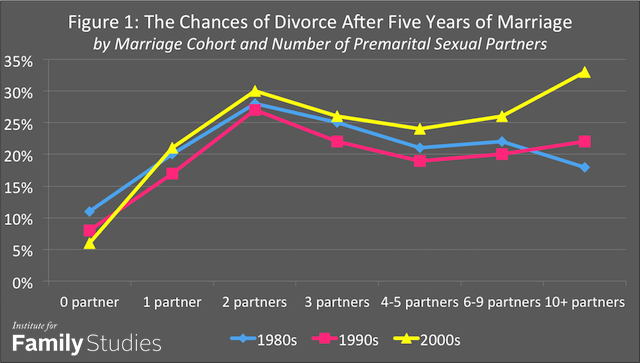
It goes without saying that adultery is more like to reduce marriage stability. And studies also show that marriage stability is severely impacted by the number of premarital sex partners.  That’s why chastity matters: it’s a predictor of marital stability. If a person can control themselves before marriage when they don’t get any sex, it’s easier to control themselves when that need is being supplied safely and generously. Also, chastity just reinforces the idea that sex is something that is done within a lifelong commitment, not something that is done outside of a commitment for fun and thrills. I don’t that the millenial approach of premarital unchastity and post-marital non-monogamy is going to help them keep their marriages together.

But young people today aren’t interested in looking at studies to figure out how to do marriage right so that it will last. They make their decisions with their feelings. They value what the culture tells them to value, rather than picking a mate who has the skills and abilities to make the marriage last.

How well is picking mates based on emotions rather than demonstrated ability working out? The marriage rates are plummeting:

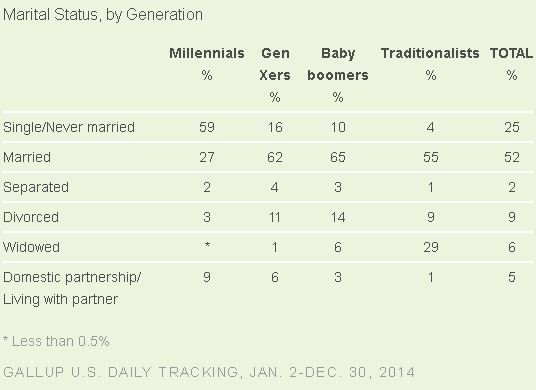
Gallup poll:

Contrary to what we would expect, given normal demographic patterns of adolescents’ movement into early adulthood and family formation, the data show that significantly more millennials are currently single/never married than was true for those in older generations, and considerably more are in domestic partnerships. Specifically, more than half of all millennials (59%) have never married, and 9% are in domestic partnerships. Gallup has noted a trend toward fewer young adults being married in recent years.

In the 2014 Gallup Daily tracking data, just 27% of millennials were married. According to historical U.S. Census Bureau data, 36% of Generation Xers, 48% of baby boomers and 65% of traditionalists were married when they were the age that millennials are now. For millennials currently aged 18 to 30, just 20% are married, compared with nearly 60% of 18- to 30-year-olds in 1962, according to the U.S. Census. When Gen Xers were the same age, 32% were married; for baby boomers, it was more than 40%.

Millennials are clearly delaying marriage longer than any generation before them, in spite of evidence suggesting that many millennials intend to marry at some point. For example, a 2013 Gallup poll found that 86% of single/never married Americans aged 18 to 34 (roughly equivalent to the millennial generation) wanted to get married someday.

Table:

Marriage rates across different generations of Americans

Who can keep a relationship going when the top criterion is ability to entertain rather than ability to commit self-sacrificially? I hear lots of Christian women say they want to get married “some day”, but there they are in their mid 30s, unemployed, penniless, with empty resumes, backpacking through Europe. The words “some day” sound good to their parents and pastors, but the actions are all about hedonism and thrill-seeking – just what the culture told them to do, in order to have a meaningful life.

Is there a cost to the younger generation turning their backs on traditional marriage, including the norms of chastity, fidelity and permanence?

I saw an article on the Public Discourse that talked about the fiscal costs of abandoning traditional marriage.

It says:

In 1965, liberal Harvard political scientist Daniel Patrick Moynihan was astonished to find that about 25 percent of African-American children were born out of wedlock. Moynihan was deeply worried about this finding because he knew exactly what being born out of wedlock means for a child. Decades of social science confirm what common sense has always taught us: that children born out of wedlock are disadvantaged in every way. They are more likely to be physically and mentally ill, more likely to be poor and unhappy, more likely to have trouble in school and with education generally, more likely to be abused sexually, more likely themselves to abuse others sexually, more likely to abuse alcohol or other drugs, and more likely to engage in criminal activity and to have a disdain for authority.

This, in turn, invariably increases the size and scope of the power of the state. The state must expand to replace fathers who have abandoned their families by providing for single mothers. It must increase its public-health efforts to provide for children whose single parents cannot pay for private healthcare and to treat victims of violence committed by those who have been raised in an environment that has failed to equip them for a robust and peaceful social life. It must create and maintain adoption agencies to care for children whose parents are unfit or absent. It must commit more funds to police departments to address crime that results from families breaking apart (or failing to form in the first place), and hence failing to instill virtue in children. It must commit funds to the creation of prisons where criminals are to be kept. The list goes on and on.

The economic costs of abandoning social conservatism, then, run quite high—in addition to all of the unquantifiable social costs of broken families, deaths, broken relationships, and ruined lives. It is no surprise that leftists, committed to consolidating power in the state, have sought to undermine the family: they realize—better than many fiscal conservatives do—that a flourishing marriage culture is required for free markets and limited governments to exist.

So, there really is a cost to the embrace of moral relativism. When morality goes, expensive things happen, and government grows to pick up the costs. The bigger the government grows, the taxes are required to pay for it, leaving you with less of your own money – less of your own freedom to live how you want to live.