
Tag Archives: Feminism

Debating forgiveness: must a person admit wrongdoing before being forgiven?

Two horses fight it out, may the best horse win!

I was traveling outside the country when this debate came out, so I couldn’t blog about it right away. I’ve now listened to it three times. I liked it so much that I even ordered Chris’ book for Dina. She has listened to the debate, and is currently split between the two debaters. I am in firm agreement with the pastor Chris.

Here’s a link to the debate page on Moody Bible Institute’s “Up For Debate” program with Julie Roys. (H/T Kris)

Details:

Should Christians Forgive No Matter What?

Should Christians forgive someone even if he’s not sorry?  Or does true forgiveness require repentance and a desire to reconcile?  This Saturday, on Up For Debate, Julie Roys will explore this issue with Chris Brauns, a pastor who believes forgiveness requires repentance, and Remy Diederich who believes it does not.

Although I disagree with Remy, I only disagree with him about whether the guilty person must admit guilt and feel remorse and make restitution (depending on the severity of the offense). I agree with him on other things like no revenge, attitude of love, expressing willingness to forgive and be reconciled, etc. I also disagree with Remy on “forgiving God”, which I think is just crazy, because when God is engineering a person’s salvation, he never fails. I think that God is the Great General, and his strategies never fail to achieve the outcomes he desires (while still respecting free will). Whatever suffering or inadequacy or longing that you experience as a Christian is not some sort of mistake, horrible as it may be for you at the time. God is not your cosmic butler, although a lot of people these days seem to think that he is, and then they get disappointed.

Anyway, please listen to that debate and comment on it about who you think is right. I think my view (and Chris’ view) is in the minority in the church, because the church is so utterly dominated by feelings and radical feminism. I think my view (and Chris’ view) is the masculine view – the view that upholds moral standards, sets moral boundaries and defends the rightness of making moral judgments.

Below, I have pasted in some of my other thoughts on forgiveness from a previous post.

I think this is the key passage – Luke 17:3-4:

Be on your guard! If your brother sins, rebuke him; and if he repents, forgive him.

And if he sins against you seven times a day, and returns to you seven times, saying, ‘I repent,’ forgive him.”

That’s Jesus speaking, there.

Also, I was having a debate with someone who disagrees with all this, and while debating with her, I thought of another example.

Luke 18:9-14:

And He also told this parable to some people who trusted in themselves that they were righteous, and viewed others with contempt:

10 “Two men went up into the temple to pray, one a Pharisee and the other a tax collector.

11 The Pharisee stood and was praying this to himself: ‘God, I thank You that I am not like other people: swindlers, unjust, adulterers, or even like this tax collector.

12 I fast twice a week; I pay tithes of all that I get.’

13 But the tax collector,standing some distance away, was even unwilling to lift up his eyes to heaven, but was beating his breast, saying, ‘God, be merciful to me, the sinner!’

14 I tell you, this man went to his house justified rather than the other; for everyone who exalts himself will be humbled, but he who humbles himself will be exalted.”

So again, no forgiveness without repentance.

Forgiveness is what happens when someone who is sinned against treats the sinner as if he had never sinned. It is not on the balance sheet. It is not brought to mind. It is not held against them in the future. The forgiver trusts the sinner again as if the previous sin had never happened.

In divine (vertical) forgiveness, there is no forgiveness without repentance. There are Bible verses above to show that.

My argument is twofold. First, there is a clear teaching of Jesus explaining the sequence of sin and forgiveness. Repentance precedes forgiveness, between humans (Luke 17:3). The verses cited by the forgive without repentance crowd don’t show the mechanics of how to forgive, they are making the point that if you want God to forgive you, you should forgive others. The parable in Luke 18:9-14 affirms this again – repentance always precedes forgiveness.

Second, we have an obligation to imitate God, and that means imitating the way he forgives those who sin against him. When I raise that with the unconditional forgiveness crowd, they want to insist that there is a difference, that the word “forgive” means different things. I’m not convinced.

Finally, I do think that forgiving someone is obligatory if they sincerely repent, and even if they screw up again and again. So long as the repentance is sincere, (like if there is restitution and a genuine effort to show an understanding how the sin affected the wronged party in writing), then forgiveness should be automatic. Depending on how bad the sin is, there maybe be more to do than just say “I’m sorry”. If the repentance is genuine, then I think the person who is sinned against must forgive, if they expect to be forgiven by God for the things they repent of.

Alan E. Kurschner adds one final point about the unconditional forgiveness view. He argues that there is serious textual doubt about the originality of Luke 23:34a, a text used by the pro-unconditional-forgiveness crowd. He has a journal article coming out on it, but a synopsis of his argument is here.

He also wrote this in a comment on this blog:

Second, on Matt 6:15, this is what I have to say. Notice the then-clause: “neither will your Father forgive your sins.” This would require universalism on the Father’s part according to the unconditional interpretation given the first half: “But if you do not forgive others their sins.” Since everyone has wronged the Father is the Father required to forgive everyone even if they are not seeking forgiveness?

So I think the case for the forgiveness being conditional on repentance is pretty strong, especially when serious harm has been caused.

Why are people like Glennon Doyle Melton and Jen Hatmaker so famous?

I keep seeing all these people in the culture like Rob Bell, Rachel Held Evans, Brian McLaren, Joel Osteen getting all this support from Christians – support that the people I admire like Jay Richards, William Lane Craig, Scott Klusendorf and Ryan T. Anderson don’t seem to get.

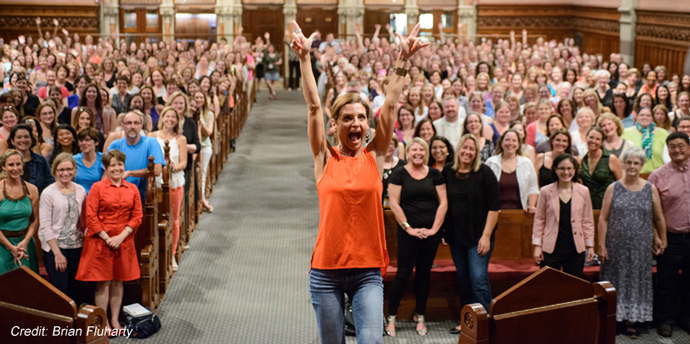
Glennon Doyle Melton in a church

First, here is Glennon being celebrated in the far-left Washington Post.

Excerpt:

Christian author Glennon Doyle Melton — known as the “ultimate confessional writer” for her honest portrayals of her struggling marriage, addiction and eating disorder — has opened up with another big revelation.

She is dating again, her new partner is a woman and that woman is celebrity soccer champ Abby Wambach.

[…]Melton’s news comes three months after she announced her divorce from Craig Melton, her husband of 14 years…

[…]Glennon Doyle Melton has reiterated for years her position affirming that same-sex marriage is not sinful and celebrating love in various forms. A few Christian writers who champion LGBT rights in the church congratulated Melton on Twitter on Sunday night. (Another Christian mom and blogger, Jen Hatmaker, came under fire last month for announcing her support of same-sex marriage for the first time.)

Melton’s coming out follows fellow inspirational author and friend Elizabeth Gilbert, of “Eat, Pray, Love” fame. Gilbert announced in September she was in a romantic relationship with her female best friend, just two months after divorcing over the summer.

Both Melton and Gilbert, who had not openly been in lesbian relationships before, first shared their news on Facebook, discussed the importance of living their truth and referred to their new partners as “my person.”

The similarities reflect what fans immediately notice: Both women value transparency and share an open-life-memoir writing style. Both have undergone spiritual journeys, separations and sexual awakenings.

[…]Melton and Gilbert have appeared on her career-making book list and popular programs. During a personable Oprah Winfrey Network interview in September, Oprah called Melton a “breath of fresh air.”

[…]Gilbert and Melton met for the first time last fall, but Melton has long admired and been inspired by Gilbert. “For the past decade she has been a minister to me,” she said.

I sent this story to a young lady I admire very much, and I was greatly comforted by her reply: “She is very deceived as to the truth. ” Thank God for women who care more what the Bible says than being popular. Just because a woman is physically fit and charismatic, that doesn’t make her a role model for Bible-believing Christians. Her book is endorsed as “epic” by Elizabeth Gilbert, which is a good sign that doesn’t mean that she is reliable where it counts – defending the moral values taught in the Bible.

Brandon and Jen Hatmaker
Brandon and Jen Hatmaker (actual photo, not Photoshopped)

Here’s an article by former lesbian Rosaria Butterfield posted at The Gospel Coalition about Jen Hatmaker and her husband Brandon.

It says:

If this were 1999—the year that I was converted and walked away from the woman and lesbian community I loved—instead of 2016, Jen Hatmaker’s words about the holiness of LGBT relationships would have flooded into my world like a balm of Gilead. How amazing it would have been to have someone as radiant, knowledgeable, humble, kind, and funny as Jen saying out loud what my heart was shouting: Yes, I can have Jesus and my girlfriend. Yes, I can flourish both in my tenured academic discipline (queer theory and English literature and culture) and in my church.

[…]To be clear, I was not converted out of homosexuality. I was converted out of unbelief. I didn’t swap out a lifestyle. I died to a life I loved. Conversion to Christ made me face the question squarely: did my lesbianism reflect who I am (which is what I believed in 1999), or did my lesbianism distortwho I am through the fall of Adam? I learned through conversion that when something feels right and good and real and necessary—but stands against God’s Word—this reveals the particular way Adam’s sin marks my life. Our sin natures deceive us. Sin’s deception isn’t just “out there”; it’s also deep in the caverns of our hearts.

How I feel does not tell me who I am. Only God can tell me who I am, because he made me and takes care of me. He tells me that we are all born as male and female image bearers with souls that will last forever and gendered bodies that will either suffer eternally in hell or be glorified in the New Jerusalem. Genesis 1:27 tells me that there are ethical consequences and boundaries to being born male and female.

[…]I only know who I really am when the Bible becomes my lens for self-reflection, and when the blood of Christ so powerfully pumps my heart whole that I can deny myself, take up the cross, and follow him.

The essential mistake that all the popular people make is that they distort the Bible in order to feel good about themselves and to be liked by other people. But sometimes, when you put being liked by other people first, you neglect the more important goal of being liked by God. Feeling good and being liked is not the same as being faithful and obedient to God. And God does not like when people misrepresent his character to non-Christians who are “looking for loopholes” in his Word. The whole point of Christianity is self-denial and self-sacrificial obedience, as modeled in Jesus, who gave up his wishes and desires by being willing to die to save others.

1 Corinthians 6:9-10: (Paul writing)

Or do you not know that the unrighteous will not inherit the kingdom of God? Do not be deceived: neither the sexually immoral, nor idolaters, nor adulterers, nor men who practice homosexuality,

10 nor thieves, nor the greedy, nor drunkards, nor revilers, nor swindlers will inherit the kingdom of God.

Matthew 19:1-11: (Jesus’ view of marriage)

1 Now when Jesus had finished these sayings, he went away from Galilee and entered the region of Judea beyond the Jordan.

2 And large crowds followed him, and he healed them there.

3 And Pharisees came up to him and tested him by asking, “Is it lawful to divorce one’s wife for any cause?”

4 He answered, “Have you not read that he who created them from the beginning made them male and female,

5 and said, ‘Therefore a man shall leave his father and his mother and hold fast to his wife, and the two shall become one flesh’?

6 So they are no longer two but one flesh. What therefore God has joined together, let not man separate.”

7 They said to him, “Why then did Moses command one to give a certificate of divorce and to send her away?”

8 He said to them, “Because of your hardness of heart Moses allowed you to divorce your wives, but from the beginning it was not so.

9 And I say to you: whoever divorces his wife, except for sexual immorality, and marries another, commits adultery.”

10 The disciples said to him, “If such is the case of a man with his wife, it is better not to marry.”

11 But he said to them, “Not everyone can receive this saying, but only those to whom it is given.

If you want to read reflections on these teachings that honor the plain meaning of the words, then by all means, pick up Ryan T. Anderson’s “Truth Overruled: The Future of Marriage and Religious Freedom” and Michael L. Brown’s “Can You Be Gay and Christian?: Responding With Love and Truth to Questions About Homosexuality“. It’s more important to align your beliefs with reason and evidence than with feelings and peer-approval.

Even ordinary Christians like me who are single have to say no to our desires to have sex before we are married. Although it is fashionable in the LGBT community to say “God wouldn’t make me have desires that I couldn’t fulfill” and “it’s not fair because straight people can fulfill their desires” this is baloney. I’m straight, and I have been thwarted in fulfilling my desire for sex for decades. It’s a normal Christian life to go without something you need and to be hungry. It’s not exceptional. This is obvious to anyone who reads the Bible and accepts the plain meaning of the words. Jesus didn’t tell people things that they wanted to hear, he told them hard truths that sometimes got him into a lot of trouble with sinful people. I’m really not sure why people who claim to be Christians are attracted to the exact opposite – false teachers who say things that make them feel good and negate the need for forgiveness from God, followed by repentance from sin.

Men on strike: the social changes that caused men to opt out of marriage

SurveyMonkey election poll cross tabs for unmarried women Nov 2016
SurveyMonkey election poll cross tabs for unmarried women only Nov 2016

I read and enjoyed Dr. Helen Smith’s book “Men on Strike” last year. The book explains a few of the developments that have led to men underperforming in school and in the workplace, and opting out of marriage and fatherhood.

Dr. Helen comes to this problem as a secular libertarian, not as a Christian conservative.

A review of Dr. Helen’s book appeared in Salvo magazine. The review is written by Terrell Clemmons, who has the best Christian worldview of any woman I know – I frequently rely on her advice.

Terrell writes:

While the feminist movement may originally have been about equal respect for both sexes, what it has morphed into, she argues, is female privilege. From rape laws that empower women but not the men they may falsely accuse, to divorce laws tilted in favor of the wife, to the feminization of the U.S. education system, men have become the sex under the gun, while women enjoy the status of a protected class.

But unlike their mothers or grandmothers, men today are not taking to the streets burning their undergarments and shrieking demands (thank God). They’re doing just the opposite, which is far worse. They’re going on strike. The strike zones are manifold:

Higher Education.In addition to the enrollment imbalance, which is approaching a 60/40 ratio of women to men, college has become, in the words of one professor, “a hostile working environment [in which] males increasingly feel emasculated.” Smith quotes a student named John, who had this to say about his college experience: “I had already been cautious around women, having grown up with Tawana Brawley in my backyard and daily stories of sexual harassment; I played it safe and passive every time. But it doesn’t matter. The only way not to lose is to not play. So I’m out.”

Work,including community involvement. With higher female graduation rates and salaries, men today are falling behind their fathers economically and professionally. Consequently, their efforts to prove themselves worthy mates through hard work and higher earnings don’t win female attention the way they used to. Discouraged, too many retreat to a man cave, and inertia sets in from there.

Marriage.Marriage rates are down, and honest men opting out will tell you why. Smith cites a Rutgers University study of single heterosexual men which turned up the top reasons they hadn’t married. They can get sex and the companionship of cohabitation without marriage more easily than in times past, and they don’t want to open themselves up to the risk of divorce and financial loss. It really isn’t that complicated a decision. In fact, it’s often not an actual decision at all. It just happens.

The simplest explanation for the difficulties that boys face in an education system that is dominated by women (teachers and administrators) is discrimination. And in the workplace, the government requires employers to report on male and female head counts, and promote women who are not qualified. I have seen receptionists with tattoos and no college degrees promoted to six-figure manager jobs in companies where I worked.

There is one more which to me was the most surprising one in the book – paternity fraud, and the laws that support paternity fraud:

Take the following cases of nonconsensual insemination: Nathaniel from California, age 15, had sex with 34-year-old Ricci, which, due to his age, was legally considered nonconsensual. Emile from Louisiana was visiting his parents in the hospital when a nurse offered him oral sex, if he wore a condom, which she conveniently offered to dispose of for him afterward. S. F. from Alabama passed out drunk at the home of a female friend and awoke undressed the following morning. In all three cases, including the one involving the minor, a woman got sperm and, nine months later, a child, and the man got ordered by a court of law to pay support for eighteen years.

Less devious, but similarly amiss, are those cases in which a man, having been betrayed by his wife or girlfriend, was nevertheless held financially responsible for a child genetically proven to be another man’s offspring. While not as sensational as sperm-jacking, it is another form of paternity extortion.

In each of those cases, the man was found liable to pay child support – including the case of the 15-year-old boy, who was forced to pay child support to his statutory rapist when he turned 18. This is how the court system works, and more and more men are understanding the risks.

I often encounter “pro-marriage” people while gathering stories for the blog. These pro-marriage people come in two varieties.

On the one end of the spectrum are people like Terrell Clemmons and Jennifer Roback Morse, who understand marriage, but who also understand the social changes that have made marriage unattractive for men. Both Clemmons and Morse have a background in STEM fields, so they are able to understand incentives and tradeoffs. They understand that society has to rollback the changes to education, divorce laws, etc. if they expect men to be interested in marriage again. They understand that men are not just accessories of women, but instead have their own desires, feelings and reasons for marrying.

On the other end of the spectrum are feminist men, who are not able to understand the changing incentives that face men in a world that has evolved under the influence of radical feminism. It is just simpler (less thinking) for these men to accept the radical feminism as a given, and then urge men to “man up”. I think a much better idea would be for the “man up” crowd to realize how marriage has changed, and how the schools and the workplace have changed, then make all of these things more attractive to men. It doesn’t do any good to try to “dare” men into jumping off a cliff. Men aren’t stupid, and they do what is in their own best interests. If the man-up crowd wants younger men to marry, then they need to change the incentives offered to men. And that means changing women first.