Tag Archives: Facts

Mitt Romney on the issues: Mitt Romney political views and positions in 2012

The libertarian Cato Institute think tank explains why Obamacare and Romneycare are identical in many ways.

Excerpt:

As part of his liberal phase when governor of Massachusetts — political principles have been ever-flexible for Romney — he orchestrated passage of legislation with eerie similarities to ObamaCare. Massachusetts mandates purchase of insurance, decides what benefits must be offered, and maintains a complex system of subsidies and penalties. Declared Boston Globe columnist Adrian Walker, the two programs are “not identical, but they’re certainly close kin.” MIT economist Jonathan Gruber, who advised both Gov. Romney and President Obama on health care, asserted: “Basically, it’s the same thing.”[…]Alas, even the former governor’s constitutional scruples are suspect. In 1994 he backed a federal mandate. His concern about the overweening federal government apparently was not so finely developed then.

[…]However, paying for more benefits for more people inevitably makes medicine more expensive. Costs for Commonwealth Care, the Massachusetts government’s subsidized insurance program alone are up a fifth over initial projections. Last year State Treasurer Timothy P. Cahill wrote: “The universal insurance coverage we adopted in 2006 was projected to cost taxpayers $88 million a year. However, since this program was adopted in 2006, our health-care costs have in total exceeded $4 billion. The cost of Massachusetts’ plan has blown a hole in the Commonwealth’s budget.”

[…]State finances have not collapsed only because RomneyCare spread the costs widely, forcing virtually everyone in and out of the state to share the pain. Cahill cited federal subsidies as keeping the state afloat financially. Indeed, a June study from the Beacon Hill Institute concluded that “The state has been able to shift the majority of the costs to the federal government.” The Institute pointed to higher costs of $8.6 billion since the law was implemented. Just $414 million was paid by Massachusetts. Medicaid (federal payments) covered $2.4 billion. Medicare took care of $1.4 billion.

But even more costs, $4.3 billion, have been imposed on the private sector — employers, insurers, and residents. This estimate is in line with an earlier study by the Massachusetts Taxpayers Foundation, which figured that 60% of the new costs fell on individuals and businesses.

As expenses have risen, so have premiums. Noted Kuttner, “because serious cost containment was not part of the original package, premium costs in the commonwealth have risen far faster than nationally — by 10.3%, the most recent year available.” Economists John F. Cogan, Glenn Hubbard, and Daniel Kessler figured that RomneyCare inflated premiums by 6% from 2006 to 2008. This at a time where the state-subsidized Commonwealth Care was displacing private insurance for many people, thereby reducing demand, which should have reduced cost pressures.

Unfortunately, noted the Beacon Hill Institute, “private companies have no choice but to pass the higher costs onto the insured. Some of these costs fall in the double-digit range.” That naturally displeased public officials, since it undercut their claim to have solved Massachusetts’ health care problems.

And the Boston Herald notes that Romneycare caused the loss of 18,000 jobs. (H/T Michelle Malkin)

Excerpt:

The Bay State’s controversial 2006 universal health-care plan — also known as “Romneycare” — has cost Massachusetts more than 18,000 jobs, according to an exclusive blockbuster study that could provide ammo to GOP rivals of former Gov. Mitt Romney as he touts his job-creating chops on the campaign trail.

“Mandating health insurance coverage and expanding the demand for health services without increasing supply drove up costs. Economics 101 tells us that,” said Paul Bachman, research director at Suffolk University’s Beacon Hill Institute, the conservative think tank that conducted the study. The Herald obtained an exclusive copy of the findings.

“The ‘shared sacrifice’ needed to provide universal health care includes a net loss of jobs, which is attributable to the higher costs that the measure imposed,” said David Tuerck, the institute’s executive director.

…Despite Romney’s vaunted business acumen as a successful venture capitalist, Bachman said the former governor “was a little naive about what would become of the law.”

The Beacon Hill Institute study found that, on average, Romneycare:

  • cost the Bay State 18,313 jobs;
  • drove up total health insurance costs in Massachusetts by $4.311 billion;
  • slowed the growth of disposable income per person by $376; and
  • reduced investment in Massachusetts by $25.06 million.

And from the Heartland Institute, an article showing how Romneycare could actually lead to single-payer health care in Massachussetts.

Excerpt:

The 2006 reform jeopardized the solvency of private health plans in the Bay State. Unfortunately, insurers’ solvency is not something patients, physicians, and voters have reason to observe closely, so the political class suffers from perverse incentives once it starts micromanaging health insurance. As a result, higher costs have been passed on through higher per capita spending and premium growth.

According to the state’s 2010 annual report, today “per capita spending on health care in Massachusetts is 15 percent higher than the rest of the nation, even when accounting for wages and spending on medical research and education in Massachusetts.” Indeed, Professor John F. Cogan of Stanford University has concluded the 2006 reform led to premium growth 6 percent higher in Massachusetts than in the rest of the United States between 2006 and 2008.

Because it was politically intolerable to allow premiums to rise in line with the costs of Romneycare, the state’s insurance commissioner denied 235 of 276 rate increase requests in April 2010. For a short time, no new policies were offered, and plans suffered significant losses. The next month, Blue Cross Blue Shield of Massachusetts, the state’s largest carrier, announced a $55 million provision for anticipated losses in the second quarter alone.

Of the 12 largest carriers, five were already operating at a loss. At this point, even if the state allows Blue Cross Blue Shield of Massachusetts to increase rates in line with medical costs, my analysis concludes the carrier will become insolvent in the vicinity of 2017. Other carriers will soon follow.

Campaign speeches and debate zingers today don’t cancel out a liberal leftist record on policy yesterday.

Mitt Romney on the issues in 2012

Mitt Romney’s record

And a comprehensive overview of Mitt Romney’s record from the Examiner.

Excerpt:

He often claims to have balanced the Massachusetts budget without raising taxes. The first part of that claim is true, but the second part is a matter of semantics.

As Cato pointed out in a 2006 report, while Romney didn’t raise general tax revenues, he raised various fees by $500 million and then proposed $140 million in business tax hikes by closing “loopholes.” His health care plan also increased spending, prompting tax increases after he left office to cover cost overruns.

This time around, by sticking by his health care law, Romney is attempting to avoid the “flip flopper” label that dogged his last campaign. But this shift in tactics isn’t going to make the problem of his past positions suddenly disappear.

As governor, Romney was no friend of gun owners. In 2004, when the Clinton-era federal assault weapons ban expired, he signed a permanent one at the state level.

Despite his tough talk on immigration during his last campaign, in 2005 Romney told the Boston Globe that reform along the lines that McCain proposed was “reasonable.”

Romney also, at various times, supported campaign finance regulations far more sweeping than McCain-Feingold, even though he subsequently blasted that law as an attack on free speech.

Romney’s support for “No Child Left Behind,” President Bush’s expansion of the federal government’s role in education, not only puts him at odds with conservatives, but it also undercuts the federalist defense of his health care law. If a one-size-fits-all approach doesn’t work for health care, why should it work for education?

Furthermore, there’s no reason to believe that social conservatives who were suspicious of Romney’s conveniently timed conversion from pro-choice to pro-life before his last presidential run will see him as any more authentic this time around.

Consider this article from the Boston Globe.

Excerpt:

“I don’t speak for the scientific community, of course,” Romney said, in response to the first question of the morning. “But I believe the world’s getting warmer. I can’t prove that, but I believe based on what I read that the world is getting warmer. And number two, I believe that humans contribute to that.”

He also said he wanted to wean the country from its dependence on foreign oil by seeking alternative sources of energy, and said that Americans should do more to conserve.

“I’m told that we use almost twice as much energy per person as does a European, and more like three times as much energy as does a Japanese citizen,” Romney said. “We can do a lot better.”

This makes me think that Mitt Romney wants to surpass Obama’s $535 million loan to Solyndra.

Mitt Romney position on abortion, gun control, gay marriage

(Image: H/T Robert)

Mitt Romney’s record on social issues

From the 1994 Massachusetts Senate debate between Mitt Romney and Edward Kennedy.

Here he is again in 2002 in his run for government of Massachusetts:

And again in May 2005, as governor of Massachusetts:

And on embryonic stem cell research in 2005:

And on gun control in 2002:

Mitt Romney is not a social conservative. He is a center-leftist who will say anything in order to get elected in 2012. Nothing he says can be trusted – he adapts himself to any environment when campaigning – he says what people want to hear, and it is not at all what his actual record shows.

Mitt Romney political views in 2012

What do conservatives think of Mitt Romney’s record?

Well-known conservative magazine Human Events listed Mitt Romney as #8 on their list of 10 RINOs. This list is from December 27, 2005.

Excerpt:

8. Gov. Mitt Romney (Mass.)
Has said, “I believe that abortion should be safe and legal in this country.”  Supports civil unions and stringent gun laws. After visiting Houston, he criticized the city’s aesthetics, saying, “This is what happens when you don’t have zoning.”

Those are the facts on Mitt Romney’s record.
Is Obama smart? How can we measure his intelligence?

Here’s a very interesting assessment of Barack Obama’s intelligence from the Wall Street Journal. (H/T Melissa)

Excerpt:

When it comes to piloting, Barack Obama seems to think he’s the political equivalent of Charles Lindbergh, Chuck Yeager and—in a “Fly Me to the Moon” sort of way—Nat King Cole rolled into one. “I think I’m a better speech writer than my speech writers,” he reportedly told an aide in 2008. “I know more about policies on any particular issue than my policy directors. And I’ll tell you right now that I’m . . . a better political director than my political director.”

On another occasion—at the 2004 Democratic convention—Mr. Obama explained to a Chicago Tribune reporter that “I’m LeBron, baby. I can play at this level. I got game.”

[…]Then there is Mr. Obama as political tactician. He makes predictions that prove false. He makes promises he cannot honor. He raises expectations he cannot meet. He reneges on commitments made in private. He surrenders positions staked in public. He is absent from issues in which he has a duty to be involved. He is overbearing when he ought to be absent. At the height of the financial panic of 1907, Teddy Roosevelt, who had done much to bring the panic about by inveighing against big business, at least had the good sense to stick to his bear hunt and let J.P. Morgan sort things out. Not so this president, who puts a new twist on an old put-down: Every time he opens his mouth, he subtracts from the sum total of financial capital.

Then there’s his habit of never trimming his sails, much less tacking to the prevailing wind. When Bill Clinton got hammered on health care, he reverted to centrist course and passed welfare reform. When it looked like the Iraq war was going to be lost, George Bush fired Don Rumsfeld and ordered the surge.

Mr. Obama, by contrast, appears to consider himself immune from error. Perhaps this explains why he has now doubled down on Heckuva Job Geithner. It also explains his insulting and politically inept habit of suggesting—whether the issue is health care, or Arab-Israeli peace, or change we can believe in at some point in God’s good time—that the fault always lies in the failure of his audiences to listen attentively. It doesn’t. In politics, a failure of communication is always the fault of the communicator.

Much of the media has spent the past decade obsessing about the malapropisms of George W. Bush, the ignorance of Sarah Palin, and perhaps soon the stupidity of Rick Perry. Nothing is so typical of middling minds than to harp on the intellectual deficiencies of the slightly less smart and considerably more successful.

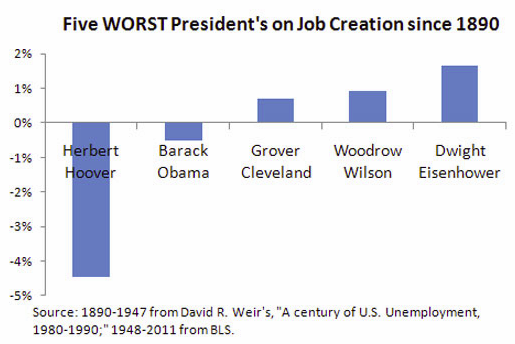
Obviously, you can’t really measure a person’s intelligence using their statements about their own intelligence in speeches read from a teleprompter. And it’s hard to assess the intelligence of someone who refuses to release any of his university transcripts. The WSJ article is right to imply that a more important way to measure intelligence is by measuring success. And we certainly are capable of looking at raw numbers to measure Obama’s success – like the unemployment rate:

The Five Worst Job Creation Presidents

And the budget deficit:

Obama Budget Deficit 2011

It’s pretty easy to assess someone’s intelligence from those two numbers alone. Obviously, none of these numbers are going to matter to people who get their news by watching Jon Stewart and Stephen Colbert. Obama is the Comedy Channel president. If provoking laughter is your standard for measuring intelligence, then Obama is very smart indeed.

What are Obama’s smart policies?

Who voted for Obama?

I notice that some people in the mainstream media have begun to pick on Texas Governor Rick Perry. It turns out that Perry is also a dastardly Darwin-doubter. (H/T Mary) For the mainstream media, if you believe in traditional Christian views on theology and morality and free market capitalism, it doesn’t matter that you created more jobs than all the other states combined. You’re still “stupid” because you value prayer and doubt materialist explanations of the origins of life.

But the mainstream media thinks that secular leftists are smart regardless of practical measures like job creation. If you are a secular leftist, and you support abortion and same-sex marriage, and you spend 864 billion taxpayer dollars on things like building underground turtle tunnels, and you actually raise the unemployment rate instead of lowering it, then you are are “smart”. Understand?

So who is smart?

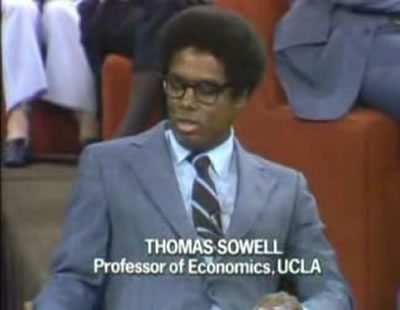
Thomas Sowell is smart in the traditional sense of understanding how things work in the real world.

Thomas Sowell is smart: he understands economics

If you want to understand the realities of economic policy, why not pick up some books by an actual economist?

Here are some of his books that I recommend:

Disclaimer: I have only read the first editions of Applied Economics, Economic Facts and Fallacies, A Conflict of Visions, and The Housing Boom and Bust. And I’ve only read the second edition of Basic Economics.

I have male and female friends who go through multiple Thomas Sowell books per month. It’s impossible to read just one. The first Thomas Sowell book you should read is Intellectuals and Society. That one is an introduction to his thought over a wide range of topics.

Thomas Sowell explains the historical effects of tax cuts

Thomas Sowell
Thomas Sowell

Here’s part 1 of 3.

Excerpt:

The actual results of the cuts in tax rates in the 1920s were very similar to the results of later tax-rate cuts during the Kennedy, Reagan and George. W. Bush administrations — namely, rising output, rising employment to produce that output, rising incomes as a result and rising tax revenues for the government because of the rising incomes, though the tax rates had been lowered.

Another consequence was that people in higher-income brackets paid not only a larger total amount of taxes, but a higher percentage of all taxes, after what were called “tax cuts for the rich.” It was not simply that their incomes rose, but that this was not taxable income, since the lower tax rates made it profitable to get higher returns outside of tax shelters.

The facts are unmistakably plain, for those who bother to check the facts. In 1921, when the tax rate on people making over $100,000 a year was 73%, the federal government collected a little over $700 million in income taxes, of which 30% was paid by those making over $100,000.

[…]By 1929, after a series of tax-rate reductions had cut the tax rate to 24% on those making over $100,000, the federal government collected more than a billion dollars in income taxes, of which 65% was collected from those making over $100,000.

There is nothing mysterious about this. Under the sharply rising tax rates during the Wilson administration, fewer and fewer people reported high taxable incomes, whether by putting their money into tax-exempt securities or by any of the other ways of rearranging their financial affairs to minimize their tax liability.

Under Wilson’s escalating income-tax rates to pay for the high costs of the First World War, the number of people reporting taxable incomes of more than $300,000 — a huge sum in the money of that era — declined from well over a thousand in 1916 to fewer than three hundred in 1921. The total amount of taxable income earned by people making over $300,000 declined by more than four-fifths in those years.

Secretary Mellon estimated in 1923 that the money invested in tax-exempt securities had tripled in a decade, and was now almost three times the size of the federal government’s annual budget and nearly half as large as the national debt. “The man of large income has tended more and more to invest his capital in such a way that the tax collector cannot touch it,” he pointed out.

Getting that money moved out of tax shelters was the whole point of Mellon’s tax-cutting proposals. He also said: “It is incredible that a system of taxation which permits a man with an income of $1,000,000 a year to pay not one cent to the support of his government should remain unaltered.”

Here’s part 2 of 3.

Excerpt:

Empirical evidence on what happened to the economy in the wake of those tax cuts in four different administrations over a span of more than 80 years has also been largely ignored by those opposed to what they call “tax cuts for the rich.”

Confusion between reducing tax rates on individuals and reducing tax revenues received by the government has run through much of these discussions over these years.

Famed historian Arthur M. Schlesinger Jr., for example, said that although Andrew Mellon, secretary of the treasury from 1921 to 1932, advocated balancing the budget and paying off the national debt, he “inconsistently” sought “reduction in tax rates.”

Nor was Schlesinger the only highly regarded historian to perpetuate economic confusion between tax rates and tax revenues. Today, widely used textbooks by various well-known historians have continued to misstate what was advocated in the 1920s and what the actual consequences were.

According to the textbook “These United States” by Irwin Unger, Mellon, “a rich Pittsburgh industrialist,” persuaded Congress to “reduce income tax rates at the upper-income levels while leaving those at the bottom untouched.”

Thus “Mellon won further victories for his drive to shift more of the tax burden from the high-income earners to the middle and wage-earning classes.”

But hard data show that, in fact, both the amount and the proportion of taxes paid by those whose net income was no higher than $25,000 went down between 1921 and 1929, while both the amount and the proportion of taxes paid by those whose net incomes were between $50,000 and $100,000 went up — and the amount and proportion of taxes paid by those whose net incomes were over $100,000 went up even more sharply.

And here’s part 3 of 3.

Excerpt:

President Kennedy, like Andrew Mellon decades earlier, pointed out that “efforts to avoid tax liabilities” make “certain types of less-productive activity more profitable than other more valuable undertakings” and “this inhibits our growth and efficiency.” Therefore the “purpose of cutting taxes” is “to achieve a more prosperous, expanding economy.”

“Total output and economic growth” were italicized words in the text of Kennedy’s address to Congress in January 1963, urging cuts in tax rates. Much the same theme was repeated yet again in President Reagan’s February 1981 address to a joint session of Congress, pointing out that “this is not merely a shift of wealth between different sets of taxpayers.”

Instead, basing himself on a “solid body of economic experts,” he expected that “real production in goods and services will grow.”

Even when empirical evidence substantiates the arguments made for cuts in tax rates, such facts are not treated as evidence relevant to testing a disputed hypothesis, but as isolated curiosities. Thus, when tax revenues rose in the wake of the tax-rate cuts made during the George W. Bush administration, the New York Times reported:

“An unexpectedly steep rise in tax revenues from corporations and the wealthy is driving down the projected budget deficit this year.”

Expectations, of course, are in the eye of the beholder. However surprising these facts may have been to the New York Times, they are exactly what proponents of reducing high tax rates have been expecting, not only from these particular tax rate cuts, but from similar reductions in high tax rates at various times going back more than three-quarters of a century.

It’s Thomas Sowell – the official economist of the Tea Party.