Tag Archives: Evidence

Nancy Fitzgerald: making a difference for God with students entering college

C.S. Lewis has some words to live by for you

About a week ago, I wrote a blog post about a column in Salvo magazine written by Terrell Clemmons, which she entitled “Captive No More: The Thoroughly Rational Conversion of Michael Minot“.

What was exciting about that post was how Minot – a lawyer – was able to put his intellect to work as a Christian after his investigation of the evidence was complete.

I found another article by Terrell in Salvo magazine about another person who did an investigation of Christianity. After becoming a Christian, she also put her intellectual ability to work for her new Boss, and she produced an amazing return.

Terrell tells the story of Nancy, who lost her faith as a child when her two-year-old brother died.  Despite letting go of God, she was a very capable student, had a good marriage and led a comfortable life:

Life went on, but for Nancy, the carefree innocence of youth had died, and the emptiness of Stephen’s crib did not compare to the barrenness in her soul. Days turned into years, and she went on to earn three degrees from Indiana University, no thanks to God, whom she managed fairly well to avoid thinking about.

Until the later years of college, that is. Is there really a God or not? she wondered. And what is my purpose in life? She began asking people from all kinds of backgrounds what they believed. Do you go to church? Why? Do you believe in God? Why? This was not a casual survey. It was a serious attempt to get at the truth about reality. It was the “Christians” she found most interesting. And most disappointing. They would acknowledge that they did believe in God, but when pressed to explain why, not a single one could give a reason that made sense to her. Not. A single. One.

“I was raised that way” or “I find comfort in it” simply would not cut it for her, and so she concluded that the whole Christian thing was either a grand hoax or a contrived crutch for weak people. Well, she was not one to be taken in, and she was certainly no weakling. Therefore, life might as well be about her own success and comfort. She decided she would be a nice atheist/humanist. In the unlikely event that there actually was a real God, he probably graded on a curve, anyway. She’d never killed anyone, and she had volunteered to serve at a church brunch once. Surely she would still get “in.”

She married Ed, a med student training to become a heart surgeon, and by age 32, had all the accoutrements of success and comfort: a nice home in the suburbs, four beautiful children, and a housekeeper and nanny to cover daily chores, leaving her free to play golf and enjoy life to her heart’s content.

She wasn’t able to get any answers to her questions from her friends. They seemed to be Christians for the emotional good it did them, or maybe for the community. They had never bothered to do any investigations of the normal questions that non-Christians ask. So, her atheism persisted.

Until one fine day:

When her youngest child reached six months old, she jumped onto an amateur golf tour and took a skinny little Bible with her to the first tournament in Florida. She started reading in the Book of Genesis and right away saw a God who was angry, who didn’t really like people, and who killed a lot of them, primarily by drowning.

“I’m done,” she said when a couple of friends dropped in and asked her what she was reading. “I can’t believe in this God. Drowning. Drowning. Really?

As it turned out, the friends were Christians, and better-prepared than the average Christian to give her some direction. Oh no, Genesis is not the place to start, they said. She should read the Book of John.

Oh thank goodness. Yes, John is always the first book to read when you are investigating the Bible. It gives you the theistic framework and a report of a miracle that you can investigate using the ordinary tools of history.

What happened next?

God, she prayed, if this is really true, if Jesus Christ really did what this book says he did, then I will believe and trust that he is God and my own personal Savior. She informed him that under no circumstances would she go to Africa as a missionary, and made a few other stipulations. And she still didn’t actually believe it all yet anyway, but a fire had been lit. Golf could wait. She left the tournament and returned home to her family, anxious to begin researching this God and the Bible.

She started by simply writing out questions she needed answers to—questions about God and about this Christian faith, and she discovered that there was a wealth of evidence to support the reliability of the Bible texts. But what really moved her was the Scriptures’ running total of fulfilled prophecies—general prophecies, yes, but the quantity of specific prophecies fulfilled in Jesus Christ was astounding! There was something supernatural about this, no question.

The whole family ended up becoming Christians, including her four children. That’s already pretty good, but she wasn’t done re-prioritizing her life to account for this new information. Because she could see challenges ahead for her children when they got to college.

More:

About ten years later, as her oldest son was preparing to go to college, she asked him, “So what are you going to do if you get a roommate in college like me?”

“What do you mean, Mom?”

“I used to be an atheist,” she said.

To which he responded, “What is that?”

Nancy was floored. Her own son had no clue about her history, and he was clearly unprepared for the university environment.

She set about organizing all her research material into handouts, rounded up a few of her son’s friends, and held a class with six students. They loved it! She didn’t preach to them, but rather interacted with them, and presented solid material using movie clips and other provocative visuals. From that start, her classes grew year by year, until some 150 kids were showing up weekly, with more being turned away for lack of room.

Nancy’s classes may well have stayed confined to her community had it not been for the intervention of Charles Colson, who got wind of this popular class and hopped a plane for a visit. “Nancy, you’ve got to publish this,” he said. “We’ve got to replicate what you’re doing here across America.” Nancy had reservations about ministries, and she definitely did not want to be a “ministry.” But she agreed with his point that “people have to get smarter about their faith.”

Fortunately, he prevailed, and the result became Anchorsaway Worldview Curriculum. “Because kids need anchor points in place when they go away,” says Nancy.

For the rest, you should click through and read Terrell’s article. You’re not going to believe how much of an impact Nancy was able to have on the people who have the most potential influence – college students and young professionals.

If you like the original article, Terrell Clemmons has many more great ones in Salvo magazine. And she has a web site. I promise you nearly everything she writes is very practical. If you like wisdom, you will enjoy her thinking. I think Christian men in particular will find practical wisdom from her writings. Like Nancy, Terrell is having a big influence as well.

But I can’t end this blog post without something else that Terrell wrote about Nancy that I really liked.

This:

She gets frustrated with churches, many of which are not only not helping young people cultivate a grounded faith, but are resistant to her efforts do so on their behalf. Now a grandmother of ten, she could retire. “But Lord, where else would I rather be?” she asks with a charming smile. “I’d take a half-lap around this property, and then come back here ready to work again.”

Ah, wonderful! I also dislike churches! They are mostly awful, and the fideist pastors will fight you tooth and nail to keep apologetics out, so that their emotion-driven flocks don’t have to worry their pretty little heads about evidence. Who cares about evidence? If we didn’t have people like Nancy fighting those battles, where would we be?

It’s really important that you see people like Nancy who have several degrees and a successful life as valuable. It’s people like her who have the biggest influence. Make sure that when college-student-aged Nancy comes to you with questions, that you have the answers to give her. Because we really need everyone to do their part for the Kingdom. This woman had an influence. And more importantly, she had an influence on her own children, protecting them from the peer pressure they would face from non-Christians at college.

The Thoroughly Rational Conversion of Michael Minot

C.S. Lewis has some words to live by for you

One of the things I’ve noticed hanging around in church on and off the last 20 years or so is that it often seems to be the case the church leaders seem to value some people as leaders more than others. Specifically, it seems to me that church leaders prefer to put athletes and cheerleaders into leadership positions, and they tend to be skeptical of people who have intellectual conversion stories, and intellectual interests. I think I actually got the phrase “jocks and cheerleaders” from Dr. John Mark Reynolds when describing who churches tend to prefer, so I’m not just making this up.

But not everyone sees things that way. Of all the people I’ve met or read, I probably agree with Terrell Clemmons the most. And if I disagree with her, then I usually find out that she is right later on. Pretty much everything she writes about is not only relevant, but practical, which is amazing for a person who writes about topics related to Christian belief and practice. One of the things she likes to write about is the background stories of people who were intelligent and successful as non-Christians, who then went on to become Christians through a careful study of the evidence, and then went on to make a difference through outward-focused enterprises.

Let’s start with this article from Salvo Magazine about a successful atheist lawyer named Michael Minot.

Terrell writes:

Never in his 28 years did Mike Minot imagine he would entertain this unthinkable thought, yet lately of an evening he might easily be found pacing around his house like an awestruck research scientist muttering things like, “It just can’t be! . . . Can it?”

The seismic shift had started quite unexpectedly just a few months prior. He was three years out of law school, and life was great. After years of living on beans and weenies as a student, he had arrived on the scene of success. He had a growing law practice, money in his pocket, and a teeming social life. The world was his oyster.

Then he had received an odd phone call. Normally confident and well-spoken, Jim, whom he’d met while studying for the Florida bar exam, spoke awkwardly, struggling uncharacteristically to get his message out. Finally he got to his point. “Sharon and I have been watching what’s been going on in your life. And we decided we would give you a call and invite you to do something. We believe the Scriptures are very important. They’re very important to our lives, and they’re helpful to us. We know what you think about spiritual matters, but we want to challenge you to take some time at this point in your life and reexamine these things.”

To say Mike was taken aback would be an understatement. He was a perfectly contented atheist, and he had no interest in interrupting his prosperous life to look at anyone’s answers to questions he wasn’t even asking. But he did value the relationship he had with Jim, Sharon, and their two adorable kids. If he were to summarily dismiss this suggestion, what would that do to their friendship? It seemed he should at least put forth a cursory effort, if for no other reason than for the health of the relationship.

First thing to note is that the people who ask Michael to give Christianity a look are successful and intelligent themselves. Not only is Jim studying for the Florida bar exam (so that he has credibility to another lawyer), but Jim’s wife has also given him more credibility by marrying him. Married couples are typically more “grown-up” than singles, and I’m saying that as a chaste single myself who has been successful in education, career and finances. Marriage requires a whole set of behaviors from people that singles don’t have to perform. The point is, though, that Michael is being approached by people from the same professional and social background. He is not being approached by a missionary or a street preacher, but by someone who has been effective in their education, career and marriage.

This really does matter – Christians are often perceived (rightly) as over-emotional, irrational, impractical, and driven more by community than by truth-seeking. It’s very important for Christians who want to produce a return that they not be living with their parents in their 20s, have gap-filled minimum-wage resumes, have $20,000 in student in outstanding student loans from an easy, unused non-STEM degree, and no achievements except zip-lining, skydiving, surfing, and fear-of-missing-out travel.

The journey starts with science:

With no predetermined plan, he delved into both the Scriptures and science. The Scriptures felt intimidating, though, and he was more comfortable with science. Not two weeks in, he found something that totally blew his mind. Ironically, it was something that had been there all along: the solar system—and the mind-boggling precision by which it operates. He marveled at the elegant complexity of it. It appeared way too precise, statistically speaking, to be an accident.

Suddenly, this was no longer a casual exercise. He had to find the natural explanation for the solar system. If he continued on his merry life without it, he would forever live plagued by lingering thoughts that he could be living a lie. Never did he want to go in for a lie, and intellectual honesty demanded that he keep searching.

So he put on his miner’s lighted helmet, so to speak, and went to work. But instead of locating the natural explanation for the solar system, he found himself turning up all manner of equally troublesome phenomena—the fine-tuning of the earth for supporting life, with its balance of nitrogen to oxygen ratios and plate tectonics; the information content of DNA; and the complexities of animal and human life, to name a few. The perplexities mounted, and the whole project snowballed. He would go looking for the explanation for one natural marvel, only to encounter two more crying out for explanation.

If I could communicate one thing to the church, it would be this: whether you agree with the old universe and old Earth timelines or not, everyone who attends church for a decade should be able to state the kalam cosmological argument, the fine-tuning argument, the intelligent design argument, the fossil record argument, and the habitability argument, to the degree where they are naming scientists, discoveries and specific books where the evidence for these arguments are laid out.

Unfortunately, thanks to the “leadership” of many prominent fideist pastors, many Christians have adopted an attitude of outright suspicion to science, preferring instead to pre-suppose the truth of the Bible by blind faith (“the burning of the bosom”, as the Mormons say), and refusing to study anything outside the Bible that might establish the necessary prerequisites to taking the Bible seriously. Successful non-Christian professionals looking to evaluate Christianity, this blind-faith approach is rightly seen as anti-intellectualism.

More:

Other complications did follow, though. He had trustingly believed teachers and authorities who had taught that everything could be explained naturalistically. What else, now, needed to be reexamined? This went beyond science and philosophy to sociology, psychology—everything had to be rethought according to this completely new paradigm. He would later liken it to being planted on a whole new planet.

And his entire social life collapsed in a matter of weeks. But he joined a church, and it became his new social center as well as his spiritual lifeline. He volunteered to serve as a jail chaplain in the evenings, a post he filled to great satisfaction for fifteen years. He met his wife Nichole at church, and they went on to adopt five children. Life settled into a richly rewarding concert of family, jail ministry, and law. Nothing he’d ever envisioned back in his atheist days could match the prosperity of these blessings.

At first glance, it may seem ironic that an atheist committed to seeing everything through the “lens of science” would come back around to see God through the lens of science. But the truth is, it wasn’t science per se that had hidden his Creator from view. Rather, it was the lens of philosophical naturalism imposed onto science—both in education and throughout the broader culture—that had fostered and fueled Mike’s unchallenged atheism.

Naturalism is a philosophy – a philosophical assumption. It’s not science. The origin and design of the universe are science. DNA is science. Habitability constraints are science. The sudden origin of major body plans in the fossil record is science. There are no scientific arguments for atheism. There’s just speculation driven by naturalistic philosophy.

In the end, Minot turns his life around 180 degrees, and puts his intellect and professional abilities to work for the gospel. You can read about all the ways he is making an impact in Terrell’s article in Salvo Magazine. Always remember stories like these when you are making decisions about your own education and career. God is still working, still reaching out to people through science and history, appealing to their minds for a fair hearing, and then asking for their best efforts for the gospel of Jesus Christ.

How the WMAP satellite confirmed nucleosynthesis predictions and falsified atheism

Christianity and the progress of science

Prior to certain scientific discoveries, most people thought that the universe had always been here, and no need to ask who or what may have caused it. But today, that’s all changed. Today, the standard model of the origin of the universe is that all the matter and energy in the universe came into being in an event scientists call “The Big Bang”. At the creation event, space and time themselves began to exist, and there is no material reality that preceded them.

So a couple of quotes to show that.

An initial cosmological singularity… forms a past temporal extremity to the universe. We cannot continue physical reasoning, or even the concept of spacetime, through such an extremity… On this view the big bang represents the creation event; the creation not only of all the matter and energy in the universe, but also of spacetime itself.

Source: P. C. W. Davies, “Spacetime Singularities in Cosmology,” in The Study of Time III, ed. J. T. Fraser (Berlin: Springer Verlag ).

And another quote:

[A]lmost everyone now believes that the universe, and time itself, had a beginning at the big bang.

Source: Stephen Hawking and Roger Penrose, The Nature of Space and Time, The Isaac Newton Institute Series of Lectures (Princeton, N. J.: Princeton University Press, 1996), p. 20.

So, there are several scientific discoveries that led scientists to accept the creation event, and one of the most interesting and famous is the discovery of how elements heavier than hydrogen were formed.

Nucleosynthesis: forming heavier elements by fusion

Here’s the history of how that discovery happened, from the National Aeronautics and Space Administration (NASA) web site:

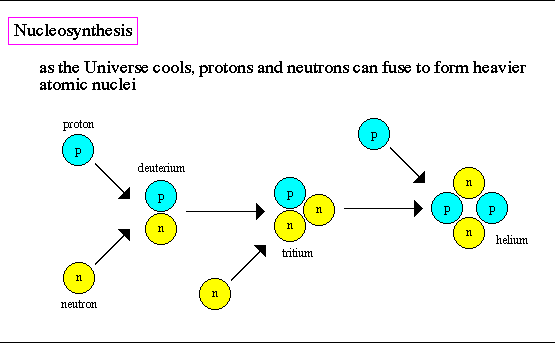
The term nucleosynthesis refers to the formation of heavier elements, atomic nuclei with many protons and neutrons, from the fusion of lighter elements. The Big Bang theory predicts that the early universe was a very hot place. One second after the Big Bang, the temperature of the universe was roughly 10 billion degrees and was filled with a sea of neutrons, protons, electrons, anti-electrons (positrons), photons and neutrinos. As the universe cooled, the neutrons either decayed into protons and electrons or combined with protons to make deuterium (an isotope of hydrogen). During the first three minutes of the universe, most of the deuterium combined to make helium. Trace amounts of lithium were also produced at this time. This process of light element formation in the early universe is called “Big Bang nucleosynthesis” (BBN).

The creation hypothesis predicts that there will be specific amounts of these light elements formed as the universe cools down. Do the predictions match with observations?

Yes they do:

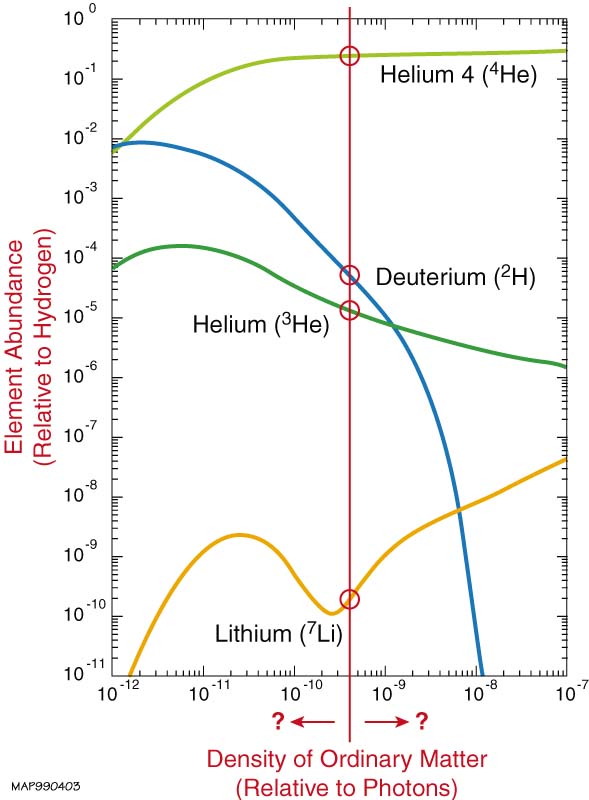
The predicted abundance of deuterium, helium and lithium depends on the density of ordinary matter in the early universe, as shown in the figure at left. These results indicate that the yield of helium is relatively insensitive to the abundance of ordinary matter, above a certain threshold. We generically expect about 24% of the ordinary matter in the universe to be helium produced in the Big Bang. This is in very good agreement with observations and is another major triumph for the Big Bang theory.

Moreover, WMAP satellite measurements of mass density agree with our observations of these light element abundances.

Here are the observations from the WMAP satellite:

Scientific observations match predictions

And here is how those WMAP measurements confirm the Big Bang creation event:

However, the Big Bang model can be tested further. Given a precise measurement of the abundance of ordinary matter, the predicted abundances of the other light elements becomes highly constrained. The WMAP satellite is able to directly measure the ordinary matter density and finds a value of 4.6% (±0.2%), indicated by the vertical red line in the graph. This leads to predicted abundances shown by the circles in the graph, which are in good agreement with observed abundances. This is an important and detailed test of nucleosynthesis and is further evidence in support of the Big Bang theory. 

“An important and detailed test”.

For completeness, we should learn how elements heavier than these light elements are formed:

Elements heavier than lithium are all synthesized in stars. During the late stages of stellar evolution, massive stars burn helium to carbon, oxygen, silicon, sulfur, and iron. Elements heavier than iron are produced in two ways: in the outer envelopes of super-giant stars and in the explosion of a supernovae. All carbon-based life on Earth is literally composed of stardust.

That’s a wonderful thing to tell a young lady when you are on a date: “your body is made of stardust”. In fact, as I have argued before, this star formation, which creates the elements necessary for intelligent life, can only be built if the fundamental constants and quantities in the universe are finely-tuned.

Now, you would think that atheists would be happy to find observations that confirm the origin of the universe out of nothing, but they are not. Actually, they are in denial.

Here’s a statement from the Secular Humanist Manifesto, which explains what atheists believe about the universe:

Religious humanists regard the universe as self-existing and not created.

For a couple of examples of how atheistic scientists respond to the evidence for a cosmic beginning, you can check out this post, where we get responses from cosmologist Lawrence Krauss, and physical chemist Peter Atkins.

You cannot have the creation of the universe be true AND a self-existing, eternal universe ALSO be true. Someone has to be wrong. Either the science is wrong, or the atheist manifesto is wrong. I know where I stand.

Positive arguments for Christian theism