Tag Archives: European Union

Greeks withdraw $894 million from Greek banks in one day

I found this article from MSNBC on The Other McCain.

Excerpt:

Political leaders in Athens were due to discuss an emergency government Wednesday to deal with a possible run on banks as it emerged Greeks withdrew almost $900 million in a single day, fearing their country could crash out of the euro currency by the end of the week.

An interim government would take the country through to new elections on June 17, triggered by the collapse on Tuesday of talks to form a coalition between winners of the inconclusive May 6 election.

Greeks are withdrawing euros from banks, apparently afraid of the prospect of rapid devaluation if the country leaves the European single currency and returns to the drachma.

President Karolos Papoulias warned of “great fear that could develop into a panic,” the minutes of Papoulias’ negotiations with political leaders showed, according to Reuters.

[…]Several banking sources told Reuters similar amounts had also been withdrawn on Tuesday. Nevertheless, there was no sign of panic or queues at bank branches in Athens on Wednesday. Bankers dismissed suggestions that a bank run was looming. A senior executive at a large Greek bank told Reuters: “There is no bank run, no queues or panic. The situation is better than I expected. The amount of deposit withdrawals the president mentioned referred to three days, not one.”

[…]Greeks have already been withdrawing their savings from banks at a sharp clip – nearly a third of bank deposits were withdrawn between January 2010 and March 2012, reducing total Greek household and business deposits to 165 billion euros.

What I find really striking about stories like this is that Greece just had an election. 75% of them want to stay in the European Union and keep the Euro as a currency. But that can only happen if they accept that they are spending too much and they are not producing anything. They have to cut spending, lower taxes and deregulate so that there is economic growth. So what did they do? They voted against austerity. They think that by refusing to meet the conditions of the people who can bail them out, that they will get a bailout. It’s just insane. Like whipping a thirsty camel with the expectation that whipping can somehow satiate its thirst and cause it to get up and keep moving.
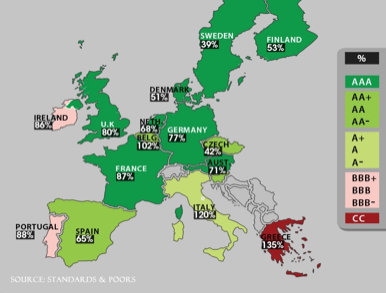
Moody’s downgrades credit rating of 26 Italian banks, Spain is next

European Debt to GDP and Credit Rating

From Yahoo News.

Excerpt:

Moody’s Investors Service has downgraded the ratings on 26 Italian banks as they struggled with the effect of government austerity measures.

The rating agency said Monday that the banks are suffering because Italy is back in recession and government austerity measures are cutting demand for loans.

The banks are struggling with more loan losses, limited access to funding and weaker profits.

Moody’s noted that support of the European Central Bank lowered the default risk of many banks.

Its outlook for all 26 banks is negative.

From the Wall Street Journal.

Excerpt:

The ratings for Italian banks are now among the lowest within advanced European countries, reflecting these banks’ susceptibility to the adverse operating environments in Italy and Europe, Moody’s said in a statement. Two of the country’s largest institutions, UniCredit SpA (UCG.MI, UNCFF) and Intesa Sanpaolo SpA (ISP.MI, ISNPY), were included.

Moody’s move came hours after the firm raised an alarm on Spain, arguing the country’s banks remain vulnerable even after Madrid moved to increase the banks’ cushions against potential losses from real-estate loans.

[…]Italy, saddled with EUR1.9 trillion ($2.44 trillion) debt, has signed onto the EU’s fiscal compact that sets strict limits on the country’s deficit levels. In recent weeks, Mr. Monti has begun pressing Germany to give Italy more fiscal slack to stimulate its economy and create jobs. Mr. Monti has recently proposed that the EU create special exemptions to the budget rules when countries target their public spending on projects like broadband investments and infrastructure.

Moody’s downgrades come after the ratings firm in February placed various ratings of 114 financial institutions in 16 European countries on review for possible downgrade, highlighting the region’s banks’ vulnerability to the euro-zone sovereign debt crisis.

Moody’s is expected to follow the downgrade of Italian banks by cutting the ratings of Spanish banks. By the end of June, more than 100 European banks, as well as Wall Street giants like Bank of America Corp. (BAC) and Citigroup Inc. (C), are likely to have ratings that are at least one notch lower.

[…]Moody’s also alluded to J.P. Morgan Chase & Co.’s (JPM) recent disclosures of more than $2 billion in trading losses as a reminder of potential problems lurking at some European banks.

“Recent events highlight the risks for creditors from potential weaknesses in governance, controls and risk management, especially at some smaller, privately-held banks,” Moody’s said in its news release.

Moody’s says it will conclude its reviews by the end of June. In coming weeks, major U.S. financial institutions, Bank of America Corp., Citigroup Inc., Goldman Sachs and Morgan Stanley are likely to face downgrades.

Banks in Austria and Sweden are expected to see downgrades after Spain.

Italy’s debt is $2.44 trillion, ours is nearly $16 trillion.

Twenty years of fiscal conservatism in Sweden: has it worked?

Map of Europe
Map of Europe

From Investors Business Daily, a story about about a nation that changed course – and won big.

Excerpt:

The turnaround has been driven in no small part by the election of Fredrik Reinfeldt as prime minister in 2006. He took office in October of that year and by January of 2007, tax-cutting had begun. The Reinfeldt government also cut welfare spending — a form of austerity — and began to deregulate the economy.

[…][A]s Finance Minister Anders Borg told the Spectator, the Reinfeldt government was simply continuing the last 20 years of reform.

[…]Sweden fell into recession in 2008 and 2009, as did many developed nations. But it’s pulled strongly out of the decline, posting GDP gains of 6.1% in 2010 and 3.9% last year, when it ranked at the top in Europe’s list of fastest-growing economies.

[…]Under Borg, Sweden handled the downturn in the most un-European way. “While most countries in Europe borrowed massively, Borg did not. Since becoming Sweden’s finance minister, his mission has been to pare back government. His ‘stimulus’ was a permanent tax cut,” Fraser Nelson wrote last month in the Spectator.

Borg strongly opposed the Keynesian solution, which the left continues to advance while it inveighs against an austerity that has yet to be implemented.

He also refused to resort to the trickery of a stimulus, instead cutting the taxes that he knew were hindering entrepreneurs from giving the economy the kick it needed.

The country needed innovators and capitalists — “the source of job creation,” says Borg — and he did what he had to, to attract new ones and to keep those already there from leaving.

During Sweden’s decline into a welfare state, it became, as Borg told the Spectator, “a textbook case of European economic sclerosis” punished by “very high taxes and huge regulatory burden.”

That lasted until the 1990s, when the nation realized it had to return to the market policies that had made it rich prior to the onset of its cradle-to-grave coddling.

How much further can Borg and Reinfeldt take their reforms? Will voters ask them to come back and complete the job?

After all, it’s not over. Though it continues to fall, Sweden’s government debt as a share of GDP is still too high at 38.4%. And while it’s dipped below 45% for the first time in decades, the country’s tax-to-GDP ratio is still far too steep.

Despite this unfinished business, Sweden is still moving in the right direction. We might be able to say that about America after the 2013 Inauguration Day. But we can’t say that now.

If liberals are so smart, why can’t they take time off from taxing, spending and buying votes, in order to look at countries that are having economic success? Isn’t it “smart policy” to do what works? Why listen to Hollywood celebrities and people with journalism degrees when we can just do what has been proven to work? It’s not like what we are doing now is working.