Tag Archives: Employment

Jay Richards explains how welfare forces people into dependency

Christian philosopher Jay Richards writing for the Heritage Foundation.

Excerpt:

More than 77 government welfare programs—which are spread across several federal departments and provide cash, food, housing, medical care, and targeted social services to poor and low-income persons—are “means-tested.” That is, beneficiaries qualify if they are below a specified income level.

Regardless of their intention, means-tested programs by their very nature pose disincentives for households to increase their incomes and risk termination of their benefits. Thus, the welfare system effectively set up roadblocks to the two main avenues for economic progress: marriage and employment. A single mother would be ensured of her benefits package as long as she did not take a job or marry an employed husband. Given this scenario, it’s not surprising that dismal societal trends have followed.

Unwed childbearing is the major cause of child poverty in America. Since 1965, the rate of unwed births has soared from 7 percent to 39 percent (and among blacks, to 69 percent). Children born and raised outside marriage are nearly seven times more likely to live in poverty than children born to and raised by a married couple. Moreover, unwed childbearing is concentrated among low-income, less educated women in their early 20s—those who have the least ability to support a family by themselves.

Low levels of parental work is the second major cause of child poverty in the United States. In a typical year, only about one-fourth of all poor households with children have combined work hours of adults equaling 40 hours a week. The typical poor family with children is supported by only 800 hours of work during a year, an average of 16 hours of work per week. If work in each family were raised to 2,000 hours per year—the equivalent of one adult working 40 hours per week through the year—nearly 75 percent of poor children would be lifted out of poverty.[6]

Marriage and one parent working = no child poverty. Why is government undermining that? Because broken homes produce children that require government intervention = more government = higher taxes = greater “equality” of wealth through government-run redistribution.

The article explains several government policies that would reduce dependency on government.

Richards explains:

The Welfare Reform Act of 1996 reduced some of these damaging incentives in one major program, Aid to Families with Dependent Children. Under AFDC, states were given more federal funds if their welfare caseloads increased, and funds were cut whenever the state caseload fell. In other words, states were basically encouraged to swell their welfare rolls.

Welfare reform replaced AFDC with a new program, Temporary Assistance to Needy Families (TANF), which provided incentives to move recipients toward self-sufficiency. Funding to each state remained constant regardless of the size of caseloads, and states were allowed to retain savings from caseload reductions.

In addition, states were required to have at least half of their welfare recipients engaged in work or activity that would prepare them for employment. Rather than anticipating depending on the government indefinitely, recipients were limited to five years on the welfare rolls. (Under the old AFDC program, recipients spent an average of 13 years on the rolls.) These reforms in funding structure and incentives made a substantial difference.

Despite dire predictions by opponents of reform that work requirements and benefit limitations would lead to a surge in poverty, just the opposite occurred. States had the flexibility to design programs that best fit the needs of their constituents. State welfare agencies were transformed overnight into job placement centers, while social workers helped recipients access child care, housing, transportation, or other support that was necessary to move them into jobs and toward self-sufficiency.

Within 10 years, welfare caseloads shrank by more than half: 2.7 million fewer families were dependent on welfare checks. As the welfare caseloads fell, the employment of single mothers surged upward, and 1.6 million fewer children were living in poverty.[7] In 2001, despite the recession, the poverty rate for black children was at the lowest point in America’s history.[8]

Unfortunately, Obama rolled back welfare reforms in order to incentivize people to go back onto government dependence.

Keep in mind that Arthur Brooks of the AEI has shown that the amount of wealth a person has (over the poverty level) is not what makes them happy. What makes a person happy (above the poverty level) is that a person is making their own way and earning their own bread by their own work. That’s what makes people happy.
How is Obama responding to a recession and global instability?

From Investors Business Daily.

Excerpt:

When Democrats held Congress, the Obama agenda was audacious. Today, faced with global unrest and an economic reckoning, the president is filling out basketball brackets and scolding school bullies.

‘There is only one president,” Senate Budget Committee Chairman Kent Conrad, D-N.D., told Politico this week, when asked if President Obama should be exercising leadership toward reforming America’s out-of-control entitlement spending programs, such as Medicare and Social Security.

The soothsayer famously told Julius Caesar to “beware the ides of March.” One of the priority items for Obama on Tuesday, March 15, was taping his picks for the NCAA basketball tournament.

Last week, the president and the first lady were holding a “White House Conference on Bullying Prevention,” at which he recalled being taunted because of “big ears and the name that I have.” He lamented recent youthful suicides, such as those of Ty Field and Carl Walker-Hoover.

We can’t just accept that “kids will be kids,” Obama insisted, citing data showing that many American students have been “pushed, shoved, tripped, even spit on.”

Then, of course, there is the partying. Late last month, the president and first lady treated themselves to an East Room concert by Smokey Robinson, Sheryl Crow, comedian Jamie Foxx and others. At previous soirees, the Obama White House has hosted Stevie Wonder, Paul Simon, Tony Bennett, Bob Dylan, Joan Baez, and even a cavalcade of stars from Broadway shows.

And let’s not forget former Beatle Paul McCartney being flown in from England to sing “Michelle” to the first lady and attack President George W. Bush from the East Room stage.

He has no idea what the average American family is facing right now.


Republicans introduce national right-to-work legislation

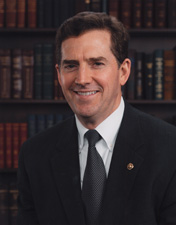
Sen. James Demint

From the Hill.

Excerpt:

Eight Republican Senators introduced a bill Tuesday giving workers a choice as to whether to join labor unions, which they argue will boost the nation’s economy and provide an increase in wages.

Sen. Jim DeMint (R-S.C.), introduced the National Right to Work Act to “reduce workplace discrimination by protecting the free choice of individuals to form, join, or assist labor organizations, or to refrain from such activities,” according to a statement.

Seven other Republicans signed onto the effort: Sens. Tom Coburn (Okla.), Orrin Hatch (Utah), Mike Lee (Utah), Rand Paul (Ky.), James Risch (Idaho), Pat Toomey (Pa.) and David Vitter (La.).

“Facing a steady decline in membership, unions have turned to strong-arm political tactics to make forced unionization the default position of every American worker, even if they don’t want it,” Hatch said. “This is simply unacceptable. At the very least, it should be the policy of the U.S. government to ensure that no employee will be forced to join a union in order to get or keep their job.

“Republicans cited a recent poll they said shows that 80 percent of union members support having their policy and that “Right to Work” states outperform “forced-union” states in factors that affect worker well being.

From 2000 to 2008, about 4.7 million Americans moved from forced-union to right to work states and a recent study found that there is “a very strong and highly statistically significant relationship between right-to-work laws and economic growth,” and that from 1977 to 2007, right-to-work states experienced a 23 percent faster growth in per capita income than states with forced unionization.

“To see the negative impacts of forced unionization, look no further than the struggling businesses in states whose laws allow it,” Vitter said. “It can’t be a coincidence that right-to-work states have on balance grown in population over the last 10 years, arguably at the expense of heavy union-favoring states.”

DeMint blamed the problems faced by U.S. automakers on the unions.

“Forced-unionism helped lead to GM and Chrysler’s near bankruptcy and their requests for government bailouts as they struggled to compete in a global marketplace,” he said. “When American businesses suffer because of these anti-worker laws, jobs and investment are driven overseas.”

If you want to attract businesses, then you need to have pro-business laws. That’s where jobs come from – businesses.

Here’s an article about states who are trying to pass these laws to attract more employers.

Excerpt:

Currently 14 states beyond Indiana and Wisconsin are considering legislation that would limit union benefits and/or collective bargaining power. They are: Alaska, Hawaii, Maine, Michigan, Minnesota, Missouri, Montana, New Hampshire, New Mexico, Ohio, Pennsylvania, Virginia, Washington (state) and West Virginia. In any number of these states, supporters have planned or held rallies against the measures. But public support might be less than deep. According to a Rasmussen Poll conducted late last week and released Monday, 48 percent of likely U.S. voters sided with Wisconsin Governor Walker whereas only 38 percent sided with his union opponents; the other 14 percent were undecided. And 50 percent of the respondents favored reducing their home state’s government payroll by one percent a year for 10 years either by reducing the work force or reducing their pay. Only 28 percent opposed such action.

This is how we are going to turn the recession around. Cut off the spending on left-wing special interests – NPR, PBS, ACORN, Planned Parenthood, Unions. They all will have to pay their own way, just like the grown-ups do.