Tag Archives: Empathy

Study: brain of child neglected by mother is smaller and underdeveloped

Dina sent me this article from the UK Daily Mail. In the past, I’ve written about how much children need their fathers, but this time I’m focusing on how much children need their mothers, especially in the first 5 years of development.

Here is two brain scans to compare:
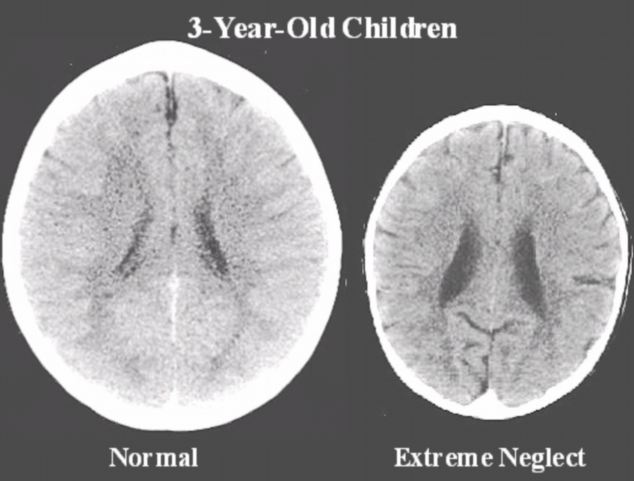
Brain scans of 3-year old children: normal vs neglected

Excerpt:

Both of these images are brain scans of a two three-year-old children, but the brain on the left is considerably larger, has fewer spots and less dark areas, compared to the one on the right.

According to neurologists this sizeable difference has one primary cause – the way each child was treated by their mothers.

The child with the larger and more fully developed brain was looked after by its mother – she was constantly responsive to her baby, reported The Sunday Telegraph.

But the child with the shrunken brain was the victim of severe neglect and abuse.

According to research reported by the newspaper, the brain on the right worryingly lacks some of the most fundamental areas present in the image on the left.

The consequences of these deficits are pronounced – the child on the left with the larger brain will be more intelligent and more likely to develop the social ability to empathise with others.

But in contrast, the child with the shrunken brain will be more likely to become addicted to drugs and involved in violent crimes, much more likely to be unemployed and to be dependent on state benefits.

The child is also more likely to develop mental and other serious health problems.

Professor Allan Schore, of UCLA, told The Sunday Telegraph that if a baby is not treated properly in the first two years of life, it can have a fundamental impact on development.

He pointed out that the genes for several aspects of brain function, including intelligence, cannot function.

[…]The study correlates with research released earlier this year that found that children who are given love and affection from their mothers early in life are smarter with a better ability to learn.

The study by child psychiatrists and neuroscientists at Washington University School of Medicine in St. Louis, found school-aged children whose mothers nurtured them early in life have brains with a larger hippocampus, a key structure important to learning, memory and response to stress.

The research was the first to show that changes in this critical region of children’s brain anatomy are linked to a mother’s nurturing, Neurosciencenews.com reports.

The research is published online in the Proceedings of the National Academy of Sciences Early Edition.

Lead author Joan L. Luby, MD, professor of child psychiatry, said the study reinforces how important nurturing parents are to a child’s development.

My friend Katy tweeted this article from far-left NPR:

Parents do a lot more than make sure a child has food and shelter, researchers say. They play a critical role in brain development.

More than a decade of research on children raised in institutions shows that “neglect is awful for the brain,” says Charles Nelson, a professor of pediatrics at Harvard Medical School and Boston Children’s Hospital. Without someone who is a reliable source of attention, affection and stimulation, he says, “the wiring of the brain goes awry.” The result can be long-term mental and emotional problems.

The article goes on to talk about children who grow up without mothers in Romanian orphanages:

As the children grew older, the researchers were able to use MRI to study the anatomy of their brains. And once again, the results were troubling. “We found a dramatic reduction in what’s referred to as gray matter and in white matter,” Nelson says. “In other words, their brains were actually physically smaller.”

The scientists realized the cause wasn’t anything as simple as malnutrition. It was a different kind of deprivation — the lack of a parent, or someone who acted like a parent.

A baby “comes into the world expecting someone to take care of them and invest in them,” Nelson says. “And then they form this bond or this relationship with this caregiver.” But for many Romanian orphans, there wasn’t even a person to take them out of the crib.

“Now what happens is that you’re staring at a white ceiling, or no one is talking to you, or no one is soothing you when you get upset,” Nelson says. So areas of the brain involved in vision and language and emotion don’t get wired correctly.

I expect the woman I marry (if I marry) to have a college degree, and preferably a graduate degree, and a couple of years of employment. But I think to be fair to the research on child development, she has to stay home and invest in those children through the first five years at least. After that she can stay home or work as much as she thinks is beneficial to the family goals of impacting the university, the church and the public square – as well as continuing to raise those children.  I would take over more of the parenting as the children’s needs changed. When it comes to children, we work backward from their needs, and those needs create responsibilities and obligations on the grown-ups. That doesn’t mean the children are spoiled – it means that they get what they need.

Christian parents have to go even further

Here is a relevant post from Lindsay, a Christian mother who has a graduate degree in biology and was teaching biology before leaving her career to care for her children.

She writes:

Now, can a woman handle the logistics of the home, ensure her family is cared for, and still work outside the home? Perhaps, in some cases – especially if they do not yet have children. But no woman is Superwoman. We all have limitations. It’s just not possible for any woman to adequately care for children and home while holding down a full time job. The care of children and the home is primarily a woman’s responsibility in a way it isn’t for her husband. If there are no children, it may be possible for her to care for the home and her husband and still keep a job outside the home, but she must keep the home and her husband as her priority.

Once children arrive, it becomes pretty much impossible for her to work outside the home and still fulfill her duties at home. The funny thing about children is that they need constant care. One cannot care for children and work outside the home too. The choice once children come along is whether to outsource the care of the children to someone else or to do it yourself. I firmly believe that God entrusts children to a husband and wife because he wants them to be the primary influences in their children’s lives. That doesn’t happen if the children spend a majority of their waking hours in the care of someone else.

Children don’t just need food and shelter provided to them, they need love, teaching, discipline, a sense of security, and examples of how they are to live. All of those things are best done when the child spends time primarily with his or her parents. Daycare workers, school teachers, and even grandparents simply cannot provide them in the same way parents can. No one loves a child like his own parents do. No one has such a vested interest in ensuring that he grows up with the proper spiritual and moral training. Even if others care about the child, the responsibility for the training of a child belongs to his parents. Daycare workers and teachers and grandparents won’t answer to God for the soul of that child. His parents will.

For Christian parents, the stakes are even higher. Not only do they have to care about basic needs of child, but the higher spiritual needs as well. Men really need to be careful to pick a mother for their child who has demonstrated ability in caring for the needs of others, letting the needs of others override her own selfish desires.

Can evolution, empathy and well-being account for the existence of moral facts?

J. Warner Wallace: God's Crime Scene
J. Warner Wallace: God’s Crime Scene

J. Warner Wallace is publishing blog posts related to the material covered in his newest book. This latest post is related to that big discussion we had last week about whether atheists can ground objective moral values and objective moral duties.

He writes:

How are we to account for the existence of objective, transcendent moral truths? Some philosophers, like Sam Harris, believe “moral values are really questions about the well-being of conscious creatures.” Well-being (also described as human “flourishing”) is, according to Harris, the purpose of our existence as human beings. Since human biology transcends human culture, moral truths (if they are rooted in human biology), would also transcend culture. As a result, we can account for the existence of objective, transcendent moral truths without having to ground them in a transcendent moral truth-giver (like God). Harris believes these kinds of truths are simply grounded in the well-being of our entire species, and according to Harris, can be ascertained and apprehended by simply studying the science of human flourishing. Harris argues “that science can, in principle, help us understand what we should do and should want—and, therefore, what other people should do and should want in order to live the best lives possible. There are right and wrong answers to moral questions, just as there are right and wrong answers to questions of physics, and such answers may one day fall within reach of the maturing sciences of mind.” But this attempt to ground objective, transcendent moral truths in human biological flourishing is misguided for several reasons…

Here’s one of the reasons:

This View Assumes a Moral Definition of “Well-Being”
What is Harris’ definition of “well-being” in the first place? Is it merely survival, or is it a particular kind of survival? Even philosophers who hold this view readily admit some behaviors (like subjugating slaves and stealing the resources of opposing groups) can actually aid in the survival of a people group. But these same thinkers simultaneously believe these kinds of behaviors are detrimental to the group’s well-being. This implies, however, there’s a right way to survive and a wrong way. Did you spot the logical inconsistency here? Those who believe the pursuit of human well-being is the origin of moral truth, begin with a definition of well-being already infused with moral truth. Who gets to determine the right or wrong way to survive or flourish? This approach to moral truth argues for something more than mere biological survival of the fittest. It argues for a kind of moral survival (described as “well-being”) before it has adequately explained the source for moral truth.

The minute you are talking about well-being, you have smuggled in a concept of what counts as good, and what counts as evil.

And here’s another reason:

This View Fails to Determine Whose Well-Being Is Most Important
Why would any of us consider the well-being of strangers prior to the well-being of our own families and communities? If history is any indicator, humans are far more inclined to care for themselvesthan for others, even when the activities of their own group may ultimately harm the survivability of the entire species. Who gets to define “flourishing” when cultures and individuals disagree about notions of happiness, compassion, contentedness, or physical and psychological health? When competing interests collide, whose definitions (and whose well-being) warrants our consideration? As philosopher Patricia Churchland observes, “no one has the slightest idea how to compare the mild headache of five million against the broken legs of two, or the needs of one’s own two children against the needs of a hundred unrelated brain-damaged children in Serbia.”

Even if we are only interested in the well-being of an isolated group, should we be more concerned about total well-being or average well-being of the group? Those concerned with total well-being prefer a world in which the most people possible are able to live with at least moderate well-being. Those concerned with average well-being prefer a world in which smaller groups maximize their well-being, even if others suffer, so the average for the species is elevated. If we derive moral value from an action’s impact on the well-being of the entire species, why should I, as a law enforcement officer, care at all about murdered gang members such as Jesse’s victim? Shouldn’t I be more focused on the fate of those better educated, wealthier or more intelligent contributors to our society than those who are actually preying on our society? Aren’t those in the first group more likely to contribute to the well-being of our species than those in the second? Assessing an action’s moral value on the basis of its ultimate consequence is nearly impossible to accomplish and leads to disturbing discrimination.

In fact, the “well-being” view pushed by Sam Harris and others is really just utilitarianism, and I posted something about the many problems with that view previously.

Why does objective morality matter? Well consider a previous post where I looked at a debate between Matt Dillahunty and David Robertson. Robertson asked Dillahunty whether it was an objective fact that Dachau, a Nazi concentration camp, was morally evil. Dillahunty’s reply? “I don’t know”. And that is consistent with his atheistic view. The answer to EVERY question about moral facts for an atheist is “I don’t know”. They have to not know. If they did know, then God would have to exist to ground that moral fact, because it would exist independent of personal preferences and cultural customs.They have to say I don’t know, or give up their atheism. And that’s why moral facts are nowhere grounded in an atheistic worldview. They use the words, but the words refer to nothing that exists independent of personal preferences and cultural conventions – which vary over time and place.  If you agree with Dillahunty’s ignorance about whether concentration camps are moral evils as a matter of fact, then you can be an atheist.

God’s Crime Scene

Some really good blog posts are coming out on Cold Case Christianity blog related to this new book. Just judging from the table of contents and the podcast he did on it, it looks like it covers 8 of the good, substantial arguments for God’s existence. I always like the science arguments more than the history arguments, and history arguments more than the philosophical arguments, because I’m an engineer. Really looking forward to a quiet weekend with this new book. I got the audio edition in addition to the book itself.

Study: brain of child neglected by mother is smaller and underdeveloped

Dina sent me this article from the UK Daily Mail.

Here is the scan:

Brain scans of 3-year old children: normal vs neglected

Excerpt:

Both of these images are brain scans of a two three-year-old children, but the brain on the left is considerably larger, has fewer spots and less dark areas, compared to the one on the right.

According to neurologists this sizeable difference has one primary cause – the way each child was treated by their mothers.

The child with the larger and more fully developed brain was looked after by its mother – she was constantly responsive to her baby, reported The Sunday Telegraph.

But the child with the shrunken brain was the victim of severe neglect and abuse.

According to research reported by the newspaper, the brain on the right worryingly lacks some of the most fundamental areas present in the image on the left.

The consequences of these deficits are pronounced – the child on the left with the larger brain will be more intelligent and more likely to develop the social ability to empathise with others.

But in contrast, the child with the shrunken brain will be more likely to become addicted to drugs and involved in violent crimes, much more likely to be unemployed and to be dependent on state benefits.

The child is also more likely to develop mental and other serious health problems.

Professor Allan Schore, of UCLA, told The Sunday Telegraph that if a baby is not treated properly in the first two years of life, it can have a fundamental impact on development.

He pointed out that the genes for several aspects of brain function, including intelligence, cannot function.

[…]The study correlates with research released earlier this year that found that children who are given love and affection from their mothers early in life are smarter with a better ability to learn.

The study by child psychiatrists and neuroscientists at Washington University School of Medicine in St. Louis, found school-aged children whose mothers nurtured them early in life have brains with a larger hippocampus, a key structure important to learning, memory and response to stress.

The research was the first to show that changes in this critical region of children’s brain anatomy are linked to a mother’s nurturing, Neurosciencenews.com reports.

The research is published online in the Proceedings of the National Academy of Sciences Early Edition.

Lead author Joan L. Luby, MD, professor of child psychiatry, said the study reinforces how important nurturing parents are to a child’s development.

I have a very good feminist non-Christian friend who sometimes comments here. I once asked her about marriage and she said that her skills would be wasting on raising children. I explained to her my view that a mother needs to stay at home with the children, and that is more important work. I expect my future wife to read all kinds of books on child care and to give the child attention, nutrition, exercise and play so that the child will grow up to be an effective Christian. Maybe I need to be clear. I am not going to spend hundreds of thousands per child with just any woman. I need a woman who can produce influential and effective Christians who will engage in the public square. And we do not entrust that job to just anyone. Professional women who are willing to be stay-at-home moms in the first five years of each child’s life.

I expect the woman I marry (if I marry) to have a college degree, and preferably a graduate degree, and a couple of years of employment. Then she has to stay home and invest in those children through the first five years at least. After that she can stay home or work as much as she thinks is beneficial to the family goals of impacting the university, the church and the public square – as well as continuing to raise those children. It’s not a waste of her talent to make the next William Lane Craig, the next Marsha Blackburn, the next Doug Axe, or the next Edith Jones. Even if we only aim for those guys and get decent, hard-working Christians who make a difference using apologetics, that would still be something. The main thing is not to be scared to try to achieve something with the family – if you aim at nothing, you always hit it.

UPDATE: I am linking to a relevant post from Lindsay, a Christian mother who has a graduate degree in biology and was teaching biology before leaving her career to care for her children.