Tag Archives: Efficiency

Explosion at government-run Amuay refinery, nationalized by Venezuela in 1976

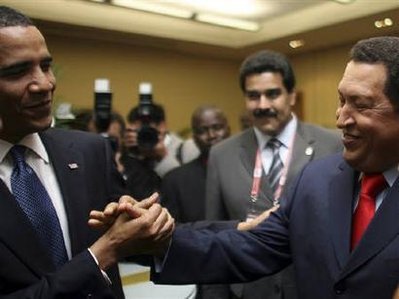
Are Barack Obama and Hugo Chavez very different?

In the United States, we’ve been seeing some efforts by the Marxist Obama administration to nationalize the auto industry and health care, too. This is what communists favor as the alternative to the free-market system. It makes sense, then, to look at how well the nationalization of assets, especially those owned by foreign-owned private companies, works out in the real world.

Let’s see:

The Creole Petroleum Corporation was an American oil company, formed in 1920 to produce fields on Lake Maracaibo, Venezuela.[1] The company was acquired by Standard Oil of New Jerseyin 1928. Until 1951 Creole Petroleum was the world’s number one oil producer.[2]

In 1950, Creole opened its refinery at Amuay.[3] This is now a part of the Paraguaná Refinery Complex.

The Venezuelan assets of Creole Petroleum Corporation were nationalized along with those of other foreign oil firms on January 1, 1976, becoming part of Lagoven, a Venezuelan government-owned operating company.[4]

And here is the latest triumph of Marxist economics in Venezuela:

A huge explosion rocked Venezuela’s biggest oil refinery early Saturday, killing at least 24 people and injuring more than 80 others in the deadliest disaster in memory for the country’s key oil industry.

Balls of fire rose over the Amuay refinery, one of the largest in the world, in video posted on the Internet by people who were nearby at the time.

At least 86 people were injured, nine of them seriously, Health Minister Eugenia Sader said at a hospital where the wounded were taken. She said 77 people suffered light injuries and were released from the hospital.

Officials said those killed included a 10-year-old boy, but that most of the victims were National Guard troops stationed at the refinery.

Filthy capitalist dogs! Making money on the backs of the poor workers! Making them work in filthy, unsafe – oh, wait. When workers are left free to take their skills to a number of private employers, then those employers are pressured to provide them with better working conditions, wages and benefits. Otherwise the employees leave for better companies. The only problem is that it doesn’t work if all the industries are state-run monopolies. Then, you just get KA-BOOM!

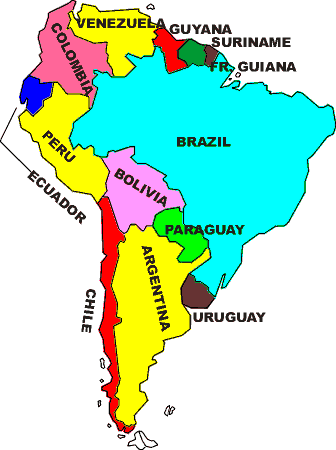
All you have to do to understand economic systems is to compare capitalist Chile with communist Venezuela. The people are the same, and both started out poor. One embraced free trade and privatization, and now that one is rich. The other one gets Chernobyl explosions because they elected a Marxist.

Venezuela’s economic policy is the same economic policy that Barack Obama wants to force on us with his takeover of General Motors, his frequent bailouts, his give-aways to campaign fundraisers, his blocking of free trade deals, his heavy-handed anti-business regulations, and his other intrusions into the private sector. Our entire economy is going KA-BOOM right now because of Marxism.

Related posts

How many jobs have wind and solar power produced in Spain and Denmark?

The problem with the Obama administration is that they keep making policy based on their intentions, instead of known results. They’ve allocated nearly 39 billion for green energy subsidies – that’s as much money as the entire annual Minnesota state budget. That’s a lot of money being taken away from job creators in the private sector.

So what can we learn about “green energy” from other countries? Is it good value for the money?

Well, we know that in Spain, the green jobs programs failed.

Excerpt:

Subsidizing renewable energy in the U.S. may destroy two jobs for every one created if Spain’s experience with windmills and solar farms is any guide.

For every new position that depends on energy price supports, at least 2.2 jobs in other industries will disappear, according to a study from King Juan Carlos University in Madrid.

U.S. President Barack Obama’s 2010 budget proposal contains about $20 billion in tax incentives for clean-energy programs. In Spain, where wind turbines provided 11 percent of power demand last year, generators earn rates as much as 11 times more for renewable energy compared with burning fossil fuels.

The premiums paid for solar, biomass, wave and wind power – – which are charged to consumers in their bills — translated into a $774,000 cost for each Spanish “green job” created since 2000, said Gabriel Calzada, an economics professor at the university and author of the report.

“The loss of jobs could be greater if you account for the amount of lost industry that moves out of the country due to higher energy prices,” he said in an interview.

The Heritage Foundation cites a study from Denmark, which shows that wind power has also failed.

Excerpt:

But according to a new study from the Danish Centre for Political Studies (CEPOS), commissioned by the Institute for Energy Research, the road to increased wind power is less traveled for a reason. The study refutes the claim that Denmark generates 20 percent of its power from wind stating that its high intermittency not only leads to new challenges to balance the supply and demand of electricity, but also provides less electricity consumption than assumed. The new study says, “wind power has recently (2006) met as little as 5% of Denmark’s annual electricity consumption with an average over the last five years of 9.7%.” Furthermore, the wind energy Denmark exports to its northern neighbors, Sweden and Norway, does little to reduce carbon dioxide emissions because the energy it replaces is carbon neutral.

The study goes on to say that the only reason wind power exists in Denmark is “through substantial subsidies supporting the wind turbine owners. Exactly how the subsidies have been shared between land, wind turbine owners, labor, capital and its shareholders is opaque, but it is fair to assess that no Danish wind industry to speak of would exist if it had to compete on market terms.”

But there’s a cost involved. When government spends more money, it necessarily diverts labor, capital and materials from the private sector. Just like promises are made in the United States about green jobs creation, the heavily subsidized Danish program created 28,400 jobs. But “this does not, however, constitute the net employment effect of the wind mill subsidy. In the long run, creating additional employment in one sector through subsidies will detract labor from other sectors, resulting in no increase in net employment but only in a shift from the non-subsidized sectors to the subsidized sector.”

And because these resources are being diverted away from more productive uses (in terms of value added, the energy technology underperforms compared to industrial average), “Danish GDP is approximately $270 million lower than it would have been if the wind sector work force was employed elsewhere.”

And the libertarian Cato Institute doesn’t think that any renewal energy program will work.

Excerpt:

A multi-billion-dollar government crusade to promote renewable energy for electricity generation, now in its third decade, has resulted in major economic costs and unintended environmental consequences. Even improved new generation renewable capacity is, on average, twice as expensive as new capacity from the most economical fossil-fuel alternative and triple the cost of surplus electricity. Solar power for bulk generation is substantially more uneconomic than the average; biomass, hydroelectric power, and geothermal projects are less uneconomic. Wind power is the closest to the double-triple rule.

The uncompetitiveness of renewable generation explains the emphasis pro-renewable energy lobbyists on both the state and federal levels put on quota requirements, as well as continued or expanded subsidies. Yet every major renewable energy source has drawn criticism from leading environmental groups: hydro for river habitat destruction, wind for avian mortality, solar for desert overdevelopment, biomass for air emissions, and geothermal for depletion and toxic discharges.

Current state and federal efforts to restructure the electricity industry are being politicized to foist a new round of involuntary commitments on ratepayers and taxpayers for politically favored renewables, particularly wind and solar. Yet new government subsidies for favored renewable technologies are likely to create few environmental benefits; increase electricity-generation overcapacity in most regions of the United States; raise electricity rates; and create new “environmental pressures,” given the extra land and materials (compared with those needed for traditional technologies) it would take to significantly increase the capacity of wind and solar generation.

A recession is not the time to be making policies based on what sounds nice. We need to do what works in a recession.

An all-of-the-above, drill-here-drill-now policy would increase supply at a time when demand for oil is growing in India and China. Increasing domestic supply would create jobs and lower energy prices – an excellent thing to do in a recession. But Obama is busy putting in drilling moratoriums and subsidizing green energy, instead. We elected someone who thought that “climate change” was a justification for raising electricity rates would necessarily skyrocket. He is fine with electricity prices skyrocketing. And that’s what we’ve gotten from him.

What happened when Chile privatized its retirement program?

Map of South America

Here’s an editorial about how Chile privatized their government-run retirement program.

Excerpt:

Nearly 30 years ago, on the very day Ronald Reagan was sworn in as U.S. president, Chile became the first nation to privatize its social security system. Three decades hence, it has surpassed all expectations.

[…]Thirty years on, Pinera’s plan, adapted from the ideas of Milton Friedman, is, along with free trade, one of the two pillars of Chile’s success story, surpassing all predictions.

Pinera’s proposal began with scrapping the payroll tax on the country’s social security system and inviting all workers to take the money they were contributing and move it into a private pension.

Workers would be free to choose the fund, how much to put in, and at what age they would retire, with a minimal safety net built into the design. Past contributions would be refunded to workers by government bond. And anyone who didn’t like the idea was free to remain with the system as it was. It was a huge success: 95% of Chile’s workers chose the private system.

Pinera told the public to expect a compounded 4% rate of return under the private plan. But as of 2010, the average annual rate of return was 9.23%, far higher than promised.

By contrast, the U.S. social security system, which today accounts for a quarter of the U.S. government budget, is slated to give retiring workers in the next decade a 1% to 2% rate of return. And those entering the system today will see a negative return.

Chile’s implicit pension debt fell to just 6% of GNP — compared with 100% in the U.S., 300% in France and 450% in Italy, leaving Chile with no net debt.

Better still, the accumulated savings in the pension funds fueled Chile’s spectacular economic ascent, taking real incomes from about $4,000 per capita in the early 1980s to $15,000 today, and GDP to the 6% range most years for nearly 20 years. With that record, is it any surprise that Chile this year earned itself a membership card into the club of rich nations, the OECD?

The U.S. could have similar result if it had started on Chile’s path 30 years ago, with no debt and a phenomenal rate of growth.

But U.S. politicians, just like Chile’s fascist generals, have insisted the public is too stupid to fend for itself without big government. Given U.S. politicians’ fraudulent mismanagement and abuse of Social Security in recent years, such claims are outrageous.

And it even works in Canada – they privatized their air traffic control program.

Excerpt:

In 1996, Canada privatized its air traffic control system, in part due to the long waits endured by passengers. Today, it should take the same approach to improve its miserable health care waiting times.

Canada’s air traffic control might not have been a major embarrassment — though its health-care system might be — but it was performing poorly enough that policymakers felt they had to do something about it. So they sold it for $1.5 billion.

In turning over its air traffic control system to Nav Canada, the country relieved itself of a multitude of air travel issues.

Lengthy delays have been minimized, flight times have been cut, circling while awaiting a landing slot has been decreased and routes are more efficient. The overall flying experience has improved as has the business environment for airlines.

According to a Christmas Eve story in the Financial Post, privatization of the air traffic control system has “cut the fuel bill of airlines flying into Canada and above it by an estimated $1.4 billion collectively.” Nav Canada “estimates it will be able to save airlines a further $2.9 billion on fuel by 2016.”

At the same time, the private company, which does not operate through a command-and-control arrangement like a state-run system would, has kept airlines’ landing fees stable “and in some cases, like in 2006,” even reduced them.

Taxpayers have benefited. The system is no longer being propped up by $100 million to $200 million a year in public funds.

Though Nav Canada is a nonprofit company, it still makes money. Its profits go to pay down debt and are plowed back into the company for new innovations — an incentive that the clumsy government-owned air traffic control system didn’t have.

Why don’t we try things that we know will work – like privatizing wasteful government agencies and social programs? If it works for Chile and Canada, then it should work for us. If massive government spending did not work for Japan, then it shouldn’t work for us, either. Why govern by rhetoric and demonizing the opposition, when we can easily do what has worked for others? They are not really so different from us, are they?