Tag Archives: Economy

Should Christians be socialists?

Philosopher and theologian Jay Wesley Richards discusses Christianity, the Bible, capitalism and socialism in the leftist Washington Post. He is responding to someone who thinks that Christianity is somehow socialist.

Excerpt:

His assertion that Jesus and Christianity are inherently socialist fares no better. Although he refers to Jesus as a socialist, the only biblical texts he appeals to are from the book of Acts (chapters 2-5), which describes the early church in Jerusalem (after Jesus ascension into heaven). The central text is worth quoting:

Now the whole group of those who believed were of one heart and soul, and no one claimed private ownership of any possessions, but everything they owned was held in common. . . . There was not a needy person among them, for as many as owned lands or houses sold them and brought the proceeds of what was sold. They laid it as the apostles’ feet, and it was distributed to each as any had need. (Act 4:32-35)

Mr. Paul insists, “Now folks, that’s outright socialism of the type described millennia later by Marx-who likely got the general idea from the gospels.” No serious biblical scholar, or economist, would mistake the practice of the early Jerusalem church for Marxism. First of all, Marx viewed private property as oppressive, and had a theory of class warfare, in which the workers would revolt against the capitalists-the owners of the means of production-and forcibly take control of private property. After that, Marx thought, private property would be abolished, and the state would own the means of production on behalf of the people. There’s none of this business in the books of Acts. These Christians are selling their possessions and sharing freely.

Second, the state is nowhere in sight. No Roman centurions are breaking down doors and sending Christians to the lions (that was later). No government is confiscating property and collectivizing industry. No one is being coerced. The church in Jerusalem was just that-the church, not the state. The church doesn’t act like the modern communist state.

Mr. Paul completely misreads the later text in Acts 5, in which Peter condemns Ananias and Sapphira for keeping back some of the money they received from selling their land. Again, it helps to actually read the text:

Ananias . . . why has Satan filled your heart to lie to the Holy Spirit and to keep back part of the proceeds of the lands? While it remained unsold, did it not remain your own? And after it was sold, were not the proceeds at your disposal? How is it that you have contrived this deed in your heart? You did not lie to us but to God! (Acts 5:3-4)

Mr. Paul asks, “Does this not sound like a form of terror-enforced-communism imposed by a God who thinks that Christians who fail to join the collective are worthy of death? Not only is socialism a Christian invention, so is its extreme communistic variant.” The only problem is that the text says exactly the opposite. Peter condemns Ananias and Sapphira not for failing to join the collective, but for lying about what they had done. In fact, Peter says explicitly that the property was rightfully theirs, even after it was sold. This isn’t communism or socialism.

Here’s a related lecture that Jay Richards did for the Family Research Council, on the topic of Christianity and Economics. It’s a very good lecture that discusses some basic economic principles and some common economics myths. You can also listen to the MP3 file, but it’s 60 megabytes.

I really recommend the following books for Christians trying to understand economics:

  • “Intellectuals and Society” by Thomas Sowell
  • “Money, Greed and God” by Jay Richards
  • “Basic Economics” by Thomas Sowell
  • “Politics According to the Bible” by Wayne Grudem

These are all must-reads.

Related posts

Did George W. Bush’s tax cuts cause Obama’s trillion dollar budget deficits?

Let’s take a look at the budget deficits again, keeping in mind that the last Republican budget was the 2007 budget. In January of 2007, the Democrats took control of the House and Senate, and all spending was in Democrat control until January of 2011, when the Republicans took back the House.

Obama Budget Deficit 2011

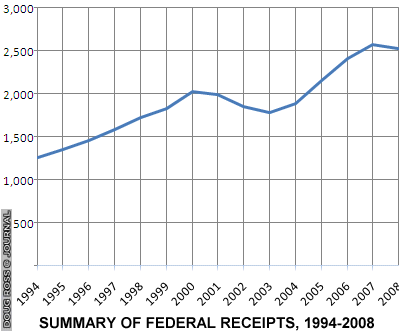
Next, let’s see what impact the Bush tax cuts from 2001 and 2003 had on tax revenue:

Federal receipts after Bush tax cuts
Federal receipts (1994-2008)

From the chart:

  • Revenue in 2001 was 2.0 trillion in the year of the first round of tax cuts
  • Revenue in 2003 was 1.8 trillion in the year of the second round of tax cuts
  • Revenue then rose in each subsequent year, ending at 2.6 trillion in 2007, when the Democrats took over the House and Senate
  • In 2007, Bush was only spending about 2.8 trillion – very close to what he was taking receiving in tax revenues
  • The budget deficit went down in each year after both tax cuts were in place (2004), until the Democrats took over the House and Senate
  • Obama is currently spending over 3.8 trillion per year, but he is only receiving about 2.2 trillion in revenue.
  • It’s a spending problem, not a revenue problem

Doug Ross explains:

According to the OMB’s own figures, the Bush tax cuts resulted in an explosion of revenue to the U.S. government.

That’s not to say Bush wasn’t a profligate spender — he was. But in virtually no cases were Democrats arguing that he spend less (unless you count national security).

In fact, fiscal conservatives opposed Bush’s absurd policies on spending, amnesty and the expansion of Medicare.

But no one in world history has ever spent money like Barack Obama.

These statements are indisputable.

Which is why they are certain to be rejected by the diminishing cadre of Obama-Democrat drones, who appear to be completely immune to facts, logic and reason.

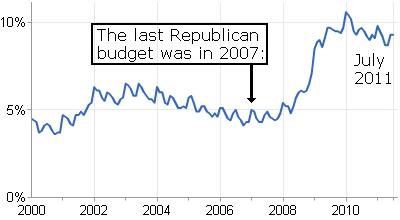
And let’s just see what happened to the unemployment rate since the Democrats took over spending in January of 2007:

Unemployment Rate (Not seasonally adusted)

There are a lot of people who don’t know about these numbers because they watch Jon Stewart and Stephen Colbert on the Comedy Channel, or Rachel Maddow and Ed Schulz on MSNBC.

I actually spoke to someone who voted for Obama about these numbers. He said that 2.6 trillion in tax revenues was worse than 2.0 trillion in tax revenues. And he said that a 4.3% unemployment rate was WORSE than a 9.2% unemployment rate. And he also said that a $160 billion dollar deficit was WORSE than a $1650 billion dollar deficit. Ok I just made that up, but still. That’s how Democrats think. Tax and spend.

Italy’s debt crisis – what can we learn from it?

Map of Europe
Map of Europe

Very bad news for Italy, but a learning opportunity for us.

Excerpt:

Fears are spreading that Italy may soon have to follow Greece, Ireland, and Portugal and seek a financial bailout from the European Union and the International Monetary Fund. Doubts over the sustainability of Italy’s explosive cocktail of high debt and low growth have led to violent routs that saw Italian stocks plunge and bond yields soar in recent days.

Italy is the seventh-largest economy in the world and the third-largest economy in the euro zone (the group of countries which use the euro as their common currency). It is also the third-most indebted country in the world after the United States and Japan. In its European context, Italy’s mountain of debt is more than that of all the other so-called PIGS (Portugal, Ireland, Greece, and Spain) group of financially troubled countries combined.

Given the massive size of the Italian economy, many analysts believe that Italy (like Spain) is too big to be rescued and that a full-blown debt crisis in the country could lead to the collapse of Europe’s single currency.

Confidence in Italy began to erode after Moody’s Investors Service and Standard & Poor’s announced in recent weeks that they are reviewing the country’s sovereign credit rating. The review for a possible downgrade of Italy’s rating comes amid stalled economic growth that will complicate any efforts to reduce the country’s debt load, and political infighting in Rome over budget cuts required to prevent government borrowing costs from spiraling to unaffordable levels.

There is no quick fix for the two most immediate problems ailing Italy: the country’s towering national debt and extremely poor prospects for economic growth.

At 120 percent of GDP, Italy’s debt is the EU’s second-largest by that measure after Greece, which has a debt-to-GDP ratio of 150 percent. Italy’s €1.8 trillion ($2.5 trillion) debt, which is equal to the country’s national income, poses an unsustainable economic burden that will push Italy into the abyss if the government’s debt servicing costs keep rising.

What can we learn from Italy that we should avoid?

First, they are planning to balance the budget by 2014:

The plan calls for freezing public sector pay, reducing funding to local government and health services, increasing the retirement age, and cracking down on tax evasion. Italians will also have to pay €25 for some non-emergency hospital visits and €10 above existing fees to see specialists. The aim is to cut the budget deficit from 3.9 percent this year to 2.2 percent in 2013 and to balance the budget by 2014.

We are running massive 1.6 trillion dollar deficits under Obama, and he refuses to balance the budget. Even if he took every penny earned by those households earning $200,000 or more per year, that would not generate enough money to cover his massive 1.6 trillion dollar spending sprees. The problem is not revenue, it’s spending.

And what else can we learn from Italy?

Here’s more from the PJM article:

Everyone seems to agree that Italy’s growth problems are structural and systemic. As noted recently by the Economist magazine: “Between 2000 and 2010 Italy’s average growth, measured by GDP at constant prices, was just 0.25% a year. Of all the countries in the world, only Haiti and Zimbabwe did worse.”

Says the Economist: “Many things contribute to these gloomy figures. Italy has become a place that is ill at ease in the world, scared of globalization and immigration. It has chosen a set of policies that discriminate heavily in favor of the old and against the young. Combined with an aversion to meritocracy, this is driving large numbers of talented young Italians abroad. In addition, Italy has failed to renew its institutions and suffers from debilitating conflicts of interest in the judiciary, politics, the media, and business. These are problems that concern the nation as a whole, not one province or another.”

Does that sound familiar? That’s right! The Democrats are scared of globalization. They oppose free trade deals that reduce the prices of consumer goods. The Democrats favor distributing wealth from young to old. They oppose reforming entitlements like Social Security and Medicare for young people. The Democrats are opposed to meritocracy. They are the party of unions, tenure and wealth redistribution. It’s this economics illiteracy that is slowing down economic growth here at home. We need to vote the people who make economic decisions by feelings out. And we need to put the people who make economic decisions based on job creation in.