
Tag Archives: Economics

What causes rich Democrats to lay off Americans and ship jobs overseas?

First off, I spotted this American Spectator story by Robert Stacy McCain on The Other McCain.

Excerpt:

California Democrat Rep. Jane Harman’s family business is laying off American workers – including engineering employees in California – and shifting jobs overseas.

A letter from the human resources director of one Harman company, obtained exclusively by The American Spectator, describes a “permanent” layoff of dozens of California workers that went into effect last week.

[…]Harman is the third-richest member of Congress, and her net worth increased last year $40 million, according to a study of Federal Election Commission records conducted by The Hill newspaper. Her husband, Sidney Harman, founded Harman International Industries, which was valued in 2007 at about $8 billion.

[…]By May 2009, the company had already slashed its U.S. workforce by 900 and expected to make more than a thousand more layoffs by mid-2010, according to a Saturday Evening Post article that noted: “[W]hile shutting down U.S. facilities, Harman was simultaneously opening factories in China and India, as well as massive multimedia outlets in Dubai and New Delhi.”

She’s a rich Democrat… and she is shipping American jobs overseas? Why???

Well, California is an anti-business state and it’s run by socialist Democrats who hate businesses and capitalism. (H/T ECM)

But what about other countries? Why do they ship jobs overseas?

Look what is happening in New Zealand with the new Hobbit movie. (H/T Anon)

Excerpt:

At least half a dozen countries, including Australia, are lobbying to win the right to film The Hobbit and Hollywood accountants are now doing the numbers of rival offers, the movie’s co-producer and co-writer Phillipa Boyens says.

The $US150 million Sir Peter Jackson blockbuster has been mired in an industrial dispute in recent weeks, following complaints from a group of international labour unions over poor on-set working conditions for actors.

Jackson, who strenuously denies the claims, has accused the Australian-based Media Entertainment and Arts Alliance of bullying to gain control over the production, which he says may be forced out of New Zealand.

Boyens told New Zealand’s National Radio’s Nine to Noon programme the movie was ready to begin filming in January but has now been thrown in turmoil by the actors’ boycott.

She said New Zealand Actors’ Equity seemed to believe the whole thing was a bluff.

“I am concerned over some of the statements made… by New Zealand Equity that there is still a misunderstanding on the seriousness of what is involved here and what is at stake,” she said.

“That is very real and that has put at risk the livelihood of countless thousand New Zealand industry workers,” she said.

Scotland, Ireland, Canada and Eastern European countries had entered the negotiations in a “feeding frenzy” inspired by the threat of union action.

And it’s not just left-wing anti-capitalist governments and unions that cause outsourcing and shipping jobs overseas.

It’s the uncertainty caused by massive spending, constant interventions, anti-business regulations, the appointment of radical anti-capitalists and judicial activists to positions of power.

Here’s a story from Reuters.

Excerpt:

Tough budget measures to keep its international bailout on track have helped prompt thousands of Romanian companies to relocate to neighboring Bulgaria, where lower taxes and more stable regulations offer an easier place to do business.

Bulgaria has corporate and income tax on profits of just 10 percent, compared with Romania’s 16 percent, and now also has lower value added tax after Bucharest hiked its rate as part of efforts to meet the conditions of a 20 billion euro EU/IMF bailout.

Sofia has also cut red tape and initial capital for setting up a company is now 2 levs ($1.39), compared with a previous 5,000 levs and 200 lei ($63.55) in Romania. It takes less than a week, almost half the time needed in Romania.

That may seem like small beer, but business people say the speed of the changes forced by the bailout and uncertainty over future cuts in Romania have encouraged them to move base.

Bulgarian authorities have not released precise data, but local media report up to 2,500 Romanian companies have set up there already and another two are registering daily in the border city of Ruse alone.

“Romanian legislation and taxation are changing from one day to another. So how can I have any guarantee, any certainty if I open a company here?” said 23-year-old Bogdan Popescu from Bucharest, who wants to open an online television business.

“I could as well wake up with a 40 percent income tax tomorrow (instead of 16 at present),” said Popescu, who plans to put his headquarters in Bulgaria. “The present fiscal legislation is in no way a stimulus.”

The two Balkan countries share a long border and though links can be complicated — only one bridge connects the states along a 470 kilometer (294 miles) stretch of the Danube — companies can set up a paper headquarters but still effectively run operations from Romania.

Both suffered deep and painful recession after 2008’s financial crisis, but while Romania is having to cut spending and raise taxes, Bulgaria previously ran large fiscal surpluses and has enough reserves to keep taxes low despite dwindling revenues.

Whenever government and their union supporters make life difficult for businesses, the businesses leave. Governments and unions ship jobs overseas. Governments and unions outsource jobs to other countries. Businesses just dance the the tune that governments and unions play. It’s no use complaining about big corporations and rich greedy executives. If you want a job then you promote the conditions that will attract businesses. Left-wing unions, left-wing political parties, left-wing news media and left-wing judges attack businesses, and that’s why unemployment goes higher.

And businesses know that massive government spending is going to require higher taxes or printing more money to that will devalue savings. They are not going to expand in banana republic economies like the United States until we vote a large enough number of Democrats out of all three branches of the federal government.

What I resent is when rich Democrats create the legal conditions that require companies to outsource and then complaining about outsourcing while engaging in outsourcing themselves. That’s hypocrisy.
Colombia’s war on terrorism and Chile’s war on poverty

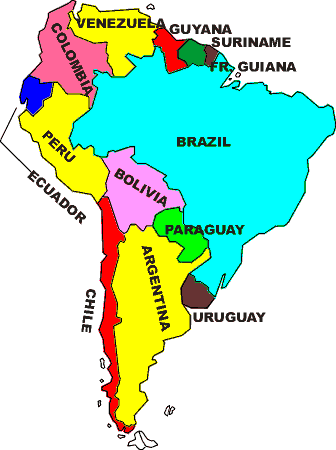
Map of South America

A magnificent column about Colombia’s war on FARC.

Excerpt:

When Juan Manuel Santos came into office as Colombia’s president and emphasized economic issues over the fight against terrorist guerrillas, he was suspected of going soft on those he had combated as minister of defense under the previous administration. Little did his critics know that he was planning the “coup de grace” against the Revolutionary Armed Forces of Colombia (FARC).

The devastating Sept. 22 attack on FARC headquarters in Colombia’s central Meta province all but signifies the end of the five-decade-old conflict. It will take a little while for the official end to be declared, but this war is pretty much over.

[…]For decades, politicians, academics, human rights activists and journalists on both sides of the Atlantic failed to see that there was nothing romantic, “bien-pensant” or Robin Hoodesque about an organization that killed, maimed, kidnapped and extorted for a totalitarian objective.

Colombia’s solitude was such that even the U.S. began to lose faith in its ally a couple of years ago, refusing to approve a free-trade agreement that Bogota had negotiated at a major political cost.

Colombians did not give up and continued to reclaim territory for civilian rule. Much like the defeat of Venezuela’s Cuba-inspired terrorist guerrillas in the 1960s, Colombia’s victory against FARC is the result of civilians awakening to the evil of totalitarian terror.

We get to hear about spectacular military feats, but how many outside Colombia realize that peasants, factory workers, teachers, students and others joined the struggle to defeat FARC, beautifully symbolized by the hundreds of thousands who took to the streets inside Colombia and around the world in 2008 to clamor for the end of terror?

There are still many challenges ahead. The lesson in courage and perseverance that Colombians have given us suggests they are ready to meet them.

I wish that we could sign a free trade deal with them like Canada’s conservative government. Canada is led by a conservative business-friendly economist, and they are very supportive of capitalist democracies like Colombia. Stephen Harper is Canada’s prime minister. He has economics degrees from the University of Calgary. Like Santos, he is very, very tough on terrorism – favoring increased defense spending to protect Canadian interests abroad. And guess what? Canada also has a free trade agreement with another South American country – Chile.

And Chile is also doing very well, even after the massive earthquake.

Excerpt:

Chile’s peso rose to a 27-month high after a report showed the country’s industrial growth accelerated to the fastest since 2006.

The peso appreciated 0.2 percent to 485.23 per U.S. dollar at 11:43 a.m. New York time, from 486.17 yesterday. The currency touched 483.61, the strongest since June 11, 2008. The peso has risen 13 percent during the quarter and 3.6 percent this month.

Chile’s economy is accelerating after the fifth-largest earthquake in a century struck in February, delaying its recovery from a 2009 recession.

“Retail sales grew and industrial production was better than expected,” said Roberto Melzi, a strategist at Barclays Capital in New York.

Retail sales expanded 13 percent in August from a year earlier, and industrial output grew 6.9 percent, the National Statistics Institute said in Santiago. That’s the most since January 2006. Industrial production shrank 17 percent after the 8.8-magnitude Feb. 27 earthquake and its accompanying tsunami, which caused damage worth more than a sixth of Chile’s gross domestic product.

Chile and Colombia are my two favorite South American countries. Both are led by conservative business-friendly economists. Chile’s president Sebastián Piñerahas a Masters and a Ph.D in economics from Harvard, and is successful in the private sector. The Colombian President Juan Manuel Santos specializes in business and economics, with graduate degrees from Harvard and the London School of Economics.

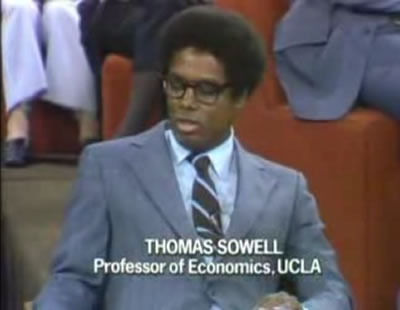
Thomas Sowell explains the concept of “moral hazard”

Young Thomas Sowell

From Real Clear Politics. (H/T Jojo)

Excerpt:

One of the things that makes it tough to figure out how much has to be charged for insurance is that people behave differently when they are insured from the way they behave when they are not insured.

In other words, if one person out of 10,000 has his car set on fire, and it costs an average of $10,000 to restore the car to its previous condition, then it might seem as if charging one dollar to all 10,000 people would be enough to cover the cost of paying $10,000 to the one person whose car that will need to be repaired. But the joker in this deal is that people whose cars are insured may not be as cautious as other people are about what kinds of neighborhoods they park their car in.

[…]Although “moral hazard” is an insurance term, it applies to other government policies besides insurance. International studies show that people in countries with more generous and long-lasting unemployment compensation spend less time looking for jobs. In the United States, where unemployment compensation is less generous than in Western Europe, unemployed Americans spend more hours looking for work than do unemployed Europeans in countries with more generous unemployment compensation.

People change their behavior in other ways when the government pays with the taxpayers’ money. After welfare became more readily available in the 1960s, unwed motherhood skyrocketed. The country is still paying the price for that– of which the money is the least of it. Children raised by single mothers on welfare have far higher rates of crime, welfare and other social pathology.

San Francisco has been one of the most generous cities in the country when it comes to subsidizing the homeless. Should we be surprised that homelessness is a big problem in San Francisco?

[…]We also hear a lot of talk about “the uninsured,” for whose benefit we are to drastically change the whole medical-care system. But income data show that many of those uninsured people have incomes from which they could easily afford insurance. But they can live it up instead, because the government has mandated that hospital emergency rooms treat everyone.

And here’s another Tom Sowell column making a related point.

Excerpt:

Much has been made of the fact that families making less than $250,000 a year will not see their taxes raised. Of course they won’t see it, because what they see could affect how they vote.

But when huge tax increases are put on electric utility companies, the public will see their electricity bills go up. When huge taxes are put on other businesses as well, they will see the prices of the things those businesses sell go up.

If you are not in that “rich” category, you will not see your own taxes go up. But you will be paying someone else’s higher taxes, unless of course you can do without electricity and other products of heavily taxed businesses. If you don’t see this, so much the better for the Obama administration politically.

This country has been changed in a more profound way by corrupting its fundamental values. The Obama administration has begun bribing people with the promise of getting their medical care and other benefits paid for by other people, so long as those other people can be called “the rich.” Incidentally, most of those who are called “the rich” are nowhere close to being rich.

[…]There was a time when most Americans would have resented the suggestion that they wanted someone else to pay their bills. But now, envy and resentment have been cultivated to the point where even people who contribute nothing to society feel that they have a right to a “fair share” of what others have produced.

The most dangerous corruption is a corruption of a nation’s soul. That is what this administration is doing.

Republicans prefer private voluntary charity as the best way to provide a safety net. Just because people on the left give less to charity than people on the right, it doesn’t mean that no one one gives to charity. Europe has the highest taxes, and they give the least in charity. Why not LOWER taxes for people who want to give MORE in charity? When government hands out money, it encourages people to be more dependent. But when a person in trouble has to go to a neighbor or a charity in their own community, it sends the right message – “this should be temporary – don’t let this become a habit”. It’s not GOOD for someone to depend on the government. People need to work in order to be happy.

Having the government take over the role of provider in the home is an insult to men. It’s not government’s job to replace men. They ought to stay right out of it. Leave money in the pockets of the working man so he can save for a rainy day himself. If you subsidize a behavior, you get more of it. If you tax a behavior, you get less of it. It makes no sense to subsidize irresponsible lifestyle choices and tax productive and moral lifestyle choices. You don’t want to make the rescue from bad decisions an anonymous and automatic affair. You want people to worry, so that they won’t want to make risky and irresponsible choices. Everybody goes through though times, but we shouldn’t make it normal. People ought to know that it’s not normal.

You may want to read about how government dependence makes people less happy than having a job. Don’t make people depend on government by taxing businesses and investment. We need more companies hiring – not less. And that means letting the profit motive provide an incentive for entrepreneurs to engage in more risk-taking and enterprise.