Tag Archives: Economic Growth

Niall Ferguson argues that government is making it harder to run a business

In the Wall Street Journal.

Excerpt:

Seven years of data suggest that most of the world’s countries are successfully making it easier to do business: The total number of days it takes to carry out the seven procedures has come down, in some cases very substantially. In only around 20 countries has the total duration of dealing with “red tape” gone up. The sixth-worst case is none other than the U.S., where the total number of days has increased by 18% to 433. Other members of the bottom 10, using this metric, are Zimbabwe, Burundi and Yemen (though their absolute numbers are of course much higher).

Why is it getting harder to do business in America? Part of the answer is excessively complex legislation. A prime example is the 848-page Wall Street Reform and Consumer Protection Act of July 2010 (otherwise known as the Dodd-Frank Act), which, among other things, required that regulators create 243 rules, conduct 67 studies and issue 22 periodic reports. Comparable in its complexity is the Patient Protection and Affordable Care Act (906 pages), which is also in the process of spawning thousands of pages of regulation. You don’t have to be opposed to tighter financial regulation or universal health care to recognize that something is wrong with laws so elaborate that almost no one affected has the time or the will to read them.

[…]Each year, the World Economic Forum publishes its Global Competitiveness Index. Since it introduced its current methodology in 2004, the U.S. score has declined by 6%. (In the same period China’s score has improved by 12%.) An important component of the index is provided by 22 different measures of institutional quality, based on the WEF’s Executive Opinion Survey. Typical questions are “How would you characterize corporate governance by investors and boards of directors in your country?” and “In your country, how common is diversion of public funds to companies, individuals, or groups due to corruption?” The startling thing about this exercise is how poorly the U.S. fares.

In only one category out of 22 is the U.S. ranked in the global top 20 (the strength of investor protection). In seven categories it does not even make the top 50. For example, the WEF ranks the U.S. 87th in terms of the costs imposed on business by “organized crime (mafia-oriented racketeering, extortion).” In every single category, Hong Kong does better.

At the same time, the U.S. has seen a marked deterioration in its World Governance Indicators. In terms of “voice and accountability,” “government effectiveness,” “regulatory quality” and especially “control of corruption,” the U.S. scores have all gone down since the WGI project began in the mid-1990s. It would be tempting to say that America is turning Latin, were it not for the fact that a number of Latin American countries have been improving their governance scores over the same period.

Whatever the root causes of the deterioration of American institutions, smart people are starting to notice it. Last year Michael Porter of Harvard Business School published a report based on a large-scale survey of HBS alumni. Among the questions he asked was where the U.S. was “falling behind” relative to other countries. The top three lagging indicators named were: the effectiveness of the political system, the K-12 education system and the complexity of the tax code. Regulation came sixth, efficiency of the legal framework eighth.

Asked to name “the most problematic factors for doing business” in the U.S., respondents to the WEF’s most recent Executive Opinion Survey put “inefficient government bureaucracy” at the top, followed by tax rates and tax regulations.

The troubling thing to me is that the private sector has to make a profit in order to fund government, and I don’t see that the private sector will be able to producing the profits needed to fund our government’s lavish spending. Nothing that I see about the next generation causes me to believe that they understand economics enough to vote to improve the business climate. They seem to be very much anti-business. One wonders where they expect to find jobs.

What causes Colombia’s economy to grow? What causes Venezuela’s economy to shrink?

Political Map of South America

Would you like to have a growing economy? Then follow the lessons of Colombia.

Excerpt:

Colombia expects lower fiscal deficits in 2013 than in 2012, while economic growth is projected at 4.8 percent for both years, Finance Minister Juan Carlos Echeverry said on Thursday.

Latin America’s No. 4 oil producer has seen a strong recovery from the global economic crisis, recouping three investment-grade credit ratings and continuing to reap strong inflows in the mining and oil sectors.

Presenting the latest fiscal plan, Echeverry said the government had revised down the 2012 central government fiscal deficit target to 2.4 percent of gross domestic product from 2.8 percent previously, and the consolidated deficit to 1.2 percent of GDP from 1.8 percent. The consolidated deficit includes the central and regional governments.

The central government deficit target is seen at 2.2 percent of GDP in 2013, with the consolidated deficit at 1 percent.

“This fiscal plan is serious, reasonable, we’re not extracting liquidity from the economy, but injecting liquidity into the economy,” Echeverry told reporters.

The government expects the economy to grow 4.8 percent this year and next. Economic expansion was 5.9 percent in 2011, the fastest growth rate in four years, helped by high foreign investment and strong consumer spending growth.

Colombia has attracted billions of dollars in foreign direct investment over the past decade, mostly into the oil and mining sectors after U.S. military aid helped security forces deal crippling blows to leftist guerrillas and cocaine cartels.

Consumer prices have remained at steady levels in recent months, and economists expect 2012 annual inflation to fall within the central bank’s target of 2 percent to 4 percent.

The fiscal plan forecasts full-year inflation at 3 percent this year and next.

Under Obama, the United States has been running deficits of between 8-10% GDP. Revenue is the same as usual, but spending to reward reckless, irresponsible behavior has skyrocketed.

Would you like to avoid a shrinking economy? Then avoid the policies of Venezuela.

Excerpt:

Venezuela has devalued its currency, joining Iran, Argentina and others whose wars on math brought the same result. Some call this a “restorative.” It’s not. It’s what happens when big government hits a wall.

Venezuela’s monster 47% devaluation from 4.3 to 6.3 bolivars to the dollar, reportedly ordered by President Hugo Chavez from his hospital bed in Cuba, marks the reckoning for his regime’s big-spending ways in Venezuela’s low-growth economy.

[…]This devaluation is characteristic of all tyrannies, which benefit by effectively expropriating the savings of the private sector through monetary means rather than the more common thuggery.

Chavez’s meltdown is coming for the same reason devaluations are also shaking Argentina, which is undergoing a new fiscal disaster of its own, Egypt, which is going through a slo-mo devaluation that’s pushing up the price of food and prompted its Islamofascist rulers to actually urge people to eat less food, and Iran, whose madhouse economics has triggered hyperinflation.

It’s how dictators do business. This is Chavez’s sixth devaluation in the last decade of his big-spending power, following devaluations in 2002, 2003, 2004, 2005, 2010 and 2011. Every one of these devaluations inflates away some of his debts — but at the expense of the country’s savings and investment, which are snapped away through inflation.

What’s more, this devaluation, which was done to plug his deficit spending and prop up the state oil company, will only cover 60% of the country’s deficit, meaning more devaluations ahead this year, likely to take the bolivar to 8 by year end.

Venezuelan officials, predictably, claimed it was “good” as well as an “improvement” that protects the middle class against “speculators,” echoing the party line of establishment economists such as Joseph Stiglitz, former Bill Clinton adviser and chief economist of the International Monetary Fund, who in the past has called devaluations an economic ” restorative.”

Tell that to the panic buyers across Venezuela. There, terrified consumers who are buying goods ahead of expectations of soaring prices, while the poor have seen their life savings wiped out.

When Obama took office, a US dollar was worth over 1.20 Canadian. Today it’s worth about 98 cents. He has been devaluing the currency in order to pay for massive government spending. Private savings of individuals have been devalued, as a result. Inflation is a hidden tax on those who earn and save.

In the United States, we are doing the exact opposite of Colombia. We are embracing Venezuela policies, and expecting Colombia results. Why are we stupid enough to believe words instead of results? Socialism doesn’t work. Capitalism does work. We should choose what works.

Conservative Party MP Pierre Poilievre explains how Canada escaped the recession

Conservative M.P. Pierre Poilevre (Nepean-Carleton), a member of the majority government in Canada, explains how Canada embraced the free entreprise system that America has rejected, and the results they got.

Here is the speech that went viral on Youtube:

And here is his article in the liberal Huffington Post.

Excerpt:

In a few days the “fiscal cliff” deadline will arrive and potentially bring massive automatic spending cuts and tax increases. Even if Congress and the President agree to avoid the cliff, the next crisis awaits. Treasury Secretary, Timothy Geithner, wrote the Senate this week to report that the “statutory debt limit will be reached on December 31, 2012,” which will require extraordinary measures to prevent a mass default. These measures will give the government 60 days before it runs out of money and Uncle Sam’s head smashes into the so-called “debt ceiling.”

It has long been said that when the U.S. sneezes, Canada catches a cold. So why have these debt-related ailments in the U.S. not afflicted the Canadian government?

The answer is that Canada has been practicing what the U.S. always preached: free markets, low taxes and minimal state interference. And it is working.

For example, Canada avoided the interventionist policies that led the U.S. to the sub-prime crisis.

In an attempt to expand home ownership, administrations from Carter to Bush Jr. forced banks to offer mortgages to people who would otherwise not qualify for them. Washington then ordered government-sponsored enterprises such as Freddie Mac and Fannie Mae to insure these “sub-prime” mortgages.

According to a 2010 Report on the U.S. Financial Crisis by the World Bank’s Development Research Group, Freddie and Fannie bought an estimated 47 per cent of these toxic mortgages. Harvard financial historian Niall Ferguson indicates that the amount of mortgage debt backed by these government-sponsored enterprises grew from $200-million in 1980 to $4-trillion in 2007.(1) The government pumped so much air into the housing bubble that it burst in 2008. The resulting financial crisis led to government bailouts of the banking sector.

Big government caused the economic crisis. So we are told the solution is more big government. Funny how the problem becomes the solution.

Because the Canadian government did not impose sub-prime mortgages on the country’s charter banks, we avoided the crisis and did not bailout a single financial institution. To keep it that way, Canada’s Finance Minister has ended all government-backed insurance of low-down payment and long-amortization mortgages. In other words, if you want to take on risky debt, taxpayers will not insure you.

Governments must lead by example when managing their own debt and spending. Low debt is the result of low spending. Federal government spending as a share of the overall economy is 15 per cent in Canada (2) and 24 per cent in the U.S. (3). The numbers are not merely the result of prodigious U.S. military spending, though that is certainly a factor. Non-military federal government spending is 14 per cent of Canada’s economy (4), and 18 per cent of America’s (5).

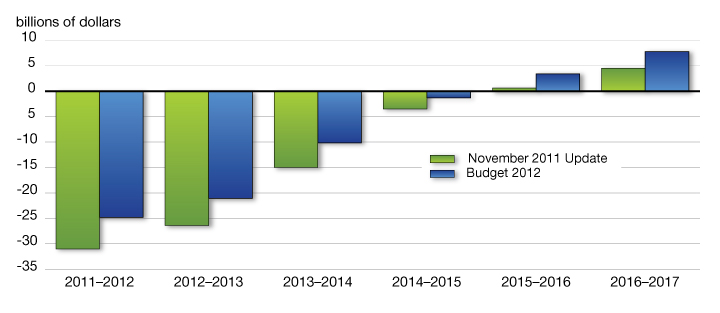
Take a look at some of these graphs from earlier in the year about the Canadian 2012 budget. (This is straight from their government’s web site – they have new transparency/anti=corruption measures now, so the citizens know everything that government does). When comparing the deficit and debt of Canada to the United States, always multiply the Canadian number by 10 to get a benchmark to compare. For example, Canadian GDP is 1.7 trillion, and the US GDP is 15 trillion.

Canada’s budget deficit is around 30 billion, but ours is 1.2 trillion:

Canada Federal Budget Deficit / Surplus 2012

If we were doing as well as Canada, our deficit would be about $300 billion. But we have run up about 6 trillion in debt over 4 years! Not only that, but Canada’s national debt is only $600 billion. If we multiple that by 10, we would expect ours about $6 trillion. And it was that – during the Bush Presidency. But then the Democrats took over the House and Senate in 2007 and everything went wrong and we packed trillions and trillions onto the debt, including about $6 trillion during Obama’s first term.

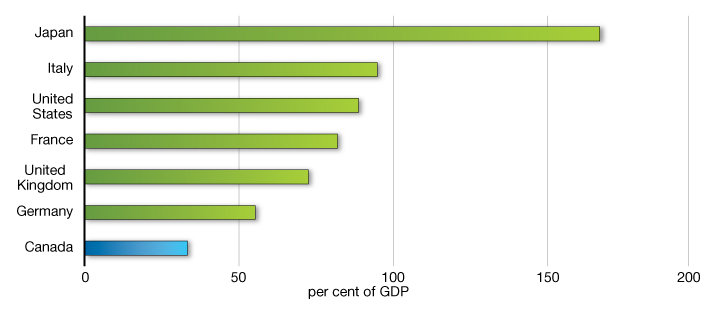
Canada’s Debt to GDP ratio is 34%:

Canada vs US Debt to GDP

But things are even worse for the United States, now. The current United States Debt to GDP is 105%, according to official U.S. government figures. We are due for yet another credit downgrade, and should see Greece-like levels of Debt to GDP during Obama’s second term. We are spending too much, and we aren’t going to be able to make up trillion dollar deficits even if we confiscate every penny that rich people earn. (And they won’t be daft enough to keep working as hard if we did that – they would move, and probably to Canada)

What is happening to us here in the United States is self-inflicted. We are – and have been – voting to impoverish ourselves and generations of children born and unborn, by punishing those who work hard and play by the rules, and rewarding those who don’t work and don’t play by the rules. It didn’t have to be this way. We could have elected a President who actually knew something about business and economics. Knowledge matters. We can’t just choose a President who gives us the “tingles” and then expect him to perform the actual duties of being President. Competence is more important than confidence. Substance is more important than style.