
Tag Archives: Earth

Jupiter deflects comets and asteroids that might otherwise hit Earth

Circumstellar Habitable Zone

This is an older article from Astrobiology magazine, but it shows how important Jupiter is for habitability.

Excerpt:

To a biologist, the ingredients needed to form life include water, heat and organic chemicals. But some in the astrophysics and astronomy community argue that life, at least advanced life, may require an additional component: a Jupiter-sized planet in the solar neighborhood.

“A long-period Jupiter may be a prerequisite for advanced life,” said Dr. Alan Boss, a researcher in planetary formation. Boss, who works at the Carnegie Institution of Washington, is a member of the NASA Astrobiology Institute (NAI).

In our own solar system, Jupiter, with its enormous gravitational field, plays an important protective role. By deflecting comets and asteroids that might otherwise hit Earth, Jupiter has helped to create a more stable environment for life to evolve here. It’s generally believed that a massive impact was responsible 65 million years ago for wiping out dinosaurs on Earth. If not for Jupiter, it’s possible that many other such impacts would have occurred throughout Earth’s history, preventing advanced life from ever gaining a foothold.

Jupiter is significant not only for its size but also for its location in our solar system, far from the Sun. Because it orbits at slightly more than 5 AU (astronomical units the distance between the Earth and the Sun is 1 AU), there is plenty of room in the inner part of our Solar System to accommodate a range of smaller planets.

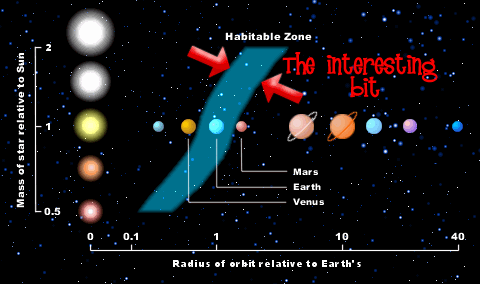
Within the inner solar system there exists a region, known as the habitable zone, where liquid water, and therefore life, can potentially exist on a planet’s surface. Without liquid water, life as we know it is not possible. The habitable zone around our Sun stretches roughly from the orbit of Venus to the orbit of Mars. Venus is generally believed to be too hot to support life. Earth, it appears, is just right. And the jury is still out on Mars.

Understanding the role that Jupiter plays in our own Solar System helps astronomers focus their search for habitable planets around other stars. “If,” Boss explains, “a Jupiter-mass planet on a stable, circular orbit [around another star at] around 4 to 5 AU was found, without any evidence for other gas giant planets with shorter period orbits, such a discovery would be like a neon light in the cosmos pointed toward that star, saying ‘Look here!’. That star would be a prime target for looking for a habitable, Earth-like planet.”

Previously, I blogged about how the circular orbit of Saturn and the mass of our star also play a role in making our planet habitable.

People who are not curious about science sort of take these blessings for granted and push away the God who is responsible for the clever life-permitting design of our habitat. In contrast, theists are curious and excited about what science tells us about the Creator. Theists care about science, but naturalists have to sort of keep experimental science at arm’s length – away from the presuppositions and assumptions that allow them to have autonomy to live life without respect, accountability and gratitude. Naturalists take refuge in the relief provided by speculative science and science fiction. They like to listen to their leaders speculate about speculative theories, and willingly buy up books by snarky speculators who think that nothing is really something (Krauss), or who think that the cosmic fine-tuning is not real (Stenger), or who think that silicon-based life is a viable scenario (Rosenberg), etc. But theists prefer actual science. Truth matters to us, and we willingly adjust our behavior to fit the scientific facts.

UPDATE: Rebuttal to me here at The Secular Outpost.

New study: Saturn’s orbit keeps Earth in the circumstellar habitable zone

Circumstellar Habitable Zone

What do you need in order to have a planet that supports complex life? First, you need liquid water at the surface of the planet. But there is only a narrow range of temperatures that can support liquid water. It turns out that the size of the star that your planet orbits around has a lot to do with whether you get liquid water or not.

A heavy, metal-rich star allows you to have a habitable planet far enough from the star so  the planet can support liquid water on the planet’s surface while still being able to spin on its axis. The zone where a planet can have liquid water at the surface is called the circumstellar habitable zone (CHZ). A metal-rich star like our Sun is very massive, which moves the habitable zone out further away from the star.

If our star were smaller, we would have to orbit much closer to the star in order to have liquid water at the surface. Unfortunately, if you go too close to the star, then your planet becomes tidally locked, like the moon is tidally locked to Earth. Tidally locked planets are inhospitable to life. So we need a star massive enough to give us a nice wide habitable zone far away from the Sun itself.

But even with the right size star, which we have in our solar sytem, we still have CHZ problems. Just because a planet starts off in the circumstellar habitable zone, it doesn’t mean that it will stay there.

Jay Richards tweeted about this new article from the New Scientist, which talks about that very problem.

Excerpt: (links removed)

Earth’s comfortable temperatures may be thanks to Saturn’s good behaviour. If the ringed giant’s orbit had been slightly different, Earth’s orbit could have been wildly elongated, like that of a long-period comet.

Our solar system is a tidy sort of place: planetary orbits here tend to be circular and lie in the same plane, unlike the highly eccentric orbits of many exoplanets. Elke Pilat-Lohinger of the University of Vienna, Austria, was interested in the idea that the combined influence of Jupiter and Saturn – the solar system’s heavyweights – could have shaped other planets’ orbits. She used computer models to study how changing the orbits of these two giant planets might affect the Earth.

Earth’s orbit is so nearly circular that its distance from the sun only varies between 147 and 152 million kilometres, or around 2 per cent about the average. Moving Saturn’s orbit just 10 percent closer in would disrupt that by creating a resonance – essentially a periodic tug – that would stretch out the Earth’s orbit by tens of millions of kilometres. That would result in the Earth spending part of each year outside the habitable zone, the ring around the sun where temperatures are right for liquid water.

Tilting Saturn’s orbit would also stretch out Earth’s orbit. According to a simple model that did not include other inner planets, the greater the tilt, the more the elongation increased. Adding Venus and Mars to the model stabilised the orbits of all three planets, but the elongation nonetheless rose as Saturn’s orbit got more tilted. Pilat-Lohinger says a 20-degree tilt would bring the innermost part of Earth’s orbit closer to the sun than Venus.

So the evidence for a out solar system being fine-tuned for life keeps piling up. It’s just another factor that has to be just right so that complex, embodied life could exist here. All of these factors need to be just right, not just the orbits of any other massive planets. And you need at least one massive planet to attract comets and other such unwelcome intruders away from the life-permitting planets.

Here’s a good clip explaining the circumstellar habitable zone:

The factor I blogged about today is just one of the things you need in order to get a planet that supports life.

Here are a few of the more well-known ones:

  • a solar system with a single massive Sun than can serve as a long-lived, stable source of energy
  • a terrestrial planet (non-gaseous)
  • the planet must be the right distance from the sun in order to preserve liquid water at the surface – if it’s too close, the water is burnt off in a runaway greenhouse effect, if it’s too far, the water is permanently frozen in a runaway glaciation
  • the solar system must be placed at the right place in the galaxy – not too near dangerous radiation, but close enough to other stars to be able to absorb heavy elements after neighboring stars die
  • a moon of sufficient mass to stabilize the tilt of the planet’s rotation
  • plate tectonics
  • an oxygen-rich atmosphere
  • a sweeper planet to deflect comets, etc.
  • planetary neighbors must have non-eccentric orbits

Here is a study that I wrote about recently about galactic habitable zones.

How likely is it for blind forces to sequence a functional protein by chance?

How likely is it that you could swish together amino acids randomly and come up with a sequence that would fold up into a functional protein?

Evolution News reports on research performed by Doug Axe at Cambridge University, and published in the peer-reviewed Journal of Molecular Biology.

Excerpt:

Doug Axe’s research likewise studies genes that it turns out show great evidence of design. Axe studied the sensitivities of protein function to mutations. In these “mutational sensitivity” tests, Dr. Axe mutated certain amino acids in various proteins, or studied the differences between similar proteins, to see how mutations or changes affected their ability to function properly.10 He found that protein function was highly sensitive to mutation, and that proteins are not very tolerant to changes in their amino acid sequences. In other words, when you mutate, tweak, or change these proteins slightly, they stopped working. In one of his papers, he thus concludes that “functional folds require highly extraordinary sequences,” and that functional protein folds “may be as low as 1 in 10^77.”11 The extreme unlikelihood of finding functional proteins has important implications for intelligent design.

Just so you know, those footnotes say this:

[10.] Douglas D. Axe, “Estimating the Prevalence of Protein Sequences Adopting Functional Enzyme Folds,” Journal of Molecular Biology, 1-21 (2004); Douglas D. Axe, “Extreme Functional Sensitivity to Conservative Amino Acid Changes on Enzyme Exteriors,” Journal of Molecular Biology, Vol. 301:585-595 (2000).

[11.] Douglas D. Axe, “Estimating the Prevalence of Protein Sequences Adopting Functional Enzyme Folds,” Journal of Molecular Biology, 1-21 (2004).

And remember, you need a lot more than just 1 protein in order to create even the simplest living system. Can you generate that many proteins in the short time between when the Earth cools and the first living cells appear? Even if we spot the naturalist a prebiotic soup as big as the universe, and try to make sequences as fast as possible, it’s unlikely to generate even one protein in the time before first life appears.

Here’s Doug Axe to explain his research:

If you are building a protein for the FIRST TIME, you have to get it right all at once – not by building up to it gradually using supposed Darwinian mechanisms. That’s because there is no replication before you have the first replicator. The first replicator cannot rely on explanations that require replication to already be in place.