
Tag Archives: Douglas Groothuis

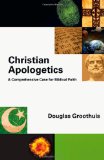
Douglas Groothuis’ 752-page Christian apologetics book is now under $22

Christian Apologetics

Looking for a good textbook on apologetics that covers everything you need to know? Check out Dr. Groothuis’ book. It’s now under $22 on Amazon.

Here are the chapters:

Part I: Apologetic Preliminaries
1 Introduction: Hope, Despair and Knowing Reality
2 The Biblical Basis for Apologetics
3 Apologetic Method: Evaluating Worldviews
4 The Christian Worldview
5 Distortions of the Christian Worldview–or the God I Don’t Believe In
6 Truth Defined and Defended
7 Why Truth Matters Most: Searching for Truth in Postmodern Times
8 Faith, Risk and Rationality: The Prudential Incentives to Christian Faith

Part II: The Case for Christian Theism
9 In Defense of Theistic Arguments
10 The Ontological Argument
11 Cosmological Arguments: A Cause for the Cosmos
12 The Design Argument: Cosmic Fine-Tuning
13 Origins, Design and Darwinism
14 Evidence for Intelligent Design
15 The Moral Argument for God
16 The Argument from Religious Experience
17 The Uniqueness of Humanity: Consciousness and Cognition
18 Deposed Royalty: Pascal’s Anthropological Argument
19 Jesus of Nazareth: How Historians Can Know Him and Why It Matters by Craig L. Bloomberg
20 The Claims, Credentials and Achievements of Jesus Christ
21 Defending the Incarnation
22 The Resurrection of Jesus

Part III: Objections to Christian Theism
23 Religious Pluralism: Many Religions, One Truth
24 Apologetics and the Challenge of Islam
25 The Problem of Evil: Dead Ends and the Christian Answer
26 Conclusion: Take It to the Streets

Appendix 1 Hell on Trial
Appendix 2 Apologetic Issues in the Old Testament by Richard S. Hess

Here’s a review of the book by Michael D. Stark.

Introduction:

Contemporary Christians interested in apologetics can now turn to another text that is bound to become one of the most-used textbooks in apologetics. Douglas Groothuis’ Christian Apologetics: A Comprehensive Case for the Biblical Faith (InterVarsity, 2011) may have more breadth both in content and wisdom than any apologetics text to date. The subtitle is justified as the book, over 700 pages and 26 chapters long (not including two appendixes), presents the need for apologetics and explores the main philosophical arguments for the existence of God. Unlike other apologetics texts, Groothuis includes chapters examining truth in postmodern society, religious pluralism, and a tactful approach to dealing with Islam. Furthermore, biblical scholars (and Denver Seminary colleagues) Richard Hess and Craig Blomberg build on an already strong text by writing chapters on apologetics in the Old Testament (Appendix 2) and a historical approach to the person of Christ and the gospels, respectively.

Here’s a snip from the review:

The chapter on cosmological arguments is superb and only further qualifies Groothuis as a proficient thinker. This chapter without question is the chapter I learned the most from. Groothuis engages very difficult scientific and philosophical concepts and communicates them in a way that even the beginner will be able to grasp. Though there are many different versions of the cosmological argument, the chapter hones in on the kalam cosmological argument as put forth by William Lane Craig. The kalam argument is superior to other cosmological arguments in that it supposedly secures the theistic doctrine of ex nihilo if the arguments proves successful (note: a minor quibble of this chapter is that Groothuis purports that the Thomistic cosmological argument does not endorse ex nihilo. I believe this to be false). This specific chapter was sensational – however I was left disappointed that no time was given to addressing the cosmological argument posited by Aquinas. In some respects, the Thomistic cosmological argument is the simplest form for people new to apologetics. The Thomistic version does not get into the technical issues of the metaphysics of time and Big Bang cosmology that the kalam version uses, nor does it require knowledge of the principle of sufficient reason that the Leibnizian version necessitates. While the kalam and Leibnizian versions are logical and sound arguments, they may confusing to people new to apologetics. Because of this, beginners ought to take the time to read this chapter slowly and more than once because of the finer technical details.

Chapters 12-14 are devoted to the design argument and issues relating to it. Groothuis opposes macroevolution and thus goes to great extent to battle Darwinism. Those interested in the philosophy of science will be drawn to these chapters. The chapter focused on intelligent design relies heavily on the work of William Dembski and Michael Behe. These chapters serve as a valuable introduction for those new to discussion between Christian and naturalistic sciences.

Chapter 15 is perhaps the most successful chapter of the entire book as it deals with the moral argument. It is my belief that the moral argument is the most successful argument for the existence of God as it appeals to everyone, Christian, atheist, and non-Christian religious persons. Ethical theory may perhaps be the most widely debated philosophical topic throughout history and thus Groothuis could have taken many approaches when discussing the moral argument. The way he structured his chapter, however, is nearly flawless. Building off his chapter examining truth in the postmodern culture (chapter 7), Groothuis correlates the denial of objective truth to the ridding of objective moral value. He unmercifully attacks moral relativism and brilliantly shows its dangers. He states that cultural relativism reduces to individual relativism, which, in turn, ultimately rests on nihilism. The setup of this reductio ad absurdum points the reader to a moral system that does not reduce to nihilism. Thus, a worldview that embraces objective moral truths must be embraced. Groothuis makes the claim that the source of objective moral truths is found in the absolute Being – God. Groothuis puts for the notion that God is the source of all perfect moral code because he himself is incapable of an evil act as it would be a contradiction of God’s Being.

I think that the big advantage you get from Doug Groothuis is his worldview. He has the most fully-integrated worldview of any Christian scholar I know.

I bought one copy of Dr. Groothuis’ book, but I gave it away. So I got myself another one. It’s a must have. My favorite four apologetics books are this one, “Philosophical Foundations for a Christian Worldview” by William Lane Craig and J.P. Moreland, Michael Licona’s “The Resurrection of Jesus” and Stephen C. Meyer’s “Signature in the Cell”. I think that if you add Wayne Grudem’s “Politics According to the Bible” to that list, then that’s a very practical set of tools.

Douglas Groothuis’ exhortation to Christians to study apologetics

Dr. Groothuis’ article lays out 6 “enemies” to the task of apologetics. I’ll look at the first 4.

Enemy #1: We don’t defend God’s existence and character to other people

If we really cared about God like we say we do, then we would care enough to defend his reputation in public. If we really loved our neighbor and believed that they need to follow Jesus in order to be reconciled with God, we would tell them that. But we don’t really care enough about God when his reputation is slammed in public. That’s what being a good friend to God and to our neighbor requires.

Groothuis writes:

Too many Christians don’t seem to care that Christianity is routinely ridiculed as outdated, irrational, and narrow-minded in our culture. They may complain that this “offends” them (just as everyone else is complaining that one thing or another “offends” them), but they do little to counteract the charges by offering a defense of the Christian world view in a variety of settings. Yet Scripture commands all Christians to have a reason for the hope that is within them and to present this with gentleness and respect to unbelievers (1 Peter 3:15).

Our attitude should be that of the Apostle Paul who was “greatly distressed” when he beheld the idolatry of sophisticated Athens. This zeal for the truth of God led him into a fruitful apologetic encounter with the thinkers gathered to debate new ideas (see Acts 17). It should for us as well. Just as God “so loved the world” that he sent Jesus to set us right with God (John 3:16), Jesus’ disciples should so love the world that they endeavor to reach the lost by presenting the Gospel and answering objections to the Christian faith (John 17:18).

Enemy #2: We separate Christianity from the reasons and evidence that ground it

Many Christians alter their theology in order to “get along” with other religions that conflict with ours. Instead of wrestling with the competing truth claims of other religions, some Christians just change the nature of our religion so that it is just our personal preference or cultural narrative, instead of being about truth. If the Bible claims that Jesus rose from the dead, we reinterpret that historically testable claim so that it’s only true for us. If the Bible says that the universe began to exist, we reinterpret that scientifically testable claim so that it is only true for us.

Groothuis says:

For some Christians, faith means belief in the absence of evidence and argument. Worse yet, for some faith means belief in spite of evidence to the contrary. The more irrational our beliefs, the better–the more “spiritual” they are… When Christians opt for irrationalism, they become just another “religious option,” and are classified along with Heaven’s Gate, the Flat Earth Society, and other intellectually impaired groups.

Enemy #3: We don’t take the time to study the reasons and evidence we have

We don’t make time for preparing a defense for our beliefs by leveraging the resources produced by Christian scholars.

Groothuis says:

Many Christians are not aware of the tremendous intellectual resources available to defend “the faith that was once for all entrusted to the saints” (Jude 3). This is largely because many major churches and parachurch organizations virtually ignore apologetics… Few evangelical sermons ever address the evidence for the existence of God, the resurrection of Jesus, the justice of hell, the supremacy of Christ, or the logical problems with nonChristian worldviews. Christian bestsellers, with rare exceptions, indulge in groundless apocalyptic speculations, exalt Christian celebrities (whose characters often do not fit their notoriety), and revel in how-to methods.

Enemy #4: We would rather be liked by people than be a friend to God

Somehow, we have gotten the idea that the purpose of Christianity is for us to be happy. Being popular and accepted by non-Christians makes us feel happy. Moral judgments are divisive, so we avoid making those. Exclusive salvation is divisive, so we avoid exclusivity. All of this so that our lives will be easier and happier.

Groothuis says:

In our pluralistic culture, a “live and let live” attitude is the norm, and a capitulation to social pressure haunts evangelicalism and drains its convictions. Too many evangelicals are more concerned about being “nice” and “tolerant” than being biblical or faithful to the exclusive Gospel found in their Bibles. Not enough evangelicals are willing to present and defend their faith in challenging situations, whether at school, at work, or in other public settings. The temptation is to privatize faith, to insulate and isolate it from public life entirely. Yes, we are Christians (in our hearts), but we have difficulty engaging anyone with what we believe and why we believe it. This is nothing less than cowardice and a betrayal of what we say we believe.

You can read the rest of the article here.

Doug Groothuis interviewed by Michael Brown on his radio show

Mary mentioned this radio show episode to me, and now I can share it with you, because the MP3 has been posted. You simply must listen to this inspiring interview.

Here’s Dr. Groothuis’ bio:

Douglas R. Groothuis (Ph.D., Philosophy, University of Oregon) is professor of philosophy at Denver Seminary in Denver, Colorado. He has also been a visiting professor or adjunct faculty member at Fuller Theological Seminary (Colorado Springs extension), Metropolitan State College of Denver, Westminster Theological Seminary (California campus), University of Oregon, New College Berkeley and Seattle Pacific University.

His articles have been published in professional journals such asReligious Studies, Sophia, Theory and Research in Education, Philosophia Christi, Themelios, Think: A Journal of the Royal Institute of Philosophy, Christian Scholar’s Review, Inquiry andJournal of the Evangelical Theological Society. He has written several books, including Truth Decay, In Defense of Natural Theology (coeditor),Unmasking the New Age, Jesus in an Age of Controversy, Deceived by the Light, The Soul in Cyberspace, and, in the Wadsworth Philosophers Series,On Pascal and On Jesus. Read more here.

The MP3 file is here. (99 minutes, 57 Mb)

Here’s a summary of the topics:

  • the relationship between Christianity and philosophy
  • which Christian thinker inspired Dr. Groothuis to study apologetics (it’s Francis Schaeffer)
  • is apologetics mandatory and non-negotiable for every Christian, or is it optional?
  • what is fideism? is fideism Biblical? should Christians avoid education? are faith are reason opposed?
  • was Jesus good at making logical arguments? was Jesus an intelligent person?
  • how Christianity addresses the problems of purpose and meaning for individuals
  • what are the major sections of Doug’s new book on Christian Apologetics?

And there are questions from callers. The first question is on faith vs. knowledge, and what the Bible says about them. And there’s another point about the importance and significance of Jesus’ suffering, and how it fits in to the problem of evil and suffering. He talks about how an atheist professor is using his apologetics book as a text book at the very very secular University of Colorado at Boulder (blech!), and invited him to speak to his students. He contrasts Christian theism with naturalism and the role that science plays in apologetics. He goes over the two best scientific arguments for God’s existence.

Dr. Groothuis is on Facebook and Twitter. He has nearly 2500 Facebook friends and nearly 2000 Twitter followers. He is one of my favorite Christian scholars, because he has a worldview that fully integrates every topic you can possibly imagine. He is very, very evangelical – and not ashamed of it. A very passionate, authentic and influential Christian, who just happens to be a first class scholar and teacher. I think this interview has a very clear message, especially to young men:  if you learn apologetics, God will use you. You will have adventures if you only take the time to arm yourself through study.

You can get a copy of Dr. Groothuis’ “Christian Apologetics” book. It won the 2012 Christianity Today Award of Merit. I really recommend the book.

I also posted a lecture that Dr. Groothuis delivered on the kalam cosmological argument earlier in the week.

I am also a big fan of the interviewer, Dr. Michael Brown, who is solid on the same-sex marriage issue, and I have featured one of his debates on same-sex marriage before on this blog.