
Tag Archives: Divorce

The meaning of marriage: a lecture at Google by Tim Keller

Painting: "Courtship", by Edmund Blair Leighton (1888)
Painting: “Courtship”, by Edmund Blair Leighton (1888)

Disclaimer: I have reservations about Tim Keller. I consider him to be too liberal for my tastes, especially on scientific (intelligent design) and political/economic issues. However, I think he did a good job explaining marriage in the lecture below.

Here’s the the video:

Details:

Timothy Keller visits Google’s New York, NY office to discuss his book “The Meaning of Marriage.” This event took place on November 14, 2011, as part of the Authors@Google series.

Timothy J. Keller is an American author, speaker, preacher, and the founding pastor of Redeemer Presbyterian Church in New York City. He is the author of several books, including “The Reason for God: Belief in an Age of Skepticism.”

“The Meaning of Marriage” touches on topics that all readers can relate to, starting with the role of marriage in our culture, its history and the pessimism that is often associated with it. The Kellers also discuss the feelings of and acts of love, romantic relationships, gender roles, singleness, and the role of sex in a marriage.

I saw a lot of things in his lecture that echo my own views. One point where we agree is on not just looking for traits and virtues in the other person, but in seeing how they handle conflict and solve problems with you.  You have to give the other person things to do and see if they make progress and work cooperatively with you. The most important thing to look for is someone who sees potential in you and is committed to helping you realize it. You want someone who won’t give up on you, no matter how hard things get. There are fun and happy times in a marriage, but those come naturally – the real question is how well two people stick together to get things done when it’s hard. I definitely recommend Keller’s book on marriage, it’s such a good vision of what marriage could be.

Here’s an article entitled “You Never Marry the Right Person“, that discusses one of the points in the lecture.

Excerpt:

In generations past, there was far less talk about “compatibility” and finding the ideal soul-mate. Today we are looking for someone who accepts us as we are and fulfills our desires, and this creates an unrealistic set of expectations that frustrates both the searchers and the searched for.

[…]The Bible explains why the quest for compatibility seems to be so impossible. As a pastor I have spoken to thousands of couples, some working on marriage-seeking, some working on marriage-sustaining and some working on marriage-saving. I’ve heard them say over and over, “Love shouldn’t be this hard, it should come naturally.” In response I always say something like: “Why believe that? Would someone who wants to play professional baseball say, ‘It shouldn’t be so hard to hit a fastball’? Would someone who wants to write the greatest American novel of her generation say, ‘It shouldn’t be hard to create believable characters and compelling narrative’?” The understandable retort is: “But this is not baseball or literature. This is love. Love should just come naturally if two people are compatible, if they are truly soul-mates. “

The Christian answer to this is that no two people are compatible. Duke University Ethics professor Stanley Hauerwas has famously made this point:

Destructive to marriage is the self-fulfillment ethic that assumes marriage and the family are primarily institutions of personal fulfillment, necessary for us to become “whole” and happy. The assumption is that there is someone just right for us to marry and that if we look closely enough we will find the right person. This moral assumption overlooks a crucial aspect to marriage. It fails to appreciate the fact that we always marry the wrong person.We never know whom we marry; we just think we do. Or even if we first marry the right person, just give it a while and he or she will change. For marriage, being [the enormous thing it is] means we are not the same person after we have entered it. The primary challenge of marriage is learning how to love and care for the stranger to whom you find yourself married.

Hauerwas gives us the first reason that no two people are compatible for marriage, namely, that marriage profoundly changes us. But there is another reason. Any two people who enter into marriage are spiritually broken by sin, which among other things means to be self-centered—living lifeincurvatus in se. As author Denis de Rougemont said, “Why should neurotic, selfish, immature people suddenly become angels when they fall in love … ?” That is why a good marriage is more painfully hard to achieve than athletic or artistic prowess. Raw, natural talent does not enable you to play baseball as a pro or write great literature without enduring discipline and enormous work. Why would it be easy to live lovingly and well with another human being in light of what is profoundly wrong within our human nature? Indeed, many people who have mastered athletics and art have failed miserably at marriage. So the biblical doctrine of sin explains why marriage—more than anything else that is good and important in this fallen world—is so painful and hard.

When you are courting, don’t worry about appearances and feelings and passion so much, because that is all subject to change over time, and those things won’t help you with the real challenges you’ll face in a marriage. Worry about whether they are the kind of person who can make commitments and love other people self-sacrificially – even if they are unlovable. In the long run, their ability to read and understand issues, to care for others and serve them, to keep promises, to be respectful and supportive, to argue respectfully and reasonably, and to solve problems constructively, will all be far more important than appearances and feelings and passion.

During the courtship, give the other person things to do that challenge them and see how they handle being given responsibilities – giving a person hard things to do is a much better way to test a person than recreational nights out with recreational drinking, recreational dancing and recreational sex. Marriage means commitment and hard work, not recreation. And that’s what you should test for – the ability to work hard at the relationship and to keep promises and commitments and to communicate reasonably and to work through difficulties fairly. The most dangerous thing you want to avoid is self-centeredness. You don’t want someone who is primarily interested in minimizing your feelings, and then getting her friends to agree with her that this is legitimate for whatever reasons. You want a person who has had a hard enough life that responsibilities and obligations are natural to her, and who doesn’t try to wiggle out of self-sacrificial acts of love when she doesn’t feel like doing it. Each person needs to invest in the other, so that both can have fuel to do their job in the relationship.
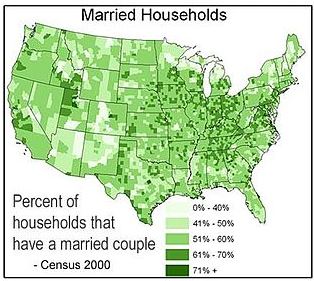
Red families v. blue families: which states have the strongest families?

Map of marriage rate by state

This article from The Daily Signal talks about a recent study.

It says:

According to a study from the Institute for Family Studies, red counties tend to have more married adults, more children born within marriage and higher levels of children living with both biological parents than blue counties.

“The reddest counties have higher rates of family stability, which is surprising because red counties, especially in the South, tend to have higher divorce rates,” said W. Bradford Wilcox, senior fellow with the Institute for Family Studies and author of the study. “But what seems to be happening here is that non-marital childbearing has emerged as a bigger engine of family instability than divorce in America. And this brief indicates that non-marital childbearing is lower in redder counties.”

[…]Wilcox acknowledged in his report some of the most stable families do come from blue states, such as Massachusetts and Minnesota, and that, indeed, the most stable families exist in the most extreme red and blue states.

But Wilcox said the state-level data addresses only part of the equation because it does not explain the “connection between family stability and political culture” at the local level.

“At the local level, red counties typically enjoy somewhat stronger families than do blue counties on at least three measures worth considering: marriage, non-marital childbearing and family stability,” Wilcox wrote in the report.

“The bottom line: The marriage advantage in red America helps explain why children in red counties are somewhat more likely to enjoy stable families than are children in blue counties,” he added.

I’m going to guess that the reason why people in blue states have lower rates of marriage and higher out-of-wedlock birth rates is because of higher tax rates, marriage penalties at the state level, and big government welfare programs that reward single mothers. Smaller government helps economic growth and leaves money in the pockets of responsible people. It’s much easier to take the marriage track when you have more of your own money in your pocket.

I also think that Judeo-Christian values are a huge factor. People who are religious have the habit of unselfishness that is necessary to get married in the first place. Marriage is about self-sacrificially loving another sinner, and that is attractive to religious people. Marriage is not so attractive to people who think that there is no afterlife, that the purpose of life is fun, and selfishness is awesome. If you believe that this life is all there is and there is no objective morality, then there is no rational basis there for serving others when it goes against your self-interest.

Regarding that last point, about how religious people are more suited to unselfishness and cooperation, there is a new study out.

Consider this recent study from the University of Toronto, in Canada.

The abstract says:

A large literature is currently contesting the impact of religion on prosocial behavior. As a window into this discussion, I examine the close social networks of American adults and consider whether religious traditionalists are more likely than other network members to supply several basic forms of social support. Analysis of the Portraits of American Life Survey reveals three main findings. First, a majority of Americans—religious or not—count at least one perceived religious traditionalist among their close network ties. Second, American adults are more likely to receive advice, practical help, and money from ties identified as religious traditionalists than from other types of ties, a pattern that held among both kin and nonkin network ties. Finally, although perceived traditionalist network members appear especially inclined to assist highly religious people, they nevertheless offer social support to Americans across a broad spectrum of religiosity. Beyond its relevance for debates on religion and community life, this study also proposes a novel strategy to assess prosocial behavior. Asking people to recount the deeds of their network members can reduce certain self-reporting biases common to survey research and helps locate prosocial activity in concrete and meaningful social relationships.

So, people who are more religious and traditional already have the character traits to be unselfish. And what is marriage, but the promise to be unselfish, for the sake of your spouse, and eventually, for the sake of your kids?

Is the answer to multiple victim shootings more gun control, or less fatherlessness?

Did the family background of Dylann Roof have anything to do with his desire to commit a violent crime?

This article from The Federalist has some answers. (H/T ECM)

It says:

As more information slowly seeps out about Dylann Roof, the 21-year-old who murdered nine people at a church in Charleston, South Carolina, one fact should surprise exactly no one: Roof came from a broken home. Roof’s parents divorced three years before he was even born, later reuniting just long enough to produce a child who would later become a mass murderer.

[…]As University of Virginia Professor Brad Wilcox pointed out back in 2013: “From shootings at MIT (i.e., the Tsarnaev brothers) to the University of Central Florida to the Ronald E. McNair Discovery Learning Academy in Decatur, Ga., nearly every shooting over the last year in Wikipedia’s ‘list of U.S. school attacks’ involved a young man whose parents divorced or never married in the first place.” His observation is largely ignored.

In contrast, conversations about black-on-black violence often raise the link between broken households (or fatherless homes) and juvenile delinquency. But when the conversation turns to mass shootings, we seem to forget that link altogether.

[…]On CNN’s list of the “27 Deadliest Mass Shootings In U.S. History,” seven of those shootings were committed by young (under 30) males since 2005. Of the seven, only one—Virginia Tech shooter Seung-Hui Cho (who had been mentally unstable since childhood)—was raised by his biological father throughout childhood.

It turns out that fatherlessness is known to cause the character traits that are present in multiple victim shooters.

More:

Let’s revisit some those characteristics of mass shooters. Violence? There’s a direct correlation between fatherless children and teen violence. Suicide? Fatherless children are more than twice as likely to commit suicide. Dropping out of school? Seventy-one percent of high school dropouts came from a fatherless background. Drug use? According to the U.S. Department of Health and Human Services, “Fatherless children are at a dramatically greater risk of drug and alcohol abuse.” How about guns? Two of the strongest correlations with gun homicides are growing up in a fatherless household and dropping out of school, which itself is directly related to lack of an active or present father.

If we wanted to get serious about stopping these multiple victim shootings, the first thing we should do is repeal no-fault divorce and make it harder for people to leave marriages in which they are “unhappy”. People should be more careful about vetting their candidate spouse before they marry. And people should also be careful about preparing their own character for the constraints and duties of marriage – perhaps by not engaging in recreational sex with a high number of partners before marriage.

But in addition to repealing no-fault divorce, we should also be scaling back welfare for single mothers, because this is basically paying women to have fatherless children.

Read this congressional testimony from a Cato Institute economist:

Welfare contributes to crime in several ways. First, children from single-parent families are more likely to become involved in criminal activity. According to one study, children raised in single-parent families are one-third more likely to exhibit anti-social behavior.(3) Moreover, O’Neill found that, holding other variables constant, black children from single- parent households are twice as likely to commit crimes as black children from a family where the father is present. Nearly 70 percent of juveniles in state reform institutions come from fatherless homes, as do 43 percent of prison inmates.(4) Research indicates a direct correlation between crime rates and the number of single-parent families in a neighborhood.(5)

As Barbara Dafoe Whitehead noted in her seminal article for The Atlantic Monthly:

The relationship [between single-parent families and crime] is so strong that controlling for family configuration erases the relationship between race and crime and between low income and crime. This conclusion shows up time and again in the literature. The nation’s mayors, as well as police officers, social workers, probation officers, and court officials, consistently point to family break up as the most important source of rising rates of crime.(6)

At the same time, the evidence of a link between the availability of welfare and out-of-wedlock births is overwhelming. There have been 13 major studies of the relationship between the availability of welfare benefits and out-of-wedlock birth. Of these, 11 found a statistically significant correlation. Among the best of these studies is the work done by June O’Neill for the U.S. Department of Health and Human Services. Holding constant a wide range of variables, including income, education, and urban vs. suburban setting, the study found that a 50 percent increase in the value of AFDC and foodstamp payments led to a 43 percent increase in the number of out-of-wedlock births.(7) Likewise, research by Shelley Lundberg and Robert Plotnick of the University of Washington showed that an increase in welfare benefits of $200 per month per family increased the rate of out-of-wedlock births among teenagers by 150 percent.(8)

The same results can be seen from welfare systems in other countries. For example, a recent study of the impact of Canada’s social-welfare system on family structure concluded that “providing additional benefits to single parents encourages births of children to unwed women.”(9)

[…]Current welfare policies seem to be designed with an appallingly lack of concern for their impact on out-of-wedlock births. Indeed, Medicaid programs in 11 states actually provide infertility treatments to single women on welfare.(12)

I should also point out that, once the child is born, welfare also appears to discourage the mother from marrying in the future. Research by Robert Hutchins of Cornell University shows that a 10 percent increase in AFDC benefits leads to an eight percent decrease in the marriage rate of single mothers.(13)

As welfare contributes to the rise in out-of-wedlock births and single-parent families, it concomitantly contributes to the associated increase in criminal activity.

So, it seems to me that we know that there is a link between fatherlessness and crime, and that’s where we should be putting our efforts. Gun control isn’t the solution young people who commit terrible acts of violence, but promoting fathers in the home is.