Tag Archives: Divorce

More and more women are asking why they can’t find a good man to marry

Do young women understand how to get to a stable marriage?

In the last few months, I’ve met 5 different Christian women in their 30s who all asked me the same question: where are all the good men who want to marry me?

Christian men’s rights blogger Dalrock had two different posts where he described the answer to this question.

Here is the first post from Dalrock that concisely illustrates the problem:

As I wrote in A very long season, feminists don’t want to waste a day more of their youth and fertility on their husbands than absolutely necessary. As if to prove this very point, 30 year old Mona Chalabi writes in the NY Times* I Want My 2.3 Bonus Years:

If I could prolong my time as a young adult by, say, 2.3 years, here is a list of things I would like to do:

• Go to more parties. Preferably wild parties that I can think about, years later, at mild parties.

[…]• Have more romantic partners.

[…]• Get a bit higher up the career ladder a bit earlier on. That would probably boost my earnings, giving me more financial security. I could use that money to go to more parties, get a membership to a fancy gym and maybe even meet a romantic partner on the ab machines.

To drive the message home, the image at the top of the article is a cartoon of a resentful Chalabi giving her future husband the side eye for her lost years of sampling penises!

Surely, this must be an isolated case just for New York Times feminists, right? It’s not widespread, is it?

Second post from Dalrock:

Margaret Wente at the Globe and Mail* asks where all the good men have gone.  Wente comes to the conclusion that women need a sex cartel:

…it’s up to us to make the rules. “Why buy the cow when you can get the milk for free?” my father used to say. It drove me crazy when he said that. Now, it’s dawned on me that he was right.

Since the women’s cartel collapsed, women’s bargaining power has seriously eroded. That’s why so many single women hate Tinder, which has further commodified sex for the benefit of men. Women are just another consumer good in the shop window.

The apex fallacy aside, Wente is partially right.  Women (as a group) have signaled to men that what they really want are exciting sexy badboys, not boring loyal dudes. It isn’t that women no longer want to marry beta providers, they just don’t want to waste a day more of their youth and fertility on their husband than absolutely necessary.

As a result, some up and coming boring loyal dudes aren’t knocking themselves out in their twenties while they wait for their future wife to tire of having sex with other men.

If you wonder why men are no longer performing in school, and exchanging careers for video games, the answer is simple. Men have realized that young women today, under the influence of feminism, are not interested in traditional husbands during their late teens and 20s. During these years, women are interested in travel, fun, drinking, hook-ups and cohabitation with amoral atheists. This is what I have personally observed. In the minds of young women, the highest value men are good-looking men who have no religion, and make no moral judgments, and are left of center politically – especially on abortion. There are many good men who are romantic about women from their youth, and want to get married. But when they see what young women really want, they just give up on school and work, since doing the traditional male roles has no value to young women. Many good men even give up on morality and Christianity because they want a relationship with a woman so badly.

More from second post:

What Wente doesn’t understand is that timing is everything.  From an economic point of view, women are dividing up sexual access that traditionally would have been reserved only for their husband into two blocks.  The first block contains their most attractive and fertile years, and it is dedicated to no strings sex with exciting badboys.  Then, once women reach what Rollo calls the epiphany phase, they want to bargain sexual access in their remaining (older and less fertile) years for maximum beta bucks.

The problem with this strategy is (generally speaking) not that the previously overlooked beta men will refuse to marry the suddenly reformed party girls.  The problem is that young men now look at the men 3-5 (and even 5-10) years older than them and don’t see an indication that signaling provider status will make them attractive to women.  They also see a society that holds married fathers in contempt**.  Most of these men are still working hard in their late teens and twenties to prepare to signal provider status in their 30s.  But a growing minority of young men are no longer doing so.  These men are instead working like women.  Once the reformed party girls are ready to find Mr. Beta Bucks, there is a shortage of 30 something men who fit the bill.  Even worse, no amount of complaining or shaming will cause the missing beta providers to go back in time and spend the prior decade preparing for this moment.

I’m one of the last men who followed the marriage-preparedness script for traditional men who wanted to marry and have four children and have a stay-at-home homeschooling mom to raise them from birth to graduate school. I find myself now in my early 40s, with a 6-figure income and a nearly 7-figure net worth. I declined to use those assets to play the field with hot bad girls, preferring instead to keep my sexual past completely clean for my eventual wife. However, what I observed in my late teens and 20s and even early 30s was a complete lack of interest in marriage ability, from non-Christian women and Christian women alike. Christian women aren’t learning to value early marriage from their married parents or their evangelical churches. None of the traditional husband skills are valued by young women, i.e. – chastity, gapless resume, alcohol abstinence, undergraduate and graduate STEM degrees, experience nurturing and mentoring others, stewardship of earned income.

I recently caused an uproar on my Facebook page by saying that even if the perfect woman showed up right now to marry me, I would not pursue her because the critical time where the woman could have applied maximum youth, beauty and fertility as a wife to make an impact on my education, early career, health, and finances has passed. A younger woman develops value to her husband precisely by applying herself to him and to her family in these critical early years. Men who have experienced this self-sacrificial love and support are loyal to their wives even after their wives lose their youth and beauty. Why? Because the men know that they are much better than they could have been, having enjoyed that early investment of value made by their young wives.

Young women very supportive of premarital sex

As Christian writer Matt Walsh notes in a recent article at the Daily Wire, this “follow your heart” focus on happiness in women is lethal to marital stability, and men know it.

Excerpt:

There was an article in Cosmo this week with a title that summarizes all that’s wrong with Cosmo and modern society as a whole: “I eloped at 25, divorced at 26, and dated my way across Europe all summer.” Of course, by “dated my way across Europe” she means that she slept with half the continent.

The author, Elise, says she “started fighting” with her husband and within a few months they both decided that their differences were irreconcilable. Despite counseling, she says, “neither of us was happy.” So, exhausted from 12 whole months of marriage, Elise embarked on a voyage of self-discovery and STD cultivation. She met random dudes in half a dozen countries and had sex with them, learning quite a lot as she went, though she can’t really explain what exactly she learned or why sex was a necessary component in learning it. Finally, she came home and started dating some other guy. The end.

Well, not really the end. 20 years from now I’m sure we’ll get the follow up article: “I’m alone and miserable and it’s everyone’s fault but mine.” After all, you may be able to fill the emptiness in your soul with frivolous sex when you’re young and physically desirable, but that phase is fleeting. People who don’t want to “waste” their beauty and youth on a spouse, so they waste it instead on strangers who don’t love them or even care what happens to them tomorrow, will be shocked when a tomorrow comes where even strangers aren’t interested anymore. This is where the single-minded, utterly selfish pursuit of “happiness” at all costs inevitably leads: to rejection, despair, and a quiet, unnoticed death on a lonely hospital bed.

As Elise helpfully demonstrated, “do what makes you happy” is poison in a marriage. Many a vow has been broken because one or both partners decide to chase “happiness” instead of commitment, fidelity, and love. “I deserve to be happy,” reports the legion of serial divorcees, as they drift on to the next spouse, and the next, and the next, and the next, looking for the one — the one, finally — who might cure the misery they’ve inflicted on themselves. Increasingly unhappy, yet increasingly convinced that they deserve to be.

And this follow your heart to happiness situation is alive and well in the church today. Marriage-minded Christian men who have prepared for husband roles are surprised to find that there is often little or no difference between Elise and the Christian women the church produces. Christian men who desire to invest in a marriage that is stable, productive and influential have nowhere to turn for a wife who is able and willing to help. In my experience, the problem with happiness-focused women who delay marriage is never discussed in churches from the pulpit. The “good men to marry” that today’s 30-something women are looking for were plentiful back when those same women were in their early-to-mid 20s.


Why sexual permissiveness is not compatible with the welfare of children

Gay activist Terry Bean and Barack Obama

Here is a striking essay from the Public Discourse. It talks about how we, as a society, have generally taken on an anything-goes approach with respect to sex. The one exception (for now) is pedophilia, which is the sexual abuse of children by adults. The essay points out that there is no moral reason for having this one exception, on secularism. The exception exists because of a sort of “ick” factor – not because we have a moral framework that makes anything right or wrong objectively. The essay argues that we are not shy about harming children in a million other ways, and lists some examples. I just want to quote a few and then I’ll comment about my own moral views around sexuality.

Quick summary of his argument:

The moral structure of pedophilia is simply this: the welfare of children is subordinate to the sexual gratification of adults.

[…]We should be thankful that the Sanduskys and Laheys are still considered monstrous. But in contemporary America that condemnation rests on sentiment and not on moral reasoning. No one can simultaneously explain why their actions were so vile and uphold the first commandment of the sexual revolution: fulfill thy desires.

[…]No, it isn’t how Sandusky and Lahey did what they did, or under what circumstances, that explains the disgust. It’s what they did—but nobody wants to acknowledge that.

The reason for that reluctance becomes clear, if we keep in mind the moral structure of pedophilia. Sexual gratification trumps. Thank goodness that for now, there aren’t many men who are sexually attracted to youngsters. In that single case, we raise the banner for the children. But in no other case.

That’s his argument.

Now, a quick excerpt:

If we altered the question, and asked not how many people have done sexually abusive things with children, but how many people have done sexual things that redounded to the suffering of children, then we might confess that the only thing that separates millions of people from Jerry Sandusky is inclination. Everything that was once considered a sexual evil and that is now winked at or cheered, everything without exception, has served to hurt children, and badly.

We might point here to divorce. Unless it is necessary to remove oneself and one’s children from physical danger and moral corruption, the old wisdom regarding divorce should hold, if children themselves have anything to say about it. Parents will say, “My children can never be happy unless I am happy,” but they should not lay that narcissistic unction to their souls. Children need parents who love them, not parents who are happy; they are too young to be asked to lay down their lives for someone else. It is not the job of the child to suffer for the parent, but the job of the parent to endure, to make the best of a poor situation, to swallow his pride, to bend her knees, for the sake of the child.

We might point to births out of wedlock. The child has a right to enter more than a little nursery decorated with presents from a baby shower. He should enter a human world, a story, a people. He should be born of a mother and a father among uncles and aunts and cousins and grandparents, stretching into the distant past, with all their interrelated histories, with his very being reflected in all those mirrors of relation, not to mention his eyes and his hair, the talents in his fingers and the cleverness in his mind. This belonging to a big and dependable world can be secured only in the context of the permanent love of his mother and father, declared by a vow before the community and before the One in whom there is no shadow of alteration.

And now my comments about this article.

So pretty much all my regular readers know that I take extremely conservative views on social issues, since I am an evangelical Protestant Christian. But I don’t just have conservative views – I am also chaste at a personal level. I am not one of these re-virgins – I have never had sex. Not once. And I don’t mean I have never had sexual intercourse only, I mean that I have never even kissed a woman on the lips. I am a radical on the issue of chastity. I don’t view chastity as depriving oneself of something good, I view it is as a thing that serious Christian men do when we want to enable and develop other capabilities. It’s my conviction that chastity enables the capability to see women as God sees them, which is a precursor to growing them up to serve him. That’s what women are for, on my view – exactly like men are for knowing and serving God. It’s my belief that once a man has premarital sex, it becomes much harder for him to view women that way.

So, I am really really really against any kind of sexual activity of any kind prior to marriage. I think that if a man wants to show affection to a woman, then sex before marriage is not the way to do that. There are other ways, and men ought to know how to speak the language of love to a woman in many different ways apart from sex, assuming that this is his goal for her. A man needs to create a context for sex before he can have it. Marriage is how a man provides a context for sex. Not just by giving a woman safety, but by specifying a shared vision which the woman agrees to support when she agrees to marriage. Men shouldn’t have intimate experiences with women who are not committed to a constructive partnership with specific goals, e.g. – birthing or adopting children in order to give them a stable, loving sane environment to grow up in. That is so rare nowadays, especially on college campuses which are inundated with sexual liberalism, thanks to radical feminism. My conviction that sex is not something that should be done before marriage emerges partly from a concern that children should have the best opportunity for that stable environment. And that’s what I want to focus on – sexual restraint as a means of providing for children and protecting children.

First, premarital sex creates a situations where abortion happens. Men and women should not engage in activities for recreational reasons that could possibility lead to the death of another human being, period. I am not one of these people who thinks “oh, poor woman who is pregnant, what a beastly man who did that to her – but she can do the right thing and keep the baby”. I think that women are equally to blame with men for even having sex before marriage – the mistake was having sex in the first place. So getting pregnant and keeping the baby is good, but preventing fatherlessness and not putting burdens on taxpayers is much, much better. People who engage in premarital sex are not only selfish, immature and irresponsible, but they are actually acting in a negligent fashion towards the child that may result from their choices. We should not make choices that put innocent children at risk. Premarital sex can be compared with driving while drunk in that regard. You might think it’s fun, but it’s not a good, moral thing to do because of the harm that may result. Saying “but I didn’t mean to” after the fact doesn’t change the harm.

Second, I’ve blogged before about many studies (like this one) that show that premarital sex reduces relationship stability, duration, and quality. Another study I blogged about showed that the number of sexual partners that a man or woman has before marriage directly affects the probability that the relationship will provide a stable environment for raising children. So one of my reasons for being chaste is to maximize the probability of giving my future children that stable environment. Another reason to be chaste is to give my future wife that gift of fidelity. When a man has proven that he has the ability to restrain himself with his wife during the courtship, that is a signal to her that he is good at self-control. The ability to court without premarital sex shows her that he is able to think about her as a person, and that he is able to evaluate her objectively for the purpose of filling the roles of wife and mother. And that this is, in fact, his whole purpose for her. A purpose that will survive the decline of her appearance and youth. Security is another gift that a chaste man gives his wife, so that she can age confidently.

Thirdly, I have in the past blogged about research on gay unions showing how various factors that are more probable in gay relationships, (e.g. – elevated rates of domestic violence, low relationship stability, drug abuse, high rates of promiscuity, etc.), undermine the stability of the environment in which children grow up. More here. Dr. Ryan Anderson has argued that the norms present in gay relationships will undermine the norms of traditional marriage, (permanence, sexual exclusivity, etc.), if marriage is redefined to eliminate the gender requirement. I think we need to keep the traditional definition of marriage because it’s better for children if we do (and there are other reasons to prefer natural marriage, as I’ve written about before).

I think I’ve said enough here to show that very often when it comes to sexual activity what is driving my conservative views is concern for others. Concern not just for the future children, but for the future wife. And not just for them, but for society as a whole, who would have to pay the social costs of things like divorce, and the social costs of children of divorce, etc. And not just for society, but also for God, who intends sexuality for a very specific purpose – it is a form of communication for two people who have been bonded to each other for life. Marriage has to count for God and achieve his goals. One of those goals is raising up children well for his sake. And adults need to control themselves in order to provide children with what they need.

Study: women who have fewer premarital sex partners have lower risk of divorce

Man helping a woman with proper handgun marksmanship

Consider this article from Family Studies that talks about how the number of pre-marital sex partners that a woman has increases her risk of divorce.

It says:

American sexual behavior is much different than it used to be. Today, most Americans think premarital sex is okay, and will have three or more sexual partners before marrying. What, if anything, does premarital sex have to do with marital stability?

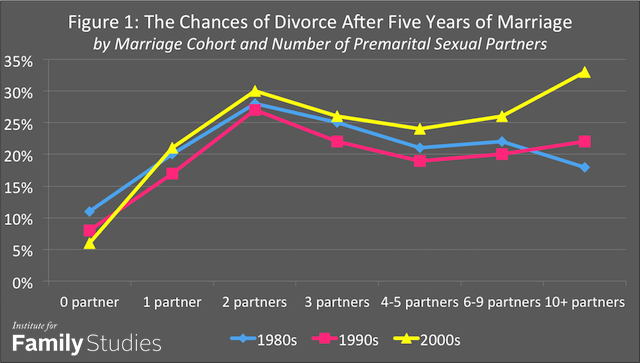
This research brief shows that the relationship between divorce and the number of sexual partners women have prior to marriage is complex. I explore this relationship using data from the three most recent waves of the National Survey of Family Growth (NSFG) collected in 2002, 2006-2010, and 2011-2013. For women marrying since the start of the new millennium:

  • Women with 10 or more partners were the most likely to divorce, but this only became true in recent years;
  • Women with 3-9 partners were less likely to divorce than women with 2 partners; and,
  • Women with 0-1 partners were the least likely to divorce.

Earlier research found that having multiple sex partners prior to marriage could lead to less happy marriages, and often increased the odds of divorce.

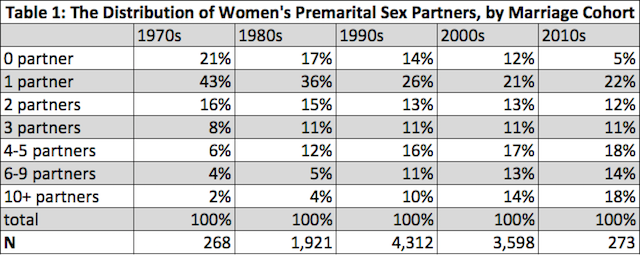
[…]Even more noteworthy has been the decline in the proportion of women who get married having had only one sex partner (in most cases, their future husbands). Forty-three percent of women had just one premarital sex partner in the 1970s.

[…]By the 2010s, only 5 percent of new brides were virgins. At the other end of the distribution, the number of future wives who had ten or more sex partners increased from 2 percent in the 1970s to 14 percent in the 2000s, and then to 18 percent in the 2010s. Overall, American women are far more likely to have had multiple premarital sex partners in recent years (unfortunately, the NSFG doesn’t have full data on men’s premarital sexual behavior, and in any event they recall their own marital histories less reliably than do women).

Here’s the change:

Women have freely chosen to dismiss the Bible and the moral law

And the problem with this, of course, is that more premarital sex partners means a higher risk of divorce:

Even one non-husband premarital sex partner raises risk of divorce

Why is the 2-partner number so high?

In most cases, a woman’s two premarital sex partners include her future husband and one other man. That second sex partner is first-hand proof of a sexual alternative to one’s husband. These sexual experiences convince women that sex outside of wedlock is indeed a possibility. The man involved was likely to have become a partner in the course of a serious relationship—women inclined to hook up will have had more than two premarital partners—thereby emphasizing the seriousness of the alternative.

The Christian Post had an article about some recent numbers from the Centers for Disease Control about virgins.

Excerpt:

A new Centers for Disease Control study examines teenage health behaviors in connection to their self-reported sexual activity and shows those who remain abstinent are much healthier on many fronts than their sexually active peers.

The report, titled “Sexual Identity, Sexual Contacts, and Health-Related Behaviors Among Students in Grades 9-12, United States and Selected Sites,” showcased the results from a 2015 survey that monitored several categories of health-related behaviors like tobacco usage, drug and alcohol use, sexual habits, unhealthy dietary behaviors, and behaviors that contribute to unintentional injuries and violence.

The report concludes “that students who had no sexual contact have a much lower prevalance of most health-risk behaviors compared with students” who had sexual contact.

The article quotes Dr. Jennifer Roback Morse, who I have featured on this blog many times:

In a Monday interview with The Christian Post, Jennifer Roback Morse, founder and president of the Ruth Institute, said, “this study is remarkable because it asks questions and reports the answers, rather than avoiding questions or assuming answers.”

As Glenn Stanton noted last week in The Federalist, the results from those questions and answers are remarkable.

With regard to smoking, teenage virgins are 3,300 percent less likely to smoke daily than their peers who are sexually involved with someone of the opposite sex, Stanton computed from the report’s data. Teen virgins are 9,500 percent less likely to smoke daily than their peers who are sexually involved with someone of the same sex or in a bisexual relationship, he added. Chaste young people are also extremely less likely to use indoor tanning beds, binge drink, smoke marijuana, ride in cars as passengers with a drunk driver, and get into physical fights than their sexually active peers. Abstinent youth are also more likely to get a solid eight hours of sleep every night and eat breakfast daily.

[…]The CDC report also included findings from 25 state surveys, and 19 large, urban school district surveys conducted among students in grades 9–12 which took place between December of 2014 and September of 2015.

Now, many pro traditional marriage people will tell young men “feminism and the sexual revolution change nothing about a woman’s suitability for marriage, so go out there and get married to these women anyway”. In my experience, no one is telling women NOT to follow their hearts, and explaining to them the harm that they do by allowing their feelings to determine who they will engage in relationships.

I would like to see women make better decisions with men before they marry, rather than be influenced by their peers and culture to give themselves to men who are not marriage-minded. Maybe a little skepticism should be shown to “follow your heart”? Women need to understand what they are losing when they choose to have premarital sex.

In my group of friends, the men are aware of the Biblical prohibition on premarital sex. My friends know about the research on marriage, and what it takes to make a marriage work. We don’t follow our hearts, because we do what we know will work to achieve the results we want. We don’t listen to the culture, and we don’t listen to radical feminists. Men generally take an engineering approach to marriage – we want to know what the best practices and tradeoffs are, and then we plan and act to succeed.