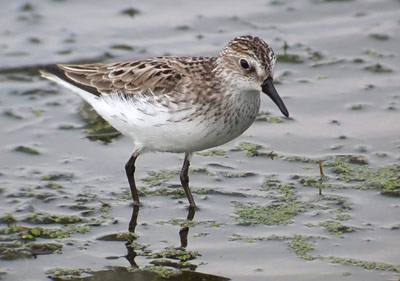
The shorebird’s beak is more interesting than you might think
Dr. Fazale Rana of Reasons to Believe tweeted this cool example of biomimetics from Science Daily.
Excerpt:
A UT Arlington engineering professor and his doctoral student have designed a device based on a shorebird’s beak that can accumulate water collected from fog and dew.
The device could provide water in drought-stricken areas of the world or deserts around the globe.
Xin Heng… a doctoral student in Mechanical and Aerospace Engineering, and Cheng Luo, MAE professor, have made a device that can use fog and dew to collect water.
Cheng Luo, professor in the Mechanical & Aerospace Engineering Department, and Xin Heng, PhD candidate in the same College of Engineering department, published “Bioinspired Plate-Based Fog Collectors” in the Aug. 25 edition of ACS’ (American Chemical Society) Applied Materials & Interfaces journal.
The idea began when Heng saw an article that explained the physical mechanism shorebirds use to collect their food — driving food sources into their throats by opening and closing their beaks. Luo said that inspired the team to try to replicate the natural beak in the lab.
“We wanted to see if we could do that first,” Luo said. “When we made the artificial beaks, we saw that multiple water drops were transported by narrow, beak-like glass plates. That made us think of whether we could harvest the water from fog and dew.”
Their experiments were successful. They found out they could harvest about four tablespoons of water in a couple of hours from glass plates that were about 26 centimeters long by 10 centimeters wide.
Now, if we are lifting designs out of nature, then shouldn’t we give honor to God for putting the designs in there in the first place? I really think it’s important to give God credit where due for his clever designs, even if you’re not a big fan of the shorebird. I also think it’s interesting that it’s engineers who made this application of something in nature, not biologists. Also, I feel I have to mention that the birdy is also cute, which is not insignificant, if you like birds as much as I do.
I think this “sub-optimal” argument against a Designer is stupid, because designs are always trade-offs between different quality goals, but just to put this one to bed, here is Evolution News.
Excerpt:
Now a new paper in Nature Communications, “Müller cells separate between wavelengths to improve day vision with minimal effect upon night vision,” has expanded upon this research, further showing the eye’s optimal design. According to the paper, Müller cells not only act as optical fibers to direct incoming light through the optic nerve, but are fine-tuned to specific wavelengths to ensure that light reaches the proper retinal cells. From the Abstract:
Vision starts with the absorption of light by the retinal photoreceptors — cones and rods. However, due to the ‘inverted’ structure of the retina, the incident light must propagate through reflecting and scattering cellular layers before reaching the photoreceptors. It has been recently suggested that Müller cells function as optical fibres in the retina, transferring light illuminating the retinal surface onto the cone photoreceptors. Here we show that Müller cells are wavelength-dependent wave-guides, concentrating the green-red part of the visible spectrum onto cones and allowing the blue-purple part to leak onto nearby rods. This phenomenon is observed in the isolated retina and explained by a computational model, for the guinea pig and the human parafoveal retina. Therefore, light propagation by Müller cells through the retina can be considered as an integral part of the first step in the visual process, increasing photon absorption by cones while minimally affecting rod-mediated vision.
(Amichai M. Labin, Shadi K. Safuri, Erez N. Ribak, and Ido Perlman, “Müller cells separate between wavelengths to improve day vision with minimal effect upon night vision,” Nature Communications, DOI: 10.1038/ncomms5319 (July 8, 2014).)
The paper presents Müller cells as a direct answer to the view that the vertebrate eye has a suboptimal wiring:
[T]he mammalian retina and the peripheral retina of humans and primates are organized in a seemingly reverse order with respect to the light path. This arrangement places the photoreceptors, responsible for light absorption, as the last cells in the path of light, rather than the first. Therefore, the incident light must propagate through five reflecting and scattering layers of cell bodies and neural processes before reaching the photoreceptors. This ‘inverted’ retinal structure is expected to cause blurring of the image and reduction in the photon flux reaching the photoreceptors, thus reducing their sensitivity. It has been recently reported that retinal Müller cells act as light guides serving to transfer light across the retina, from the vitreo-retinal border towards the photoreceptors.
Bookmark it because this is the kind of silly objection to design that they hear on the Discovery Channel, PBS, etc.
A great post from Evolution News about my favorite animals in the whole world – BIRDS!
Excerpt:
How hard can it be to make a flexible wing flap for an airplane? Almost all aircraft today use rigid wings with rigid landing flaps. They work, but they waste fuel. German engineers embarked on a mission to reduce kerosene consumption by 6%: “integrating flexible landing devices into aircraft wings is one step towards that target,” a news item from Fraunhofer says. They’ve named the project SARISTU, for Smart Intelligent Aircraft Structures.
Birds are way ahead of them:
While birds are able to position their feathers to suit the airflow, aircraft wing components have so far only been rigid. As the name suggests, landing flaps at the trailing edge of the wing are extended for landing. This flap, too, is rigid, its movement being limited to rotation around an axis. This is set to change in the SARISTU project. “Landing flaps should one day be able to adjust to the air flow and so enhance the aerodynamics of the aircraft,” explains Martin Schüller, researcher at the Fraunhofer Institute for Electronic Nano Systems ENAS in Chemnitz. (Emphasis added.)
What are some of the challenges in building a flexible wing?
Knowing where to flex: The flap can’t be flexible all over, or it would be hard to control. The designers made “five hard and three soft zones, enclosed within a silicon skin cover extending over the top.”
Finding stretchy skin: When the soft zone moves, the skin of the aircraft has to stretch with it. “The mechanism that allows the landing flap to change shape can only function if the skin of the landing flap can be stretched as it moves, a problem tackled by researchers from the Fraunhofer Institute for Manufacturing Technology and Advanced MaterialsIFAM in Bremen.”
Covering the air gap: “Any gap between the flap and the fixed aircraft wingwould cancel out any positive effect,” the article notes. “This led us to develop an elastic connecting element, and this work already covers everything from the chemical makeup to the process technology andmanufacture of the component,” an engineer says.
Designing the material to tolerances: “The mechanism sits underneath the soft zones, the areas that are most distended. While the novel design is noteworthy, it is the material itself that stands out, since the flexible parts are made of elastomeric foam that retain their elasticity even attemperatures ranging from minus 55 to 80 degrees Celsius.”
No feathers, but it’s a start. The team showed off their prototype at the ILA Berlin Air Show in May. Apparently it was not quite ready for takeoff:
When the prototype takes off for the first time it will benefit from a development known as SARISTU, a deformable wing which is currently the subject of intensive research by Fraunhofer Gesellschaft. In future the landing flaps will be designed to adapt in flight to the air flow conditions, thereby always ensuring the best possible aerodynamics.
We celebrate this advance, but you know where we’re going. Birds had it all figured out long ago: the right shape, the right material, the control of airflow, and much more. As Dr. Timothy Standish says in the film Flight: The Genius of Birds, “Feathers do a number of jobs remarkably well.” They are individually controllable, they flex, they insulate, they save on weight, and they can handle the temperature requirements of avian flight. That’s just a partial list achievements in powered flight that surpass anything man has yet designed.
If you want to get hold of that DVD on “Flight” that they mentioned, it’s right here on Amazon.com. I highly recommend it.
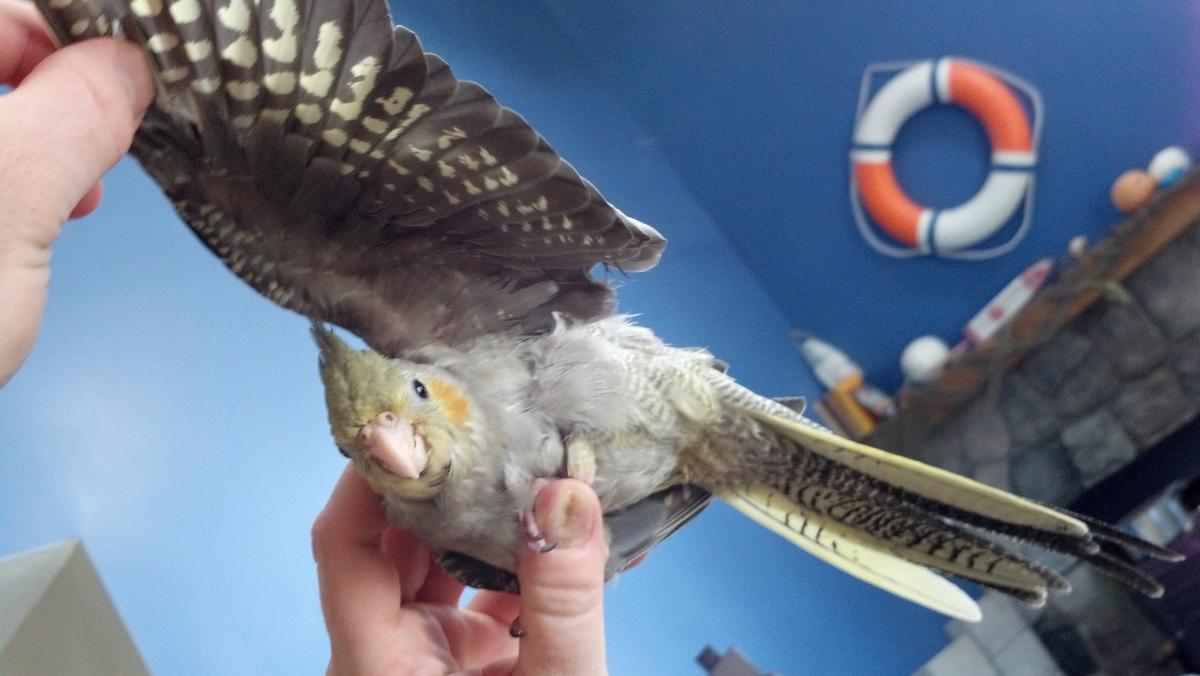
I also highly recommend owning birds – because if you work really hard at caring for one for a long time, they might grow to trust you. There is nothing quite like a tiny little bird trusting you enough to let you gently pull open his or her wing for a closer look at how it works:
Awww! Cockatiel lets a trusted friend see under her wing
There’s more to birds than just well-designed wings. There’s a well-designed heart in there, too! That might even be more amazing than the design of the wing. It is to me.
Note: although this post does not provide a rigorous case for intelligent design, that can be found by looking at the work of Stephen C. Meyer on the origin of life and on the Cambrian explosion. The books that demonstrate the superiority of the intelligent design hypothesis are “Signature in the Cell” and “Darwin’s Doubt“. If you’d like to see a good popular-level presentation of intelligent design related to the origin of life, click here for a lecture.

 WINTERY KNIGHT