Tag Archives: Design

Study: galactic habitable zone depends on fine-tuning of cosmological constant

This is going to be old news to readers of this blog who are familiar with the Michael Strauss, Walter Bradley and Guillermo Gonzalez lectures on habitability and fine-tuning. But, it’s nice to see these ideas show up in one of the most prestigious peer-reviewed science journals in the world (if not the most prestigious).

Here’s the article from Science.

It says:

Scientists have known for several years now that stars, galaxies, and almost everything in the universe is moving away from us (and from everything else) at a faster and faster pace. Now, it turns out that the unknown forces behind the rate of this accelerating expansion—a mathematical value called the cosmological constant—may play a previously unexplored role in creating the right conditions for life.

That’s the conclusion of a group of physicists who studied the effects of massive cosmic explosions, called gamma ray bursts, on planets. They found that when it comes to growing life, it’s better to be far away from your neighbors—and the cosmological constant helps thin out the neighborhood.

“In dense environments, you have many explosions, and you’re too close to them,” says cosmologist and theoretical physicist Raul Jimenez of the University of Barcelona in Spain and an author on the new study. “It’s best to be in the outskirts, or in regions that have not been highly populated by small galaxies—and that’s exactly where the Milky Way is.”

Jimenez and his team had previously shown that gamma ray bursts could cause mass extinctions or make planets inhospitable to life by zapping them with radiation and destroying their ozone layer. The bursts channel the radiation into tight beams so powerful that one of them sweeping through a star system could wipe out planets in another galaxy. For their latest work, published this month in Physical Review Letters, they wanted to apply those findings on a broader scale and determine what type of universe would be most likely to support life.

The research is the latest investigation to touch on the so-called anthropic principle: the idea that in some sense the universe is tuned for the emergence of intelligent life. If the forces of nature were much stronger or weaker than physicists observe, proponents note, crucial building blocks of life—such fundamental particles, atoms, or the long-chain molecules needed for the chemistry of life—might not have formed, resulting in a sterile or even completely chaotic universe.

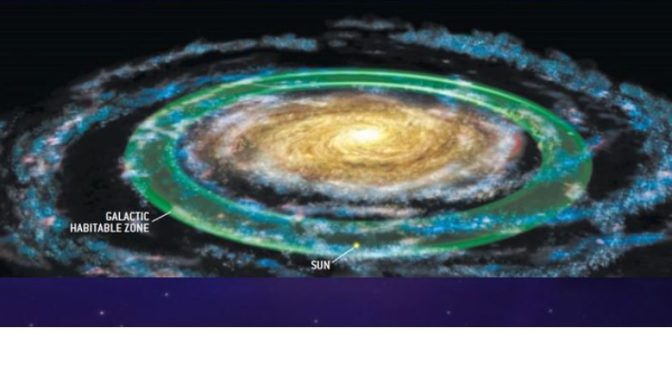
Basically, the best place for a galaxy that permits complex, embodied life to exist is one where you can pick up enough heavy elements from dying stars nearby, but not be in an area that is so crowded by stars that you will be wiped out by intense gamma radiation when they die. So, you want to be between the “arms” of a spiral galaxy, close enough to the areas with a lot of stars, and not too far away. But you can only get that pattern of stars if the universe is expanding at the right rate.

More:

As it turns out, our universe seems to get it just about right. The existing cosmological constant means the rate of expansion is large enough that it minimizes planets’ exposure to gamma ray bursts, but small enough to form lots of hydrogen-burning stars around which life can exist. (A faster expansion rate would make it hard for gas clouds to collapse into stars.)

Jimenez says the expansion of the universe played a bigger role in creating habitable worlds than he expected. “It was surprising to me that you do need the cosmological constant to clear out the region and make it more suburbanlike,” he says.

Remember, this is only one of many characteristics that must obtain in order for a have a location in the universe that can support complex, embodied life of any conceivable kind.
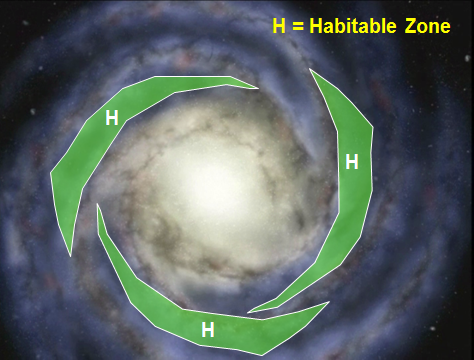
The galactic habitable zone (GHZ) is shown in green against a spiral galaxy

Let’s review the big picture

Time for me to list out some of the things that are required for a galaxy, solar system and planet to support complex embodied life. Not just life as we know it, but life of any conceivable kind given these laws of physics.

  • a solar system with a single massive Sun than can serve as a long-lived, stable source of energy
  • a terrestrial planet (non-gaseous)
  • the planet must be the right distance from the sun in order to preserve liquid water at the surface – if it’s too close, the water is burnt off in a runaway greenhouse effect, if it’s too far, the water is permanently frozen in a runaway glaciation
  • the solar system must be placed at the right place in the galaxy – not too near dangerous radiation, but close enough to other stars to be able to absorb heavy elements after neighboring stars die
  • a moon of sufficient mass to stabilize the tilt of the planet’s rotation
  • plate tectonics
  • an oxygen-rich atmosphere
  • a sweeper planet to deflect comets, etc.
  • planetary neighbors must have non-eccentric orbits

And remember, these requirements for a habitable planet are downstream from the cosmic fine-tuning of constants and quantities that occurs at the Big Bang. No point in talking about the need for plate tectonics if you only have hydrogen in your universe. The habitability requirements are a further problem that comes after the fine-tuning problem.

J. P. Moreland explains the meaning of happiness in the Christian worldview

From happiness expert and Christian philosopher J.P. Moreland.

Excerpt:

According to ancient thought, happiness is a life well lived, a life that manifests wisdom, kindness and goodness. For the ancients, the happy life — the life we should dream about — is a life of virtue and character. Not only did Plato, Aristotle, the Church Fathers and medieval theologians embrace this definition, but Moses, Solomon and (most importantly) Jesus did, too. Sadly their understanding is widely displaced by the contemporary understanding of happiness defined as pleasure and satisfaction, a subjective emotional state associated with fleeting, egocentric feelings.

Consider the differences:

Contemporary Understanding Classical Understanding
Happiness is: Happiness is:
1. Pleasure and satisfaction 1. Virtue and character
2. An intense feeling 2. A settled tone
3. Dependent on external circumstances 3. Depends on internal state; springs from within
4. Transitory and fleeting 4. Fixed and stable
5. Addictive and enslaving 5. Empowering and liberating
6. Irrelevant to one’s identity, doesn’t color the rest of life and creates false/empty self 6. Integrated with one’s identity, colors rest of life and creates true/fulfilled self
7. Achieved by self-absorbed narcissism; success produces a celebrity 7. Achieved by self-denying apprenticeship to Jesus; success produces a hero

How can we be certain Jesus is inviting us to a classical understanding of happiness in Matthew 16:24-26? He isn’t talking about going to heaven rather than hell, nor is He telling his followers how to avoid premature death. Where Matthew writes, “what will a man be profited, if he gains the whole world, and forfeits his soul” (emphasis added), Luke clarifies Jesus’ teaching by replacing “his soul” with the word “himself” (Luke 9:25). The issue is finding one’s self vs. losing one’s self. More specifically, to find one’s self is to find out how life ought to look like and learn to live that way; it’s to become like Jesus, with character that manifests the fruit of the Spirit and the radical nature of Kingdom living; it’s to find out God’s purposes for one’s life and to fulfill those purposes in a Christ-honoring way.

I like that “success produces a hero”. Who doesn’t want to be a hero? I certainly do.

In one of his lectures, Dr. Moreland says, and I quote: “Happiness is the freedom to do what we ought to do”. That’s right. When a person is free to comply with God’s design for human flourishing, then he/she is happy. My biggest source of unhappiness is the feeling that I cannot be who I want to be as a Christian. It’s getting even worse when I think about how the government is now using force to prevent me from spending what I earn the way I want, and saying what I want about the issues of the day, regardless of who is offended. I am becoming increasingly thankful for the time I spend with other dedicated Christians. That’s when I can be myself and not worry about what anyone is going to think of me. This is no small source of happiness.

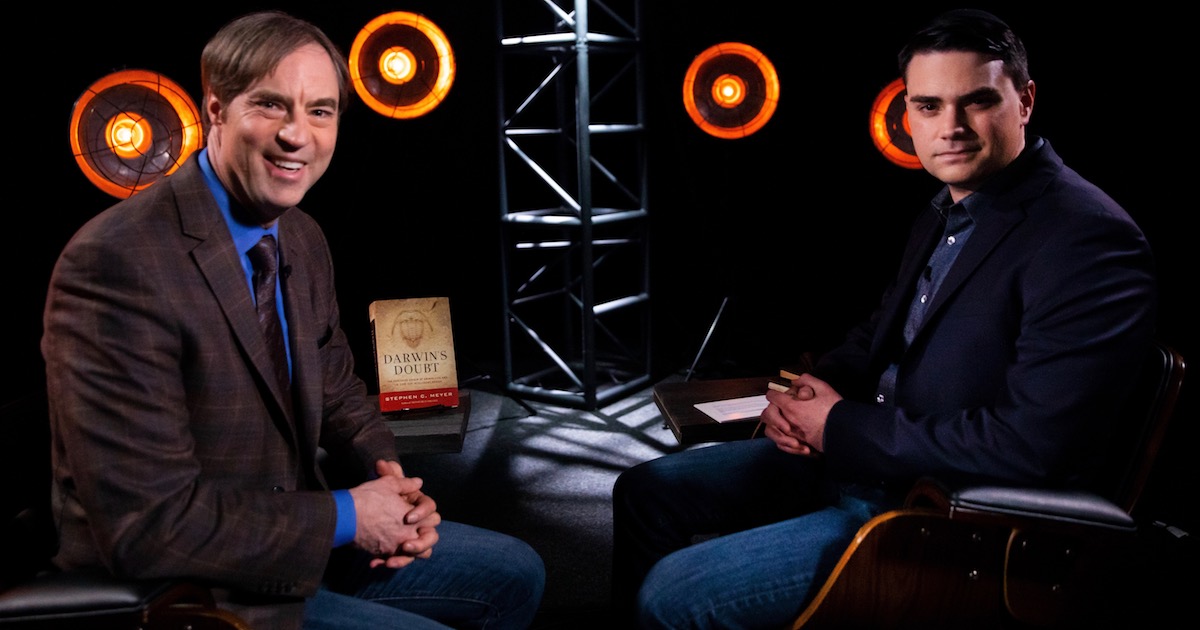
Video, audio and summary of intelligent design discussion, with Ben Shapiro and Stephen C. Meyer

Stephen C. Meyer and Ben Shapiro discuss evolution and intelligent design

(Re-posting this for those who missed it the first time around)

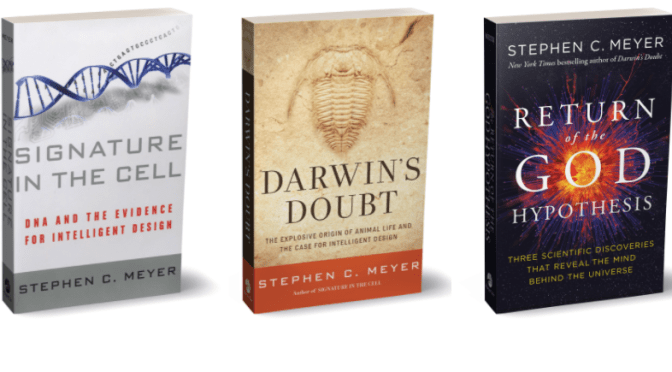
This is a must-see / must-hear conversation. Famous conservative Ben Shapiro discusses evolution and intelligent design with Dr. Stephen C. Meyer, author of “Signature in the Cell” (origin of life) and “Darwin’s Doubt” (fossil record). These are the two best books on intelligent design. Their conversation covers the most important issues in the origins debate.

So to start, here’s the full video:

Someone actually put out an outline on Youtube, with a time-based index, so I’ll just steal that as a base, and add to it:

  • 1:34 What is your scientific background? Science undergraduate degree, professional geologist, later did a PhD in philosophy of science from Cambridge University.
  • 2:39 What is the difference between intelligent design and creationism? Creationism starts from the Bible and posits a shorter history of the universe. ID starts from the data of the natural world and is neutral about the age of the Earth / universe. Meyer accepts the old-Earth.
  • 3:36 How is Intelligent Design a scientific theory? The discovery of DNA reveals that code is central to living systems. Intelligent design uses the method of “inference to the best explanation” in order to argue that the best explanation for the code is an intelligent agent.
  • 6:10 What evidence would have to arise to make Intelligent Design Falsifiable? If a naturalistic mechanism was discovered that could produce biological information using the probabilistic resources of the universe, and the time available, then intelligent design would be falsified.
  • 7:26 Is religion separate from science or intertwined within it? There are three views: science is totally separate from religion, science is in total conflict with religion, science and religion agree on some issues, e.g. – the origin of the universe and Genesis 1:1. There are areas where science and religion overlap.
  • 9:55 Why are the most prominent Darwinians also militant atheists? Evolution is a theory that tries to explain nature using naturalistic mechanisms, so it is compatible with atheism.
  • 10:45 What does the theory of evolution say? The term evolution has multiple meanings, and should be defined before discussions. It can refer to change over time. It can refer to animals changing slightly to adapt to enviromental changes. It can refer to the idea that all animals evolved from simpler life forms, and that there is a tree of life showing how different types of organisms share common ancestors. And it can refer to the idea that purely undirected processes can explain the history of life using purely materialistic forces. It’s that final view that intelligent design challenges.
  • 13:15 Where is the discontinuity in naturalistic processes in the development of life? The first discontinuity is the origin of simple life from non-living components. The second discontinuity is the sudden appearance of different body plans in a very narrow window of time in the Cambrian era.
  • 15:42 Why does information theory suggest that code requires some sort of designer? DNA is a true information-bearing system identical to the software in computers, e.g. – operating system, applications.
  • 19:45 Can information be created by random mutation, and favorable mutations preserved by natural selection? Just as in software code, instructions must be added in order to develop new functionality. Random additions of characters will almost always degrade biological function. The number of possible sequences that do nothing useful is vastly higher than the number of sequences that perform biological functions. Doug Axe did research on this at Cambridge University, and he found that the number of functional sequences of amino acids is 1 in 10 to the 77th power. Given the probabilistic resources (replicating organisms)and the time available, it is extremely unlikely to find sequences that have functional information by chance.
  • 25:05 What about Stephen Jay Gould’s model of punctuated equilibrium – doesn’t it explain the sudden jumps in information? Gould’s mechanism is accurate according to the fossil record, which shows a lot of jumps. But he did not have a naturalistic explanation for sudden jumps in biological function. Darwinian mechanisms work slowly and would (in theory) produce different body plans gradually. But this is not what the fossil record shows.
  • 27:22 What is the mechanism for injecting information in the theory of intelligent design? The information comes in from an intelligence when new major body plans appear, and minor variations within types could be explained by evolution.
  • 29:25 Does the Miller-Urey experiment provide a naturalistic explanation for the building blocks necessary for the origin of life? The MU experiment only produced a few types of amino acids, it doesn’t say anything about how to sequence the amino acids in order to form protein folds that can perform biological functions. The MU experiment also pre-supposes conditions on the early Earth (reducing gases) that do not match what was there (oxidyzing or neutral gases).
  • 32:00 Is the RNA world hypothesis is a good explanation for the origin of life? Evolution requires that replication already be in place, because evolution assumes that mutations appear during the replication. The RNA world hypothesis suggests that sequences contain information, but also catalyze origin of life chemistry. The problem with RNA world is that it starts with self-replicating systems. And those replicating systems require the scientist to inject information into the system to get even the simplest replication started.
  • 34:56 How do scientists respond to the critiques of Darwinism proposed by intelligent design advocates? By and large, they accept them. They think that mutation and selection works once living systems are in place, but they realize it has no explanation for the origin of life or the sudden origin of body plans. (Tells about the  conference of the Royal Society, where problems with Darwinian mechanisms were discussed, and the 2003 MIT Press book by Muller and Newman).
  • 37:16 Why do people hold to Darwinian evolution in the face of these problems? Many scientists presuppose methodological naturalism, which requires that any explanation for the origin of life and the origin of major body plans involve materialist explanations only. No intelligent agents are allowed. The problems occur when assumption of naturalism causes scientists to propose incorrect explanations for what we observe in nature. It’s also not clear how naturalistic mechanisms could produce organisms who are capable of reason and free will.
  • 40:43 Does naturalistic evolution have an answer for conscious minds, reasoning, free will? No, consider the work of atheist scholar Thomas Nagel, who argues in his book “Mind and Cosmos” (Oxford University Press 2012) that the existence of mind is a disproof of the neo-Darwinian explanation for life. Darwinism stops us from accepting the reality of minds.
  • 42:06 So do naturalistic evolutionists have to explain away the mind as an illusion? First, we humans have immediate experience of consciousness, reason and free will. Second, our whole legal system is based on the idea free will, because you can’t hold someone guilty unless they chose to do something they knew was wrong. Third, we have an epidemic of suicide among young people. This is caused by a crisis of meaning. Intelligent design opens up the possibility of their being a mind behind the universe, who we could have a relationships with.
  • 44:53 Why aren’t schools allowed to be honest about the problems with neo-Darwinian evolution? The intellignt design view is to that teachers should be allowed to teach all the vidence for Darwinian evolution, and also discuss some of the problems with the theory. Students learning science should not be told that everything is solved. Students learn science better when they are presented with peer-reviewed evidence for and against a theory, rather than being indoctrinated.
  • 47:37 Is intelligent design theory connected to God? Intelligent design infers from the information content in nature that a mind with capabilities like ours injected information into living systems. Intelligent design is agnostic about the designer, because in principle, embodied or unembodied agents could inject information into living systems. Intelligent design is friendly to theism, because theists will immediately identify the mind as God. Furthermore, the fine-tuning in the initial conditions of the universe is another intelligent design argument. In that case, since the design occurs at the beginning of the universe, the intelligent agent acting prior to the creation of the universe would have to be supernatural, i.e. – God.
  • 50:53 Can naturalists say that the imposition of “function” on a sequence is arbitrary, in the same way that the English language is arbitrary? This won’t work, because biological function is not arbitrary in the same way as language. Biological function is not arbitrary, because sequences can be tested for function objectively by observing whether sequences can perform functions necessary for life, e.g. – replication.
  • 52:43 Doesn’t the multiverse explain away the improbabilities of the fine-tuning, the origin of life, and the development of life? No, because all models of the multiverse require fine-tuning in the mechanism that generates the different universes.
  • 55:42 What about cosmological models that eliminate the beginning of the universe? The standard Big Bang model and the inflationary model both posit a beginning of the universe. There is also the Borde-Guth-Vilenkin theory which proves that any universe that is expanding requires a beginning. The only chance for naturalists is quantum cosmologies, but this doesn’t work because 1) it requires an abstract reality of mathematics to actualize the physical universe, but this presupposes a mind. 2)  The model requires an earlier input of information, which can only have come from a mind.

If you listen to this lecture, or watch the video, and you enjoyed it, then please share. If you have questions, I can try to answer them for you – just leave your question in the comments, or shoot me an e-mail, or message me from the blog’s Facebook page, or direct message me on Twitter. I’ve invested a lot of time in this, and have been studying intelligent design since the late 1990s.