

Tag Archives: Dependency

The biggest driver of income inequality is single motherhood

Does government provide incentives for people to get married?
Does government provide incentives for people to NOT get married?

Indian economist Aparna Mathur, whose work I’ve featured here before, writes about it in Forbes magazine.

Excerpt:

The fabric of our society is changing. In 1980, approximately 78 percent of families with children were headed by married parents. In 2012, married parents headed only 66 percent of families with children. In a new report, Bradford Wilcox and Robert Lerman explore the role of family structure with new data and analysis, and document how this retreat from marriage is not simply a social and cultural phenomenon. It has important economic implications for, amongst others, men’s labor force participation rates, children’s high school dropout rates and teen pregnancy rates. Since these factors are highly correlated with economic opportunity and the ability to move up the income ladder, this suggests that income inequality and economic mobility across generations are critically influenced by people’s decisions and attitudes towards marriage. Understanding the role of family structure is therefore key to understanding the big economic challenges of our time.

[…]Wilcox and Lerman document how the shift away from marriage and traditional family structures has had important consequences for family incomes, and has been correlated with rising family-income inequality and declines in men’s labor force participation rates. Using data from the Current Population Survey, the authors find that between 1980 and 2012, median family income rose 30 percent for married parent families, For unmarried parents, family incomes rose only 14 percent.

These differential patterns of changes in family income have exacerbated family-income inequality. Since unmarried parent families generally expand the ranks of low-income families, while high-income, high-education adults increasingly marry partners from similar socioeconomic backgrounds, inequality trends are worsened.

[…]The authors estimate that approximately 32 percent of the growth in family-income inequality between 1979 and 2012 is associated with changes in family structure. Other research, studying the period 1968-2000, finds that the changing family structure, accounted for 11 percent of the rise widening of the income gap between the bottom and top deciles.

So, what specific policies discouraged people from marrying, especially before they have children? Was it conservative policies or liberal policies?

Robert Rector explains in The Daily Signal.

He writes:

It is no accident that the collapse of marriage in America largely began with the War on Poverty and the proliferation of means-tested welfare programs that it fostered.

When the War on Poverty began, only a single welfare program—Aid to Families with Dependent Children —assisted single parents.

Today, dozens of programs provide benefits to families with children, including the Earned Income Tax Credit, Temporary Assistance for Needy Families, the Women, Infants and Children food program, Supplemental Security Income, food stamps, child nutrition programs, public housing and Section 8 housing, and Medicaid.

Although married couples with children can also receive aid through these programs, the overwhelming majority of assistance to families with children goes to single-parent households.

The burgeoning welfare state has promoted single parenthood in two ways. First, means-tested welfare programs such as those described above financially enable single parenthood. It is difficult for single mothers with a high school degree or less to support children without the aid of another parent.

Means-tested welfare programs substantially reduce this difficulty by providing extensive support to single parents. Welfare thereby reduces the financial need for marriage. Since the beginning of the War on Poverty, less-educated mothers have increasingly become married to the welfare state and to the U.S. taxpayer rather than to the fathers of their children.

As means-tested benefits expanded, welfare began to serve as a substitute for a husband in the home, and low-income marriage began to disappear. As husbands left the home, the need for more welfare to support single mothers increased. The War on Poverty created a destructive feedback loop: Welfare promoted the decline of marriage, which generated a need for more welfare.

A second major problem is that the means-tested welfare system actively penalizes low-income parents who do marry. All means-tested welfare programs are designed so that a family’s benefits are reduced as earnings rise. In practice, this means that, if a low-income single mother marries an employed father, her welfare benefits will generally be substantially reduced. The mother can maximize welfare by remaining unmarried and keeping the father’s income “off the books.”

For example, a single mother with two children who earns $15,000 per year would generally receive around $5,200 per year of food stamp benefits. However, if she marries a father with the same earnings level, her food stamps would be cut to zero.

I blogged recently about a study that was done to make sure that welfare programs really do discourage young people from marrying, and that’s exactly what the study found.

The authors of that study found that penalties to marriage “on the margin”, i.e. – at lower income levels where welfare could substitute for a husband – caused lower rates of marriage:

“The supposition that marriage penalties have an impact on decisions to marry gains credence from the simple fact that marriage rates are highest among higher-income groups that are less affected by them and for whom such penalties represent a smaller proportion of total income,” they wrote.

So you see, the thing the left complains about (income inequality) is actually the thing they do the most to cause. Their big spending on welfare programs for the poor makes it easier for them not to get married and stay married before they have children. This is true across all races, too. It’s an economic issue, not a race issue. People on the left are all about taxpayer-funded welfare programs and growing government to make more and more people dependent. They are causing the income inequality, and then complaining about what they have caused.

So what’s the answer? It seems to me that we should be paying people to do what is best for children – marriage. People do more of what they get rewarded for doing. Right now, we’re taking money from high-earning married couples, and paying people to have fatherless children. This creates more dependency, more poverty, and more income inequality. If we want to reduce income inequality, and for children to be happier, we should be encouraging people to marry.
Which government policies enable terrorist attacks like the one in Belgium?

So, there was another terrorist attack in Belgium, and before I have a stab at explaining what caused it, I want to hear from 5 prominent Democrats about what they think about terrorism.

Here’s Bernie Sanders explaining his view:

And here’s Hillary Clinton explaining her view:

And here’s Obama and John Kerry explaining their view:

And Obama’s attorney general Loretta Lynch explaining her view:

Well, that’s what Democrats think about radical Islamic terrorism.

But what is the real cause of the frequent terrorist attacks in Europe that are committed by radicalized Muslims?

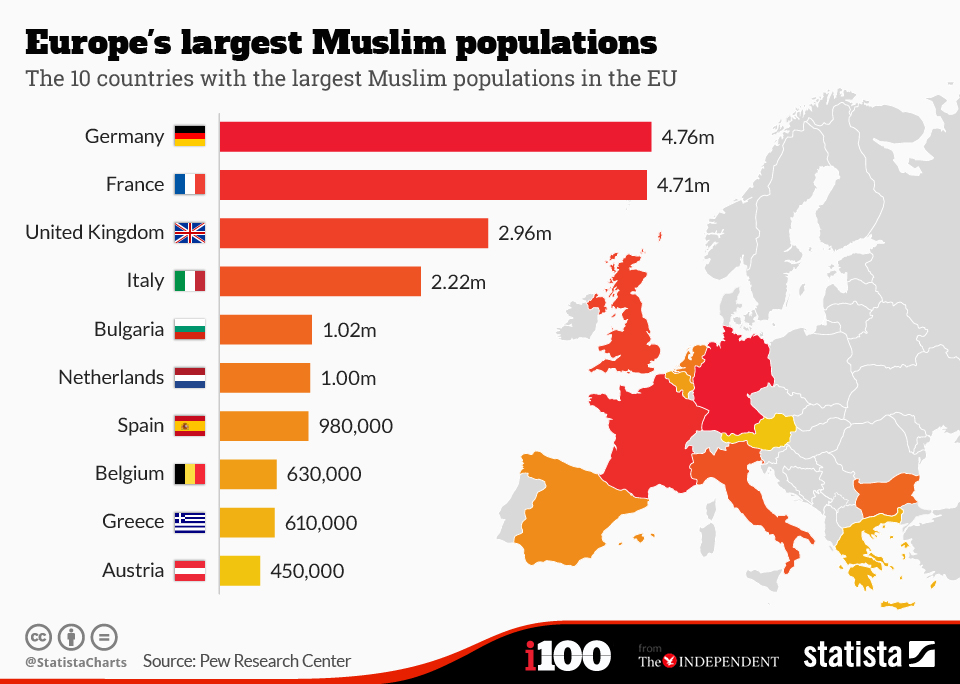
Muslim populations in Europe

The left-leaning The Atlantic has an article that talks about radical Islamic terrorism in Belgium:

French authorities say they believe Abdelhamid Abaaoud, a 27-year-old Belgian man, masterminded the November 13 attacks in Paris.

The focus on Abaaoud helps emphasize how tiny Belgium has taken on an oversized role in the European theater of jihad. The country has provided a steady flow of fighters to ISIS in the Middle East—including Abaaoud—and has been the site of planning of attacks in Europe. (The Daily Beast has a good timeline of incidents involving Belgian militants.)

Abaaoud was already suspected of planning a prior attack that was foiled by Belgian authorities in the days after January’s Charlie Hebdo attacks in Paris. Two suspects were killed in the operation. At the time, Slate’s Joshua Keating warned: “The Belgian police may claim today to have ‘averted a Belgian Charlie Hebdo,’ but it’s clear that the country’s radicalization problem is much larger, and will take more than police raids to address.” Those words proved prophetic.

Belgium has just 11 million people, and Pew estimated that about 6 percent of the population was Muslim as of 2010. But Belgian and French nationals make up around a quarter of the Europeans who went to fight in Iraq in the mid-2000s. While the government has acknowledged that hundreds of Belgians have gone to fight with ISIS or for other groups in the Syrian civil war, Pieter Van Ostaeyen, an independent researcher, calculated in October that 516 Belgians had fought in Iraq or Syria, far higher than the government’s figures. Based on his numbers, Belgium has contributed more fighters per capita to the fight in the Levant than any other European country.

[…]Belgian jihadism seems to mimic French Islamist militancy, only more concentrated—as befits the smaller country. Both have large numbers of immigrants who are poorer and isolated from the dominant culture.

So, it’s not just that the generous European socialists in Belgium took in lots and lots of Muslim immigrants, it’s that they took in lots and lots of unskilled Muslim immigrants, who struggle to integrate because they struggle to find work. Belgium, like other socialist countries in Europe, offers generous welfare programs to those who do not work. That’s a big draw to people in Middle Eastern countries.

The problem with offering generous welfare programs and welcoming in millions of illegal immigrants who cannot easily assimilate is twofold. First, eventually, socialists run out of other people’s money with which to bribe their unskilled immigrants. Second, everyone knows that making your own way through your own work is what makes people happiest. No one who is dependent on others (via social welfare programs) can truly be content. All of us deep down have a desire to be the author of our own success – to eat the food that we have earned with our own productive labor. Skilled immigrants can make their own way, but unskilled immigrants cannot.

It is good to have a system of legal immigration, in order to attract the a few of the best and brightest from other countries. If we take in a few at a time, then there is time for them to assimilate. And they can earn their own pay because they are skilled immigrants who came into the country to work. But it’s a mistake to let in millions and millions of unskilled immigrants who often cannot even speak the languages of Western nations.

So why did so many European countries import so many unskilled immigrants? The answer is simple.

Consider this article from the UK Daily Mail.

Excerpt:

Ministers today faced calls for an inquiry into claims that their open-door immigration policy was designed to make Britain more multicultural and allow Labour to portray the Tories as racists.

A former Labour adviser alleged that the Government opened up Britain’s borders in part to try to humiliate Right-wing opponents of immigration…

The Daily Mail reported on Saturday the controversial claims by Andrew Neather, who worked for Tony Blair and Jack Straw.

He said Labour’s relaxation of immigration controls in 2000 was a deliberate attempt to engineer a ‘truly multicultural’ country and plug gaps in the jobs market.

He said the ‘major shift’ in immigration policy was inspired by a 2001 policy paper from the Performance and Innovation Unit, a Downing Street think-tank based in the Cabinet Office…

Ministers were reluctant to discuss the move publicly for fear that it would alienate Labour’s core working-class vote, Mr Neather said. But they hoped it would allow them to paint the Conservatives as xenophobic and out of touch.

‘I remember coming away from some discussions with the clear sense that the policy was intended – even if this wasn’t its main purpose – to rub the Right’s nose in diversity and render their arguments out of date,’ Mr Neather added.

The parties of the left in Europe viewed mass immigration of unskilled immigrants as a way of creating a voting bloc that could be counted on to vote for bigger government, higher taxes, and more spending. The frequent terrorist attacks that we are seeing now are nothing but the outworking of this policy of deliberately bringing in millions of unskilled immigrants in order to get their votes for more welfare spending when they could not find jobs and pay their own way. We should be very careful about doing the same here. We must learn from the mistakes of leftist policies that have been tried in other places, in other times. We have to look beyond the compassionate rhetoric and ask “then what happened next?”.

Is dependency on welfare good for people? Or is it better for people to work?

Major welfare programs as of 2012

What’s best for poor people – to remain dependent on government, or to be encouraged to work for their own money so they can be independent?

Consider this article from the Wall Street Journal.

Excerpt:

Earned success means defining your future as you see fit and achieving that success on the basis of merit and hard work. It allows you to measure your life’s “profit” however you want, be it in money, making beautiful music, or helping people learn English. Earned success is at the root of American exceptionalism.

The link between earned success and life satisfaction is well established by researchers. The University of Chicago’s General Social Survey, for example, reveals that people who say they feel “very successful” or “completely successful” in their work lives are twice as likely to say they are very happy than people who feel “somewhat successful.” It doesn’t matter if they earn more or less income; the differences persist.

The opposite of earned success is “learned helplessness,” a term coined by Martin Seligman, the eminent psychologist at the University of Pennsylvania. It refers to what happens if rewards and punishments are not tied to merit: People simply give up and stop trying to succeed.

During experiments, Mr. Seligman observed that when people realized they were powerless to influence their circumstances, they would become depressed and had difficulty performing even ordinary tasks. In an interview in the New York Times, Mr. Seligman said: “We found that even when good things occurred that weren’t earned, like nickels coming out of slot machines, it did not increase people’s well-being. It produced helplessness. People gave up and became passive.”

Learned helplessness was what my wife and I observed then, and still do today, in social-democratic Spain. The recession, rigid labor markets, and excessive welfare spending have pushed unemployment to 24.4%, with youth joblessness over 50%. Nearly half of adults under 35 live with their parents. Unable to earn their success, Spaniards fight to keep unearned government benefits.

Meanwhile, their collective happiness—already relatively low—has withered. According to the nonprofit World Values Survey, 20% of Spaniards said they were “very happy” about their lives in 1981. This fell to 14% by 2007, even before the economic downturn.

That trajectory should be a cautionary tale to Americans who are watching the U.S. government careen toward a system that is every bit as socially democratic as Spain’s.

Government spending as a percentage of GDP in America is about 36%—roughly the same as in Spain. The Congressional Budget Office tells us it will reach 50% by 2038. The Tax Foundation reports that almost 70% of Americans take more out of the tax system than they pay into it. Meanwhile, politicians foment social division on the basis of income inequality, instead of attempting to improve mobility and opportunity through education reform, pro-growth policies, and an entrepreneur-friendly economy.

These trends do not mean we are doomed to repeat Spain’s unhappy fate. But our system of earned success will not defend itself.

How do we make government promote “earned success” over dependency on welfare?

Investors Business Daily reports on one state that decided to encourage people to get off of welfare, and to get back to work.

Excerpt:

The number of childless, able-bodied adult food stamp recipients in a New England state fell by 80% over the course of a few months. This didn’t require magic, just common sense.

From December 2014 to March 2015, the caseload of able-bodied Maine adults with no dependents crashed from 13,332 recipients to 2,678, says the Heritage Foundation. This is a remarkable change and needs to be repeated in government programs across the country.

How Maine achieved this is no mystery. Gov. Paul LePage simply established work requirements for food stamp recipients who have no dependents and are able enough to be employed. They must, write Heritage policy analysts Robert Rector and Rachel Sheffield, “take a job” — just 20 hours a week — “participate in training, or perform community service” for a mere 24 hours a week. Recipients who do none of those are stripped of their food stamp benefits after three months.

This isn’t a radical new idea. Rector and Sheffield cite a successful historical precedent:

“When work requirements were established in the Aid to Families with Dependent Children (AFDC) program in the 1990s, nationwide caseloads dropped by almost as much, albeit over a few years rather than a few months.”

In the Obama era, “the food stamp caseload of adults without dependents who are able-bodied has more than doubled nationally, swelling from nearly 2 million recipients in 2008 to around 5 million today” across the country, Rector and Sheffield report. That’s far too many Americans who can take care of themselves living at the expense of others. The situation cries out for reform.

The Heritage report says that if the Maine policy were repeated nationally, and the caseload dropped “at the same rate it did in Maine (which is very likely), taxpayer savings would be over $8.4 billion per year.”

“Further reforms could bring the savings to $9.7 billion per year: around $100 per year for every individual currently paying federal income tax.”

[…]The success in Maine is but a blip, affecting only a thin slice of the nation’s welfare rolls. Yet it is a model, a prototype for reforming welfare programs in need of change or elimination, which is all of them. Policymakers at all levels should be rushing to adopt it, then adapt it.

Now, do you think that the governor of Maine is a Republican, or a Democrat? Republicans want people to be independent of government, and productive, because that makes them more free. Democrats want people to be unproductive and dependent, because that makes them easier to control.