Tag Archives: Dependence

Obama ends welfare reform and calls for $12.7 trillion of new welfare spending

From the Heritage Foundation explains the 1996 Welfare Reform Act and its detractors.

Excerpt:

Last Thursday, the Obama Administration quietly issued new bureaucratic rules that overturned the popular welfare reform law of 1996. This was an illegal move, and it completely undoes years of progress that helped millions of Americans.

The 1996 reform replaced the old Aid to Families with Dependent Children (AFDC) program with a new program called Temporary Assistance to Needy Families (TANF). At the core of the TANF program were new federal work standards that required able-bodied welfare recipients to work, prepare for work, or at least look for work as a condition for receiving aid. Welfare reform turned “welfare” into “workfare.”

Under the old, pre-reform AFDC program, welfare was a one-way handout: Government mailed checks to recipients who did nothing in return. Reform changed that. The new TANF program was based on fairness and reciprocal responsibility: Taxpayers continued to provide aid, but beneficiaries were required, in exchange, to engage in constructive behavior to increase self-sufficiency and reduce dependence.

The TANF work requirements were not onerous. Under the law, some 40 percent of adult TANF recipients in a state were required to engage in “work activities,” which is defined as unsubsidized employment, subsidized employment, on-the-job training, attending high school or a GED program, vocational education, community service work, job search, or job readiness training. Participation was part-time, 20 hours per week for mothers with children under six and 30 hours for mothers with older children.

[…]As welfare dependence fell and employment increased, child poverty among the affected groups fell dramatically. For a quarter century before the reform, poverty among black children and single mothers had remained frozen at high levels. Immediately after the reform, poverty for both groups experienced dramatic and unprecedented drops, quickly reaching all-time lows.

None of this reduced the left’s antipathy for welfare reform. The left had strongly opposed work requirements in welfare in 1996. When TANF faced reauthorization in 2001, they again aggressively sought to repeal federal work standards; they repeated the attack in 2006. For the most part, they lost those battles. But they were not done.

[…]Having lost repeated legislative battles to abolish workfare, the left has now gone backdoor, using an arcane bureaucratic device called a section 1115 waiver to declare the actual work standards written in the TANF law null and void and grant federal bureaucrats carte blanche authority to devise new replacement standards.

Now that we are in an election year, I expect to see a lot of promises by the Democrats of more and more handouts, bailouts and rewards to all of their various constituencies. And all paid for by the job creators in the private sector, and their hard-working employees. After all, “the private sector is fine” and “if you’ve got a business — you didn’t build that.  Somebody else made that happen”.
Ten reasons why the jobs situation is much worse than reported

From Investors Business Daily.

There are 10 reasons listed.

Here’s #2:

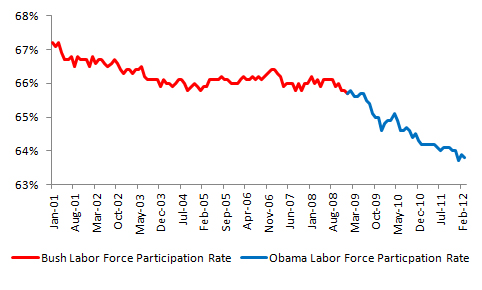
2. The jobless rate actually makes the labor market look better than it actually is. The rate only counts people who want a job but don’t have one. But the labor force participation rate was 63.8% in June, just above near modern-era lows. (It was 66.2% in January 2008 and 67.3% in April 2000). Otherwise, unemployment would be around 11%.

And #4:

4. Chronic unemployment. The average length of unemployment rose to 39.9 weeks in June, close to recent peak. It was 17.4 weeks at the January 2008 peak and 23.9 weeks in June 2009, when the recession officially ended. Long-term joblessness is particularly bad because skills erode or become obsolete, leading to permanent losses in income.

And #9:

9. Entrepreneurial activity fading. The number of startup firms has crashed from pre-recession highs, still near levels previously seen in the early 1980s, when the number of establishments was far lower. Establishments less than a year old, including those belonging to the same firm, totaled 556,553 in 2010, according to the latest Commerce Department data. That’s down 26% from the peak of 747,278 in 2006. Meanwhile, the number of employees at startups has plunged, with a greater share of new firms with no employees — one-man shops. Very small startups are less likely to invest or to grow, a bad sign for future hiring.

But it’s worse than that. The number of people going onto federal disability payments is outpacing the number of new jobs being created.

Despite record youth unemployment, young people support Obama 52-27

Labor Force Participation 2012 (click for larger image)

From Breitbart.

Excerpt:

Even as unemployment among college graduates remains stuck above the national average at 9.3 percent, a Reuters/Ipsos poll of four-year college graduates finds that President Barack Obama leads his Republican challenger Mitt Romney 52 percent to 27 percent.

The poll’s findings are especially surprising given reports last month that, for the first time in American history, unemployment for college graduates eclipsed that of high school graduates.   As Jed Graham of Investor’s Business Daily reported, “Out of 9 million unemployed in April, 4.7 million had gone to college or graduated and 4.3 million had not, seasonally adjusted Labor Department data show.”

Still, some unemployed college graduates say they are sticking with Mr. Obama in 2012: “I was really excited when Obama won,” said Joe Zmudczynski, a 2011 graduate of Michigan’s Ferris State University who now lives at home with his parents. “He’s still my favorite. It’s not like you can snap your fingers and everything gets better.”

Leftist PBS explains:

Returning to the nest with mom and dad after college and even into the thirties is becoming increasingly more common, but also less stigmatized. Young adults who live with their folks are cheerful, upbeat even, about their choice.

That’s the finding of a new Pew report, released Thursday morning. Three in 10 young adults (aged 25 to 34) say they’ve lived at home recently during the down economy, and 78 percent said they were satisfied doing so. Another 77 percent said they were optimistic about their future finances.

The number of young adults living in a multi-generational household — which can be any combination of grandparents, parents and adult children — saw a steep uptick during the recent recession, after being on the rise since 1980, said Kim Parker, the study’s lead author and a senior researcher with Pew’s Social & Demographic Trends Project. Historically, such high rates of moving back home haven’t been seen since the late 1940s.

Here’s an Associated Press piece on Yahoo News:

The college class of 2012 is in for a rude welcome to the world of work.

A weak labor market already has left half of young college graduates either jobless or underemployed in positions that don’t fully use their skills and knowledge.

Young adults with bachelor’s degrees are increasingly scraping by in lower-wage jobs — waiter or waitress, bartender, retail clerk or receptionist, for example — and that’s confounding their hopes a degree would pay off despite higher tuition and mounting student loans.

[…]Taking underemployment into consideration, the job prospects for bachelor’s degree holders fell last year to the lowest level in more than a decade.

[…]The figures are based on an analysis of 2011 Current Population Survey data by Northeastern University researchers and supplemented with material from Paul Harrington, an economist at Drexel University, and the Economic Policy Institute, a Washington think tank. They rely on Labor Department assessments of the level of education required to do the job in 900-plus U.S. occupations, which were used to calculate the shares of young adults with bachelor’s degrees who were “underemployed.”

About 1.5 million, or 53.6 percent, of bachelor’s degree-holders under the age of 25 last year were jobless or underemployed, the highest share in at least 11 years. In 2000, the share was at a low of 41 percent, before the dot-com bust erased job gains for college graduates in the telecommunications and IT fields.

Out of the 1.5 million who languished in the job market, about half were underemployed, an increase from the previous year.

The EPI is a left-wing think tank.

As if this were not bad enough, remember that the secular socialists have run the national debt up from 8 trillion to 16 trillion since taking over the House and Senate in January 2007. Labor union bailouts, green energy payoffs to Democrat fundraises, health care takeovers, and massive welfare spending, have to be paid back. Who is going to pay all of this back? Students with degrees in feminist studies and peace studies? And yet, incredibly, the government-run public school system and the universities have brainwashed these young fools into voting for their own dependence and enslavement. That’s what secularism and leftism offers young people: the road to serfdom.