Tag Archives: Deficit

Standard and Poor’s cuts credit ratings for nine European Union countries

From CNBC.

Excerpt:

Standard & Poor’s downgraded the credit ratings of nine euro zone countries, stripping France and Austria of their coveted triple-A status but not EU paymaster Germany, in a Black Friday 13th for the troubled single currency area.

[…]S&P lowered its long-term rating on Cyprus, Italy, Portugal and Spain by two notches, and cut its rating on Austria, France, Malta, Slovakia and Slovenia by one notch.

The move puts highly indebted Italy on the same BBB+ level as Kazakhstan and pushes Portugal into junk status.

The credit-rating agency affirmed the current long-term ratings for Belgium, Estonia, Finland, Germany, Ireland, Luxembourg and the Netherlands.

[…]The credit-rating agency put all 14 euro-zone nations — Austria, Belgium, Cyprus, Estonia, Finland, France, Ireland, Italy, Luxembourg, Malta, the Netherlands, Portugal, Slovenia, and Spain — on “negative” outlook for a possible further downgrade.

Germany was the only country to emerge totally unscathed with its triple-A rating and a stable outlook.

A negative outlook indicates that S&P believes there is at least a one-in-three chance that a country’s rating will be lowered in 2012 or 2013.

It’s gotten so bad that Greek families are abandoning their children, and ordinary medicines like Aspirin are in short supply.

Greece is a socialist country

Why is this happening to Greece?

Well, Greece elected a socialist majority in 2009, and the socialist party was in power from 1981 to 1989, 1993 to 2004, and now 2009 to 2012.

Excerpt:

The Panhellenic Socialist Movement, better known as PASOK, is a Greek centre-left political party and the current majority party in the Greek Parliament. In 1981 PASOK formed the first socialist government in Greece’s history, and subsequently governed the country for most of the 1980s, 1990s and early 2000s. PASOK served as the main opposition party between 2004 and 2009. It is a member of the Party of European Socialists and the Socialist International. In the European Parliament it has 8 out of 22 Greek MEPs. On 31 January 2006, the party’s president, George Papandreou, was elected President of the Socialist International, the worldwide organisation of social democratic, socialist and labour parties. Following the 2009 legislative election, PASOK became the majority party and Papandreou became Prime Minister.

The Wall Street Journal explains what the socialists in Greece have been doing lately.

Excerpt:

“The present government has done absolutely nothing during the last 12 months to speed up privatizations, reduce the public sector or open up closed professions,” Athanasios Papandropoulos, a leading economic analyst, told me recently in an interview. “In these 12 months it has not fired even one civil servant. The only thing it is doing is trying to tax the private sector out of existence. Why should we believe that they will do something different now?”

One commentator writing in the newspaper Kathimerini this week made the point even more forcefully: “Whereas more than 1,000 Greeks were losing their jobs in the private sector every day in August, the government was assuring civil servants with lifetime tenure that their job privileges were not in danger.”

Structural reforms have been repeatedly announced by Greek officials during the past. Yet nothing has happened. Greece’s plans tend to resemble Soviet Five Year Plans: They look good on paper but have absolutely no bearing on reality. Anyone in the government who tries to point this out is forced to resign. Economist Stella Balfousia, the head of the Greek Parliament budget office, had to tender her resignation after her office published a report contradicting the government’s official forecasts on debt and deficit.

Privatization is a case in point. Greece will have to raise some €1.7 billion by the end of September from the privatization program and €5 billion by the end of the year from the medium-term fiscal strategy program. Yet in the past year and a half not a single privatization has taken place. The explanation given for this is the low share prices of the listed companies. The real reason is probably that Greek politicians are loath to give up the system of spoils that they have long run through these enterprises, which are staffed by the party faithful in exchange for votes.

I saw that Zero Hedge posted recently regarding the massive withdrawal of deposits from Greek banks.

Excerpt:

The year is not over yet, and already Greece’s banks have lost €36.7 billion of their deposit base in 2011, and a whopping €64.6 billion since the beginning of 2010, which is down from €233 billion to €173 billion in under two years. In October another €3.5 billion was withdrawn from Greek banks and likely either redeposited somewhere deep in the heart of Switzerland, or converted to various inert metals and buried somewhere in the back yard. The good news: the outflow is just over half of October’s record €6.8 billion. The bad news: at this rate of outflows, Greek banks will have zero deposits in around 4 years. Which at the end of the day is all the matters, because while the Troica can keep funding capital shortfalls indefinitely, all faith in the country’s banks has now been lost and Greece is officially a zombie economy. The fact that the country’s deficit as a % of GDP is about to be re-revised even higher is no longer even meaningful: the Greek economy and its banking sectors are now officially dead. We merely feel bad for anyone who still has cash in banks as, just like gold in 1930s America, any residual cash may soon be “sequestered” for national security purposes. After all there are bankers who need record bonuses, and Military sales from Europe and the US that have to proceed using what will likely soon be “commingled” deposit cash.

Greece is a socialist nation. And they are reaping the rewards of socialism. You cannot spend your way out of debt. You cannot create jobs by taxing job creators. You cannot create wealth by punishing those who create wealth.

Since Barack Obama was elected, we have been running deficits of about $1.3 trillion dollars each year. The last Republican deficit under Bush and Boehner was $160 billion dollars. We made a mistake and we elected a socialist, and now we are Greece – just a little less far down the road to serfdom.
Rick Santorum for President of the United States

I am endorsing Rick Santorum for President.

Here’s the break-down on the other two leaders in the Republican primary, Romney and Paul:

Mitt Romney: When Mitt Romney was running for office in Massachusetts, he tried to assure Mass voters that he was solidly pro-abortion and pro-gay rights. And when elected, that’s how he governmed. The only thing that he has ever done to appeal to social conservatives is smile and look handsome, starting in 2006 – when he was out of office. I’ve written before about Romney’s pro-abortion record and Romney’s pro-gay-marriage record. He is a social liberal. The most socially liberal candidate in the primary.

Here is an excerpt from an assessment of Mitt Romney’s economic record from Club for Growth:

Because of his long tenure in public life, especially his presidential run in 2008, Mitt Romney is considered a well-vetted candidate by now.  Perhaps to his consternation, he has developed an unshakeable reputation as a flip-flopper. He has changed his position on several economic issues, including taxes, education, political free speech, and climate change.  And yet the one issue that he doesn’t flip on – RomneyCare – is the one that is causing him the most problems with conservative voters.  Nevertheless, he labels himself as a pro-growth fiscal conservative, and we have no doubt that Romney would move the country in a pro-growth direction.  He would promote the unwinding of Obama’s bad economic policies, but we also think that Romney is somewhat of a technocrat. After a career in business, quickly finding a “solution” seems to be his goal, even if it means more government intrusion as a means to an end. To this day, Romney supports big government solutions to health care and opposes pro-growth tax code reform – positions that are simply opposite to those supported by true economic conservatives.  How much Romney’s philosophy of governance will affect his policy goals if elected, we leave for the voters to decide.

There is no reason for us to counter Obama with Obama-lite.

Ron Paul: Ron Paul is the absolute worst candidate on foreign policy and national security, and bad on social policy, too. Ron Paul opposes a constitutional amendment defining marriage, because he doesn’t think that the federal government should define traditional marriage as being between one man and one woman. He has a moderately pro-life voting record. NRLC says that he votes pro-life only 75% of the time.

Excerpt from the Club for Growth report on Ron Paul’s fiscal policy:

When it comes to limited government, there are few champions as steadfast and principled as Representative Ron Paul.  In the House of Representatives, he plays a very useful role constantly challenging the status quo and reminding his colleagues, despite their frequent indifference, that our Constitution was meant to limit the power of government.  On taxes, regulation, and political free speech his record is outstanding.  While his recent pork votes are troubling, the vast majority of his anti-spending votes reflect a longstanding desire to cut government down to size.

But Ron Paul is a purist, too often at the cost of real accomplishments on free trade, school choice, entitlement reform, and tort reform.  It is perfectly legitimate, and in fact vital, that think tanks, free-market groups, and individual members of Congress develop and propose idealized solutions.  But presidents have the responsibility of making progress, and often, Ron Paul opposes progress because, in his mind, the progress is not perfect.  In these cases, although for very different reasons, Ron Paul is practically often aligned with the most left-wing Democrats, voting against important, albeit imperfect, pro-growth legislation.

Ron Paul has not been able to move legislation to implement his pro-growth vision. His fiscal positions are excellent, but he has no record whatsoever of being able to build enough consensus.

Let’s meet Rick Santorum

Here’s an article that explains the pros and cons of Rick Santorum as candidate. I really recommend this article. It is from a Catholic web site, so there is Catholic stuff in it, but it mentions all the weaknesses and strengths that I’m familiar with – it’s a balanced article.

Excerpt:

As a member of the U.S. Senate from 1995 until 2007, Santorum was the prime author and champion of key pro-life bills, including the Born-Alive Infants Protection Act, a ban on partial-birth abortion, and the Unborn Victims of Violence Act, which makes it a separate crime if an unborn child is harmed or killed during the commission of a stipulated list of federal crimes.

Santorum not only has signed the Susan B. Anthony Pro-Life Presidential Pledge, but he has helped raise money for that organization, too.

Santorum believes that abortion is never justified, including in cases of rape or incest.

[…]Santorum has been similarly staunch in taking a stand against same-sex “marriage,” which has earned him the enmity of homosexual-activist groups.

[…]“Rick Santorum has been a hero of the movement in every sense on marriage, life and religious liberty. No one has been braver or taken more hits for his courage than Rick,” said Maggie Gallagher, co-founder of the National Organization for Marriage.

For Santorum, the issues of marriage and abortion aren’t just social issues — they spill over into his economic philosophy.

“You cannot have limited government if you have broken families, because someone has to pick up the pieces; and the ones who pick up the pieces are the taxpayers,” Santorum has said.

While some argue that an emphasis on social issues is detrimental to a politician’s chances of being elected, Santorum on Dec. 20 got two endorsements from family-issues leaders that some say could provide the needed boost in the Jan. 3 Iowa caucuses to make Santorum a first-tier candidate.

Santorum was endorsed by Bob Vander Plaats, a leading Christian conservative in Iowa, and Chuck Hurley, another family-issues stalwart. Both are affiliated with The Family Leader, which Vander Plaats founded. Hurley is president of the affiliated Iowa Family Policy Center.

“We care about any issue affecting the family, from the sanctity of human life to preserving a biblical view of marriage, and even issues such as gambling and economic issues,” said Julie Summa, spokeswoman for The Family Leader.

Summa said that the board of The Family Leader unanimously supported Santorum but decided that only the two leaders, not the organization, would endorse him because some of their conservative Christian constituency supports other candidates.

“When you listen to Senator Santorum speak,” Summa added, “he ties everything back to the family, including economics. Our economy is better when we have strong families.”

And here is the Club for Growth report on Santorum’s fiscal policy, which is his weakest link.

Excerpt:

On the whole, Rick Santorum’s record on economic issues in the U.S. Senate was above average.  More precisely, it was quite strong in some areas and quite weak in others.  He has a strong record on taxes, and his leadership on welfare reform and Social Security was exemplary.  But his record also contains several very weak spots, including his active support of wasteful spending earmarks, his penchant for trade protectionism, and his willingness to support large government expansions like the Medicare prescription drug bill and the 2005 Highway Bill.

As president, Santorum would most likely lead the country in a pro-growth direction, but his record contains more than a few weak spots that make us question if he would resist political expediency when it comes to economic issues.

It’s not that weak for a weak link, is it?

My concerns about Rick Santorum are mostly on fiscal policy. I don’t like his vote against NAFTA in 1993, and I don’t like his plan to focus corporate tax cuts on the manufacturing only – I want across the board tax cuts. His support for Arlen Specter over Pat Toomey was hard for me to get over, too. But it’s minor – there is no perfect candidate.

Rev. James Leonard points out that Santorum has a good pro-growth record:

First, Santorum was the first of the candidates to endorse the Ryan plan. No statist would ever do so. Santorum has pledged to cut 5 trillion dollars in the next 5 years.

Second, Santorum co-sponsored and fought for a balanced budget amendment that failed by a single vote, prompting Santorum to demand that the RINO (Hatfield, OR) who voted against it be stripped of his chairmanship. He did so even against such stalwart Republicans as Jesse Helms who defended the RINO. Santorum’s fight led to the RINO’s early retirement.

One final thing: Rick Santorum introduced an amendment to No Child Left Behind Act in 2001 to encourage critical thinking on issues like evolution and global warming in the schools. That’s good, but it’s also good that Rick has been pushing away from the idea of a federal role in education at all. Another plus.

Could Obama have done better? He could learn from Canada’s success

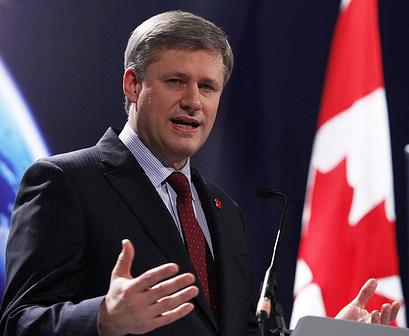
Prime Minister Stephen Harper

Here’s an editorial from Investors Business Daily.

Excerpt:

Away from the low growth and high regulation of an America under Washington’s thumb, our northern neighbor is economically strong. As 2011 ends, Canada has announced yet another tax cut — and will soar even more.

The Obama administration and its economic czars have flailed about for years, baffled about how to get the U.S. economy growing.

In reality, the president need look no further than our neighbor, Canada, whose solid growth is the product of tax cuts, fiscal discipline, free trade, and energy development. That’s made Canada a roaring puma nation, while its supposedly more powerful southern neighbor stands on the outside looking in.

On Thursday, Canadian Prime Minister Stephen Harper announced that he will slash corporate taxes again on Jan. 1 in the final stage of his Economic Action Plan, dropping the federal business tax burden to just 15%.

Along with fresh tax cuts in provinces such as Alberta, total taxes for businesses in Canada will drop to 25%, one of the lowest in the G7, and below the Organization of Economic Cooperation and Development average.

“Creating jobs and growth is our top priority,” said Minister Jim Flaherty. “Through our government low-tax plan … we are continuing to send the message that Canada is open for business and the best place to invest.”

It’s not just that Canada’s conservative government favors makers over takers. Harper’s also wildly popular for shrinking government. “The Harper government has pursued a strategic objective to disembed the federal state from the lives of citizens,” wrote University of Calgary Professor Barry Cooper, in the Calgary Herald.

Harper also has made signing free trade treaties his priority. Canada now has 11 free trade pacts in force, and 14 under active negotiation — including pacts with the European Union and India, among others.

“We believe in free trade in Canada, we’re a free-trading nation. That’s the source of our strength, our quality of life, our economic strength,” Flaherty said last month.

Lastly, Canada has pursued its competitive advantage — oil. And it did so not through top-down “industrial policy,” but by getting government out of the way.

Harper has enacted market-friendly regulations to accomplish big things like the Keystone Pipeline — and urged President Obama to move forward on it or else Canada would sell its oil to China.

These policies have been well-known since the Reagan era. But in a country that’s been institutionally socialist since the 1950s, Harper’s moves represent a dramatic affirmation for free market economics.

For Canada, they’ve had big benefits.

Canada’s incomes are rising, its unemployment is two percentage points below the U.S. rate, its currency is strengthening and it boasts Triple-A or equivalent sovereign ratings across the board from the five top international ratings agencies, lowering its cost of credit.

Is it too much to ask Washington to start paying attention to the Canadian success story?

These sound principles work every time they are tried, and they have led to a transformation in Canada.

Although this article doesn’t mention it, Stephen Harper is also the most solid statesman on foreign policy issues as well.

And here’s a view from up north from Canadian journalist Brian Lilley.

Excerpt:

Prime Minister Stephen Harper has put out his own list of accomplishments for the year that just ended but here are a few of the key conservative minded actions that spring to mind for me.

  • Ending political welfare. The per-vote subsidy that made political parties lazy and unresponsive to the voters of this country and insulated them from angering their core supporters will be gone by 2015-2016. Legislation ending the subsidy has already passed but the parties are slowly being weaned off the money and will get smaller amounts each year until the subsidy is gone.
  • They saw the light of common sense and released the names of those on their wanted list of suspected foreign war criminals. These were people that officials admitted should not be in the country, had been ordered out but that were still in Canada. At first officials would only admit there was a list of suspected war criminals but not say who they were. After much pressure, common sense won the day.
  • Ending the insane rules that would see farmers from certain provinces jailed for daring to sell their wheat to the customer of their choice. The Canadian Wheat Board still exists for those that want to use its centralized system. For those that want freedom, they now have that choice.
  • While much attention has been paid to Bill C-10, the omnibus crime bill, the government has passed C-2 (the mega-trials bill), this bill will make it easier to conduct the mega-trials now associated with organized crime without infringing on the right to a fair trial.
  • While the bill to end the gun registry has not been passed yet, it has been introduced and will pass early this year.
  • Immigration. On this file the Conservatives continue to push for ever higher numbers of newcomers while keeping those skeptical of high immigration onside by cracking down on fraud, cleaning up the system and putting Canada first.

Another thought for those, often myself included, that like to say this government is not conservative enough.

Lilley also notes that electing Harper presented a national day care program (which punishes families with stay-at-home), increasing unemployment benefits (which encourages people not to work), etc.