
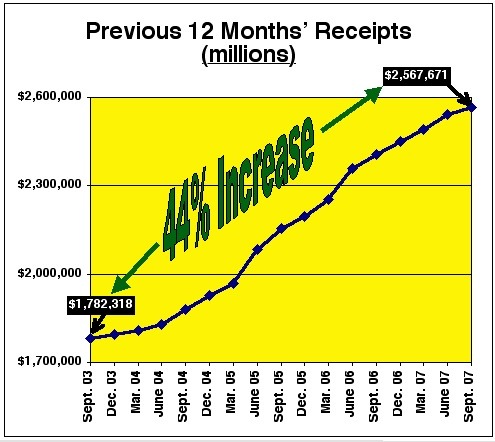
From Newsbusters. It turns out that Bush’s tax cuts in 2001 and 2003 were not responsible for adding to the deficit. They actually increased the amount of tax money being collected, as the economy grew, and more jobs were created. People pay more in taxes when they have jobs.
Excerpt:
The graph doesn’t show collections tanking, does it? Instead, the graph shows that collections increased by 44%, or almost $800 billion, in four years. Adding up the individual increments in each of the four years compared to 2003 (2004 – $98B; 2005 – $371B; 2006 – $624B; 2007 – $785B; 2008, not shown, treating IRS stimulus payments as outlays instead of negative receipts – $835B), what really happened is that in the five full fiscal years after George W. Bush got the across-the-board and investment-related tax cuts he had been pushing for since taking office in 2001, the cumulative increase in tax collections was over $2.7 trillion.
Doubtless, the static analysis crowd will claim that collections would have been even higher (I guess by a cumulative $1.6 trillion, given the AP’s Democratic Party talking point above) if the Bush cuts hadn’t been enacted. Two words, guys: Prove it. Two follow-up words: You can’t.
We can argue all day long about the how much of the increase in collections was due to the incentive effects of the tax cuts and how of the improvement might have occurred anyway, but no one can credibly act as if it’s an established fact that the Bush cuts somehow caused collections to go $1.6 trillion in the opposite direction. There is absolutely no proof for this contention, and plenty of evidence that the Bush cuts jump-started an economy and federal collections, both of which had been flat or declining during the two years leading up to mid-2003. The more reasonable conclusion to reach is that the country would already be dead in the water if the Bush tax cuts hadn’t passed in 2003. Instead, the wire service hopes that its “Bush tax cuts cost us” meme will be gullibly recited during the next several days at its subscribing newspaper, TV, and radio outlets. “Disgraceful” doesn’t even begin to describe this pathetic promotion of self-evident falsehood.
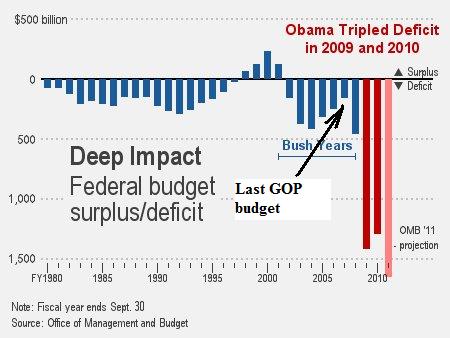
The fact is that the federal budget was one good year away from balancing after the $162 deficit reported in fiscal 2007. Unfortunately, that was the last budget passed by a Republican-controlled Congress, and it was the only year which showed a modest increase in overall spending. Beginning in 2007 with effects beginning in fiscal 2008, the House and Senate controlled by Nancy Pelosi and Harry Reid began increasing spending at rates far beyond what profligate Republicans spent earlier in the decade, and, unfortunately, Bush 43 made no real effort to stop them…
Read the whole thing.
UPDATE: Reggie sent me this article showing that the Reagan tax cuts also increased revenues.
Excerpt:
In 1980, the last year before the tax cuts, tax revenues were $956 billion (in constant 1996 dollars).
Revenues exceeded that 1980 level in eight of the next 10 years. Annual revenues over the next decade averaged $102 billion above their 1980 level (in constant 1996 dollars).
When you get people to start engaging in the economy, you can collect more taxes from them. They engage when they think that they will be able to keep more of what they make from their labor.
 WINTERY KNIGHT